Blog Archives
In celebration of the 13th anniversary of my blog three days from now, I am republishing the very first post from July 15, 2012. Q: What does it take to be an artist, especially one living and working in New York?
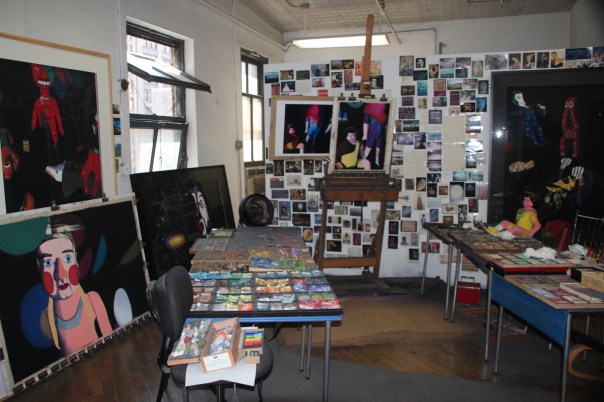
Barbara’s Studio (in 2012) with works in progress.
A: The three Big P’s – Patience, Persistence, and Passion. Without all three you will not have the stamina to work tirelessly for very little external reward. You can expect help from no one.
There are so many obstacles to art-making and countless reasons to just give up. When you really think about it, it’s amazing that great art gets made at all. So why do we do it? Above all it’s about making our time on earth matter, about devotion to our innate gifts and love of our hard-fought creative process.
And, my God, it even gets harder as we get older! So what do we do? We dig in that much deeper. It’s a most noble and sacred calling – you know when you have it – and that’s what separates those of us who are in it for the long haul from the wimps, fakers, and hangers-on. I say to my fellow artists who continue to work despite the endless challenges, we are all true heroes!
These words still ring true and it’s good, even for me, to occasionally be reminded.
Most importantly, THANK YOU to my 222,000+ subscribers for taking this journey with me. When I began this blog in 2012, I had no idea it would prove to be so popular… WOW!
Comments are welcome!
Pearls from artists* # 642

New York City
*an ongoing series of quotations – mostly from artists, to artists – that offers wisdom, inspiration, and advice for the sometimes lonely road we are on.
Radical changes in our culture threaten to undermine the potency of art and artists alike. Disparate forces conspire to lower the bar for how we expect art to function. As decades go by, we are educating and evolving to value left-brain strengths over holistic right-brain thought, with disastrous consequences for humanity… Deep contemplation has been hijacked by addictive technology. Rising authoritarianism strives to squash dissenting and diverse voices, as well as historical truths and critical thinking skills. Social media approval affects the art that is produced, shared, and validated. Easily digested work is promoted, while the most compelling work (the kind that could transform the trajectory of art, or affect real social change) is left behind. Critics are coining terms like ‘Zombie Formalism’ … and ‘Zombie Figuration’ … in response to the sterility and stultifying sameness of much contemporary work. It’s as if artists were absorbing online algorithms into their bloodstreams. This empty, safe sensibility riffs and rehashes a vacuous culture, generating a perpetual cycle of well-branded insignificance.
Kate Kretz in Art From Your Core: A Holistic Guide to Visual Voice
Comments are welcome!
Pearls from artists* # 639

Barbara’s Studio
*an ongoing series of quotations – mostly from artists, to artists – that offers wisdom, inspiration, and advice for the sometimes lonely road we are on.
… my deep and lifelong conviction [is] that the results of my work don’t have much to do with me. I can only be in charge of producing the work itself. That’s a hard enough job. I refuse to take on additional jobs, such as trying to police what anybody thinks about my work once it leaves my desk.
Also, I realized it would be unreasonable and immature of me to expect that I should be allowed to have a voice of expression, but other people should not. If I am allowed to speak my inner truth, then my critics are allowed to speak their inner truths, as well. Fair’s fair. If you dare to create something and put it out there, after all, then it may accidentally stir up a response. That’s the natural order of life: the eternal inhale and exhale of action and reaction. But you are definitely not in charge of the reaction – even when the reaction is bizarre.
Elizabeth Gilbert in Big Magic: Creative Living Beyond Fear
Comments are welcome!
Pearls from artists* # 562

“Shadow,” soft pastel on sandpaper, 26” x 20,” in progress
*an ongoing series of quotations – mostly from artists, to artists – that offers wisdom, inspiration, and advice for the sometimes lonely road we are on.
Jung observed that complexes could affect groups of people en masse. He saw that certain moments seemed to be expressions of a collective shadow, a bursting forth of a mass psychosis; the repressed side of a whole group coming alive; a tribal Mr. Hyde. He saw this madness first-hand in Germany in the 1930s and wrote about it. But every era carries some measure of collective shadow.
One could argue that no moment in time has seen more of the reality of human darkness than ours. Having witnessed the Holocaust and faced the threat of nuclear war in the twentieth century, and now facing the environmental impact of fossil fuels and plastics in the twenty-first century, we are undoubtedly aware of more of humanity’s potential for destruction than any of our ancestors ever were. Such a view does not come from a moralizing stance. Our era has made forced witnesses of us all.
The shadow is about where we put the Devil – where do we allow darkness to be housed? Racism and bigotry offer the relief of foisting our group’s shadow onto another whom we view as lesser. Doing so enables us not to look at or feel our shadow, and not see our own worst selves. But this collective shadow of our modern culture is also bigger and wider than group-to-group projections. There are culture-wide or civilization expressions of the collective shadow.
Jung saw the widespread loss of connection to the inner life and to a lived spirituality as one of the primary illnesses of our time. He observed that people were no longer animated by the traditional religions… For Jung, this meant that we’ve lost the old way but not yet found the new, and are sitting in a spiritual vacuum.
Into that vacuum, without our awareness, has slipped our fascination with human technology. Observe people closely today and you’ll notice that we have an almost magical faith in our devices. People see their computers and phones as all-knowing and expect them to function perfectly all the time, and view pharmaceuticals as magic cure-alls. Where we used to put God, we now have put technology. Where spirit was, we have unconsciously placed human genius.
Gary Bobroff in Carl Jung: Knowledge in a Nutshell
Comments are welcome!
Pearls from artists* # 549
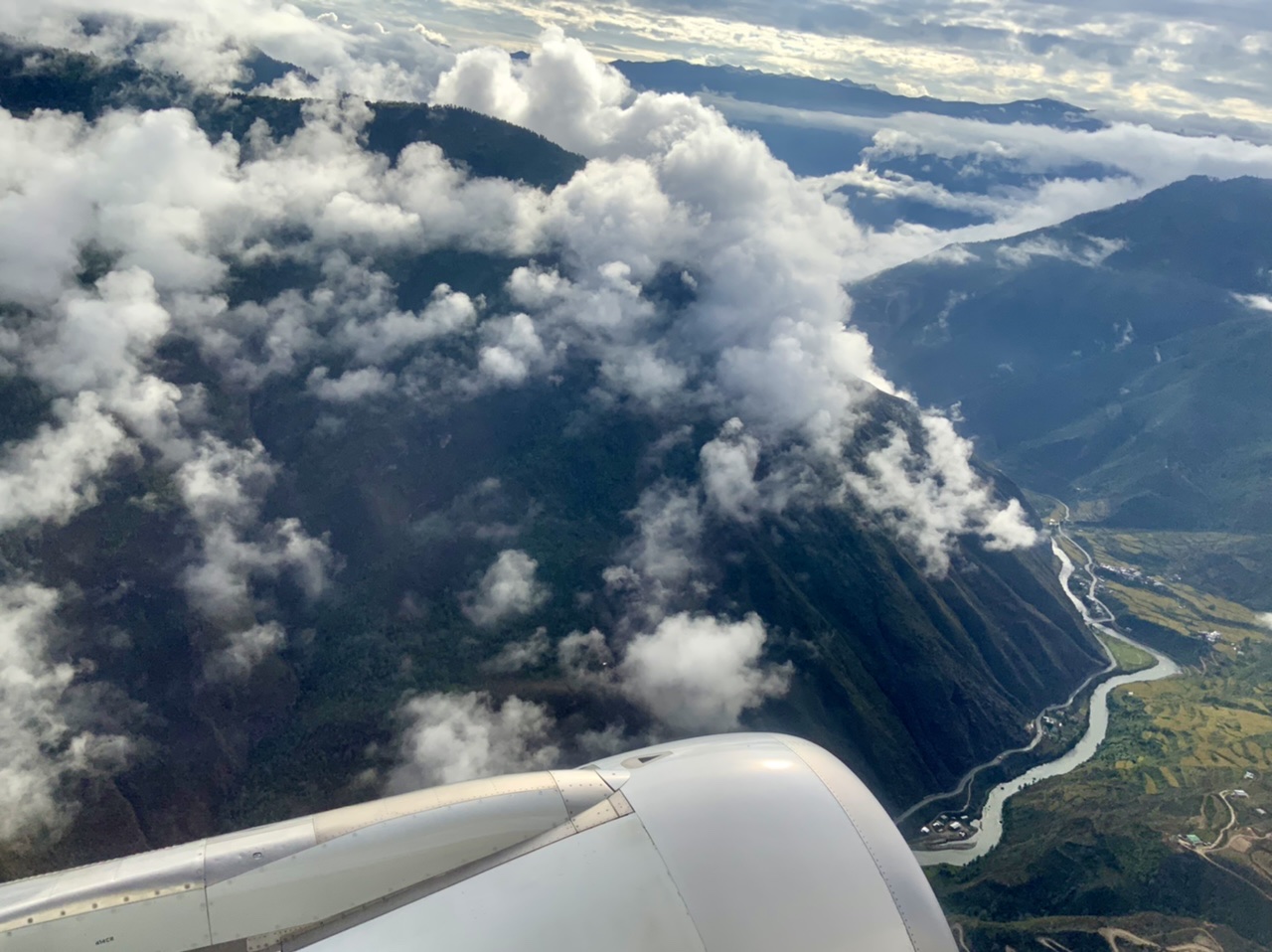
Departing from Paro Airport in Bhutan
*an ongoing series of quotations – mostly from artists, to artists – that offers wisdom, inspiration, and advice for the sometimes lonely road we are on.
… a lot of times you take a trip halfway around the world. You think the trip is for one thing… and you came away with something else. You change in a way you did not expect. These are the lessons that come well after school, college, training, apprenticeships. These lessons are not full courses; they are two sentences long. I felt I had gotten a degree in two minutes.
Anna Deavere Smith in Letters to a Young Artist: Straight-up Advice on Making a Life in the Arts – For Actors, Performers, Writers, and Artists of Every Kind
Comments are welcome!
Q: What’s the best piece of advice you’ve been given?
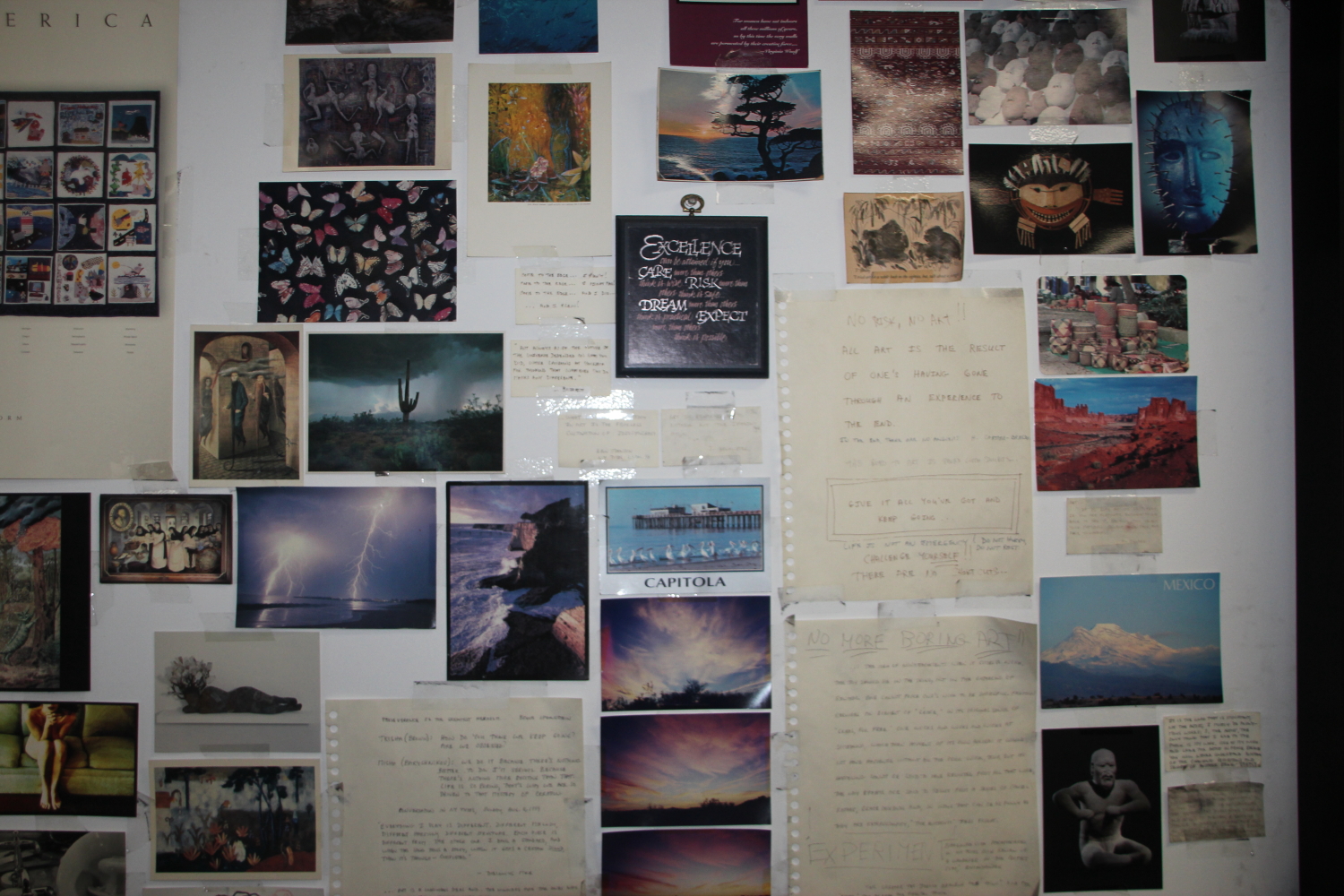
A wall in Barbara’s studio
A: When I left the active duty Navy in 1989, my co-workers threw a farewell party. One of the parting gifts I received was a small plaque from a young enlisted woman whom I had supervised. The words on the plaque deeply resonated with me, since I was about to make a significant, risky, and scary career change. It was the perfect gift for someone facing the uncertainty of an art career.
Many years later Tina’s plaque is still a proud possession of mine. It is hanging on the wall behind my easel, to be read every day as I work. It says:
“Excellence can be attained if you…
Care more than others think is wise…
Risk more than others think is safe…
Dream more than others think is practical…
Expect more than others think is possible.”
Comments are welcome!
Pearls from artists* # 439

New York Harbor
* an ongoing series of quotations – mostly from artists, to artists – that offers wisdom, inspiration, and advice for the sometimes lonely road we are on.
Art is a way of preserving experiences, of which there are many transient and beautiful examples, and that we need help containing. There is an analogy to be made with the task of carrying water and the tool that helps us do it. Imagine being out in a park on a blustery April day. We look up at the clouds and feel moved by their beauty and grace. They feel delightfully separate from the day-to-day bustle of our lives. We give our minds to the clouds, and for a time we are relieved of our preoccupations and placed in a wider context that stills the incessant complaints of our egos. John Constable’s cloud studies invite us to concentrate, much more than we would normally, on the distinctive textures and shapes of individual clouds, to look at their variations in colour and at the way they mass together. Art edits down complexity and helps us to focus, albeit briefly, on the most meaningful aspects. In making his cloud studies, Constable didn’t expect us to become deeply concerned with meteorology. The precise nature of a cumulonimbus is not the issue. Rather, he wished to intensify the emotional meaning of the soundless drama that unfolds daily above our heads, making it more readily available to us and encouraging us to afford it the central position it deserves.
Alain de Botton and John Armstrong in Art as Therapy
Comments are welcome!
Pearls from artists* # 400

In the studio with friends
* an ongoing series of quotations – mostly from artists, to artists – that offers wisdom, inspiration, and advice for the sometimes lonely road we are on.
A student in the audience raised her hand and asked me:
“Why should I live?”
… In the very act of asking that question, you are seeking reasons for your convictions, and so you are committed to reason as the means to discover and justify what is important to you. And there are so many reasons to live!
As a sentient being, you have the potential to flourish. You can refine your faculty of reason itself by learning and debating. You can seek explanations of the natural world through science, and insight into the human condition through the arts and humanities. You can make the most of your capacity for pleasure and satisfaction, which allowed your ancestors to thrive and thereby allowed you to exist. You can appreciate the beauty and the richness of the natural and cultural world. As the heir to billions of years of life perpetuating itself, you can perpetuate life in turn. You have been endowed with a sense of sympathy – the ability to like , love, respect, help, and show kindness – and you can enjoy the gift of mutual benevolence with friends, family, and colleagues.
And because reason tells you that none of this is particular to you, you have the responsibility to provide to others what you expect for yourself. You can foster the welfare of other sentient beings by enhancing life, health, knowledge, freedom, abundance, safety, beauty, and peace. History shows that when we sympathize with others and apply our ingenuity to improving the human condition, we can make progress in doing so, and you can help to continue that progress.
Stephen Pinker in Enlightenment Now: The Case for Reason, Science, Humanism, and Progress
Comments are welcome!
Q: What advice would you give to up and coming artists, as well as experienced artists, who want to reach the level of publicity and notoriety that you have achieved?
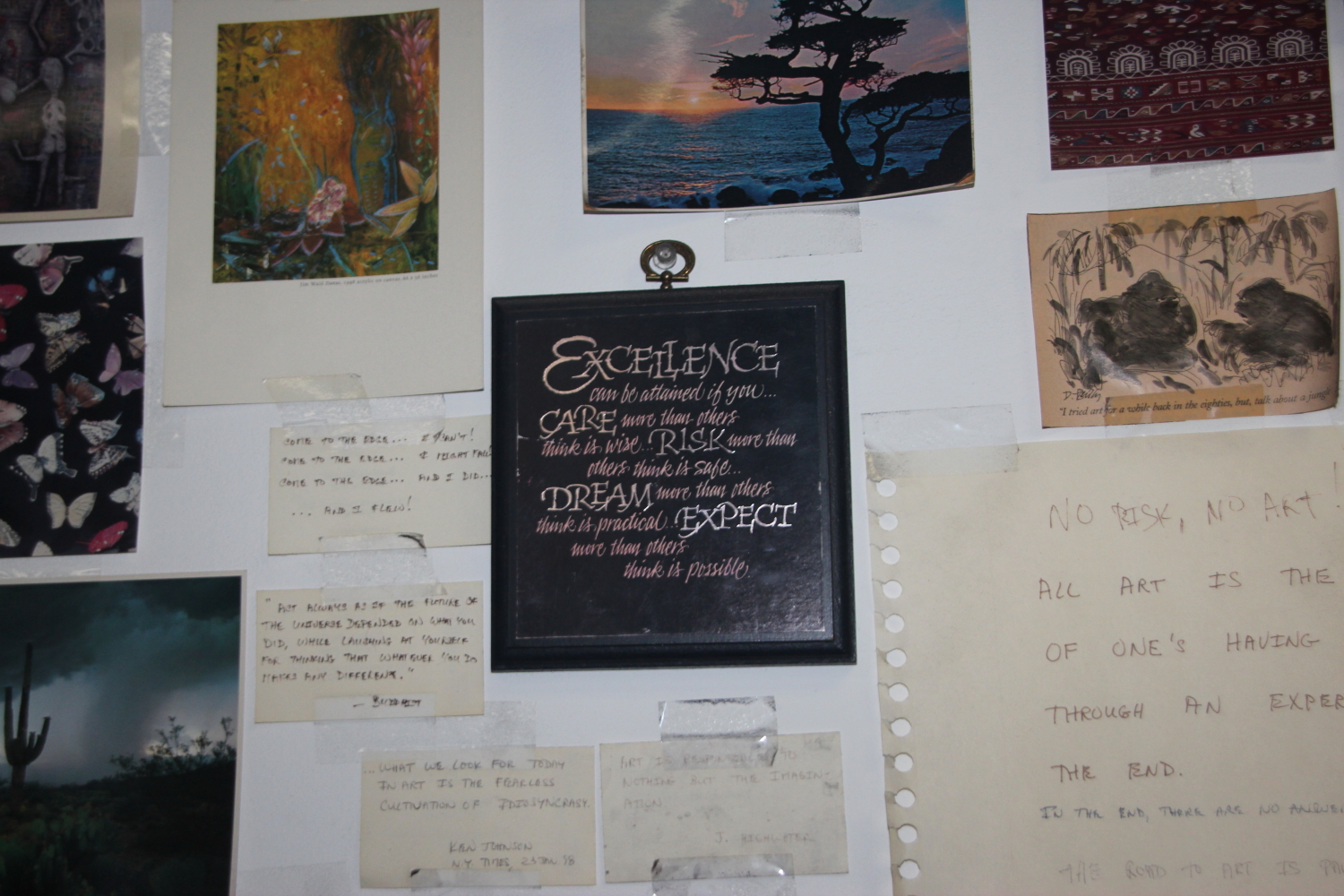
On my studio wall
A: I have several pieces of advice:
Build a support network among your fellow artists, teachers, and friends. It is tough to be an artist, period. Be sure to read plenty of books by and about artists. You will learn that all have experienced similar challenges.
Do whatever you must to keep working – no matter what! Being an artist never gets easier. There are always new obstacles and you will discover solutions over time.
When I left the active duty Navy in 1989, my co-workers threw a farewell party. One of the parting gifts I received was a small plaque from a young enlisted woman whom I had supervised. The words on the plaque deeply resonated with me, since I was about to make a significant and risky career change. It was the perfect gift for someone facing the uncertainty of an art career.
Many years later the plaque is still a proud possession of mine. It hangs on the wall behind my easel, to be read every day as I work. It says:
“Excellence can be attained if you…
Care more than others think is wise…
Risk more than others think is safe…
Dream more than others think is practical…
Expect more than others think is possible.”
I continue to live by these wise words.
Comments are welcome!
Q: Do you have an essential philosophy that guides you in your creative expression?
A wall in Barbara’s studio
A: Here are my two essential philosophies:
“Give it all you’ve got and keep going.” I wrote this years ago on a piece of paper and tacked it onto the wall behind my easel so I can always see it.
“Excellence can be attained if you… care more than others think is wise… risk more than others think is safe… dream more than others think is practical… expect more than others think is possible.” These words are on a small plaque, also tacked on the wall behind my easel. A co-worker gave this to me when I resigned my Naval commission to pursue an art career.
Comments are welcome!


 barbararachkoscoloreddust.com