Blog Archives

Pearls from artists* # 665

"Broken," soft pastel on sandpaper, 38" x 58" image, 50" x 70" framed
“Broken,” soft pastel on sandpaper, 38″ x 58″ image, 50″ x 70″ framed

*an ongoing series of quotations – mostly from artists, to artists – that offers wisdom, inspiration, and advice for the sometimes lonely road we are on.

We are wordlessly persuaded and taught outright to hide so much of what we have unearthed in our lives. But artists throughout the centuries have described the power of using anguish as a catalyst to fuel their creativity. In Greek epic poetry, ‘Kleos’ refers to immortal renown. Unlike present-day fame, this term referred exclusively to heroes who had surmounted a great obstacle or persevered through tremendous difficulties. There is a certain authority that comes from those who have endured hardship. They have earned the depth of their work.

Darkness contains a great deal of energy. We can use it for destruction or creativity. Only those who tolerate it are able to illuminate the shadowy corners, revealing the nefariousness that hopes to stay hidden. We cannot change our past, or any hell that we have been through. But art provides the means to exorcise the pain that has taken up residence in our body and fashion it into a form outside ourselves, in an infinitely affirmative gesture. The darkness we have passed through was not endured in vain if we mold it into a vision that lights the way out… for us, and for all the other souls who undoubtedly need it.

Kate Kretz in Art From Your Core: A Holistic Guide to Visual Voice

Comments are welcome!

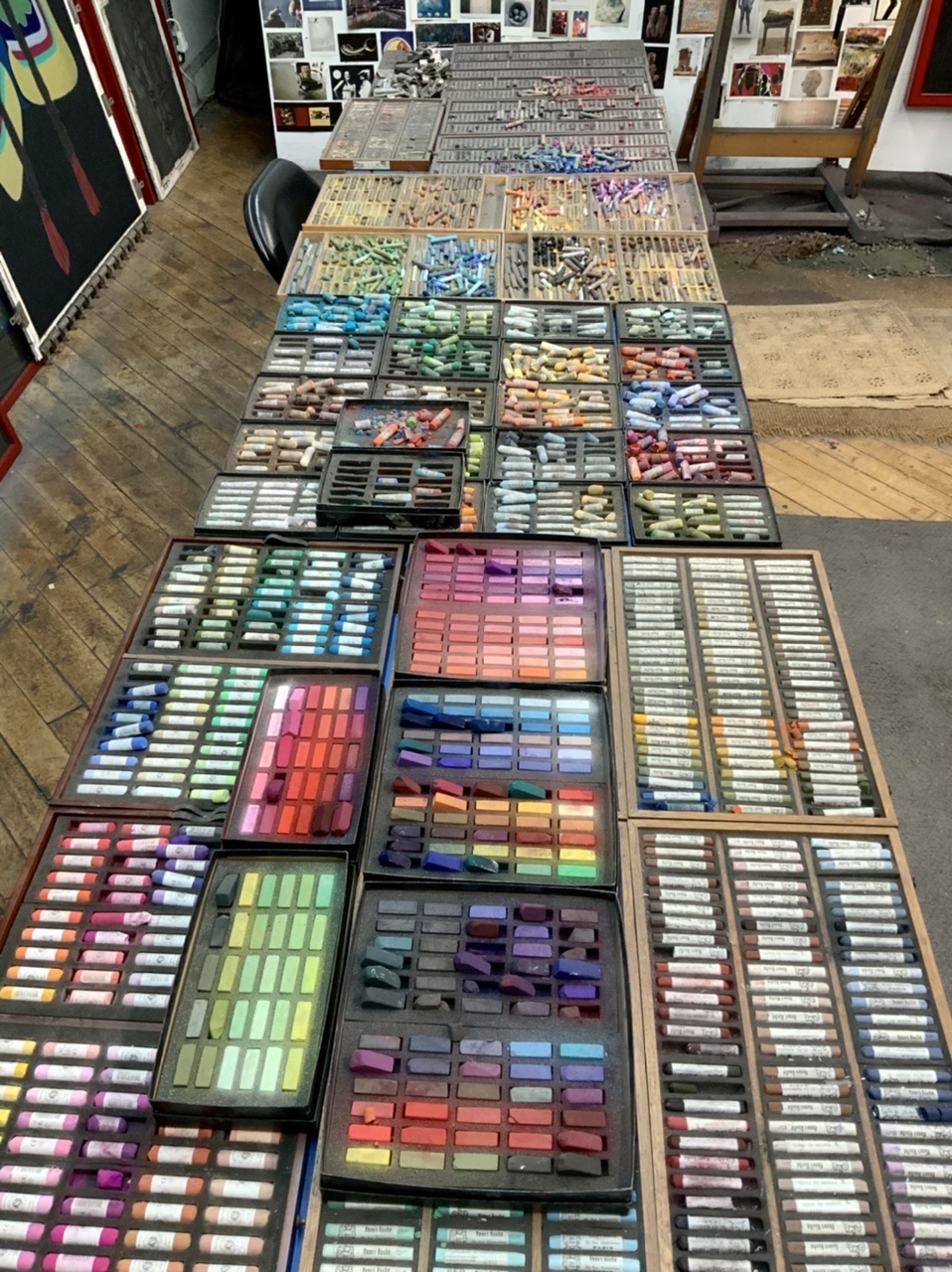
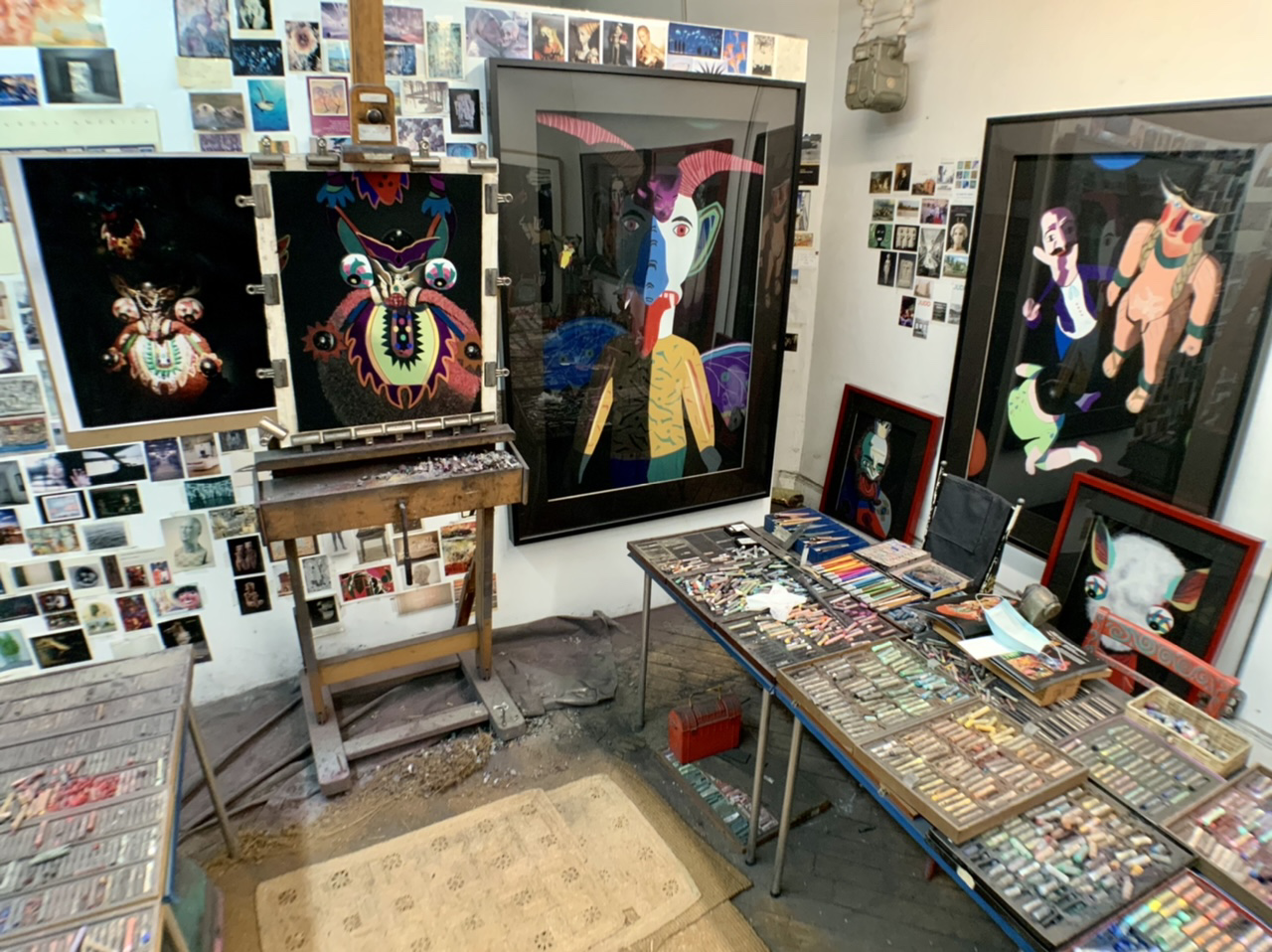
Q: Why do you have so many pastels?

Barbara’s Studio

A: Our eyes can see infinitely more colors than the relative few that are made into pastels. When I layer pigments onto the sandpaper substrate, I mix new colors directly on the paper. The short answer is, I need lots of pastels so that I can make new colors.

I have been working exclusively with soft pastel for 40 years. Whenever I feel myself getting into a rut in how I select and use my colors, I look around for new materials to try.   Fortunately, new brands of soft pastels are continually coming onto the market. There are pastels that are handmade by artists – I love discovering these – and new colors manufactured by well-known pastel companies.  Some sticks of soft pastel are oily, some are buttery, some more powdery, some crumble easily, some are more durable.  Each one feels distinct in my hand.

Furthermore, they each have unique mixing properties.  It’s an under-appreciated science that I stumbled upon (or maybe I invented it, I’m not sure since I cannot know how other pastel painters work). In this respect soft pastel is very different from other paint media. Oil painters, for example, need only a few tubes of paint to make any color in the world. I don’t go in much for studying color theory as a formal discipline. If you want to really understand and learn how to use color, try soft pastel and spend 10,000+ hours (the amount of time Malcolm Gladwell says, in his book, “Outliers,” that it takes to master a skill) figuring it all out for yourself!

Comments are welcome.

Q: Why do you have so many pastels?

Barbara’s Studio

A: Our eyes can see infinitely more colors than the relative few that are made into pastels. When I layer pigments onto the sandpaper substrate, I mix new colors directly on the painting. This has the result of making many of my colors unrepeatable. The short answer is, I need lots of pastels so that I can mix new colors.

I have been working exclusively with soft pastel for nearly 40 years. Each pastel stick has unique mixing properties that depend on what was used as a binder to hold the dry pigment together. Some soft pastels are oily, some are buttery, some are powdery, some crumble easily, some are harder.  Each one feels slightly different when I apply it to the sandpaper.

Soft pastel is distinct among paint media. Oil painters need only a few tubes of paint to make any number of colors, but pastels are not easily combined to form new colors. I learned how to mix colors by experimenting. In the process I developed a personal and unique science of color-mixing and blending. This is one of the factors that makes my work so recognizable and sets it apart from that of other pastel painters.

Comments are welcome.

Q: How large is your collection of Mexican folk art objects?

Part of my collection

A: I began collecting these figures in the early 1990s.I haven’t counted them, but my guess is that I have amassed around 200 pieces of various sizes. This includes some Guatemalan figures. I went to Guatemala in 2009 and 2010.Since I divide my time between a house in Alexandria, VA, an apartment in Manhattan, and a studio in Chelsea, a portion of my folk art collection resides in each of these places.

Since 2017 I have been creating pastel paintings in the “Bolivianos” series, which exclusively use my photographs of Bolivian Carnival masks as source material. Occasionally, I will add one of my smaller Mexican or Guatemalan figures to improve and enrich a painting’s composition. Otherwise, my Mexican collection sits gathering dust. My thinking and my ideas, not to mention my travels, have evolved and just naturally moved on with time.

Comments are welcome!

Pearls from artists* # 605

“The Mentalist,” Soft Pastel on Sandpaper, 26” x 20” Image, 35” x 28.5” Framed

*an ongoing series of quotations – mostly from artists, to artists – that offers wisdom, inspiration, and advice for the sometimes lonely road we are on.

At first the concept of the unconscious was limited to denoting the state of repressed or forgotten contents. Even with Freud, who makes the unconscious – at least metaphorically – take the stage as the acting subject, it is really nothing but the gathering place of forgotten and repressed contents, and has a functional significance thanks only to these. For Freud, accordingly, the unconscious is of an exclusively personal nature, although he was aware of its archaic and mythological thought forms.

A more or less superficial layer of the unconscious is undoubtedly personal. I call it the personal unconscious. But this personal unconscious rests upon a deeper layer, which does not derive from personal experience and is not a personal acquisition but is inborn. This deeper layer I call the collective unconscious. I have chosen the term “collective” because this part of the unconscious is not individual but universal; in contrast to the personal psyche, it has contents and modes of behavior that are more or less the same everywhere and in all individuals. It is, in other words, identical in all men and thus constitutes a common psychic substrate of a suprapersonal nature which is present in every one of us.

Carl Jung in The Archetypes and the Collective Unconscious, translated by RFC Hull

Comments are welcome!


Q: What is your process? (Question from artamour)

Some of Barbara’s pastels

A: For thirty-six years I have worked exclusively in soft pastel on sandpaper.  Pastel, which is pigment and a binder to hold it together, is as close to unadulterated color as an artist can get.  It allows for very saturated color, especially employing the self-invented techniques I have developed and mastered. I believe my “science of color” is unique, completely unlike how any other artist works.  I spend three to four months on each painting, applying pastel and blending the layers together to mix new colors on the paper. 

The acid-free sandpaper support allows the buildup of 25 to 30 layers of pastel as I slowly and meticulously work for hundreds of hours to complete a painting.  The paper is extremely forgiving.  I can change my mind, correct, refine, etc. as much as I want until a painting is the best I can create at that moment in time. 

My techniques for using soft pastel achieve rich velvety textures and exceptionally vibrant color.  Blending with my fingers, I painstakingly apply dozens of layers of pastel onto the sandpaper.  In addition to the thousands of pastels that I have to choose from, I make new colors directly on the paper.  Regardless of size, each pastel painting takes three to four months and hundreds of hours to complete. 

have been devoted to soft pastel from the beginning.  In my blog and in numerous interviews online and elsewhere, I continue to expound on its merits.  For me no other fine art medium comes close. 

My subject matter is unique.  I am drawn to Mexican, Guatemalan, and Bolivian cultural objects—masks, carved wooden animals, papier mâché figures, and toys.  On trips to these countries and elsewhere I frequent local mask shops, markets, and bazaars searching for the figures that will populate my pastel paintings.  How, why, when, and where these objects come into my life is an important part of the creative process.  Each pastel painting is a highly personal blend of reality, fantasy, and autobiography.

Comments are welcome!

Pearls from artists* # 501

New York City

* an ongoing series of quotations – mostly from artists, to artists – that offers wisdom, inspiration, and advice for the sometimes lonely road we are on.

When I talk about “creative living” here, please understand that I am not necessarily talking about pursuing a life that is professionally or exclusively devoted to the arts. I’m not saying that you must become a poet who lives on a mountaintop in Greece, or that you must perform at Carnegie Hall, or that you must win the Palme d’Or at the Cannes Film Festival. (Though if you want to attempt any of these feats, have at it. I love to watch people swing for the bleachers.) No, when I refer to “creative living,” I am speaking more broadly. I’m talking about living a life that is driven more strongly by curiosity than by fear.

... A creative life is an amplified life. It’s a bigger life, a happier life, an expanded life, and a hell of a lot more interesting life. Living in this manner – continually and stubbornly bringing forth the jewels that are hidden within you – is a fine art, in and of itself.

Elizabeth Gilbert in Big Magic: Creative Living Beyond Fear

Comments are welcome!

Q: What are your favorite subject(s) and media? (Question from “Arts Illustrated”)

Barbara’s New York Studio

A: Here’s the short answer. I work exclusively in soft pastel on sandpaper, using self-invented pastel techniques that I have been refining for thirty-five years.  Since 2017, I have depicted authentic Bolivian Carnival masks that I encountered and photographed at the Museum of Ethnography and Folklore In La Paz.

Comments are welcome!

Q: Walk us through your “typical day”?

Barbara at work on “Schemer,” Soft Pastel on Sandpaper, 26” x 20”

Barbara at work on “Schemer,” Soft Pastel on Sandpaper, 26” x 20”

A:  I’ll describe a typical day at the studio.  When I first arrive in the morning, I read for 30 minutes. Reading focuses and quiets my mind and gets me ready to begin the day’s work.  While I read, I look at the pastel painting that’s on my easel to see where to begin.  Then I close the book, turn on some music, plug in the Halogen lamps I use while working, apply a barrier cream to my hands, put on a surgical mask (to avoid breathing pastel dust), pick up a pastel, and start.   

I never sit while working.  I enjoy the physicality of art-making and prefer to stand at my easel so I can back up to see how the pastel painting looks from a distance.  I like being on my feet all day and getting some exercise.  I work for a couple of hours, break for lunch, and then work the rest of the afternoon.

I believe artists need to be disciplined.  I work five days a week, taking Wednesdays and Sundays off, and spend seven hours or more per day in the studio.  Daylight is essential so I work more hours in summer, fewer in winter.  I like to think of art-making as independent of time tables, but I tend to work in roughly two-hour blocks before taking a break.  I typically work until 5:00 or so.

Studio hours are sacrosanct and exclusively for creative work.  I do not have WiFi at my studio and prefer to keep my computer and mobile devices elsewhere (they devour time).  Art business activities – answering email, keeping up with social media, sending jpegs, writing blog posts, doing interviews, etc. – are accomplished at home in the mornings, in the evenings, and on days off from the studio.

Comments are welcome!
Q: How long did it take you to discover the properties of pastel? (Liliana Mileo via facebook.com/BarbaraRachko/)

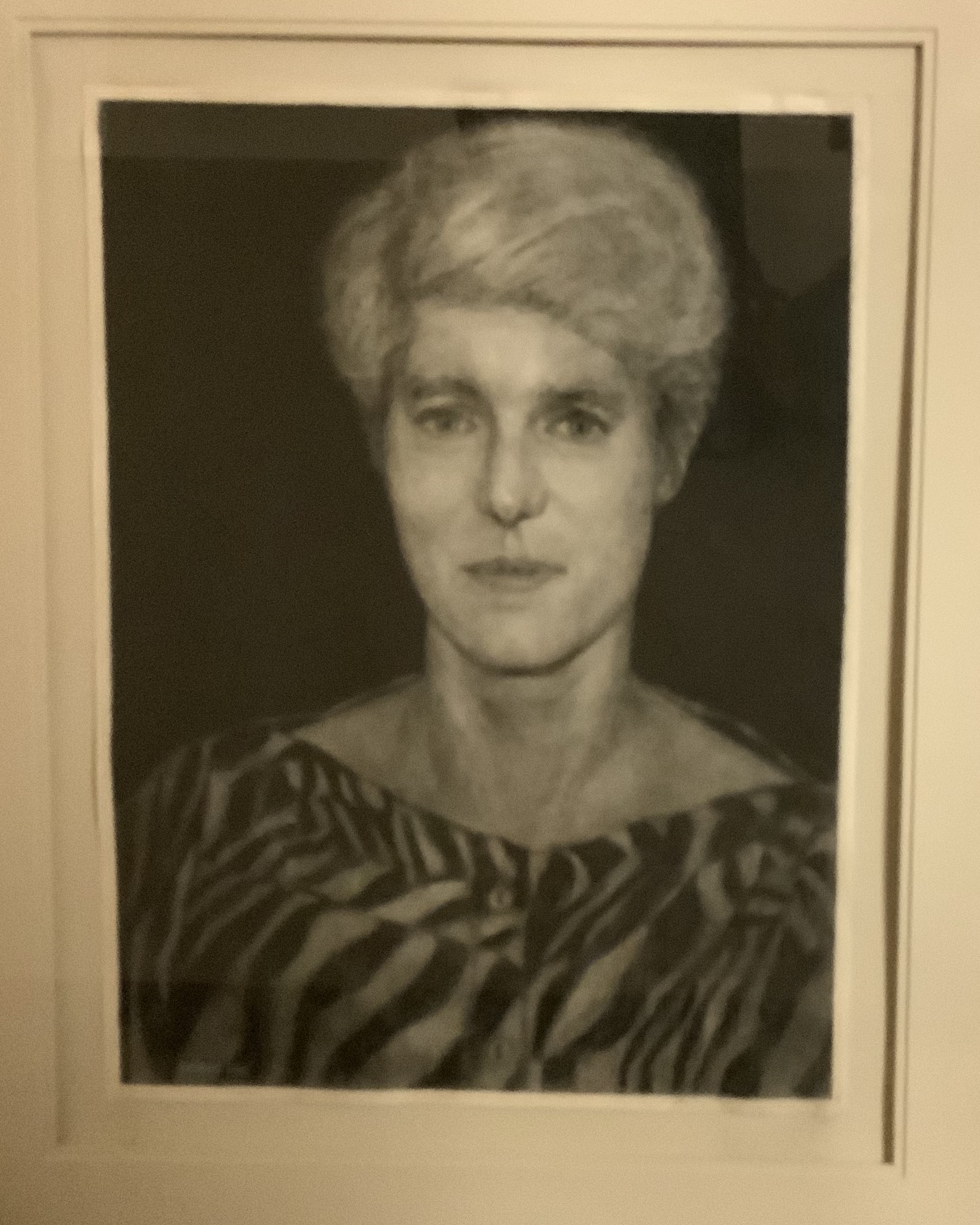
A charcoal self-portrait from 1988

A charcoal self-portrait from 1988

A:  After I moved to Alexandria, Virginia in the mid-1980s, I began taking classes at The Art League School.  I was extremely unhappy with my career as a Navy Lieutenant.  I worked as a computer analyst for the Joint Chiefs of Staff at the Pentagon and was searching for something more meaningful to do with my life.

I began with a basic drawing class and liked it.  I enrolled in more classes and decided to spend two years working exclusively in black and white media, such as charcoal and graphite, before advancing to color.  Fortunately, early on I found an excellent teacher in Lisa Semerad.  I remain deeply grateful for the strong foundational drawing skills she imparted to me during this period.

After two years I tried water color and soon discovered it was not for me, a perfectionist who needs to refine my work.  Then I tried etching and found it extremely tedious, the antithesis of instant gratification.

Finally I began studying soft pastel with Diane Tesler, another gifted teacher, and fell in love with this medium!  At The Art League School I also completed a one-week workshop with Albert Handell, who introduced me to the archival sandpaper that I have been using ever since.

While I fell in love with pastel three decades ago, I continue to learn about its unique properties.  I am pushing pastel to new heights as my techniques continually evolve.  This is a lifetime journey of learning.  I hope to never know all there is to know.

Comments are welcome!  Ask anything and I may answer in a future blog post, as you’ve seen here with Liliana’s question.
