Blog Archives
Pearls from artists* # 683
*an ongoing series of quotations – mostly from artists, to artists – that offers wisdom, inspiration, and advice for the sometimes lonely road we are on.
Clichéd subject matter can be a symptom of shallow understanding. Experiencing our subject matter firsthand helps us absorb complexities and discover surprising insights, leading to enriched outcomes. Envision a painting of a tree copied from a found internet photograph. Then, imagine the possibilities of a work executed by a person who loves to climb, sit under, caress, plant, and nurture trees, one who has observed their qualities through downpours, windstorms, and the Fall twilight filtered through leaf layers. They don’t just see, but feel these living, breathing giants straining to grow toward the sun, cooperatively respecting their neighbor’s space high in their crowns, and communicating with their community underground. Inspiration is not just gleaned through the eyes but through our entire bodies, intellect, and feelings.
Kate Kretz in Art From Your Core: A Holistic Guide to Visual Voice
Comments are welcome!
Pearls from artists* # 669

*an ongoing series of quotations – mostly from artists, to artists – that offers wisdom, inspiration, and advice for the sometimes lonely road we are on.
Pure creativity is magnificent expressly because it is the opposite of everything else in life that’s essential or inescapable (food, shelter, medicine, rule of law, social order, community and familial responsibility, sickness, loss, death, taxes, etc.). Pure creativity is something better than a necessity; it’s a gift. It’s the frosting. Our creativity is a wild and unexpected bonus from the universe. It’s as if all our gods and angels gathered together and said, “It’s tough down there as a human being, we know. Here – have some delights.”
It doesn’t discourage me in the least, in other words, to know that my life’s work is arguably useless.
All it does is make me want to play.
Elizabeth Gilbert in Big Magic: Creative Living Beyond Fear
Comments are welcome!
Pearls from artists* # 627

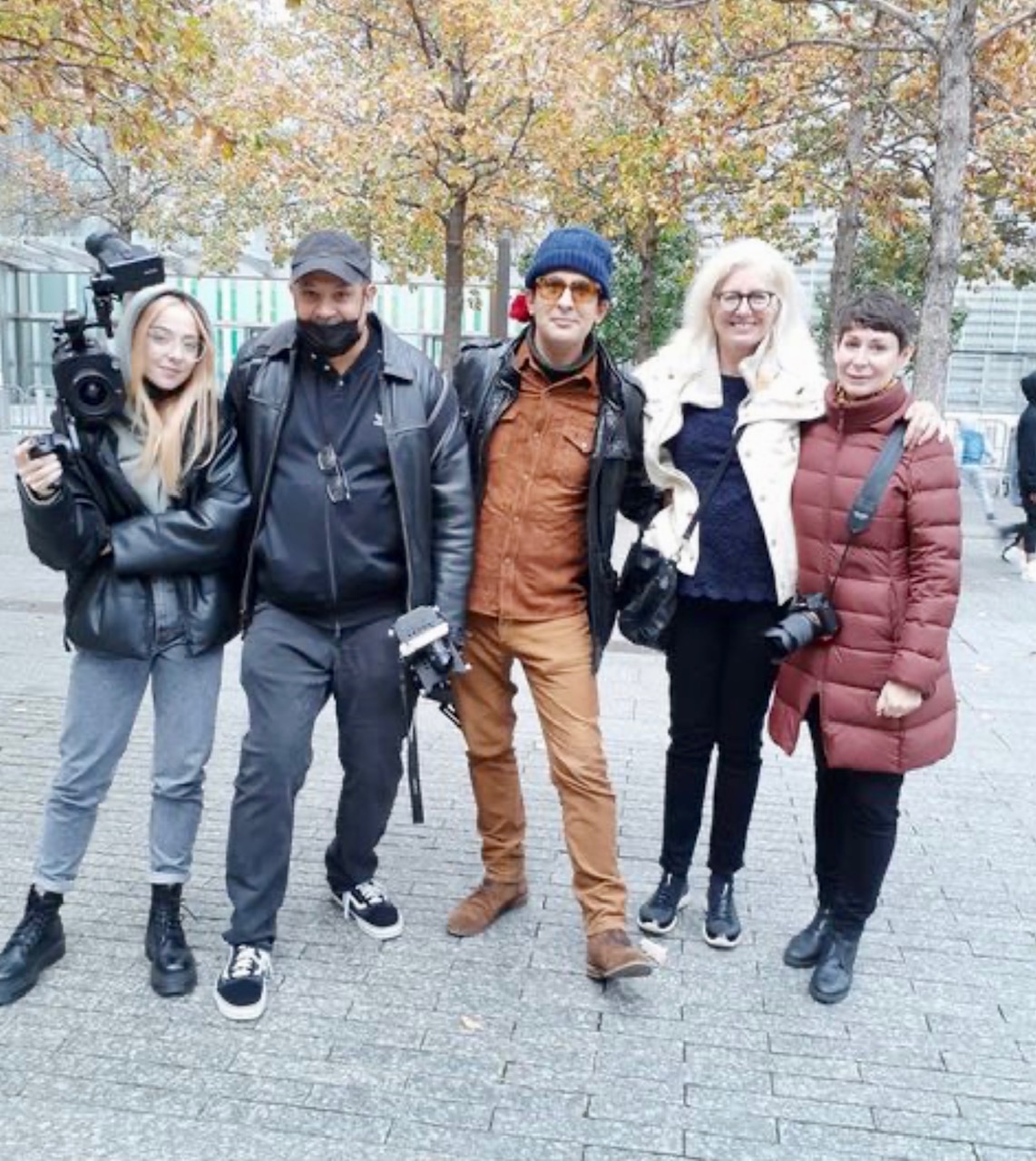
With friends at the 2024 Whitney Biennial!
*an ongoing series of quotations – mostly from artists, to artists – that offers wisdom, inspiration, and advice for the sometimes lonely road we are on.
“People are really open here and very dynamic, and they really respect hard work. So if you are going to shows, if you are part of the community, if you go do studio visits, if you’re interested in other people, you can create a community, said Julie [Curtiss]. “You can’t be a lazy artist in New York.”
Julie Curtiss quoted in Get the Picture: A Mind-Bending Journey Among the Inspired Artists and Obsessive Art Fiends Who Taught Me How to See by Bianca Bosker
Comments are welcome!
Pearls from artists* # 612
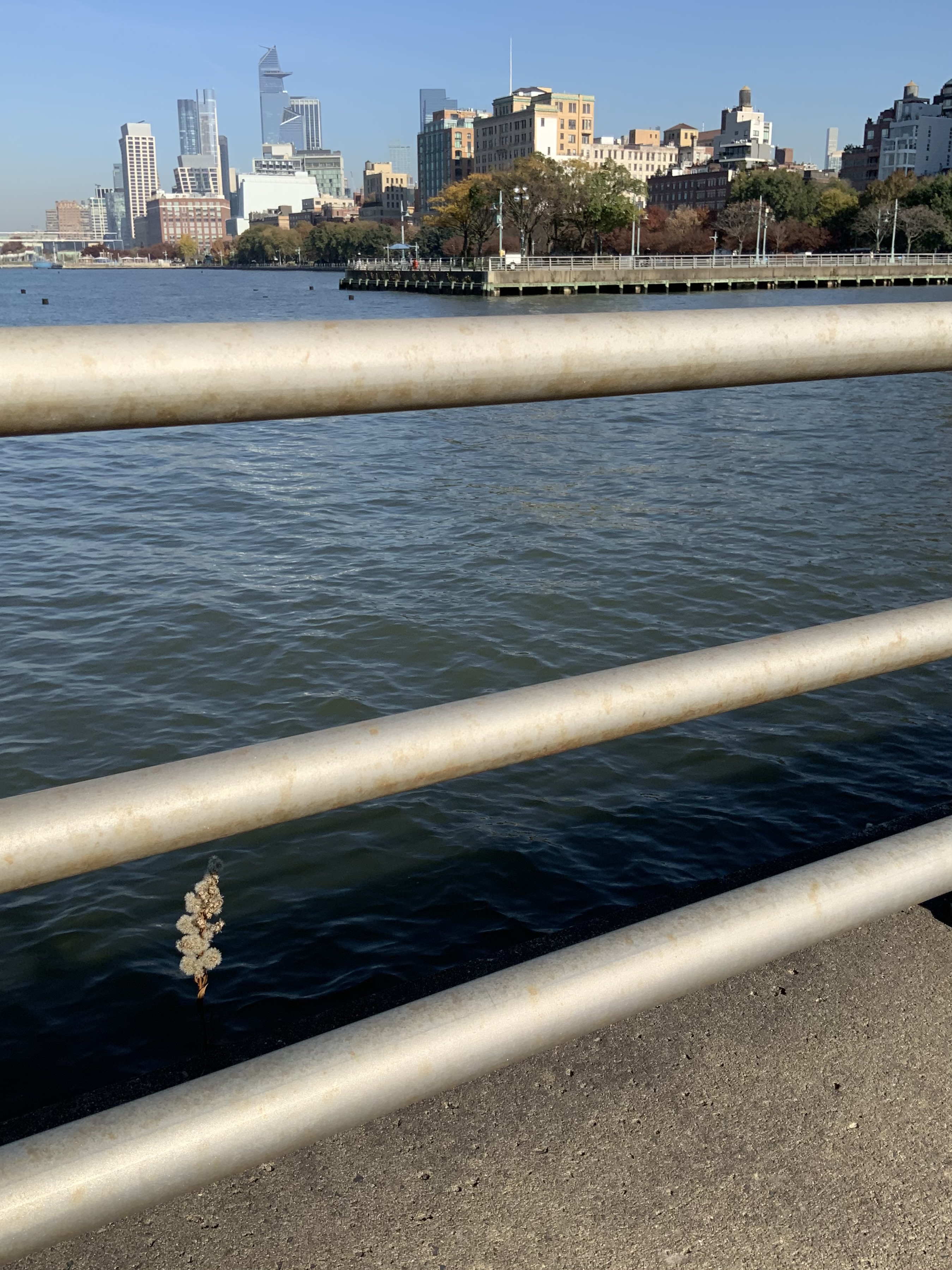
New York, NY
*an ongoing series of quotations – mostly from artists, to artists – that offers wisdom, inspiration, and advice for the sometimes lonely road we are on.
It is the poet and philosopher who provide the community of objectives in which the artist participates. Their chief preoccupation, like the artist, is the expression in concrete form of their notions of reality. Like him, they deal with verities of time and space, life and death, and the heights of exaltation as well as the depths of despair. The preoccupation with these external problems creates a common ground which transcends the disparity of the means used to achieve them. And it is in the language of the philosopher and poet or, for that matter, of other arts which share the same objective that we must speak if we are to establish some verbal equivalent of the significance of art.
Let us not for a moment conceive that the language of one is interchangeable with that of the other: that one can duplicate the sense of a picture by the sense of words or sounds, or that one can translate the truth of words by means of pictorial delineations. Not all odes of Pindar, framed and embroidered, could duplicate the portrayal by Apelles’ brush of the Hero of the Palaestra. The Pandemonium of Milton or Dante’s Inferno can never replace the vision of the Last Judgment by either Michelangelo or Signorelli. No more so than the Pastoral Symphony of Beethoven can be apprehended through the reading of idyllic poems, augmented by descriptions of woodland and fields, of torrents and streams, the study of ornithological sounds, and the laws of harmonics. Neither books on jurisprudence, nor costume plates, can possibly reconstruct Raphael’s School of Athens. And the man who knows a book or a picture through its critics, whatever his experience, has no experience of the art itself. The truth, the reality of each, is confined within its own boundaries and must be perceived in terms of the means generic to itself.
In speaking of art here, there is no thought of recreating the experience of the picture. If we compare one art to another, it is not with the intention of contrasting their actuality, but to speak rather of the motivations and properties such as are admissible to the world of verbal ideas. And if… we are partial to the philosopher – at the expense of those others who share with the artist his common objectives, it is not because we divine in his effort a greater sympathy to the artist, but because philosophy shares with art it’s preoccupation with ideas in the terms of logic.
Mark Rothko in The Artist’s Reality: Philosophies of Art
Comments are welcome!
Pearls from artists* # 539
*an ongoing series of quotations – mostly from artists, to artists – that offers wisdom, inspiration, and advice for the sometimes lonely road we are on.
It is important to consider, when cities like New York continue a process of gentrification that make them unlivable for most artists and intellectuals, that the community Schloss describes was to some extent brought into being by a number of radically different circumstances: first, immigration – in some cases, such as de Kooning, illegal, and in others, such as Schloss, forced by war and politics – and second, the existence in post-Great Depression New York of cheap rents for run-down spaces that no one other than artists would consider or would be able to make not just livable but eventually fashionable.
Mira Schor in The Loft Generation: From the de Koonings to Twombly, Portraits and Sketches 1942-2011 edited by Mary Venturini
Comments are welcome!
Pearls from artists* # 493
*an ongoing series of quotations – mostly from artists, to artists – that offers wisdom, inspiration, and advice for the sometimes lonely road we are on.
Professional opportunities in the art world almost always come out of personal connections, and community – almost by definition – is the way to make them. That’s not a prescription for superficial networking or obnoxious self-promotion, neither of which will get you anywhere. It means realizing that the chance to get a piece into a group show or meet a gallerist will probably come through someone you know and rspect, who knows and respects you.
Depending on your temperament, building community can feel daunting, artificial, or fun. There’s no need to subject yourself to awkward conversation at stuffy cocktail parties. Just keep in touch with your friends and professors from art school, attend local openings, and be open to meeting new people at events. If you’re shy, bring a friend along. It’s easier to break your way into conversation when you have a sidekick, and then you can talk about each other’s work instead of your own.
In Art/Work: Everything You Need to Know (and Do) As You Pursue Your Art Career by Heather Darcy Bhandari and Jonathan Melber
Comments are welcome!
Pearls from artists* # 492
*an ongoing series of quotations – mostly from artists, to artists – that offers wisdom, inspiration, and advice for the sometimes lonely road we are on.
Start with the community you know, who knows you. who’s interested in whatever it is that you’ve put together with your work or your gallery space or your magazine or your brand or your performance series. Start with who you know and build from there.
I think it’s about working in a way that’s true to yourself and that allows things to happen naturally, with bits of prodding to bring new people into contact with what you do.
Peter Eleey, curator, in Art/Work: Everything You Need to Know (and Do) As You Pursue Your Art Career by Heather Darcy Bhandari and Jonathan Melber
Comments are welcome!
Pearls from artists* # 472
*an ongoing series of quotations – mostly from artists, to artists – that offers wisdom, inspiration, and advice for the sometimes lonely road we are on.
A remark by Kurt Anderson suggests how the Internet discourages patient gazing: “Waiting a while to get everything you want… was a definition of maturity. Demanding satisfaction right this instant, on the other hand, is a defining behavior of seven-year-olds. The powerful appeal of the Web is not just the ‘community’ it enables but its instantane-ity… as a result… delayed gratification itself came to seem quaint and unnecessary.” A survey commissioned by the Visitor Studies Association reveals the impact of impatience. On average, the survey found, Americans spend between six and ten seconds looking at individual works in museums. (Is it just a coincidence that six to ten seconds is also the average time browsers perch on any given Web page?) Yet how many hours a day do we spend absorbed by one or another electronic screen? For the Los Angeles artist Ed Ruscha (born 1937) brief encounters won’t suffice. When somebody asked, “How can you tell good art from bad?” Ruscha replied, “With a bad work you immediately say, ‘Wow!’ But afterwards, you think, ‘Hum? Maybe not.’ With a good work, the opposite happens.” Time is lodged at the heart of Ruscha’s formula, as the artwork becomes part of our temporal experience. In order to know what is good, we need to take a breather. Even to know what is bad, we need to pause.
Arden Reed in Slow Art: The Experience of Looking, Sacred Images to James Turrell
Comments are welcome!
Pearls from artists* # 462
*an ongoing series of quotations – mostly from artists, to artists – that offers wisdom, inspiration, and advice for the sometimes lonely road we are on.
It seems contradictory to call an artist both shy and conceited, introverted and extraverted, empathic and self-centered, highly independent and hungry for community – until we realize that all of these qualities can be dynamically present in one and the same person.
Indeed, this dynamism regularly perplexes and buffets the artist. He may begin to consider himself crazy for longing to perform even though public performance frightens him, or neurotic for feeling competent at the piano but incompetent in the world. He may come to possess the vain hope that he can live quietly, like other people, his personality statically integrated in some fashion, and then feel like a failure when the contradictory forces at play in him prevent him from feeling relaxed even for a minute. Once he realizes, however, that this puzzling contradiction is his personality, he is better able to accept himslef and to understand his motives and actions.
Eric Maisel in “A Life in the Arts: Practical Guidance and Inspiration for Creative and Performing Artists”
Comments are welcome!


 barbararachkoscoloreddust.com
Pearls from artists* # 529
Oct 19
Posted by barbararachkoscoloreddust
* an ongoing series of quotations – mostly from artists to artists – that offers wisdom, inspiration, and advice for the sometimes lonely road we are on.
All sorts of novelists, composers, choreographers, poets, and painters find themselves engaged in the challenges of authority and freedom that are the lifeblood of the arts. Art is a way of life – and not only or even essentially for geniuses. An artistic community – to whatever degree it may be joined by social, economic, or other concerns – is fundamentally united by the imperatives of a vocation as they are shaped in a particular time. Genius doesn’t emerge ex nihilo. And it doesn’t have a unique relationship with authority and freedom. Whatever truth there is to Walter Benjamin’s comment, apropos of Proust’s novel, that certain masterpieces begin or end a genre, it’s usually true that every masterpiece reaffirms the fundamental character of a form. For every epochal achievement that we may see as an assertion of unexpected degrees of freedom (Beethoven’s final quartets or Shakespeare’s last plays), there are others that reaffirm the pressure of tradition (an example is Raphael’s neoclassical designs for tapestries representing scenes from the lives of Saint Peter and Saint Paul). For every creative spirit, the great as well as the merely good, there is a sense in which the wager is the same.
Jed Perl in Authority and Freedom: A Defense of the Arts
Comments are welcome!
Share this:
Posted in 2022, An Artist's Life, Art in general, Art Works in Progress, Inspiration, Pearls from Artists, Quotes
Comments Off on Pearls from artists* # 529
Tags: achievement, apropos, artistic, assertion, authority, Beethoven, certain, challenges, character, choreographers, comment, community, composers, concerns, creative, degree, degrees, designs, economic, emerge, engaged, epochal, essentially, every, ex nihilo, example, freedom, fundamental, fundamentally, genius, geniuses, Jed Perl, joined, lifeblood, masterpiece, masterpieces, merely, neoclassical, novelists, painters, particular, presence, pressure, Proust, quartets, Raphael, reaffirm, relationship, Saint Paul, Saint Peter, scenes, Shakespeare, shaped, social, spirit, tapestries, the arts, themselves, tradition, unexpected, unique, united, usually, vocation, Walter Benjamin, whatever, work in progress