Category Archives: Studio

Q: What’s on the easel today?

Work in progress

Work in progress

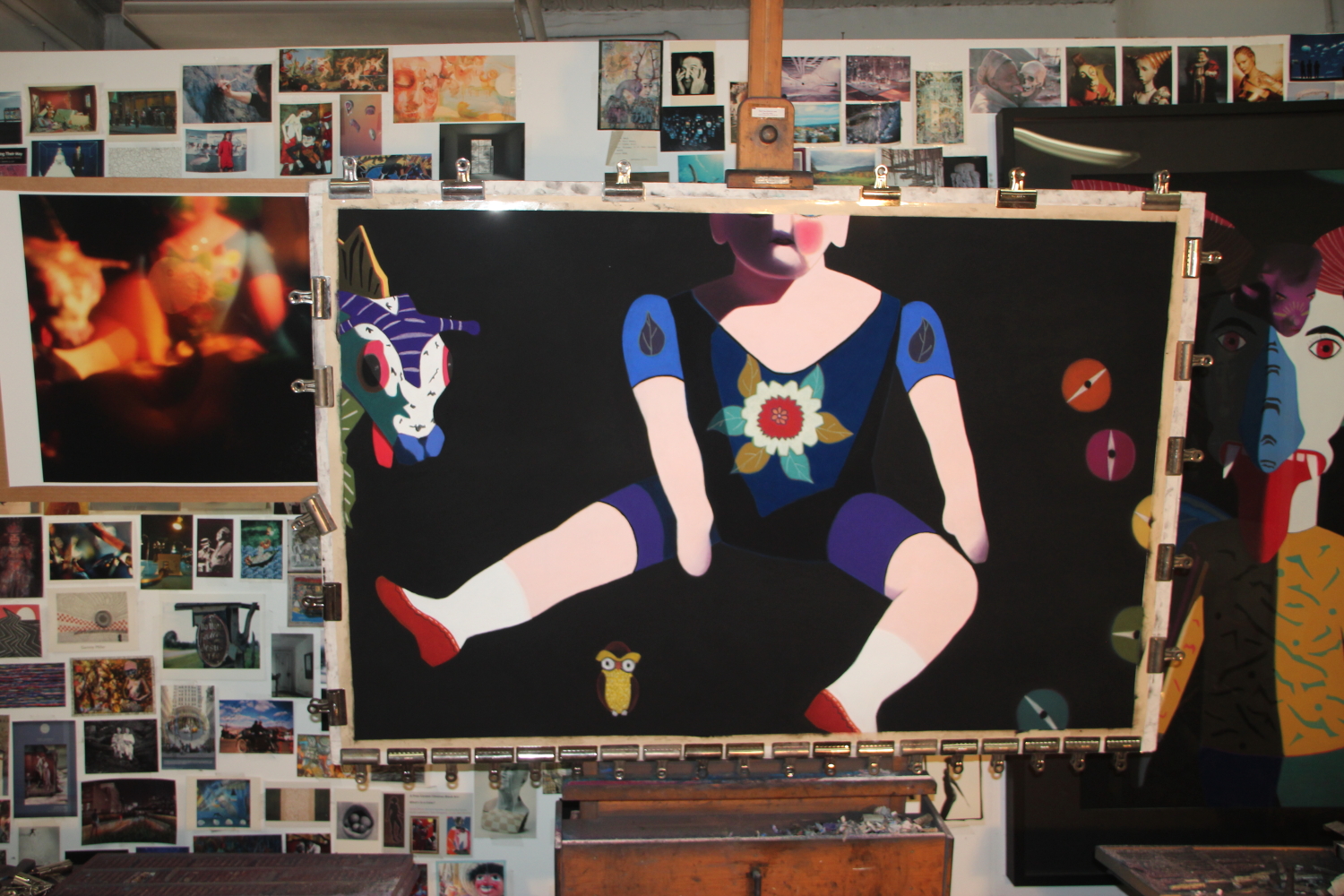
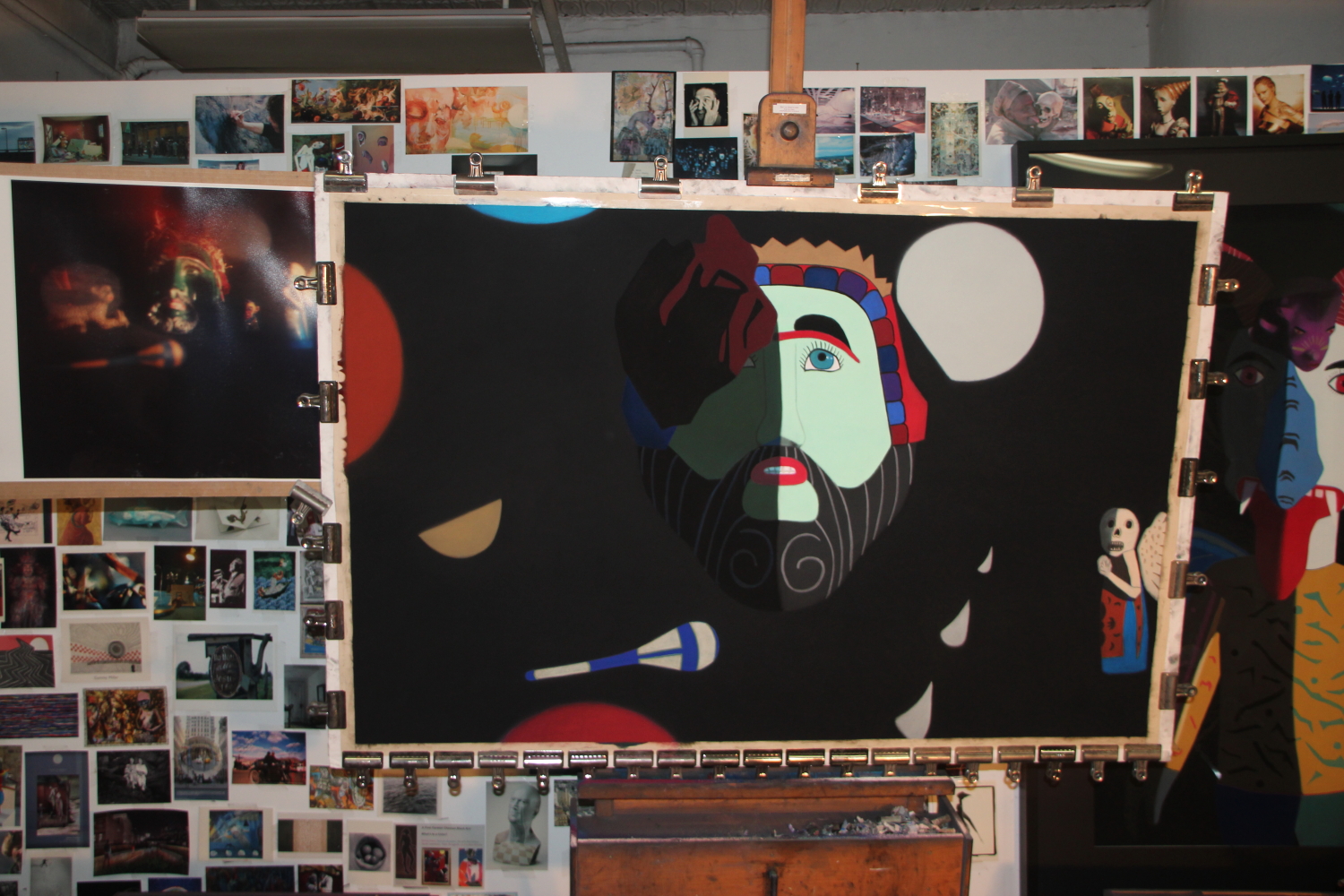
A:  I continue to work on a pastel-on-sandpaper painting that I began some weeks ago.  For now the working title is “Blinded,” which relates to the maroon and black shape on the main figure’s right eye.  I haven’t yet figured out the deeper meaning of that shape. 

Comments are welcome!

Pearls from artists* # 78

Barbara's studio

Barbara’s studio

* an ongoing series of quotations – mostly from artists, to artists – that offers wisdom, inspiration, and advice for the sometimes lonely road we are on.

To me, openings are never what you want them to be.  The excitement, relief, anxiety, and anticipation are too much to process.  There’s no apotheosis, no pinnacle, no turning point.  It’s not like theater, where at the end of a performance people get up and applaud.

Nothing gets created at an opening.  Nothing of artistic merit takes place.  All of that important stuff happens in the studio, long before the exhibition, when you’re alone.  For me, anyway, openings are something to get through, an ordeal to be endured.  The bigger the event, the less I remember it.  I pretty much walk in, and wherever I stop is where I stay.  I paint a grin on my face so fixed that by the end of the evening my jaw is sore.  I remember none of the conversations.  I stand there shaking hands, blindly mouthing, “Thank you.  Thank you very much.”  Then eventually April [Gornick, Fischl’s wife] collects me and we leave.

If, on the other hand, you were to ask me what I remember about making the paintings in a show, that’s a different story.  Imagine touching something, stroking it, jostling it, caressing it, and as you’re doing this, you are creating it.  How you touched it is how it came into existence.  Unlike other pleasures, where the feelings fade quickly as details become blurred, with paintings you remember everything.  Within the details are all the bumps and the friction, the memory of when the creative instinct flowed, when you were distracted or lazy or working too hard.  It’s all there on the canvas.  When I look at my paintings again, years later, even, I remember it all – the victory laps and the scars.

Eric Fischl and Michael Stone in Bad Boy:  My Life On and Off the Canvas  

Comments  are welcome! 

Q: Where do you want your work to go in the future?

Barbara's studio

Barbara’s studio

A:  Recently I answered a question about why I create, but now that I think about it, the same answer applies to what I want to do as an artist in the future:  

~ to create bold and vibrant pastel paintings and photographs that have never existed before  

~ to continue to push my primary medium – soft pastel on sandpaper – as far as I can and to use it in more innovative ways  

~ to create opportunities for artistic dialogue with people who understand and value the work to which I am devoting my life  

The last has always been the toughest.  I sometimes think of myself as Sisyphus because expanding the audience for my art is an ongoing uphill battle.  Many artist friends tell me they feel the same way about building their audience.  It’s one of the most difficult tasks that we have to do as artists.  I heard Annie Leibovitz interviewed on the radio once and remember her saying that after 40 years as a photographer, everything just gets richer.  Notice that she didn’t say it gets any easier; she said, “it just gets richer.”  I have been a painter for nearly  30 years and a photographer for 11.  I agree completely.  All artists have to go wherever our work goes.  Creating art and watching the process evolve is an endlessly fascinating intellectual journey.  I wouldn’t want to be spending my time on earth doing anything else!

Comments are welcome!

Pearls from artists* # 77

Barbara's studio

Barbara’s studio

* an ongoing series of quotations – mostly from artists, to artists – that offers wisdom, inspiration, and advice for the sometimes lonely road we are on.

Current possibilities far exceed any single artist’s capacity to engage them.  Indeed, every known way of making art ever undertaken in all of history is included in today’s inventory of creative options.  Thus, choices must be made.  This has had a profound effect upon the quantity and diversity of skills needed to become an artist today.  In addition to such conventional forms of artistic talent as visual acuity, manual dexterity, sensitivity, intelligence, ingenuity, and perseverance, contemporary artists must also be able to make judicious choices from a limitless inventory of alternatives.  A decisive aspect of the creative act involves choosing a place  amid possibilities that are as bountiful as they are eclectic and chaotic.  Even this process entail choices.  In staking the territory they wish to occupy, artists may be gluttons or ascetics, connoisseurs or  commoners.  Relationships between artists and their career choices may be lifelong and monogamous, or sequentially monogamous, polygamous, or promiscuous.  But artists’ options even exceed selecting precedents.  Free access to the past is amplified by freedom to augment the catalogue of creative options by contributing something new.

In the Making:  Creative Options for Contemporary Art by Linda Weintraub

Comments are welcome!  

Q: Was there a defining moment, meeting, or event that convinced you to pursue an artistic life?

West 29th Street studio

West 29th Street studio

A:  There was not a defining moment per se, but looking back now, I’d say that because the Navy assigned me to a series of boring office jobs instead of letting me fly, I became determined to find a vocation infinitely more rewarding and more interesting to devote the rest of my life to.  I came to this realization over time, rather than in a single moment. 

Comments are welcome!

New eBook!

Cover

Cover

I am pleased to announce that my first eBook, FROM PILOT TO PAINTER, is available now on Amazon!

It is based on my blog and is part memoir, including my personal loss on 9/11, insights into my creative practice, and intimate reflections on what it’s like to be an artist living in New York City now.

The eBook includes new material not  found on the blog:  25+ reproductions of my vibrant pastel-on-sandpaper paintings, a Foreword by Ann Landi (who writes for ARTnews and The Wall Street Journal), and more.

Thank you for your support!

http://www.amazon.com/From-Pilot-Painter-Interview-Barbara-ebook/dp/B00HNVR200/ref=sr_1_1?ie=UTF8&qid=1389292390&sr=8-1&keywords=barbara+rachko

Note:  If you do not own a Kindle, you can download a free Kindle app.

Here is the one for MACs:

http://www.amazon.com/gp/feature.html?docId=1000464931 

Here is a link for the rest: 

Kindle Cloud Reader – Read instantly in your browser

Smartphones – iPhone & iPod touch, Android, Windows Phone,  BlackBerry

Computers – Mac, Windows 8, Windows 7, XP & Vista

Tablets – iPad, Android Tablet, Windows 8

http://www.amazon.com/gp/feature.html/ref=sv_kstore_3?ie=UTF8&docId=1000493771

Comments are welcome!

Q: Does your work have an overall message?

Barbara's studio

Barbara’s studio

A:   Maybe there’s an overarching message, but that’s something for viewers to judge. I generally don’t like to specify what my work is about because my thinking about meanings evolves constantly and I don’t want to cut off people’s interpretations. Other people’s insights and opinions are equally as valid as mine.  

Recently I had the experience of being told that my interpretation of an artist’s work was “wrong.”  Besides hurting my feelings, she cut off a dialog and learned nothing about how her work is perceived.  I found it sad because art is communication and an opportunity was missed.

Comments are welcome!
 

Q: What’s on the easel today?

Pastel-on-sandpaper painting in progress

Pastel-on-sandpaper painting in progress

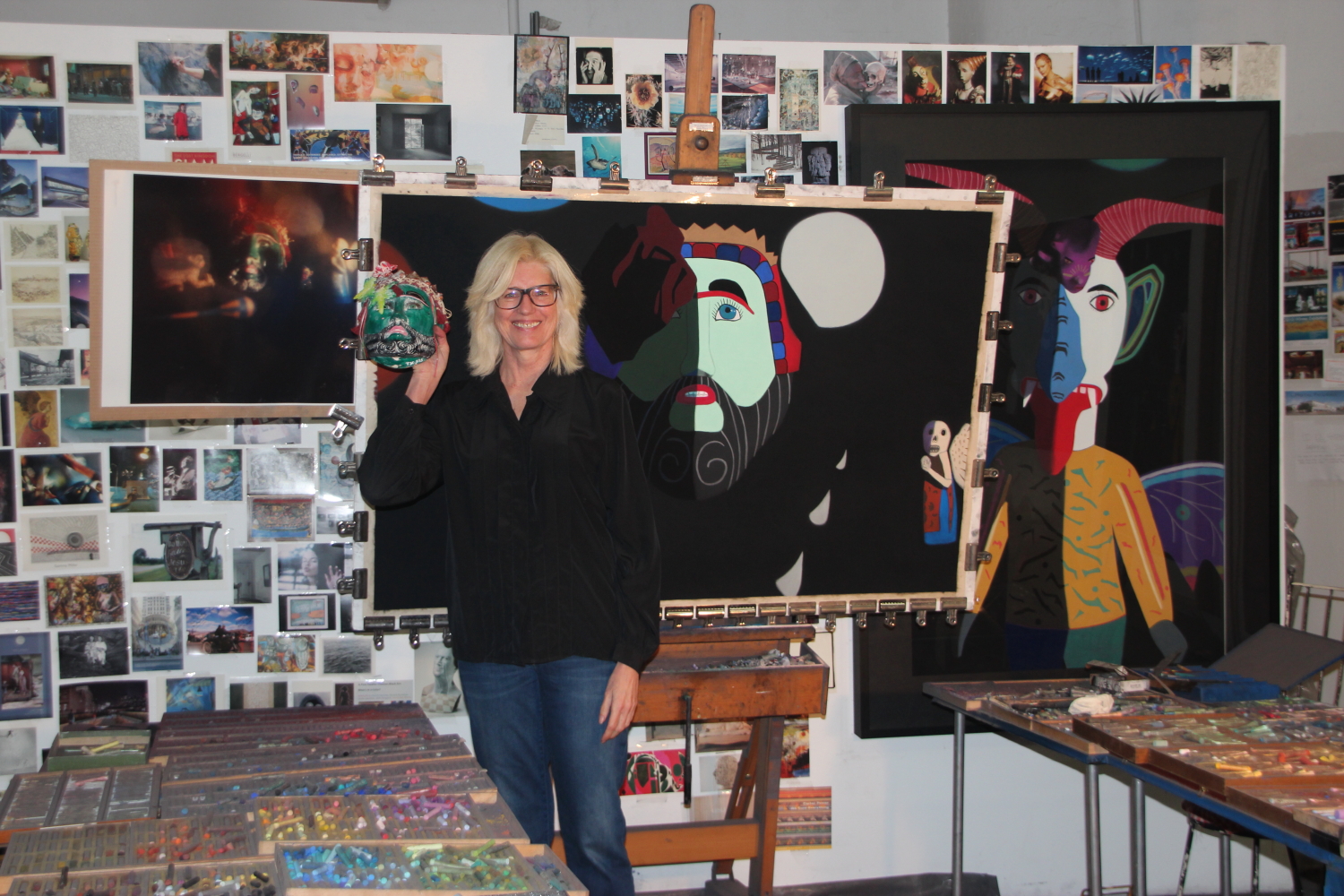
A:  I am working on a pastel painting that features a mask I found in Todos Santos, Mexico on a recent trip there with friends.  This is the first time I have so prominently featured a head without a body so I’m unsure whether the painting is coming together just yet.  Fortunately it’s very early in the process so there is plenty of time to make adjustments.

Comments are welcome!  

Merry Christmas, from my studio!

Barbara's New York studio

Barbara’s New York studio

Q: Can you discuss your process, including how you actually use Mexican and Guatemalan folk art figures in your art?

A corner of Barbara's studio

A corner of Barbara’s studio

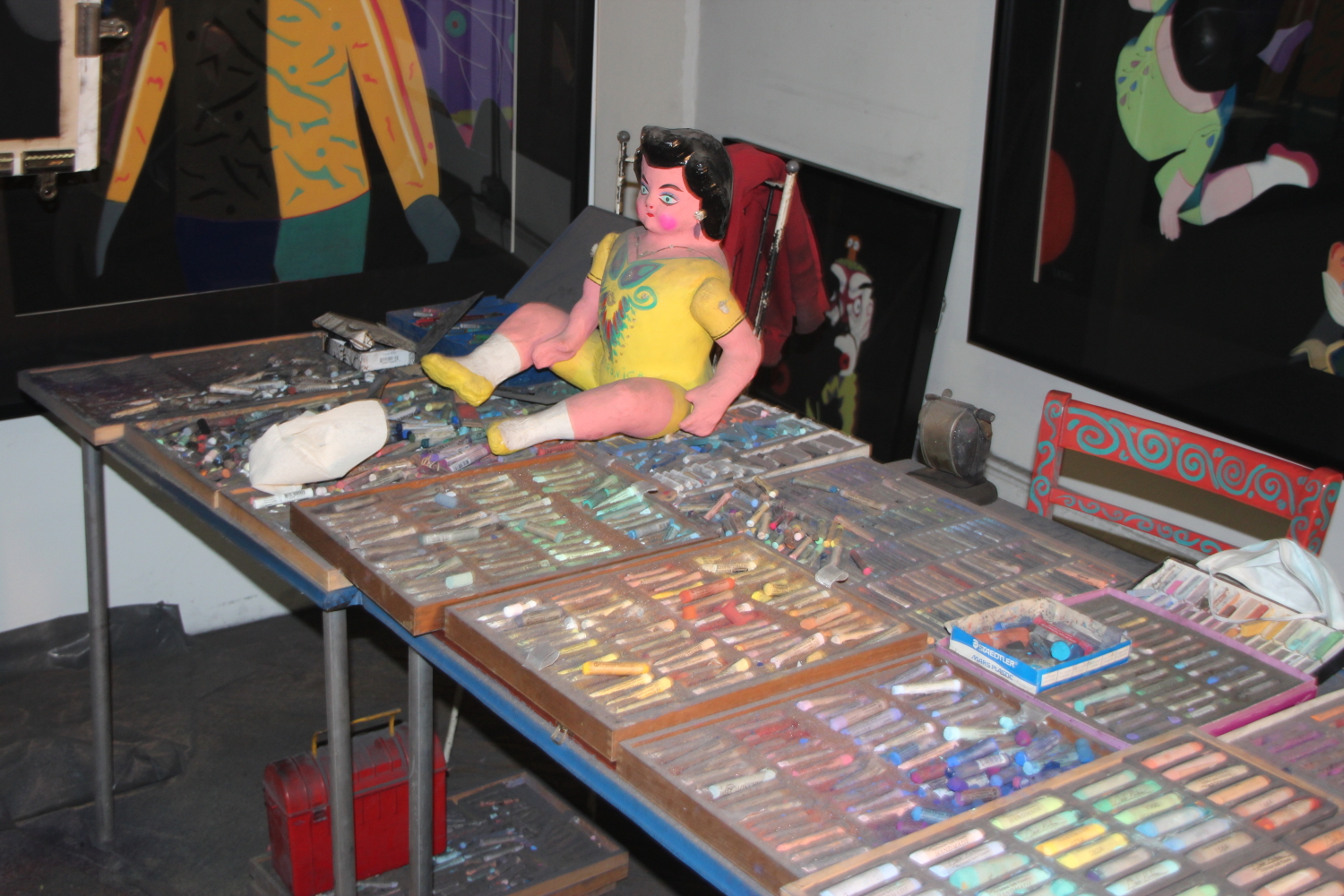
A:  When I set up the figures to photograph for a painting, I work very intuitively, so how I actually cast them in an artwork is difficult to say. Looks count a lot – I select an object and put it in a particular place, look at it, move it or let it stay, and sometimes develop a storyline. I spend time arranging lights and looking for interesting cast shadows. With my first “Domestic Threats” series, all of this was done so that Bryan, my late husband, or I could shoot a couple of negatives with his Toyo Omega 4″ x 5″ view camera.  For  my “Black Paintings” series, begun in 2007, I shoot medium format negatives with a Mamiya 6 camera.

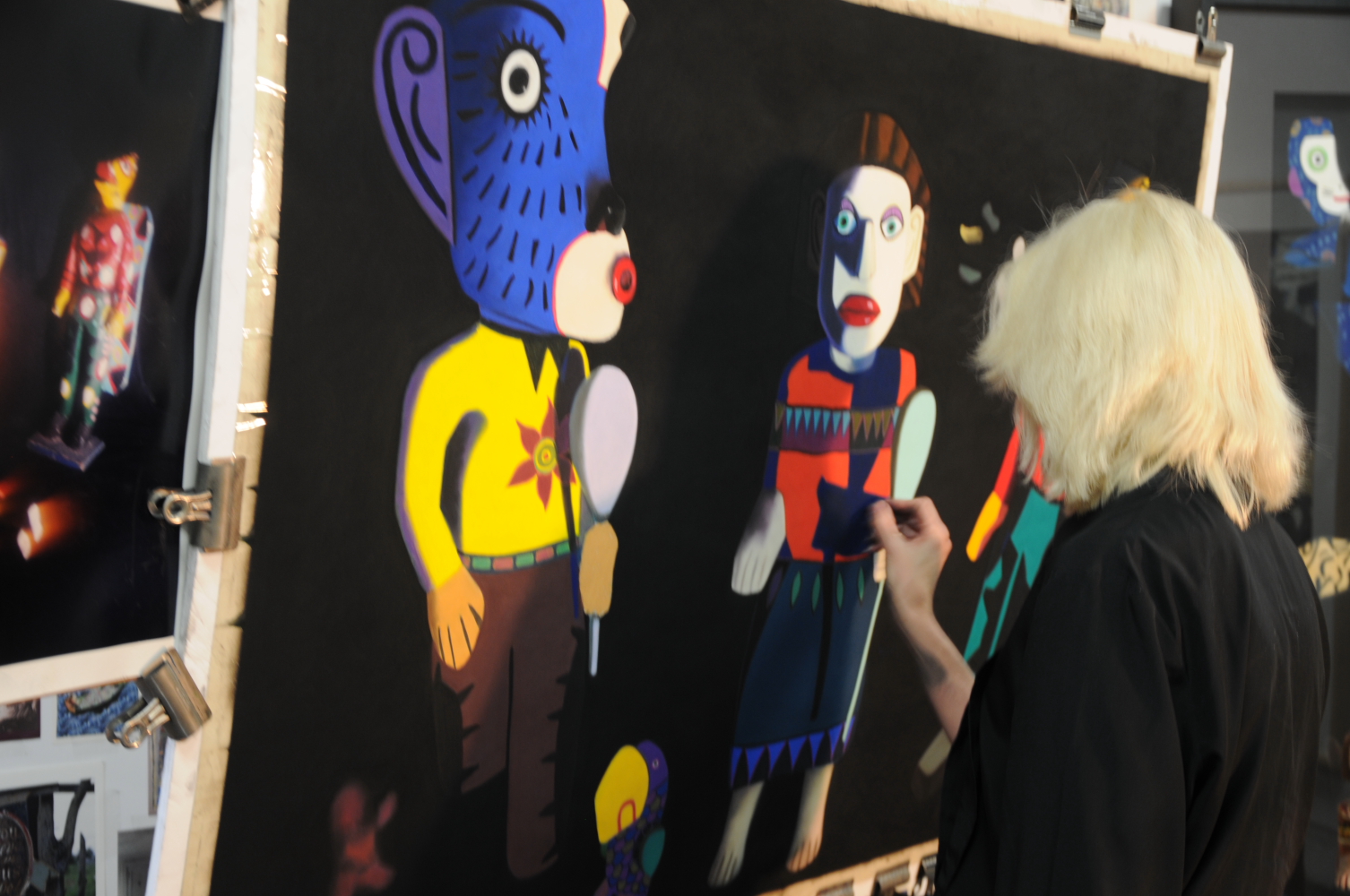
I always look at a 20″ x 24″ photograph for reference as I make a pastel-on-sandpaper painting, plus I also work from the ‘live’ objects.  The photograph is mainly a catalyst because finished paintings are always quite different from their associated reference photos.  Also, since I spend months creating them, the paintings’ interpretative development goes way beyond that of the photo.   

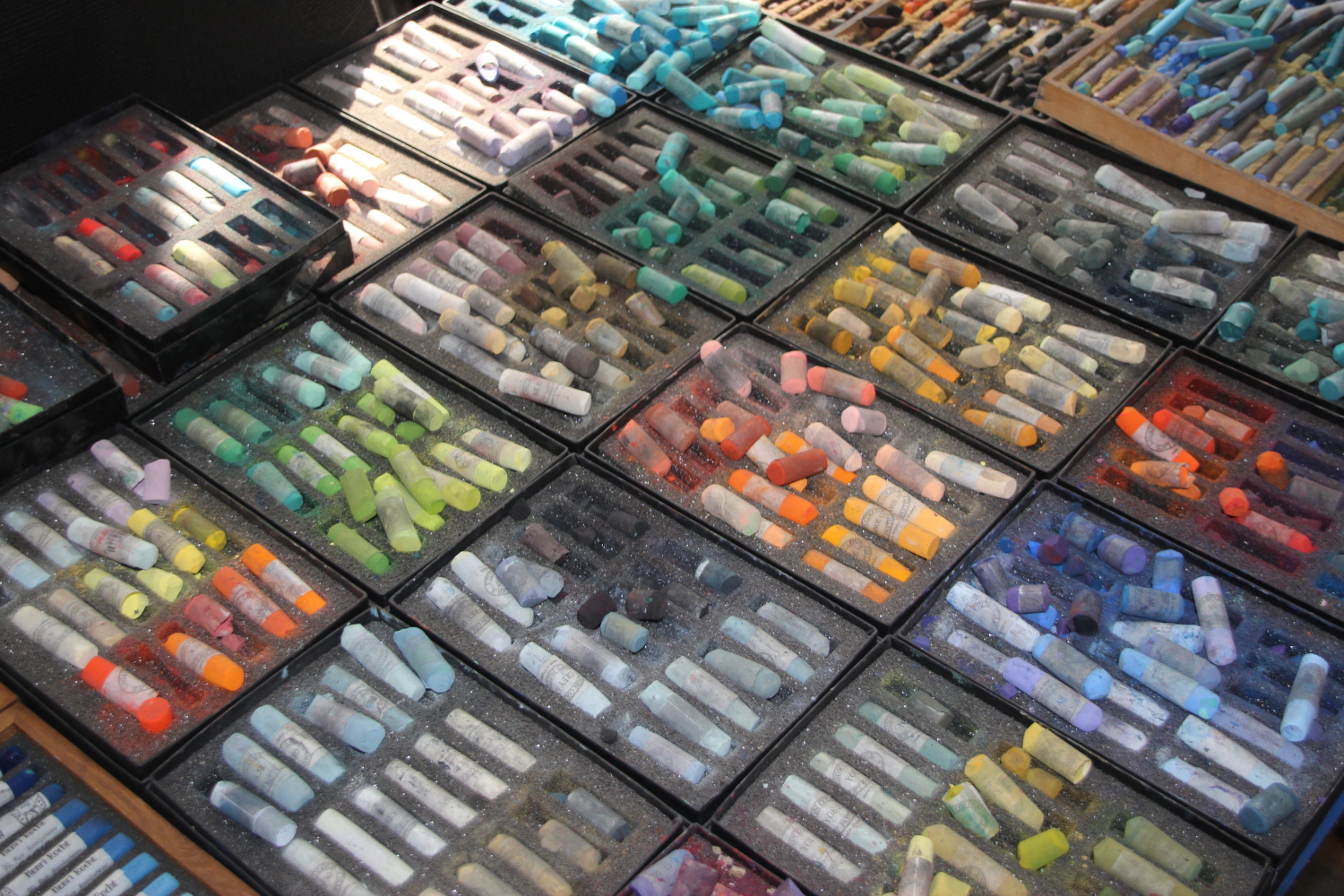
I once completed 6 large (58” x 38”) pastel paintings in a single year, but more recently 4 or 5 per year is common.  It takes approximately 3 months to make each one.  During that time I layer and blend together as many as 25 to 30 layers of pastel. Of course, the colors get more intense as the painting progresses and the pigment accumulates on the sandpaper.

Comments are welcome!