Blog Archives
Q: What’s on the easel today?
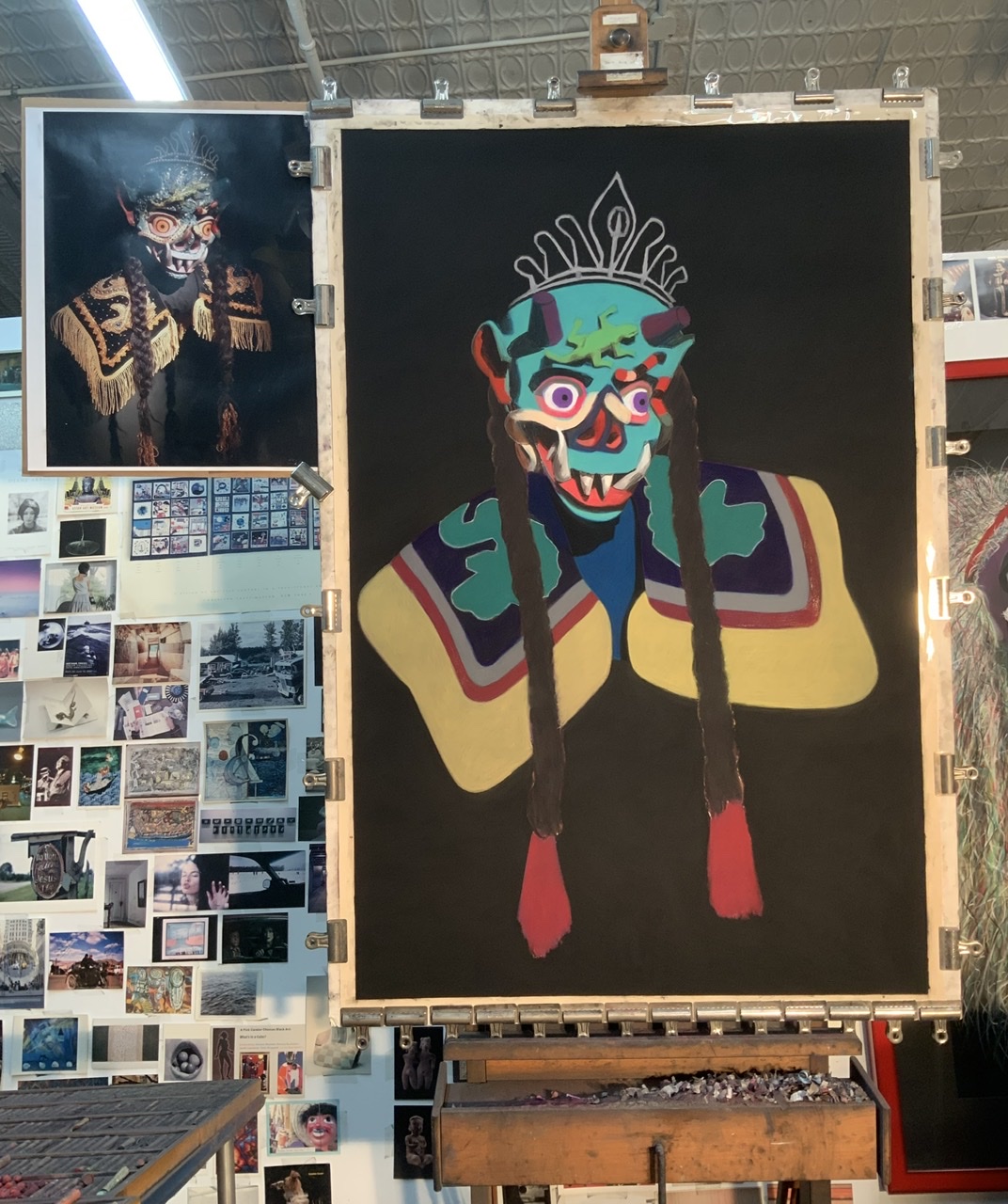
A: I’m working on a 58” x 38” pastel painting that is number 20 in the ”Bolivianos” series. It does not yet have a title. The mask depicted is a Supay. From Wikipedia:
In the Quechua, Aymara, and Inca mythologies, Supay was both the god of death and ruler of the Ukha, Pacha, and the Incan underworld, as well as a race of demons. Supay is associated with miners’ rituals.
With the Spanish colonization of the Americas, Christian priests used the name “Supay” to refer to the Christian Devil. However, unlike Europeans in relation to the Christian Devil, the indigenous people did not repudiate Supay but, being scared of him, they invoked him and begged him not to harm them.
Supay acquired a syncretic symbolism, becoming a main character of the diabladas of Bolivia (seen in the Carnival of Oruro), Peru and other Andean countries. The name Supay is now roughly translated into diablo (Spanish for devil) in most Southern American countries. In some of them, for example the northern region of Argentina, the underworld where Supay rules, is called “Salamanca”.
Comments are welcome!

Pearls from artists* # 483

*an ongoing series of quotations – mostly from artists, to artists – that offers wisdom, inspiration, and advice for the sometimes lonely road we are on.
The editor has a unique relationship with the actors. I never try to go on to the set to see the actors out of costume or out of character – and also just not to see the set. I only want to see what there is on screen. Ultimately, that’s all the audience is ever going to see. Everyone else working on the film at that stage is party to everything going on around the filmed scene: how cold it was when that scene was shot; who was mad at whom; who is in love with whom; how quickly something was done; what was standing just to the left of the frame. An editor particularly has to be careful that those things don’t exert a hidden influence on the way the film is constructed, can (and should in my view) remain ignorant of all that stuff – in order to find value where others might not see value, and on the other hand, to diminish the value of certain things that other people see as too important. It’s one o the crucial functions of the editor. To take, as far as it is possible, the view of the audience, who is seeing the film without any knowledge of all the things that went into its construction.
On Editing Actors, by Walter Murch in The Conversations: Walter Murch and the Art of Editing Film, by Michael Ondaatje
Comments are welcome!
Pearls from artists* # 479
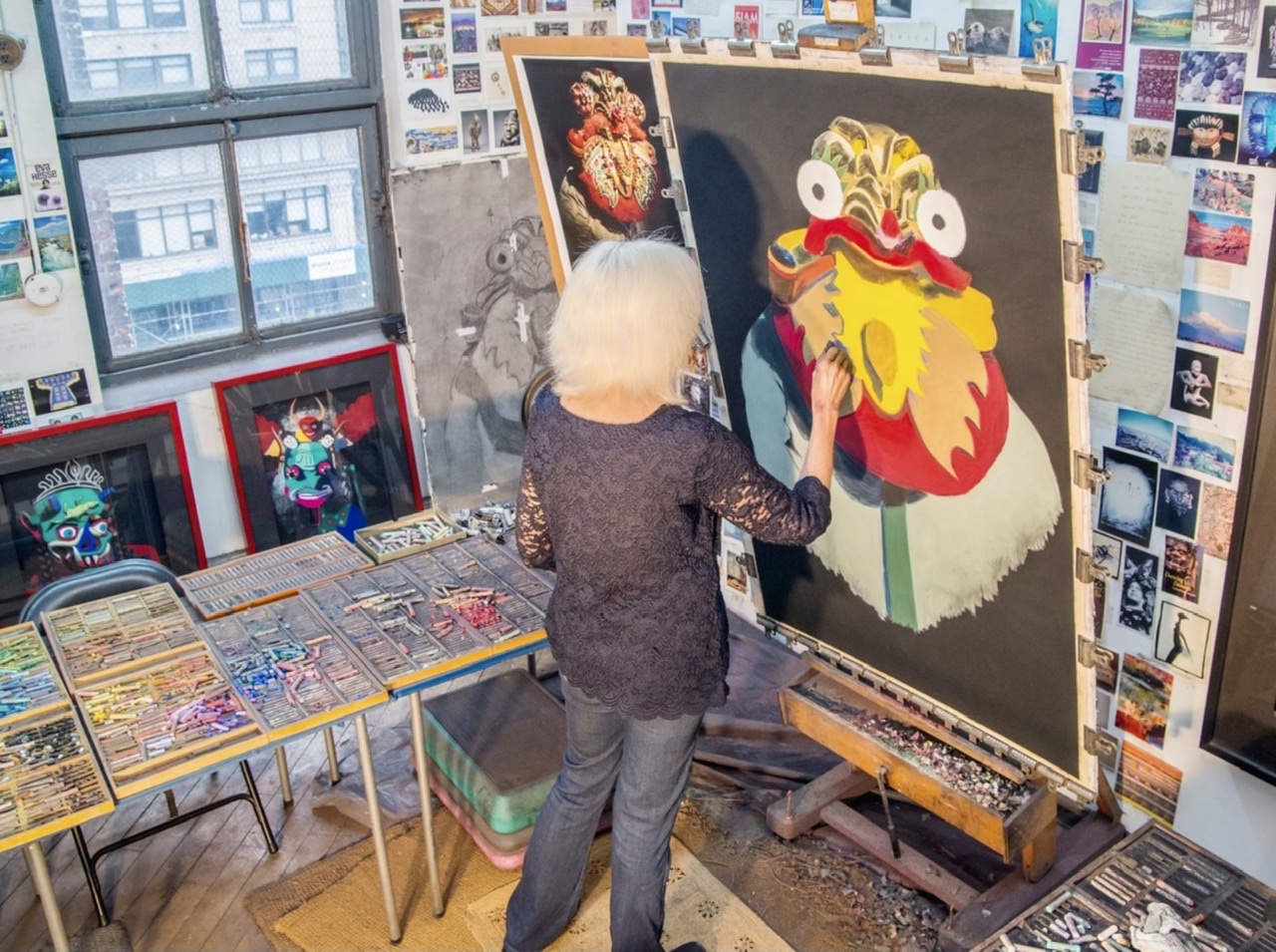
*an ongoing series of quotations – mostly from artists, to artists – that offers wisdom, inspiration, and advice for the sometimes lonely road we are on.
… a gift is a thing we cannot get by our own efforts. We cannot buy it; we cannot acquire it through an act of will. It is bestowed upon us. Thus we rightly speak of talent as a “gift,” for although a talent can be performed through an effort of the will, no effort in the world can cause its initial appearance. Mozart, composing on the harpsicord at the age of four, had a gift.
We also rightly speak of intuition or inspiration as a gift. As the artist works, some portion of his creation is bestowed upon him. An idea pops into his head, a tune begins to play, a phrase comes to mind, a color falls into place on the canvas. Usually, in fact, the artist does not find himself engaged or exhilarated by the work, nor does it seem authentic, until this gratuitous element has appeared so that along with any true creation comes the uncanny sense that “I,” the artist, did not make the work. “Not I, not I, but the wind that blows through me,” says D.H. Lawrence. Not all artists emphasize the gift phase of their creations to the degree Lawrence does, but all artists feel it.
Lewis Hyde in The Gift: Imagination and the Erotic Life of Property
Comments are welcome!
Q: Who is your core audience for your blog? What do you want people to know about your art that you have not created visually? (Question from “Arte Realizzata”)

A: As I understand it, my core audience here (currently 77,000+ and growing!) is an international group of artists and art aficionados looking for hope, inspiration, and probably, motivation to keep making art. Unfortunately, ours is a world that too often misunderstands and under-appreciates the difficult, essential, and sometimes lonely work undertaken by artists. Hopefully, my blog makes readers think, “If Barbara can keep making art under these conditions and continue to thrive after what she’s been through, maybe I can, too!”
Comments are welcome!
Pearls from artists* # 478

*an ongoing series of quotations – mostly from artists, to artists – that offers wisdom, inspiration, and advice for the sometimes lonely road we are on.
Artists, because of the demands of their personality, their sense of personal mission, and their need to create or perform, are driven people. Mixed with the love of work can be a terrible pressure to work. For many artists, and especially for the most productive ones, the line between love and obsession and between love and compulsion blurs or disappears entirely. Are such artists free or are they slaves to their work?
In The Artist and Society the psychiatrist Lawrence Hatterer said of such an artist:
His most recognizable trait is his recurring daily preoccupation with translating artistic activity into accomplishment. The consuming intensity of this artistic pursuit brooks no interference or obstacles. His absorption with the creative act is such that he experiences continually what the average artist feels only infrequently when he reaches unusual levels of creative energy with accompanying output. He appears to be incapable of willful nonproductivity.
This is Picasso working for 72 hours straight. This is van Gogh turning out 200 finished paintings during his 444 days in Arles. The artist who is “incapable of willful nonproductivity” is a workaholic for whom little in life, apart from his artistic productivity and accomplishment, may have any meaning.
Eric Maisel in A Life in the Arts: Practical Guidance and Inspiration for Creative and Performing Artists
Comments are welcome!
Pearls from artists* # 476
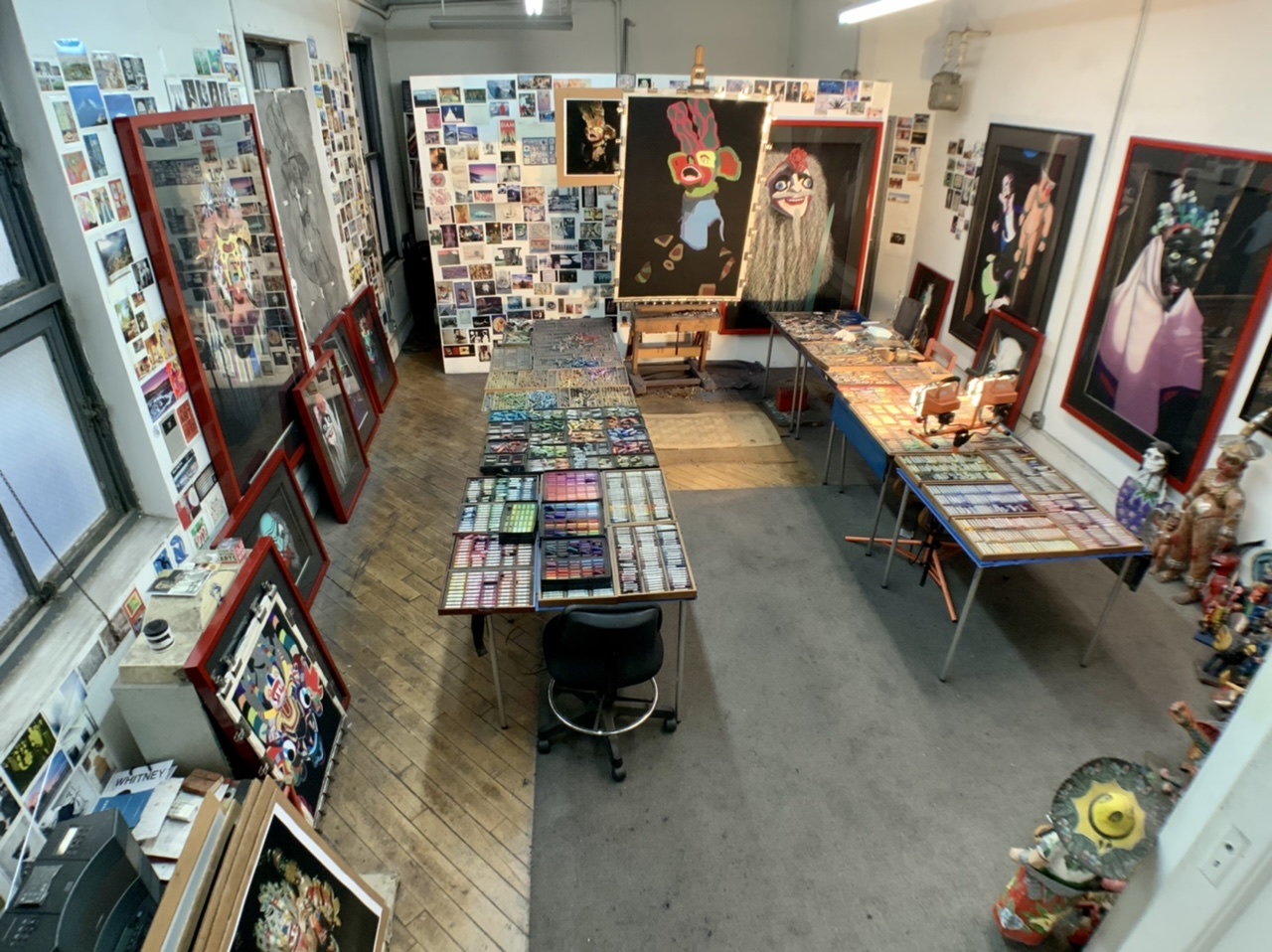
*an ongoing series of quotations – mostly from artists, to artists – that offers wisdom, inspiration, and advice for the sometimes lonely road we are on.
For a great many artists solitude is the time when they feel most real and alive. It is when they have their most intense experiences, when they can vicariously live out any adventure, any dream. Tennessee Williams said, “I’m only really alive when I’m writing.” The painter Robert Motherwell wrote, “I feel most real to myself in the studio.” The young, exuberant Russian painter Marie Bashkirtseff exclaimed at the end of the last century:
In the studio all distinctions disappear. One has neither name nor family; one is no longer the daughter of one’s mother, one is oneself and individual, and one has before one art, and nothing else. One feels so happy, so free, so proud!
We may think of his aliveness as the accumulation of al the above-listed benefits, as the artist working out her life, manifesting her creativity, suiting her personality, playing, avoiding unwanted social interactions, working authentically and integrity, living intensely – as the artist being her grandest self.
Eric Maisel in A Life in the Arts: Practical Guidance and Inspiration for Creative and Performing Artists
Comments are welcome!
Pearls from artists* # 475

*an ongoing series of quotations – mostly from artists, to artists – that offers wisdom, inspiration, and advice for the sometimes lonely road we are on.
In order to warm the artist’s heart, it’s necessary to assert that he is doing good work. Random or wrong-headed praise won’t do the trick, but will only exacerbate the artist’s feeling that he is unseen and misunderstood.
Even wrong-headed praise is the exception rather than the rule in the artist’s search for recognition. More often than not your recognition will consist of criticism, not praise. You may be criticized for not attempting work you have no desire to attempt, for pandering to mass taste, for working too exotically or too narrowly… You may be attacked in a mixed review that purports to praise you. In short, you may be criticized for everything and anything under the sun.
Can you escape this criticism as you struggle for recognition? No. The journalist Elbert Hubbard said, “To escape criticism, do nothing, say nothing, be nothing.” … you can’t escape criticism, you can’t tame your critics.
Eric Maisel in A Life in the Arts: Practical Guidance and Inspiration for Creative and performing Artists
Comments are welcome!
Pearls from artists* # 461

*an ongoing series of quotations – mostly from artists, to artists – that offers wisdom, inspiration, and advice for the sometimes lonely road we are on.
I must not eat much in the evening, and I must work alone. I think that going into society from time to time, or just going out and seeing people, does not do much harm to one’s work and spiritual progress, in spite of what many so-called artists say to the contrary. Associating with people of that kind is far more dangerous; their conversation is always commonplace. I must go back to being alone. Moreover, I must try to live austerely, as Plato did. How can one keep one’s enthusiasm concentrated on a subject when one is always at the mercy of other people and in constant need of their society? Dufresne was perfectly right; the things we experience for ourselves when we are alone are much stronger and much fresher. However pleasant it may be to communicate one’s emotion to a friend there are too many fine shades of feeling to be explained, and although each probably perceives them, he does so in his own way and thus the impression is weakened for both. Since Dufresne has advised me to go to Italy alone, and to live alone once I am settled there, and since I, myself, see the need for it, why not begin now to become accustomed to the life; all the reforms I desire will spring from that? My memory will return, and so will my presence of mind, and my sense of order.
The Journal of Eugene Delacroix edited by Hubert Wellington
Comments are welcome!
Q: What’s on the easel today?
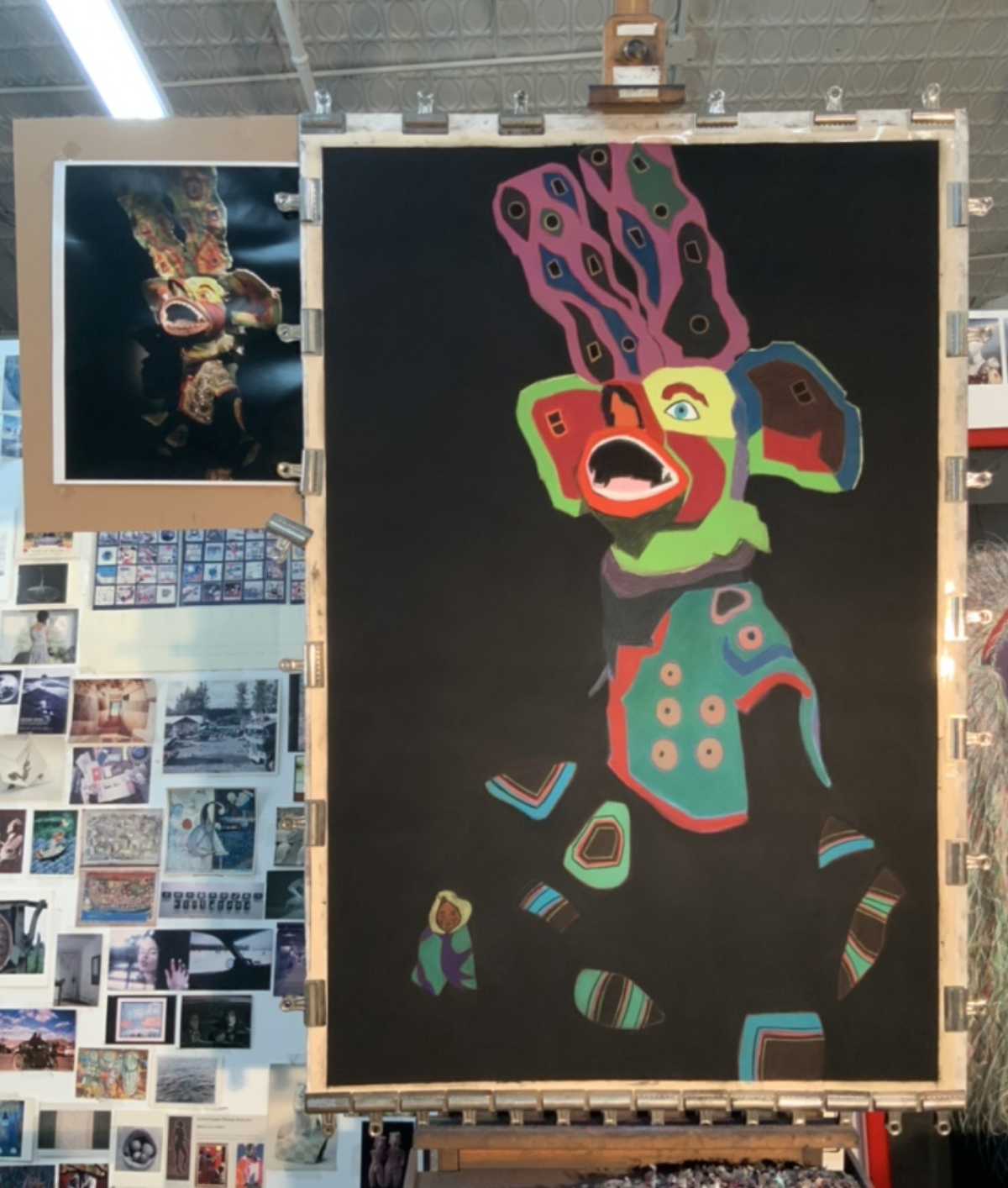
A: I continue slowly working on an untitled 58” x 38” pastel-on-sandpaper painting that is part of the acclaimed “Bolivianos” series.
Comments are welcome!


 barbararachkoscoloreddust.com