Blog Archives
Pearls from artists* # 514
*an ongoing series of quotations – mostly from artists, to artists – that offers wisdom, inspiration, and advice for the sometimes lonely road we are on
Basically I am trying not to stagnate. I go this way and I go that way and I don’t know where I’m going next. But if I should get stagnant, I’d lose my interest.
There are so many things to be considered when making music. The whole question of life itself; my life in which there are many things on which I don’t think I’ve reached a final conclusion; there are matters I don’t think I’ve covered completely, and all these things have to be covered before you make your music sound any way. You have to grow to know.
When I was younger, I didn’t think this would happen, but now I know that I’ve still got a long way to go. Maybe when I’m sixty I’ll be satisfied with what I’m doing, but I don’t know… I’m sure that later on my ideas will carry more conviction.
I know that I want to produce beautiful music, music that does things to people that they need. Music that will uplift and make them happy – those are the qualities I’d like to produce.
Coltrane on Coltrane: The John Coltrane Interviews, edited by Chris DeVito
Comments are welcome!
Pearls from artists* # 506

*an ongoing series of quotations – mostly from artists, to artists – that offers wisdom, inspiration, and advice for the sometimes lonely road we are on.
Inspiration is allowed to do whatever it wants to, in fact, and it is never obliged to justify its motives to any of us. (As far as I’m concerned, we’re lucky that inspiration talks to us at all; it’s too much to ask that it also explain itself).
In the end, it’s all about violets trying to come to light.
Don’t fret about the irrationality and unpredictability of all this strangeness. Give in to it. Such is the bizarre, unearthly contract of creative living. There is no theft; there is no ownership; there is no tragedy; there is no problem. There is no time or space where inspiration comes from – and also no competition, no ego, no limitations. There is only the stubbornness of the idea itself, refusing to stop searching until it has found an equally stubborn collaborator. (Or multiple collaborators, as the case may be).
Work with that stubbornness.
Work with it as openly and trustingly and diligently as you can.
Work with all your heart, because – I promise – if you show up for your work day after day after day after day, you just might get lucky enough some random morning to burst right into bloom.
Elizabeth Gilbert in Big Magic: Creative Living Beyond Fear
Comments are welcome!
Pearls from artists* # 494
*an ongoing series of quotations – mostly from artists, to artists – that offers wisdom, inspiration, and advice for the sometimes lonely road we are on.
Emile Cartailhac was a man who could admit when he was wrong. This was fortunate, because in 1902 the French prehistorian found himself writing an article for L’Anthropolgie in which he did just that. In “Mea culpa d’un sceptique” he recanted the views he had spent the previous 20 years forcefully and scornfully maintaining: that prehistoric man was incapable of fine artistic expression and that the cave paintings found in Altmira, northern Spain, were forgeries.
The Paleothithic paintings at Altamira, which were produced around 14,000 B.C., were the first examples of prehistoric cave art to be officially discovered. It happened by chance in 1879, when a local landowner and amateur archaeologist was busily brushing away at the floor of the caves, searching for prehistoric tools. His nine-year-old daughter, Maria Sanz de Sautuola – a grave little thing with cropped hair and lace-up booties – was exploring farther on when she suddenly looked up, exclaiming, “Look, Papa, bison!” She was quite right: a veritable herd, subtly colored with black charcoal and ocher, ranged over the ceiling. When her father published the finding in 1880, he was met with ridicule. The experts scoffed at the very idea that prehistoric man – savages really – could have produced sophisticated polychrome paintings. The esteemed Monsieur Cartailhac and the majority of his fellow experts, without troubling to go and see the cave for themselves, dismissed the whole thing as a fraud. Maria’s father died, a broken and dishonored man, in 1888, four years before Cartailhac admitted his error.
After the discovery of many more caves and hundreds of lions, handprints, horses, women, hyenas, and bison, the artistic abilities of prehistoric man are no longer in doubt. It is thought that these caves were painted by shamans trying to charm a steady supply of food for their tribes. Many were painted using the pigment most readily available in the caves at the time: the charred stick remnants of their fires. At its simplest, charcoal is the carbon-rich by-product of organic matter – usually wood – and fire. It is purest and least ashy when oxygen has been restricted during it’s heating.
In The Secret Lives of Color by Kassia St. Clair
Comments are welcome!
Pearls from artists* # 491
*an ongoing series of quotations – mostly from artists, to artists – that offers wisdom, inspiration, and advice for the sometimes lonely road we are on.
We look at ancient Egyptian painting today and may find it slightly comic, but what the Egyptians were trying to do with the figure was reveal the various aspects of the person’s body in the most characteristic aspect. The face is in profile because that reveals the most about the person’s face, but the shoulders are not in profile, they’re facing the viewer, because that’s the most revealing angle for the shoulders. The hips are not in profile, but the feet are. It gives a strange, twisted effect, but it was natural to the Egyptians. They were painting essences, and in order to paint an essence you have to paint it from its most characteristic angle. So they would simply combine the various characteristic essences of the human body. This was a piece of spiritual art. It wasn’t trying to reproduce photographic reality, it was trying to reproduce and combine all the essential features of a person within one figure.
Walter Murch in The Conversations: Walter Murch and the Art of Editing Film by Michael Ondaatje
Comments are welcome!
Pearls from artists* # 485
*an ongoing series of quotations – mostly from artists, to artists – that offers wisdom, inspiration, and advice for the sometimes lonely road we are on.
[Michael] Ondaatje: It’s an odd thing: I’ve heard you talk about the importance of ambiguity in film, and the need to save that ambiguous quality which exists in a book or painting, and which you think a film does not often have. And at the same time in a mix you are trying to “perfect” that ambiguity.
[Walter] Murch: I know. It’s a paradox. And one of the most fruitful paradoxes, I think, is that even when the film is finished, there should be unsolved problems. Because there’s another stage, beyond the finished film: when the audience views it. You want the audience to be co-conspirators in the creation of this work, just as much as the editor or the mixers or the cameraman or actors are. If by some chemistry you actually did remove all ambiguity in the final mix – even though it had been ambiguous up to that point – I think you would do the film a disservice. But the paradox is that you have to approach every problem as if it’s desperately important to solve it. You can’t say, I don’t want to solve this because it’s got to be ambiguous. If you do that, then there’s a sort of hemorrhaging of the organism.
O: And more of a confusion.
M: Yes. I keep thinking about it, and it’s a wonderful dilemma: you have to acknowledge that there must be unsolved problems at each stage. As hard as you work, you must have this secret, unspoken hope that one very significant problem will remain unsolved. But you never know what that will be until the film is done. You can almost define a film by the problem it poses, that it can’t answer itself, that it asks the audience to solve.
The Conversations: Walter Murch and the Art of Editing Film by Michael Ondaatje
Comments are welcome!
Q: What’s on the easel today?

A: I’m trying to decide if “Impresario,” soft pastel on sandpaper, 58” x 38,” is finished. Pastel paintings are pronounced ’finished’ when every detail is as good as I can make it. I still need to give this one a final look-over.
Comments are welcome!
Pearls from artists* # 185
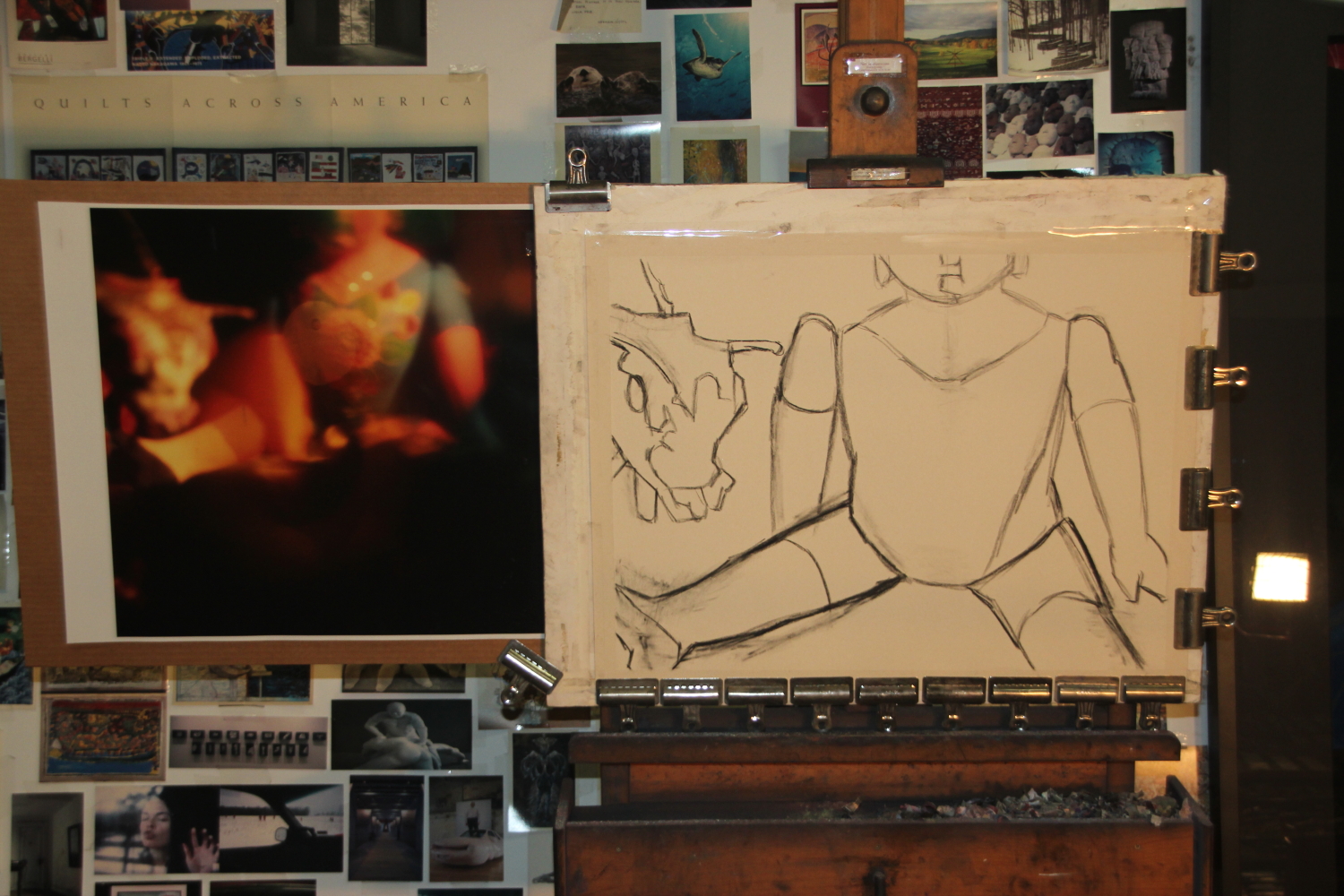
Beginning of a 20″ x 26″ pastel painting
* an ongoing series of quotations – mostly from artists, to artists – that offers wisdom, inspiration, and advice for the sometimes lonely road we are on.
All of us fail to match our dream of perfection. So I rate us on the basis of our splendid failure to do the impossible. In my opinion, if I could write all my work again, I am convinced that I would do it better, which is the healthiest condition for an artist. That’s why he keeps on working, trying again; he believes each time that this time he will do it, bring it off. Of course he won’t, which is why this condition is healthy. Once he did it, once he matched the work to the image, the dream, nothing would remain but to cut his throat, jump off the other side of that pinnacle of perfection into suicide. I’m a failed poet. Maybe every novelist wants to write poetry first, finds he can’t, and then tries the short story, which is the most demanding after poetry. And failing at that, only then does he take up novel writing.
William Faulkner in Writers at Work: The Paris Review Interviews First Series
Comments are welcome!
Pearls from artists* # 182

Hudson Yards, NYC
* an ongoing series of quotations – mostly from artists, to artists – that offers wisdom, inspiration, and advice for the sometimes lonely road we are on.
Maybe you know exactly what you dream of being. Or maybe you’re paralyzed because you have no idea what your passion is. The truth is, it doesn’t matter. You don’t have to know. You just have to keep moving forward. You just have to keep doing something, seizing the next opportunity, staying open to trying something new. It doesn’t have to fit your vision of the perfect job or the perfect life. Perfect is boring, and dreams are not real. Just… DO. You think, “I wish I could travel” – you sell your crappy car and buy a ticket and go to Bangkok right now. I’m serious. You say, “I want to be a writer” – guess what? A writer is someone who writes every day. Start writing. Or: You don’t have a job? Get one. ANY JOB. Don’t sit at home waiting for the magical dream opportunity. Who are you? Prince William? No. Get a job. Work. Do until you can do something else.
Commencement address to Dartmouth College, Shonda Rhimes in Year of Yes: How to Dance It Out, Stand in the Sun and Be Your Own Person
Comments are welcome!
Pearls from artists* # 179
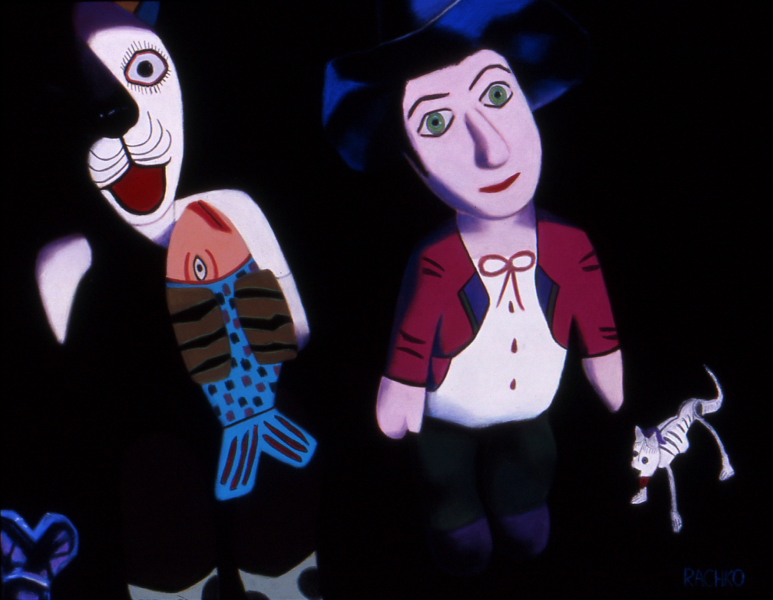
“Offering,” soft pastel on sandpaper, 20″ x 26″
* an ongoing series of quotations – mostly from artists, to artists – that offers wisdom, inspiration, and advice for the sometimes lonely road we are on.
Michael Kimmelman: You studied art in school. You started collecting early.
David Bowie: Yeah, I collected very early on. I have a couple of Tintorettos, which I’ve had for many, many years. I have a Rubens. Art was, seriously, the only thing I’ve ever wanted to own. It has always been for me a stable nourishment. I use it. It can change the way that I feel in the mornings. The same work can change me in different ways, depending on what I’m going through. For instance, somebody I like very much is Frank Auerbach. I think there are some mornings that if we hit each other a certain way – myself and a portrait by Auerbach – the work can magnify the kind of depression I’m going through. It will give spiritual weight to the angst. Some mornings I’ll look at it and go: “Oh, God, Yeah! I know!” But that same painting, on a different day, can produce in me the incredible feeling of the triumph of trying to express myself as an artist. I can look at it and say: “My God, Yeah! I want to sound like that looks.”
“At Heart an Artist with Many Muses,” by Michael Kimmelman, The New York Times, Friday, January 15, 2016
Comments are welcome!


 barbararachkoscoloreddust.com
Q: I understand your comments to mean that being at the studio challenges you to be your best. How (why) do you think that works? (Question from Nancy Nikkal)
Aug 8
Posted by barbararachkoscoloreddust
“Avenger,” soft pastel on sandpaper, 58″ x 38″
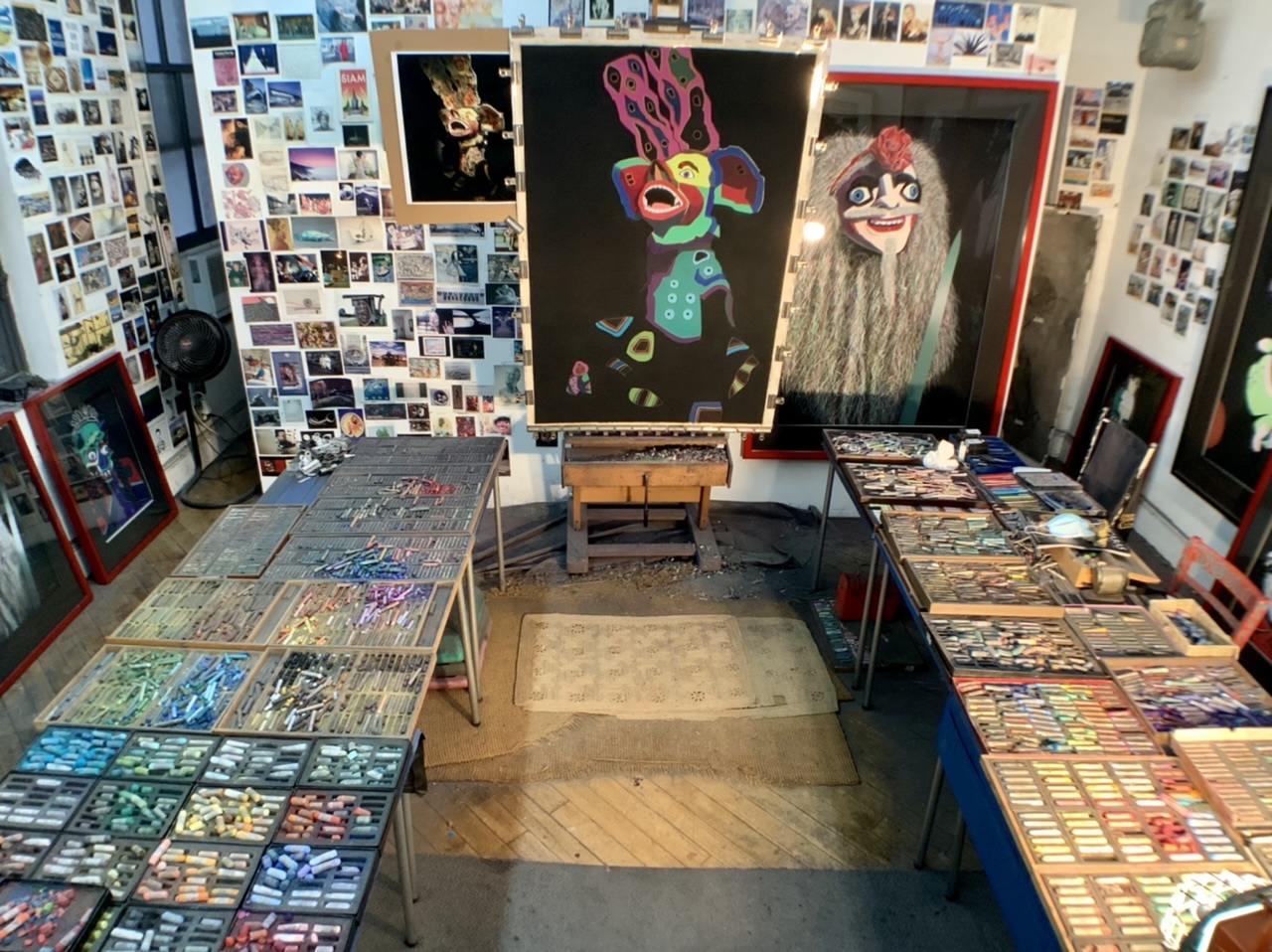
A: I am always trying to push my pastel techniques further, seeking to figure out new ways to render my subject matter, expanding my technical vocabulary. It would be monotonous to keep working the same old way. Wasn’t it John Baldessari who said, “No more boring art?” He was talking about art that’s boring to look at. Well, as someone who CREATES art I don’t want to be bored during the making so I keep challenging myself. I love learning, in general, and I especially love learning new things about soft pastel.
Very often I start a project because I have no idea how to depict some particular subject using pastel. For example, one of the reasons I undertook “Avenger” was to challenge myself to render all of that hair! Eventually I managed to figure it out and I learned a few new techniques in the process.
Comments are welcome!
Share this:
Posted in 2020, An Artist's Life, Bolivianos, Creative Process, Pastel Painting, Working methods
2 Comments
Tags: always, “Avenger”, ”No more boring art”, challenge, comments, creates, depict, eventually, expending, figure out, further, John Baldessari, learning, making, managed, matter, monotonous, myself, Nancy Nikkal, particular, pastel, process, project, reasons, render, seeking, soft pastel, soft pastel on sandpaper, Studio, subject, talking, technical, techniques, trying, understand, undertook, vocabulary, working