Blog Archives
Pearls from artists* # 612
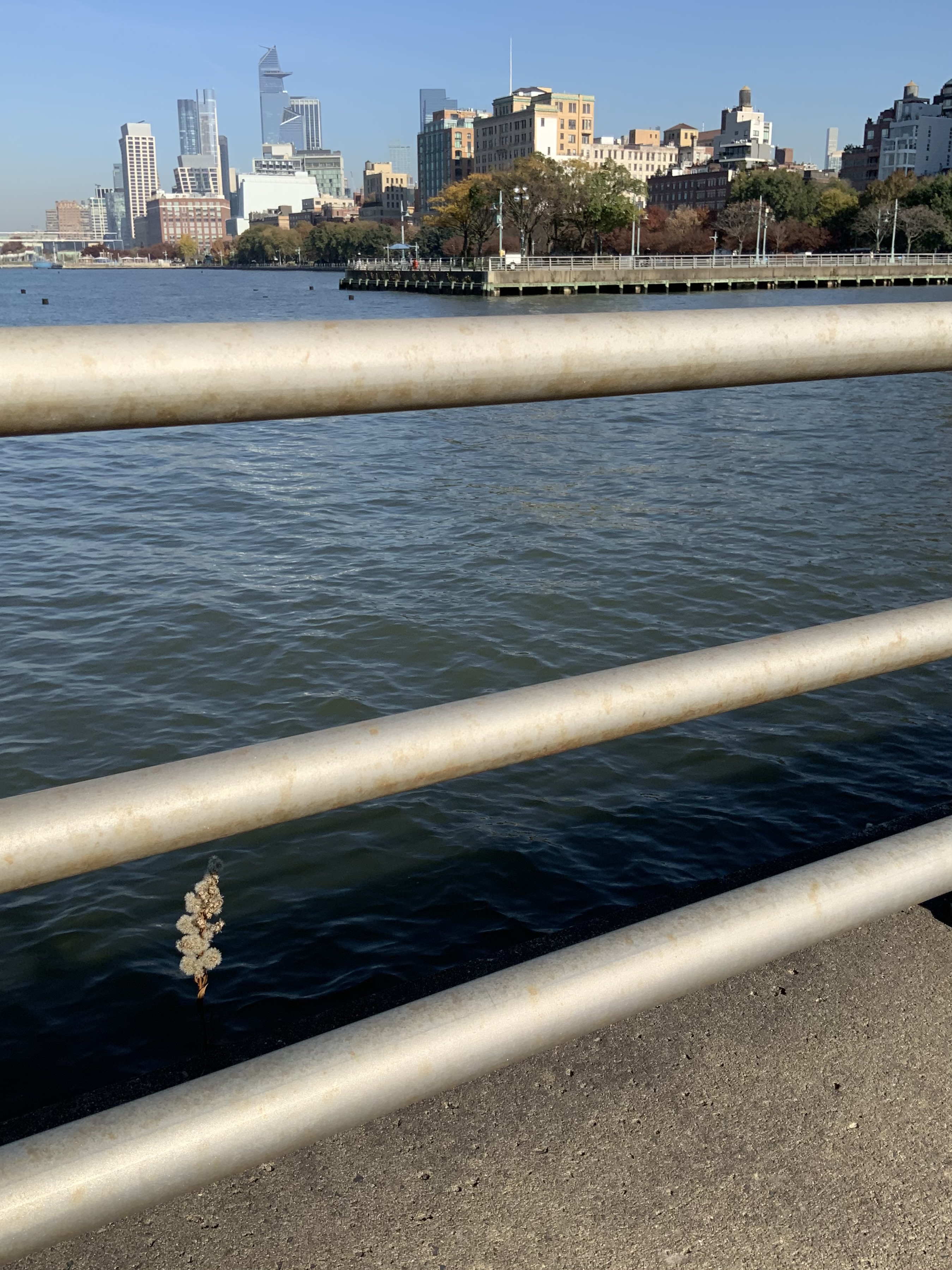
New York, NY
*an ongoing series of quotations – mostly from artists, to artists – that offers wisdom, inspiration, and advice for the sometimes lonely road we are on.
It is the poet and philosopher who provide the community of objectives in which the artist participates. Their chief preoccupation, like the artist, is the expression in concrete form of their notions of reality. Like him, they deal with verities of time and space, life and death, and the heights of exaltation as well as the depths of despair. The preoccupation with these external problems creates a common ground which transcends the disparity of the means used to achieve them. And it is in the language of the philosopher and poet or, for that matter, of other arts which share the same objective that we must speak if we are to establish some verbal equivalent of the significance of art.
Let us not for a moment conceive that the language of one is interchangeable with that of the other: that one can duplicate the sense of a picture by the sense of words or sounds, or that one can translate the truth of words by means of pictorial delineations. Not all odes of Pindar, framed and embroidered, could duplicate the portrayal by Apelles’ brush of the Hero of the Palaestra. The Pandemonium of Milton or Dante’s Inferno can never replace the vision of the Last Judgment by either Michelangelo or Signorelli. No more so than the Pastoral Symphony of Beethoven can be apprehended through the reading of idyllic poems, augmented by descriptions of woodland and fields, of torrents and streams, the study of ornithological sounds, and the laws of harmonics. Neither books on jurisprudence, nor costume plates, can possibly reconstruct Raphael’s School of Athens. And the man who knows a book or a picture through its critics, whatever his experience, has no experience of the art itself. The truth, the reality of each, is confined within its own boundaries and must be perceived in terms of the means generic to itself.
In speaking of art here, there is no thought of recreating the experience of the picture. If we compare one art to another, it is not with the intention of contrasting their actuality, but to speak rather of the motivations and properties such as are admissible to the world of verbal ideas. And if… we are partial to the philosopher – at the expense of those others who share with the artist his common objectives, it is not because we divine in his effort a greater sympathy to the artist, but because philosophy shares with art it’s preoccupation with ideas in the terms of logic.
Mark Rothko in The Artist’s Reality: Philosophies of Art
Comments are welcome!
Pearls from artists* # 543

*an ongoing series of quotations – mostly from artists, to artists – that offers wisdom, inspiration, and advice for the sometimes lonely road we are on.
Although the struggles that I faced involved me as an individual, I didn’t feel alone. I was forbidden to travel, but this forced immobility didn’t adversely affect my work; instead it gave me sustenance. For me, inspiration comes from resistance – without that, my efforts would be fruitless. Having a real – and powerful – adversary was my good fortune, making freedom all the more tangible – freedom comes from all the sacrifices you make to achieve it. Limitations come only from a fear inside the heart, and art is the antidote to fear. I did not need sympathy, for courage itself is an aesthetic feeling, and it’s only when true feeling is transformed into something broadly understood that art can avoid drying up.
Ai Weiwei in 1000 Years of Joys and Sorrows
Comments are welcome!
Pearls from artists* # 434
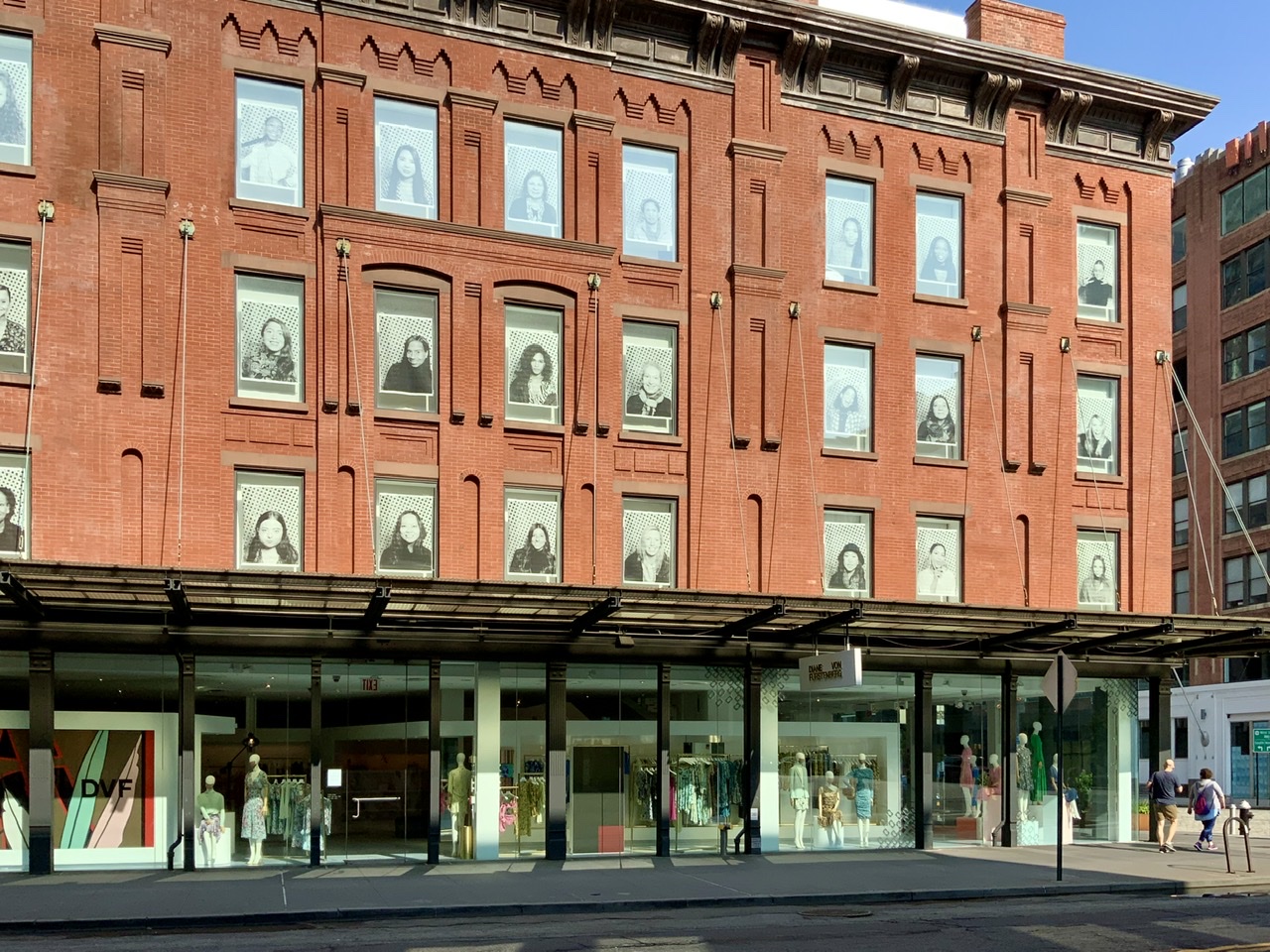
West Village, NYC
*an ongoing series of quotations – mostly from artists, to artists – that offers wisdom, inspiration, and advice for the sometimes lonely road we are on.
What do we carry forward? My family lived in New Jersey near Manhattan until I was ten, and although I have enjoyed spending my adult life as a photographer in the American West, when we left New Jersey for Wisconsin in 1947 I was homesick.
The only palliative I recall, beyond my parents’ sympathy was the accidental discovery in a magazine of pictures by a person of whom I had never heard but of scenes I recognized. The artist was Edward Hopper and one of the pictures was of a woman sitting in a sunny window in Brooklyn, a scene like that in the apartment of a woman who had cared for my sister and me. Other views resembled those I recalled from the train to Hoboken. There was also a picture inside a second-floor restaurant, one strikingly like the restaurant where my mother and I occasionally had lunch in New York.
The pictures were a comfort but of course none could permanently transport me home. In the months that followed, however, they began to give me something lasting, a realization of the poignancy of light. With it, all pictures were interesting.
Robert Adams in Art Can Help
Pearls from artists* # 400

In the studio with friends
* an ongoing series of quotations – mostly from artists, to artists – that offers wisdom, inspiration, and advice for the sometimes lonely road we are on.
A student in the audience raised her hand and asked me:
“Why should I live?”
… In the very act of asking that question, you are seeking reasons for your convictions, and so you are committed to reason as the means to discover and justify what is important to you. And there are so many reasons to live!
As a sentient being, you have the potential to flourish. You can refine your faculty of reason itself by learning and debating. You can seek explanations of the natural world through science, and insight into the human condition through the arts and humanities. You can make the most of your capacity for pleasure and satisfaction, which allowed your ancestors to thrive and thereby allowed you to exist. You can appreciate the beauty and the richness of the natural and cultural world. As the heir to billions of years of life perpetuating itself, you can perpetuate life in turn. You have been endowed with a sense of sympathy – the ability to like , love, respect, help, and show kindness – and you can enjoy the gift of mutual benevolence with friends, family, and colleagues.
And because reason tells you that none of this is particular to you, you have the responsibility to provide to others what you expect for yourself. You can foster the welfare of other sentient beings by enhancing life, health, knowledge, freedom, abundance, safety, beauty, and peace. History shows that when we sympathize with others and apply our ingenuity to improving the human condition, we can make progress in doing so, and you can help to continue that progress.
Stephen Pinker in Enlightenment Now: The Case for Reason, Science, Humanism, and Progress
Comments are welcome!
Pearls from artists* # 108
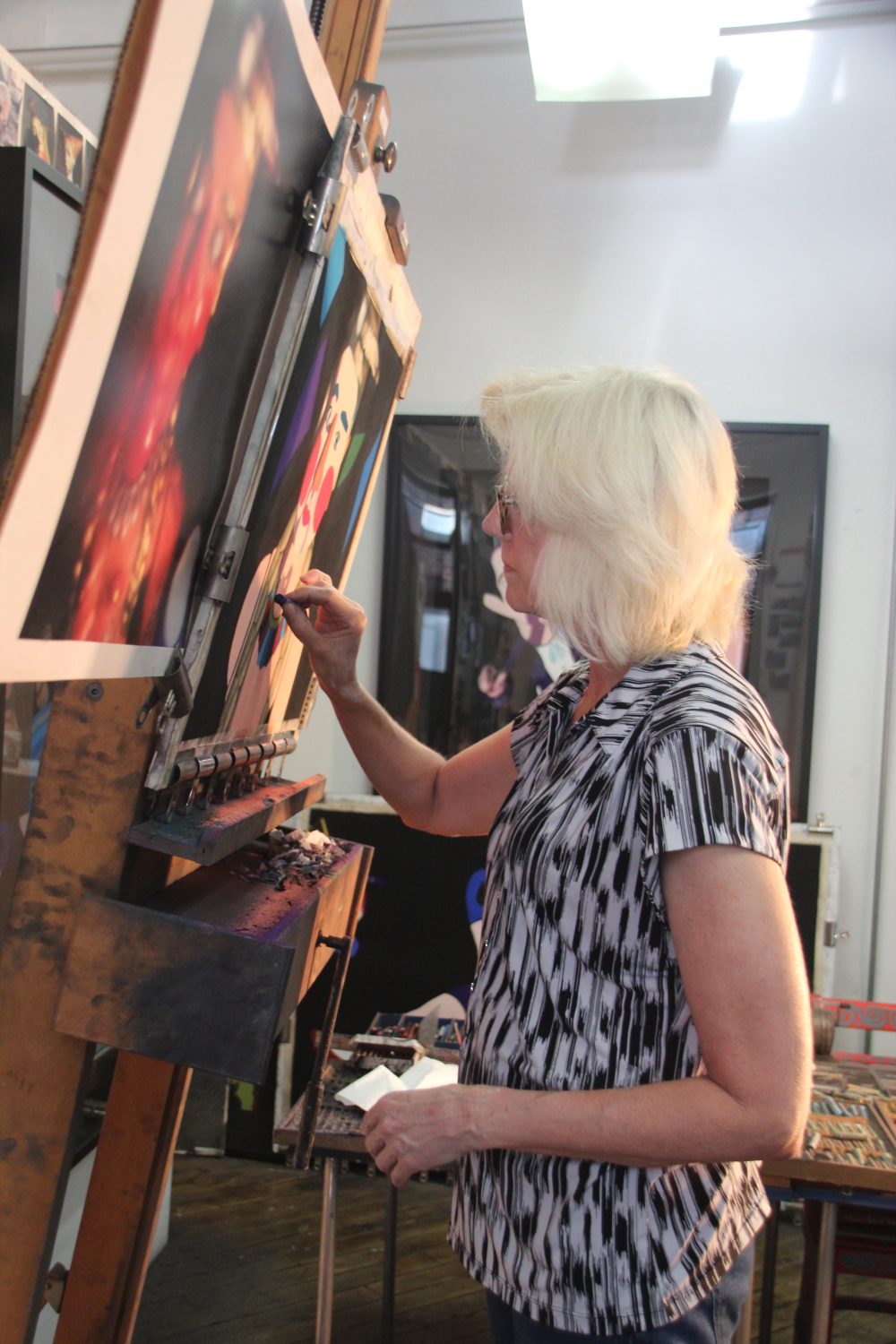
At work on a pastel painting
* an ongoing series of quotations – mostly from artists, to artists – that offers wisdom, inspiration, and advice for the sometimes lonely road we are on.
Artists generally need privacy in order to create, and as I’ve noted, what constitutes adequate privacy varies by person and time. Solitude quickly becomes isolation when it oversteps one’s desires. But most artists need to feel that they and their work won’t be examined prematurely and, certainly, won’t be ambushed unfinished by ridiculing eyes. You might go out and invite various people to critique a piece in progress, even knowing they’re unlikely to view it with sympathy, exactly because you feel there’s necessary information in their opinion. But, if you’ve invited them, however unpleasant the response, your experience is likely preferable to what you would feel if they impulsively offered up the same critiques unsolicited.
Someone making art needs privacy in part because the process of creation makes many people feel vulnerable, sometimes exquisitely so, particularly since the work frequently emerges in a jumble of mixed-up small parts that you can only assemble gradually, or in a wet lumpy mound that requires patient sculpting. When people feel prematurely revealed or exposed, they often experience great discomfort and find themselves babbling apologetically, seeking to reassure by laying out the distance they have yet to travel. It is in part this babble-as-smoke-screen to cover exposure resulting, distracting, unhappy self-consciousness that privacy seeks to shelter.
But even more significantly, privacy grants us permission to turn our attention inward without interruption. As I described earlier, in order to concentrate, think, and fantasize, we need to feel we’re in a safe enough space that we can lower our vigilance, stop monitoring our environment, and allow ourselves to refocus on the happenings within our own minds. There are times interruptions feel merciful, but many more when they disrupt our effort to flesh out an inchoate notion.
Janna Malamud Smith in an absorbing errand: How Artists and Craftsmen Make Their Way to Mastery
Comments are welcome!
Q: What’s on the easel today?
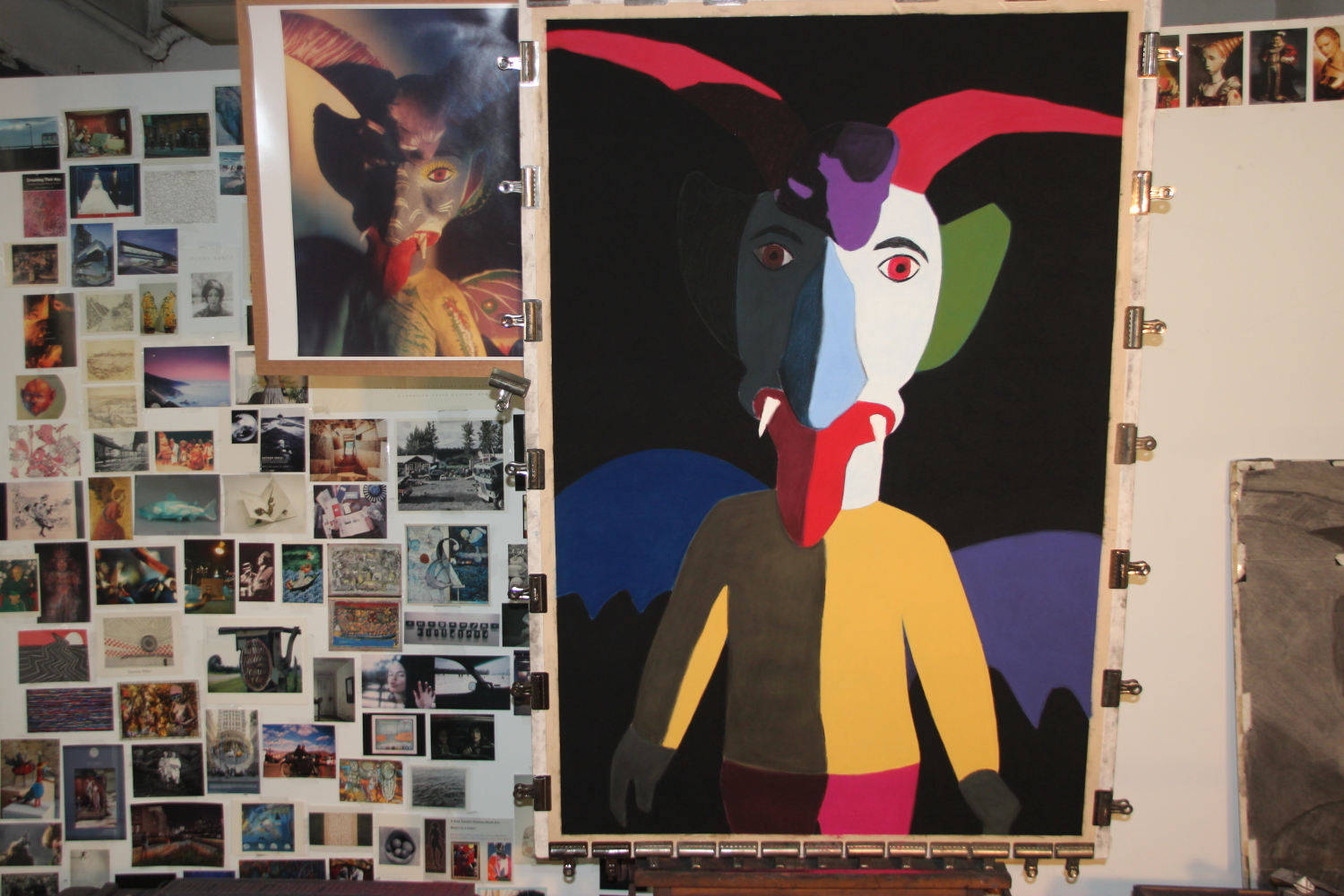
Work in progress, 58″ x 38″
A: Today is a day off to let my fingers heal. When I start a new painting, I need to rub my fingers against raw sandpaper in order to blend the pastel. With each layer the tooth of the paper gets filled up and becomes smooth, but until then my fingers suffer. Here is what I’ve been working on.
This pastel-on-sandpaper painting is an experiment, an attempt to push myself to work with bigger and bolder imagery. The photograph clipped to the easel is one of my favorites. It depicts a Judas that Bryan and I found in a dusty shop in Oaxaca. Among the Mexican and Guatemalan folk art pieces that I’ve collected are five papier mâché Judases. This particular one is unusual because it has a cat’s head attached at the forehead (the purple shape in the painting). They are not made to last. In some Mexican towns large Judases are hung from church steeples, loaded with fireworks, and burned in effigy. This takes place at 10:00 a.m. on the Saturday morning before Easter. Mexico is primarily a Catholic nation, of course, so effigy burning is done as symbolic revenge against Judas for his betrayal of Christ. The Judas in the photo is small and meant for private burning by a family (rather than in public at a church) so by bringing it back to New York I rescued it from a fire-y death! In sympathy with Mexican tradition, I began this painting last Saturday (the day before Easter) at 10 a.m.
Comments are welcome!


 barbararachkoscoloreddust.com