Blog Archives
Pearls from artists* # 362
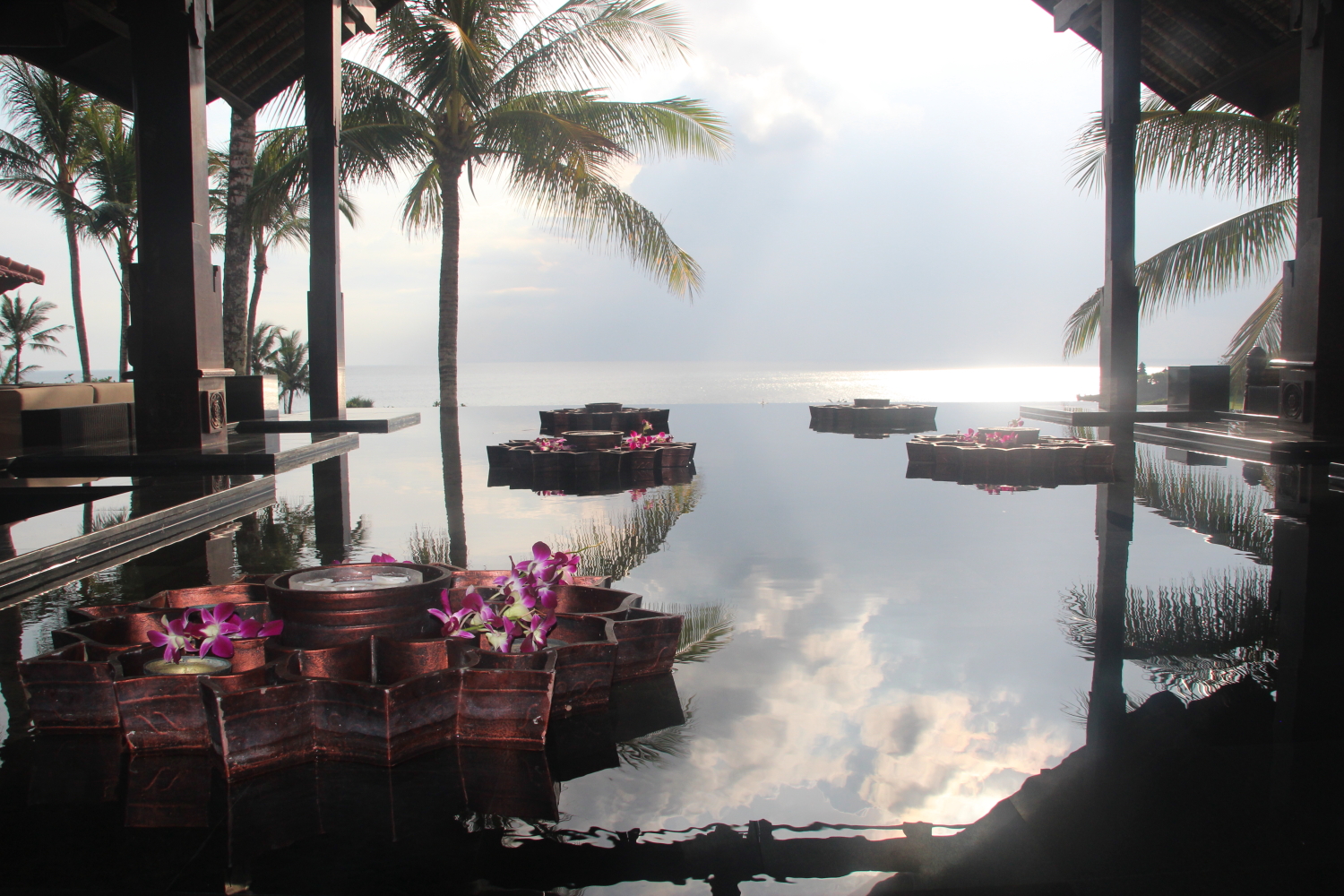
On the Indian Ocean in Tanah Lot, Bali
* an ongoing series of quotations – mostly from artists, to artists – that offers wisdom, inspiration, and advice for the sometimes lonely road we are on.
… if we look at the artifacts of all cultures, beauty always has attracted man’s attention. We know when we are in its presence. We’re held. Different pieces of art will arrest different people, and… some pieces will arrest larger numbers of people for longer periods of time. These are the works that are perhaps worthy of being called great art. We have to recognize that some people today, observing the greatest works of art, or the most awesome works of nature – the Grand Canyon, for instance – give it a minute and then are ready for something else. Insatiable for change, they are immune to deep resonance.
Art and beauty are about those resonances. It isn’t the subject matter that holds us. Some inexplicable reaction stops us, and we find ourselves connected with something other than ourself. Perhaps our ‘Self’ might be a better term, to distinguish it from the self that is caught up in thoughts, worries, and distractions. I like Ken Weber’s definition, that beauty “suspends the desire to be elsewhere.” In the face of great art, we experience transcendence.
Ian Roberts in Creative Authenticity: 16 Principles to Clarify and Deepen Your Artistic Vision
Comments are welcome!
Q: What do you see when you look back at your early efforts?
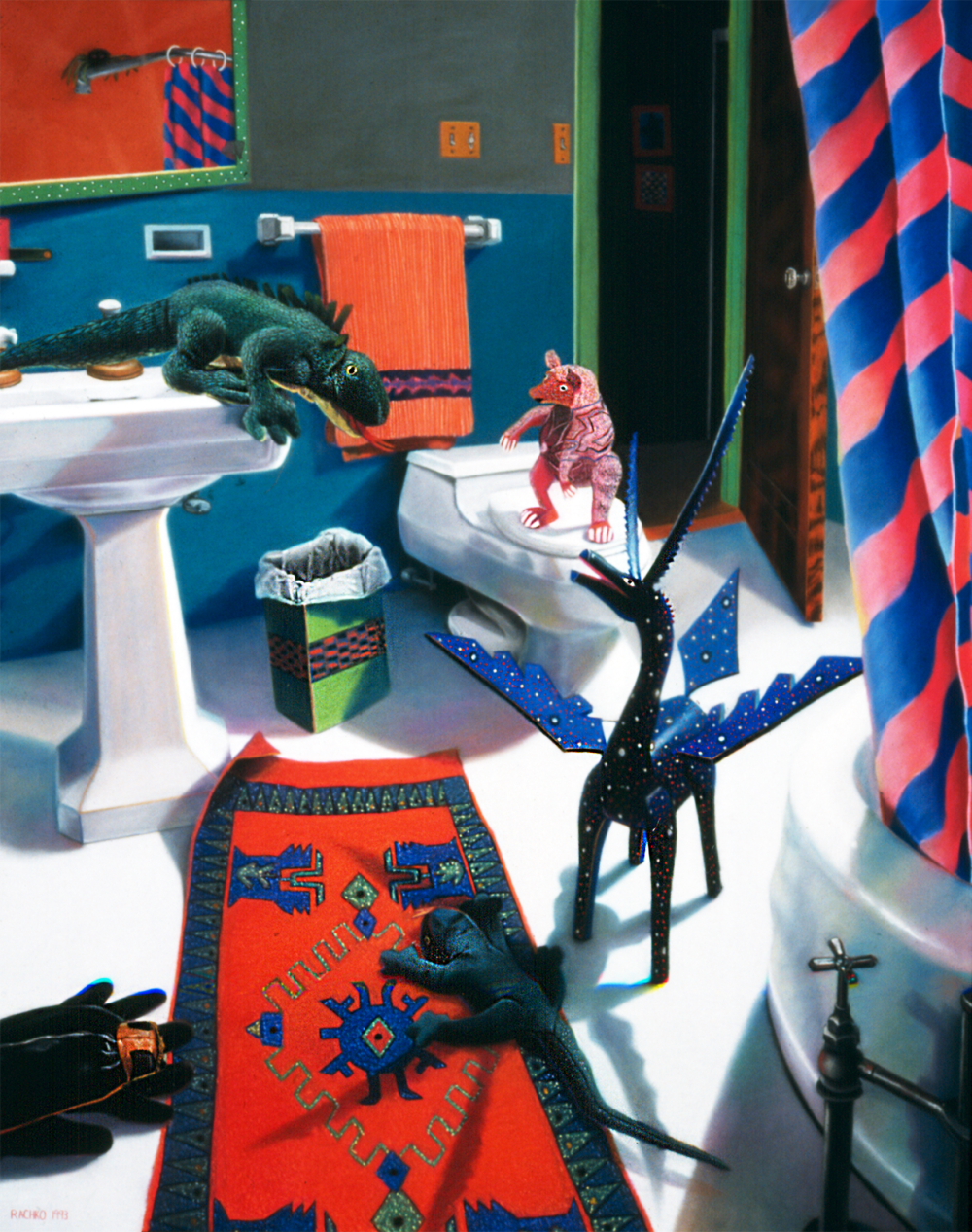
“Myth Meets Dream,” soft pastel on sandpaper, 47″ x 38,” 1993
A: I see continuity in subject matter and in medium, surely. For thirty-three years I have been inspired by foreign travel and research. In addition, I remain devoted to pushing the limits of what soft pastel can do and to promoting its merits as a fine art medium.
Here and there I see details I would render differently now; not exactly mistakes, but things that maybe could be done better. Fortunately, I think, all of my work is framed behind glass or plexiglas, making it extremely difficult to attempt revisions.
Perhaps most important of all, I see the long personal road that has advanced my work to its present state. Each gain has been hard-fought.
Comments are welcome!
Q: Why did you first decide to depict Mexican folk art in your work?
“Myth Meets Dream,” soft pastel on sandpaper, 47″ x 38″
A: As a Christmas present in 1991 my future sister-in-law sent me two brightly painted wooden animal figures from Oaxaca, Mexico. One was a blue polka-dotted winged horse. The other was a red, white, and black bear-like figure. See the two Mexican figures in “Myth Meets Dream” above.
I was enthralled with this gift and the timing was fortuitous because I had been searching for new subject matter to paint. Soon I started asking artist-friends about Oaxaca and learned that it was an important art hub. Two well-known Mexican painters, Rufino Tamayo and Francisco Toledo, had gotten their start there, as had master photographer Manual Alvarez Bravo. There was a “Oaxacan School of Painting” (‘school’ meaning a style, not an actual building) and Alvarez Bravo had established a photography school there (the building/institution kind). I began reading everything I could find. At the time I had only been to Mexico very briefly, in 1975, having made a road trip to Ensenada with my cousin and best friend from college.
The following autumn my then-boyfriend, Bryan, and I planned a two-week trip to visit Mexico. We timed it to see Day of the Dead celebrations in Oaxaca. (In my reading I had become fascinated with this unique festival). We spent one week in Oaxaca followed by one week in Mexico City. My interest in collecting Mexican folk art was off and running!
Comments are welcome!
Q: What is more important to you, the subject of the painting or the way it is executed?

“Sam and Bobo,”soft pastel on sandpaper, 36″ x 31”, 1989
A: In a sense my subject matter – folk art, masks, carved wooden animals, papier mâché figures, toys – chose me. With it I have complete freedom to experiment with color, pattern, design, and other formal properties. In other words, although I am a representational artist, I can do whatever I want since the depicted objects need not look like real things. Execution is everything now.
This was not always the case. I started out in the 1980s as a traditional photorealist, except I worked in pastel on sandpaper. (For example, see the detail in Sam’s sweater above). As I slowly learned and mastered my craft, depicting three-dimensional people and objects hyper-realistically in two dimensions on a piece of sandpaper was thrilling… until one day it wasn’t.
My personal brand of photorealism became too easy, too limiting, too repetitive, and SO boring to execute! In 1989 I had at last extricated myself from a dull career as a Naval officer working in Virginia at the Pentagon. Then after much planning, in 1997 I was a full-time professional artist working in New York.
Certainly I was not going to throw away this opportunity by making boring photorealist art. I wanted to do so much more as an artist: to experiment with techniques, with composition, to see what I could make pastel do, to let my imagination play a larger role in the paintings I made. I was ready to devote the time and do whatever it took to push my art further.
After spending the early creative years perfecting my technical skills, I built on what I had learned. I began breaking rules – slowly at first – in order to push myself onward. And I continue to do so, never knowing what’s next. Hopefully, in 2018 my art is richer for it.
Comments are welcome!
Q: Would you share your current elevator pitch?

Barbara’s studio
A: Here it is:
I live in New York and have been a working artist for more than thirty years. I create original pastel paintings that use my large collection of Mexican and Guatemalan folk art – masks, carved wooden animals, papier mache figures, and toys – as subject matter.
Blending with my fingers, I spend months painstakingly applying dozens of layers of soft pastel onto acid-free sandpaper. My self-invented technique achieves extraordinarily rich, vibrant color and results in paintings that uniquely combine reality, fantasy, and autobiography.
My background is extremely unusual for an artist. I am a pilot, a retired Navy Commander, and a 9/11 widow. Besides making art, I am a published author and blogger best known for my eBook, “From Pilot to Painter,” on Amazon and iTunes, and my popular blog, “Barbara Rachko’s Colored Dust.”
Please see images and more at http://barbararachko.art/en/
Comments are welcome!
Q: Would you describe how you are taking soft pastel in new directions as a fine art medium?

Barbara at work, Photo: Marianne Barcellona
A: I have been devoted to soft pastel for more than thirty years. In this blog and in countless interviews online and elsewhere, I continue to expound on its merits. For me no other fine art medium comes close.
I have developed my own original methods for working with soft pastel, pushing this venerable 500-year-old medium to its limits and using it in ways that no one has done before. I have created a unique science of color in which I layer and blend pigments. When viewers (including fellow artists) see my work in person for the first time, they often ask, “What medium is this?”
My self-invented techniques for using soft pastel achieve rich velvety textures and exceptionally vibrant color. Blending with my fingers, I painstakingly apply dozens of layers of pastel onto acid-free sandpaper. In addition to the thousands of pastels that I have to choose from, I blend new colors directly on the paper. Each pastel painting takes about three months and hundreds of hours to complete.
My subject matter is singular. I am drawn to Mexican, Guatemalan, and Bolivian cultural objects—masks, carved wooden animals, papier mâché figures, and toys. On trips to these places and elsewhere I frequent local mask shops, markets, and bazaars searching for the figures that will populate my pastel paintings. How, why, when, and where these objects come into my life is an important part of the creative process. Each pastel painting is a highly personal blend of reality, fantasy, and autobiography.
Comments are welcome!
Q: Please speak a little about the history of pastel.
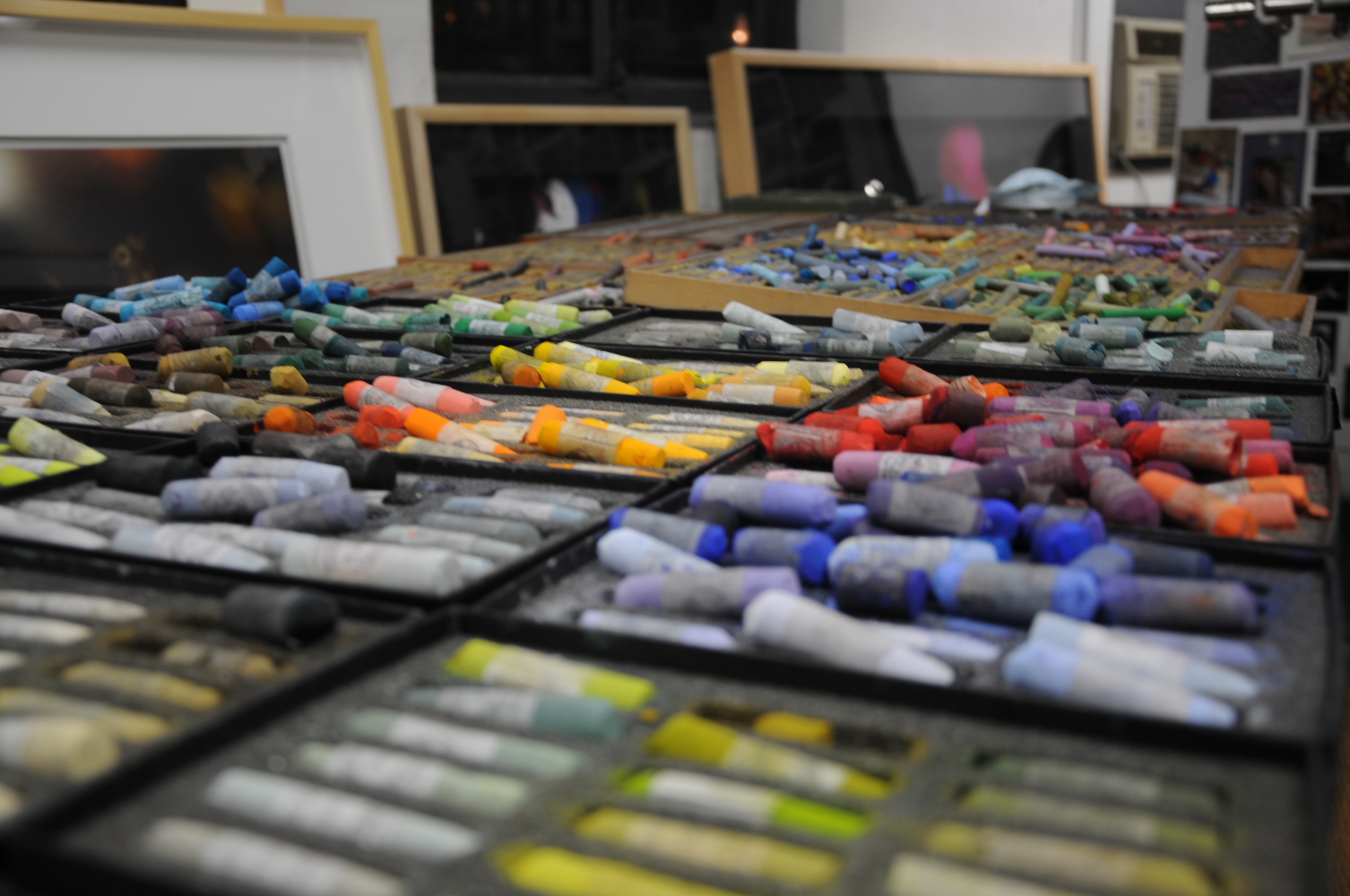
Some of Barbara’s soft pastels
A: Pastel has been in use for five hundred years. Its invention is attributed to the German painter, Johann Thiele, in the 16th century, followed by Venetian artist, Rosalba Carriera, who was the first to use it consistently. Edgar Degas, the most prolific user of pastel and its great champion, was followed by many artists who used varying techniques.
Degas’ subject matter included ballet dancers, laundresses, milliners, and denizens of the Parisian demimonde. The pure hues of pastel, plus its direct application, made it his preferred medium. Rosalba Carriera, a much-admired portrait artist, revolutionized the world of pastel by developing a wider range of colors, expanding pastel’s availability and usefulness. Mary Cassatt’s pastel portraits of children and family life provided her with a steady income while living in Paris. American painter William Merritt Chase used pastel to explore plein air painting. Pastel’s portability and rich colors made it ideal for outdoor landscapes and for capturing light.
Comments are welcome!
Q: How long does it take you to complete a pastel-on-sandpaper painting?
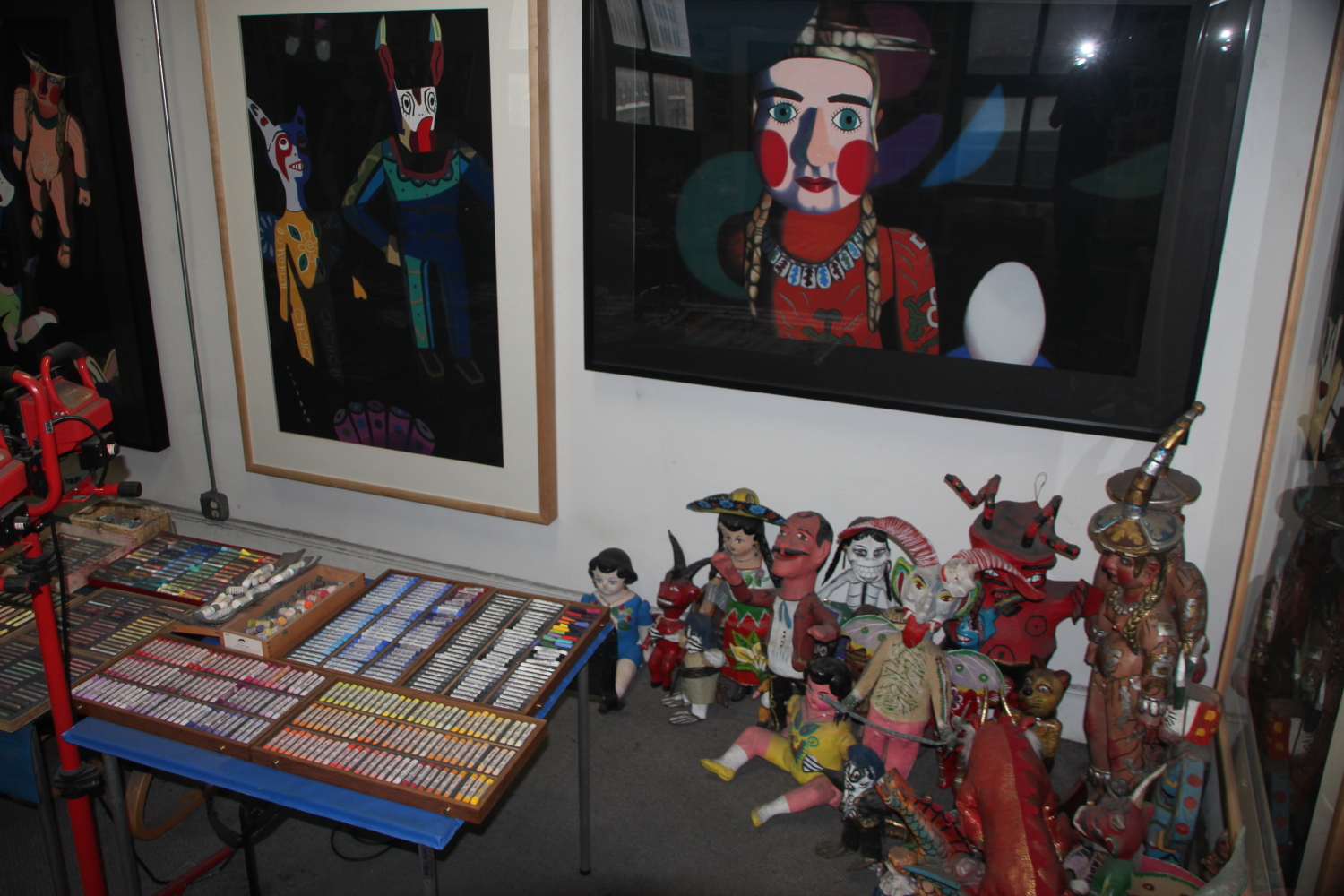
Barbara’s studio
A: Mine is a slow and labor-intensive process. First, there is foreign travel to find the cultural objects – masks, carved wooden animals, paper mâché figures, and toys – that are my subject matter. If they are heavy I ship them home.
Next comes planning exactly how to photograph them, lighting and setting everything up, and shooting a roll of 220 film with my Mamiya 6 camera. I still like to use an analog camera for my fine art work, although I am rethinking this. I have the film developed, decide which image to use, and order a 20” x 24” reference photograph from Manhattan Photo on West 20th Street.
Then I am ready to start. I work on each pastel-on-sandpaper painting for approximately three months. I am in my studio 7 to 8 hours a day, five days a week. During that time I make thousands of creative decisions as I apply and layer soft pastels (I have 8 tables-worth to choose from!), blend them with my fingers, and mix new colors directly on the sandpaper. A finished piece consists of up to 30 layers of soft pastel. My self-invented technique accounts for the vivid, intense color that often leads viewers of my originals to look very closely and ask, “What medium is this?” I believe I am pushing soft pastel to its limits, using it in ways that no other artist has done.
Comments are welcome!
Pearls from artists* # 96

Diane Arbus Revelations
* an ongoing series of quotations – mostly from artists, to artists – that offers wisdom, inspiration, and advice for the sometimes lonely road we are on.
My final day at the magic shop [in Disneyland, where he worked as a teenager], I stood behind the counter where I had pitched Svengali decks and the Incredible Shrinking Die, and I felt an emotional contradiction: nostalgia for the present. Somehow, even though I had stopped working only minutes earlier, my future fondness for the store was clear, and I experienced a sadness like that of looking at a photo of an old, favorite pooch. It was dusk by the time I left the shop, and I was redirected by a security guard who explained that a photographer was taking a picture and would I please use the side exit.
I did, and saw a small, thin woman with hacked brown hair aim her large-format camera directly at the dramatically lit castle, where white swans floated in the moat underneath the functioning drawbridge. Almost forty years later, when I was in my early fifties, I purchased that photo as a collectible, and it still hangs in my house. The photographer, it turned out, was Diane Arbus. I try to square the photo’s breathtaking romantic image with the rest of her extreme subject matter, and I assume she saw this facsimile of a castle as though it were a kitsch roadside statue of Paul Bunyan. Or perhaps she saw it as I did: beautiful.
Quoted by A.D. Coleman in Photocritical, May 28, 2014, from Born Standing Up: A Comic’s Life by Steve Martin
Comments are welcome!
Q: Have you ever worked outside?

Reproductions of “Cardinal Rule” (top) and “Blue Ego,” originals are soft pastel on sandpaper, 30″ x 38″
A: As a pastel artist I’ve never worked outside – with so many pastels, it’s just not practical – but early on in the “Domestic Threats” series, I created two outdoor setups. Works in the series derived from elaborate scenes that I arranged and then photographed.
I used to take long walks along the Potomac River in Alexandria, VA, and there was a tree stump that was fascinating. It was mostly twisted roots, knotty branches, dark hidden spaces, etc. (top painting in photo). One morning I took several hand puppets and stuffed animals (my subject matter at the time) and carefully arranged them on the tree. Around me people were busy exercising their dogs. Soon I attracted quite a bit of attention – a tall blonde woman playing with puppets on a tree stump! Dogs came over to sniff. Their owners came over, too, and I was pressed into explaining, again and again, that I was an artist, that I was photographing this scene so I could paint it, etc. The interruptions were very annoying.
The second time I tried an outdoor setup was again along the Potomac River, but this time I selected a secluded strip of beach where I was undisturbed. I had forgotten to consider the light and inadvertently chose a cloudy day. I remember being disappointed that the light was flat and lacking shadows. The painting (bottom in photo) turned out to be one of my least favorites.
I resolved from then on to focus on interiors. Alfred Hitchcock famously used rear projection so that he could work in a studio rather than on location. One reason, he said, was that in a studio he had total control. I know what he meant. When I set up an interior scene and position the lights to make interesting shadows, indeed, I have control over the whole look. No aspect is left to chance. The accidents – improvements! – happen later when I work on the painting.
Comments are welcome!


 barbararachkoscoloreddust.com