Blog Archives
Q: What would you be if you were not an artist?

The studio with pastel paintings in progress!
A: I honestly have no idea, but whatever it might be, there is a good chance that I’d be bored! In my younger days boredom was a strong motivator. I left the active duty Navy out of boredom. I couldn’t bear not being intellectually challenged (most of my jobs consisted of paper-pushing), not using my flying skills (at 27 I was a licensed commercial pilot and Boeing 727 flight engineer), and not developing my artistic talent. In what surely must be a first, by spending a lot of time and money training me for jobs I hated, the Navy turned me into a hard-working artist! And once I left the Navy there was no plan B. There was no time to waste. It was “full speed ahead.”
Art is a calling. You do not need to be told this if you are among those who are called. It’s all about “the work,” that all-consuming focus of an artist’s life. If a particular activity doesn’t make you a better artist, you avoid it. You work hard to nourish and protect your gifts. As artists we invent our own tasks, learn whatever we need in order to progress, and complete projects in our own time. It is life lived at its freest.
My art-making has led me to fascinating places: Mexico, Guatemala, Brazil, Chile, Easter island, Argentina, Uruguay, France, England, Italy, Bali, Java, India, Bhutan, and more; and to in-depth studies of intriguing subjects: drawing, color, composition, art and art history, the art business, film and film history, photography, mythology, literature, music, jazz history, and archaeology, particularly that of ancient Mesoamerica (the Olmec, Zapotec, Mixtec, Aztec, Maya, etc.). And this rich mixture continually grows! For anyone wanting to spend their time on earth learning and meeting new challenges, there is no better life than that of an artist.
I SO agree with this exchange that I read years ago between between Trisha Brown and Mikhail Baryshnikov in the New York Times. I wrote it on a piece of paper and taped it to my studio wall:
Trisha: How do you think we keep going? Are we obsessed?
Mikhail: We do it because there’s nothing better. I’m serious. Because there is nothing more exciting than that. Life is so boring, that’s why we are driven to the mystery of creation.
Comments are welcome.
Pearls from artists* # 670

*an ongoing series of quotations – mostly from artists, to artists – that offers wisdom, inspiration, and advice for the sometimes lonely road we are on.
I’ve had to keep defining and defending myself as a writer every single day of my adult life – constantly reminding and re-reminding my soul and the cosmos that I’m very serious about the business of creative living, and that I will never stop creating, no matter what the outcome, and no matter how deep my anxieties and insecurities may be.
Over time I’ve found the right tone of voice for these assertions, too. It’s best to be insistent, but affable. Repeat yourself, but don’t get shrill. Speak to your darkest and most negative interior voices the way a hostage negotiator speaks to a violent psychopath: calmly, but firmly. Most of all, never back down. You cannot afford to back down. The life you are negotiating to save, after all, is your own.
Elizabeth Gilbert in Big Magic: Creative Living Beyond Fear
Comments are welcome!
Pearls from artists* # 638

Barbara’s Studio
*an ongoing series of quotations – mostly from artists, to artists – that offers wisdom, inspiration, and advice for the sometimes lonely road we are on.
I was in the presence of a woman [Grace Hartigan] who had sacrificed everything, including her only child, to be what she was: an artist. The rewards had been few, beyond a life well-lived (not materially, but spiritually) and the recognition in her waning years that she had been honest about who she was and what she needed. A rare accomplishment for a woman of any generation, it was particularly so of hers, when servitude to family was the only goal toward which a “healthy” woman was to aspire. Grace was living proof that, on the contrary, a life dreamed could be a life lived. All it took was courage, commitment, and humor. I remember both of us laughing a lot that afternoon. Though the subject was serious, the stories Grace told were fantastic and the woman who recounted them was as wild as the twenty-six-year-old who had abandoned everything in 1948 to paint, though she wasn’t even sure how.
Mary Gabriel in Ninth Street Women
Comments are welcome!
Q: When did you begin drawing and painting? (Question from “Cultured Focus Magazine”)

A: This is a long story because my path to becoming a professional artist has been unusually circuitous.
I grew up in a blue collar family in suburban New Jersey. My parents were both first-generation Americans and no one in my family had gone to college. I was a smart kid, who showed some artistic talent in kindergarten and earlier. At the age of 6, my sister, my cousin, and I enrolled in Saturday morning painting classes at the studio of a local artist. I continued the classes for about 8 years and became a fairly adept oil painter.
At the age of 15 my father decided that art was not a serious pursuit – he called it a hobby, not a profession – and abruptly stopped paying for my Saturday morning lessons. Unfortunately, there were no artists or suitable role models in my family. So with neither financial nor moral support to pursue art, I turned my attention to very different interests.
Cut to ten years later. When I was 25, I earned my private pilot’s license and spent the next two years amassing other flying licenses and ratings, culminating in a Boeing-727 flight engineer’s certificate.
At 29, I joined the Navy. By then I was an accomplished civilian pilot with thousands of flight hours so I expected to fly jets. However, in the early 1980s women were not allowed in combat. There were very few women Navy pilots and those few were restricted to training male pilots. There were no women pilots landing on aircraft carriers.
In the mid-1980s I was in my early 30s, a lieutenant on active duty in the Navy, working a soul-crushing job as a computer analyst on the midnight shift in a Pentagon basement. It was literally and figuratively the lowest point of my life. I was completely bored and miserable.
Remembering the joyful Saturdays of my youth when I had taken art classes with a local New Jersey painter, I enrolled in a drawing class at the Art League School in Alexandria, Virginia. Initially I wasn’t very good, but it was wonderful to be around other women and a world away from the mentality of the Pentagon. I was having fun again! I enrolled in more classes and became a very motivated full-time art student who worked nights at the Pentagon. As I studied and improved my skills, I quickly discovered my preferred medium – soft pastel on sandpaper.
Although I knew I had found my calling, for more than a year I agonized over whether or not to leave the financial security of a Navy paycheck. Finally I did make up my mind and resigned my commission, effective on September 30, 1989. With Bryan’s (my then boyfriend’s) support, I left the Navy to devote my time to making art.
I’m probably one of the few people who can name THE day I became a professional artist! That day was October 1, 1989. Fortunately, I have never needed another job. I remained in the Navy Reserve for the next 14 years, working primarily at the Pentagon for two days each month and two weeks each year. I commuted by train to Washington, DC after I moved to Manhattan in 1997. Finally on November 1, 2003, I officially retired as a Navy Commander.
Life as a self-employed professional artist is endlessly varied, fulfilling, and interesting. I have never regretted my decision to pursue art full-time.
Comments are welcome!
Pearls from artists* # 433

Chatting with Jenny Holzer. It looks like she did not want her picture taken, but she was actually waiving.
*an ongoing series of quotations – mostly from artists, to artists – that offers wisdom, inspiration, and advice for the sometimes lonely road we are on.
…Two positions exist, the artistic and the commercial. Between these two an abiding tension persists. The eighteenth-century American painter Gilbert Stuart complained, “What a business is that of portrait painter. He is brought a potato and is expected to paint a peach.” The artist learns that the public wants peaches, not potatoes. You can paint potatoes if you like, write potatoes, dance potatoes, and compose potatoes, you can with great and valiant effort communicate with some other potato-eaters and peach-eaters. In so doing you contribute to the world’s reservoir of truth and beauty. But if you won’t give the public peaches, you won’t be paid much.
Repeatedly artists take the heroic potato position. They want their work to be good, honest, powerful – and only then successful. They want their work to be alive, not contrived and formulaic. As the Norwegian painter Edvard Munch put it: “No longer shall I paint interiors, and people reading, and women knitting. I shall paint living people, who breathe and feel and suffer and love.”
The artist is interested in the present and has little desire to repeat old, albeit successful formulas. As the painter Jenny Holzer put it, “I could do a pretty good third generation-stripe painting, but so what?
The unexpected result of the artist’s determination to do his [sic] own best art is that he is put in an adversarial relationship with the public. In that adversarial position he comes to feel rather irrational for what rational person would do work that’s not wanted?
…Serious work not only doesn’t sell well, it’s also judged by different standards. If the artist writes an imperfect but commercial novel it is likely to be published and sold. If his screenplay is imperfect but commercial enough it may be produced. If it is imperfect and also uncommercial it will not be produced. If his painting is imperfect but friendly and familiar it may sell well. If it is imperfect and also new and difficult, it may not sell for decades, if ever.
Ironically enough, the artist attempting serious work must also attain the very highest level of distinction possible. He must produce Crime and Punishment and The Brothers Karamazov but not also The Insulted and Injured or A Raw Youth, two of Dostoevsky’s nearly unknown novels. He is given precious little space in this regard.
I daresay, this last is why I devote my life to creating the most unique, technically advanced pastel paintings anyone will see!
Eric Maisel, A Life in the Arts: Practical Guidance and Inspiration for Creative and Performing Artists
Comments are welcome!
Q: Where did you grow up and what were some early milestones or experiences that contributed to you becoming an artist later in life?
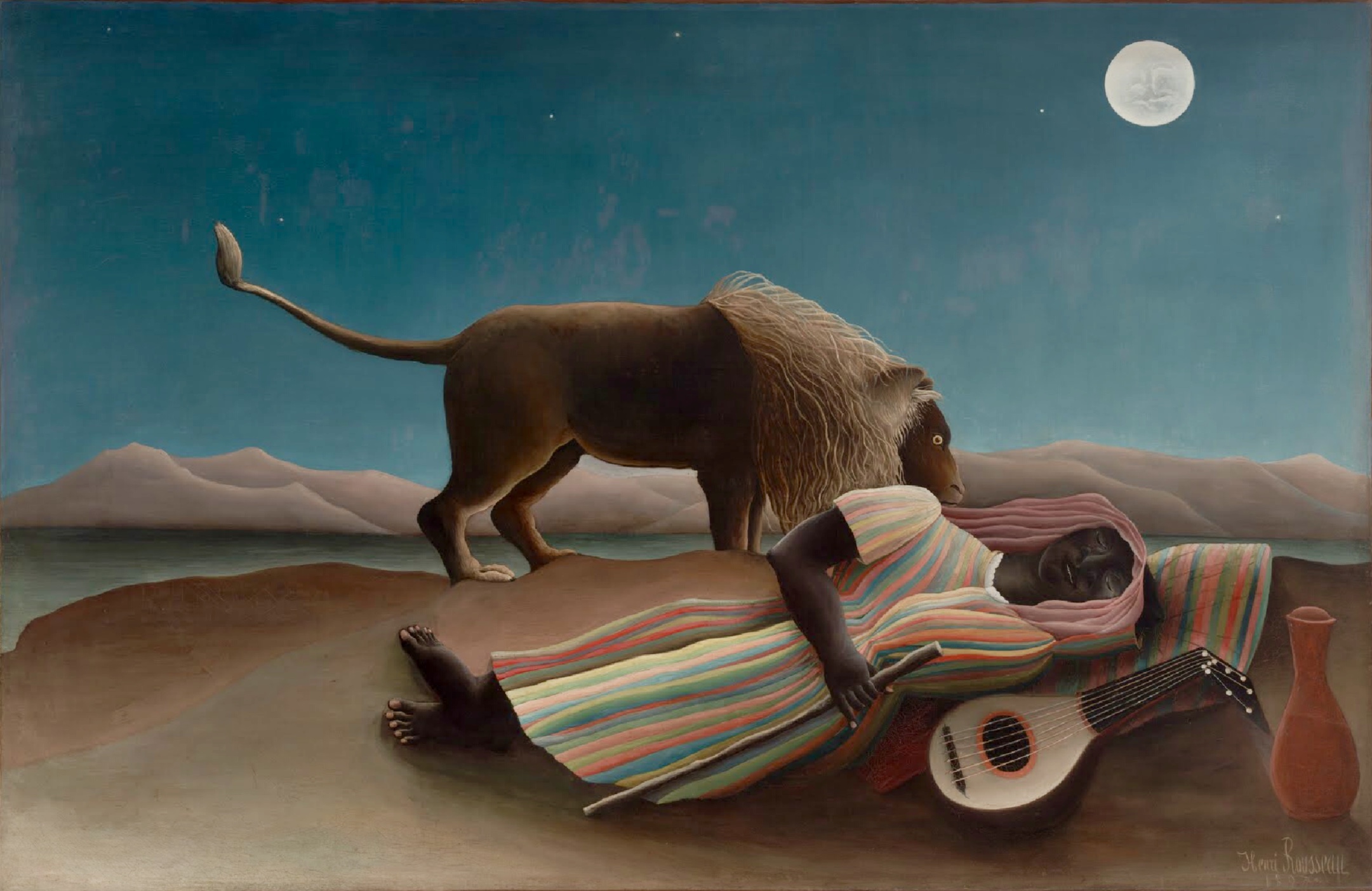
“The Sleeping Gypsy,” Henri Rousseau, oil on canvas, 1897
A: I grew up in a blue collar family in Clifton, New Jersey, a suburb about fifteen miles west of Manhattan. My father was a television repairman for RCA. My mother stayed home to raise my sister and me (at the time I had only one sister, Denise; my sister Michele was born much later). My parents were both first-generation Americans and no one in my extended family had gone to college yet. I was a smart kid who showed some artistic talent in kindergarten and earlier. I remember copying the Sunday comics, which in those days appeared in all the newspapers, and drawing small still lifes I arranged for myself. I have always been able to draw anything, as long as I can see it.
Denise, a cousin, and I enrolled in Saturday morning “art classes” at the studio of a painter named Frances Hulmes in Rutherford, NJ. I was about 6 years old. I continued the classes for 8 years and became a fairly adept oil painter. Since we lived so close to New York City, my mother often took us to museums, particularly to the Museum of Modern Art, the Metropolitan Museum of Art, and the Museum of Natural History. Like so many young girls, I fell in love with Rousseau’s “The Sleeping Gypsy” and was astonished by Picasso’s “Guernica” when it was on long-term loan to MoMA. I have fond memories of studying the dioramas at the Museum of Natural History (they are still my favorite part of the museum). As far as I know, there were no artists in my family so, unfortunately, I had no role models. At the age of 14 my father decided that art was not a serious pursuit – declaring, it is “a hobby, not a profession” – and abruptly stopped paying for my Saturday morning lessons. With no financial or moral support to pursue art, I turned my attention to other interests, letting my artistic abilities go dormant.
Comments are welcome!
Pearls from artists* # 329

“Acolytes,” soft pastel on sandpaper, 38″ x 58″
*an ongoing series of quotations – mostly from artists, to artists – that offers wisdom, inspiration, and advice for the sometimes lonely road we are on.
A painting is not a joke. If you aren’t serious, every single time you cheat by not being serious, every time you cut a corner, you are making a record of your stupidity and you won’t be able to take it back. In the end the painting is the sum of everything you have put into it. Sometimes it’s a sum of stupidity. Something stupid can never be erased – if you put down black and afterward you put a red on top to correct it, your red will not be red.
Louise Bourgeois: Destruction of the Father, Reconstruction of the Father: Writings and interview 1923-1997, edited and with texts by Marie-Laure Bernadac and Hans-Ulrich Obrist
Comments are welcome!
Pearls from artists* # 307
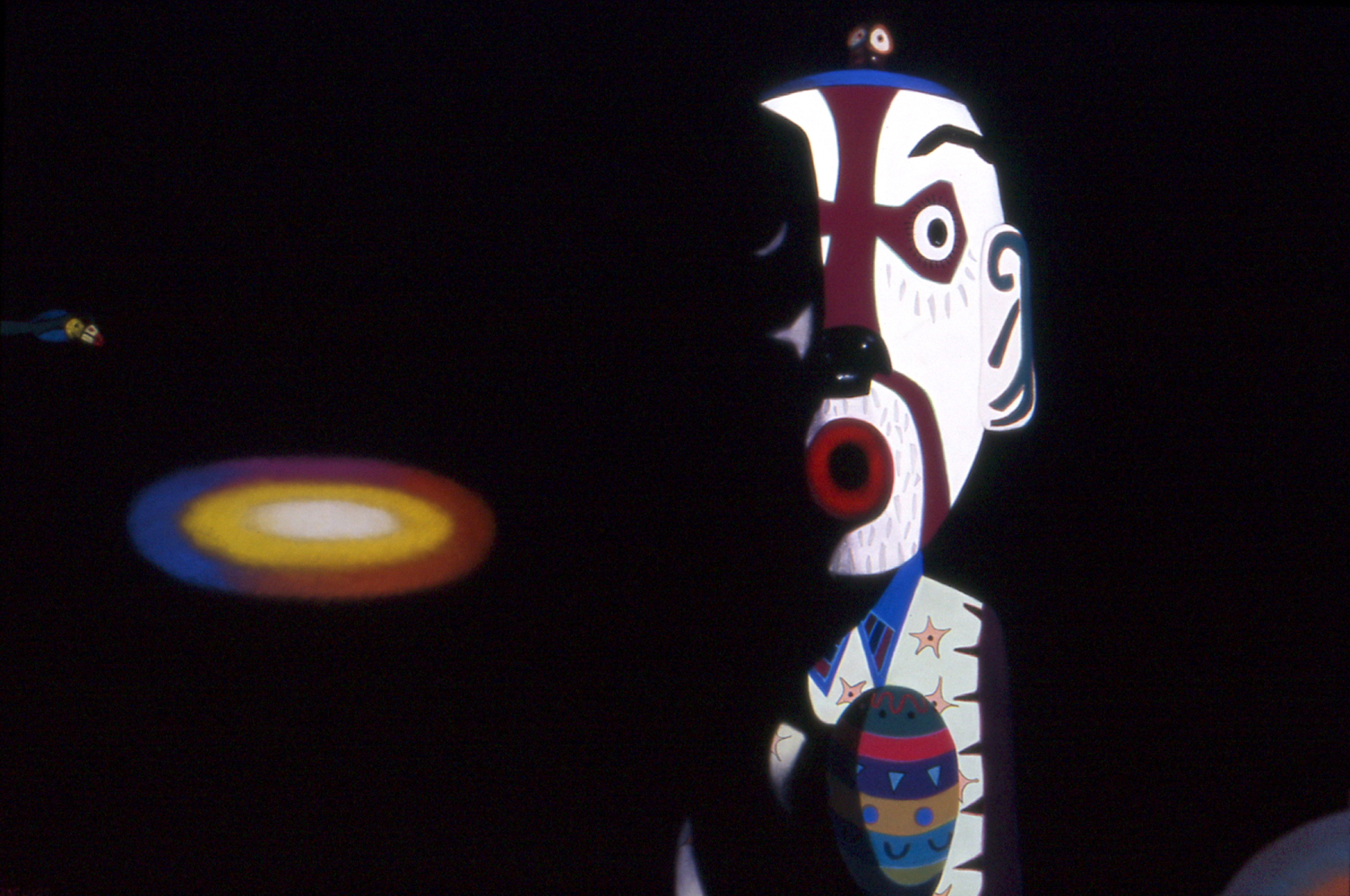
“Poker Face,” soft pastel on sandpaper, 38″ x 58″
* an ongoing series of quotations – mostly from artists, to artists – that offers wisdom, inspiration, and advice for the sometimes lonely road we are on.
Until fairly recently the word art as applied to pictures usually referred not just to representations of the world but to representations that suggested an importance greater than we might otherwise have assumed. Such pictures were said to instruct and delight, which they did by their wholeness and richness. The effect was to reinforce a sense of meaning in life, though not necessarily a belief in a particular ideology or religion, and in this they were a binding cultural achievement.
Unfortunately art of this quality is now little attempted, partly because of disillusionment from a century of war, partly because of sometimes misplaced faith in the communicative and staying powers of total abstraction, and partly because of the ease with which lesser work can be made and sold. This atrophying away of the genuine article is a misfortune because, in an age of nuclear weapons and over-population and global warming, we need more than ever what art used to provide. Somehow we have to recommit to picture making that is serious. It is impermissible any longer to endorse imitations that distract us or, openly or by implication, ridicule hope. The emptiness of material by Jeff Koons and Damien Hirst, for example, is born of cynicism and predictive of nihilism.
Robert Adams in Art Can Help
Comments are welcome!
Pearls from artists* # 182

Hudson Yards, NYC
* an ongoing series of quotations – mostly from artists, to artists – that offers wisdom, inspiration, and advice for the sometimes lonely road we are on.
Maybe you know exactly what you dream of being. Or maybe you’re paralyzed because you have no idea what your passion is. The truth is, it doesn’t matter. You don’t have to know. You just have to keep moving forward. You just have to keep doing something, seizing the next opportunity, staying open to trying something new. It doesn’t have to fit your vision of the perfect job or the perfect life. Perfect is boring, and dreams are not real. Just… DO. You think, “I wish I could travel” – you sell your crappy car and buy a ticket and go to Bangkok right now. I’m serious. You say, “I want to be a writer” – guess what? A writer is someone who writes every day. Start writing. Or: You don’t have a job? Get one. ANY JOB. Don’t sit at home waiting for the magical dream opportunity. Who are you? Prince William? No. Get a job. Work. Do until you can do something else.
Commencement address to Dartmouth College, Shonda Rhimes in Year of Yes: How to Dance It Out, Stand in the Sun and Be Your Own Person
Comments are welcome!
Q: What do you think is an artist’s chief responsibility? Do you personally feel a responsibility to society?
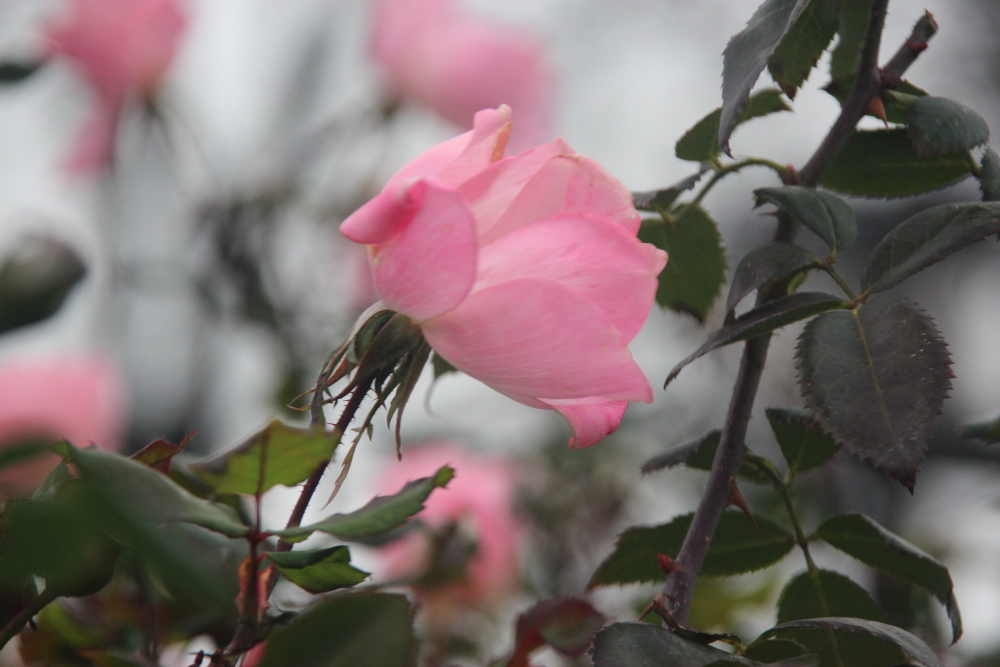
Winter roses
A: All serious artists have the responsibility of developing our unique and special gifts to the best of our abilities and sharing our creative output with an appreciative audience. In other words we do good work and then we educate, and often create, the audience for it. This is the demanding, all-important task that gets me out of bed every day.
In showing what is possible artists cannot help but create a better society. Ours is essential work.
Comments are welcome!


 barbararachkoscoloreddust.com