Blog Archives
Q: How do you decide when a pastel painting is finished?

“Magisterial,” soft pastel on sandpaper, 58” x 38” in progress
A: During the months that it takes to create a pastel painting, I search for arresting colors that work well together. The goal is to make a painting that I have never seen before and that leads the viewer’s eyes around in interesting ways. To do this I build up and blend together as many as 25 to 30 layers of pigment. I am able to complete some areas, like the background, fairly easily – maybe with just six or seven layers of black Rembrandt pastel. The more realistic parts of a pastel painting take many more applications. In general, details always take plenty of time to refine and perfect.
No matter how many pastel layers I apply, however, I never use fixatives. It is difficult to see this in reproductions of my work, but some of the finished surfaces achieve a texture akin to velvet. My technique involves blending each layer with my fingers, pushing the pastel deep into the tooth of the sandpaper, and mixing new colors directly on the paper. Fortunately, the sandpaper holds plenty of pigment so I am able to include lots of details.
Before I pronounce a pastel painting finished, I let it sit against a wall in my studio for a few days so I can look at it later with fresh eyes. I consider a piece done when it is as good as I can make it, when adding or subtracting something would diminish what is there. Always, I try to push myself and my materials to their limits, using them in new and unexpected ways.
Comments are welcome.
Q: What makes you just want to run back to the studio and start something new?

Beginnings
A: For nearly four decades, I have always worked in series, which means that one pastel painting leads quite naturally into the next. Considerable thought and planning go into each one before I ever begin, so it would be uncharacteristic for me to just start something new out of nowhere.
That said, my favorite part of the months-long creative process is when I am starting a brand new pastel painting. I get excited each time I begin a new piece because beginnings are full of so much possibility! Soon I will be looking at something I have never created before. I’ll watch it gradually take shape over months and will be challenged to solve unforeseeable problems, to continually refine and improve it along the way. The goal is always, of course, to resolve it into some sort of successful existence. Whatever happens, I know I am about to go on a very intriguing journey that will undoubtedly expand my technical knowledge and make me a much better artist.
Comments are welcome!
Q: What is your process? (Question from artamour)
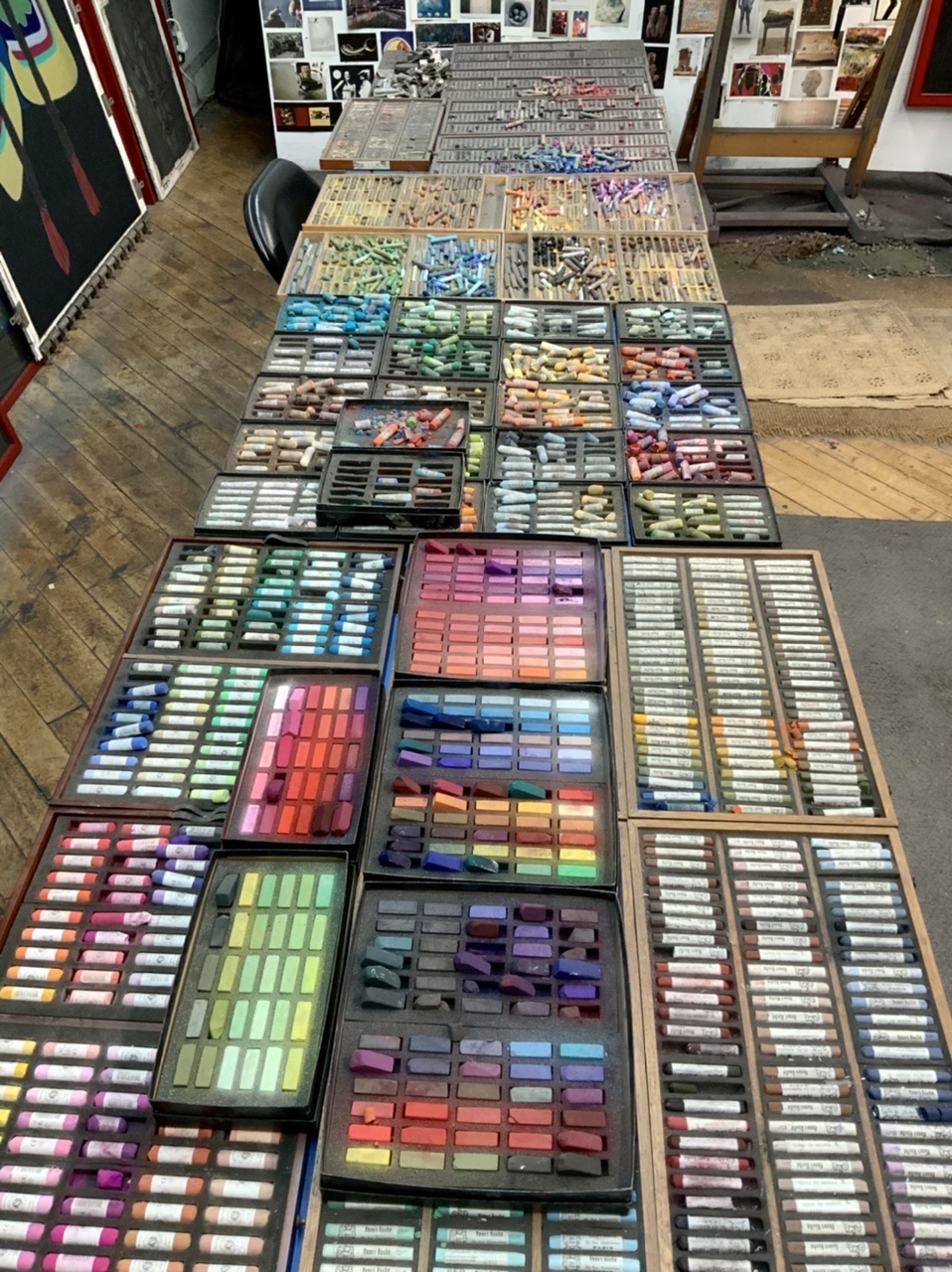
A: For thirty-six years I have worked exclusively in soft pastel on sandpaper. Pastel, which is pigment and a binder to hold it together, is as close to unadulterated color as an artist can get. It allows for very saturated color, especially employing the self-invented techniques I have developed and mastered. I believe my “science of color” is unique, completely unlike how any other artist works. I spend three to four months on each painting, applying pastel and blending the layers together to mix new colors on the paper.
The acid-free sandpaper support allows the buildup of 25 to 30 layers of pastel as I slowly and meticulously work for hundreds of hours to complete a painting. The paper is extremely forgiving. I can change my mind, correct, refine, etc. as much as I want until a painting is the best I can create at that moment in time.
My techniques for using soft pastel achieve rich velvety textures and exceptionally vibrant color. Blending with my fingers, I painstakingly apply dozens of layers of pastel onto the sandpaper. In addition to the thousands of pastels that I have to choose from, I make new colors directly on the paper. Regardless of size, each pastel painting takes three to four months and hundreds of hours to complete.
I have been devoted to soft pastel from the beginning. In my blog and in numerous interviews online and elsewhere, I continue to expound on its merits. For me no other fine art medium comes close.
My subject matter is unique. I am drawn to Mexican, Guatemalan, and Bolivian cultural objects—masks, carved wooden animals, papier mâché figures, and toys. On trips to these countries and elsewhere I frequent local mask shops, markets, and bazaars searching for the figures that will populate my pastel paintings. How, why, when, and where these objects come into my life is an important part of the creative process. Each pastel painting is a highly personal blend of reality, fantasy, and autobiography.
Comments are welcome!
Pearls from artists* # 484

*an ongoing series of quotations – mostly from artists, to artists – that offers wisdom, inspiration, and advice for the sometimes lonely road we are on.
[Walter] Murch: We hope we become better editors with experience! Yet you have to have an intuition about the craft to begin with: for me, it begins with, Where is the audience looking? What are they thinking? As much as possible, you try to be the audience. At the point of transition from one shot to another, you have to be pretty sure where the audience’s eye is looking, where the focus of attention is. That will either make the cut work or not.
[Michael] Ondaatje: So before you make the cut, if you feel the audience is looking towards point X, then you cut to another angle where the focus of attention is somewhere around that point X.
The Conversation: Walter Murch and the Art of Editing Film by Michael Ondaatje
This passage in Ondaatje’s book resonates because I work similarly to refine and construct each pastel painting. My goal is to move the viewer’s eye around in an engaging and interesting way. This part of my process is subtle so I suspect that most of my audience neither appreciates nor even suspects that I have done it.
Comments are welcome!
Q: What is the most important factor behind your success?

A: In a word, I’d say it’s love. I love soft pastel! I love being an artist! I love looking at the thousands of pastels in my studio while I think about the possibilities for mixing new colors and making exciting new pastel paintings. Soft pastels are rich and intense.
Even after more than thirty years as an artist, I still adore what I am able to accomplish. I continually refine my craft as I push pastel to new heights. My business card says it all: “Revolutionizing Pastel as Fine Art!”
The surfaces of my finished pastel paintings are velvety and demanding of close study and attention. Soft pastel on sandpaper – no other medium is as sensuous or as satisfying. Who could argue with that!
Comments are welcome!
Pearls from artists* # 400

In the studio with friends
* an ongoing series of quotations – mostly from artists, to artists – that offers wisdom, inspiration, and advice for the sometimes lonely road we are on.
A student in the audience raised her hand and asked me:
“Why should I live?”
… In the very act of asking that question, you are seeking reasons for your convictions, and so you are committed to reason as the means to discover and justify what is important to you. And there are so many reasons to live!
As a sentient being, you have the potential to flourish. You can refine your faculty of reason itself by learning and debating. You can seek explanations of the natural world through science, and insight into the human condition through the arts and humanities. You can make the most of your capacity for pleasure and satisfaction, which allowed your ancestors to thrive and thereby allowed you to exist. You can appreciate the beauty and the richness of the natural and cultural world. As the heir to billions of years of life perpetuating itself, you can perpetuate life in turn. You have been endowed with a sense of sympathy – the ability to like , love, respect, help, and show kindness – and you can enjoy the gift of mutual benevolence with friends, family, and colleagues.
And because reason tells you that none of this is particular to you, you have the responsibility to provide to others what you expect for yourself. You can foster the welfare of other sentient beings by enhancing life, health, knowledge, freedom, abundance, safety, beauty, and peace. History shows that when we sympathize with others and apply our ingenuity to improving the human condition, we can make progress in doing so, and you can help to continue that progress.
Stephen Pinker in Enlightenment Now: The Case for Reason, Science, Humanism, and Progress
Comments are welcome!
Q: How long did it take you to discover the properties of pastel? (Liliana Mileo via facebook.com/BarbaraRachko/)
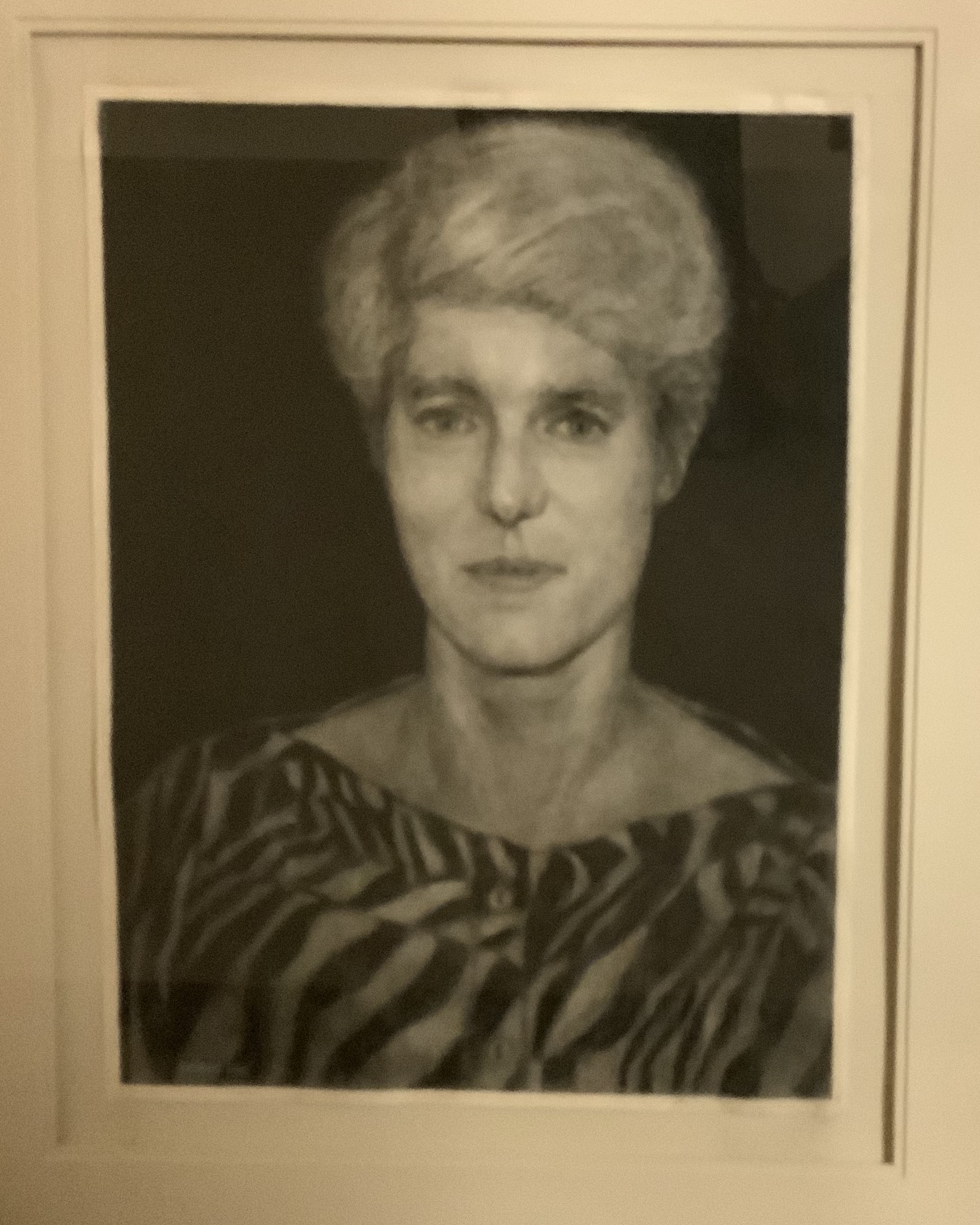
A charcoal self-portrait from 1988
A: After I moved to Alexandria, Virginia in the mid-1980s, I began taking classes at The Art League School. I was extremely unhappy with my career as a Navy Lieutenant. I worked as a computer analyst for the Joint Chiefs of Staff at the Pentagon and was searching for something more meaningful to do with my life.
I began with a basic drawing class and liked it. I enrolled in more classes and decided to spend two years working exclusively in black and white media, such as charcoal and graphite, before advancing to color. Fortunately, early on I found an excellent teacher in Lisa Semerad. I remain deeply grateful for the strong foundational drawing skills she imparted to me during this period.
After two years I tried water color and soon discovered it was not for me, a perfectionist who needs to refine my work. Then I tried etching and found it extremely tedious, the antithesis of instant gratification.
Finally I began studying soft pastel with Diane Tesler, another gifted teacher, and fell in love with this medium! At The Art League School I also completed a one-week workshop with Albert Handell, who introduced me to the archival sandpaper that I have been using ever since.
While I fell in love with pastel three decades ago, I continue to learn about its unique properties. I am pushing pastel to new heights as my techniques continually evolve. This is a lifetime journey of learning. I hope to never know all there is to know.
Comments are welcome! Ask anything and I may answer in a future blog post, as you’ve seen here with Liliana’s question.
Q: Your work is unlike anyone else’s. There is such power and boldness in your pastels. What processes are you using to create such poignant and robustly colored work?

Barbara working on an interview. Photo: Maria Cox
A: For thirty-three years I have worked exclusively in soft pastel on sandpaper. Pastel, which is pigment and a binder to hold it together, is as close to unadulterated color as an artist can get. It allows for very saturated color, especially using the self-invented techniques I have developed and mastered. I believe my “science of color” is unique, completely unlike how any other artist works. I spend three to four months on each painting, applying pastel and blending the layers together to mix new colors on the paper.
The acid-free sandpaper support allows the buildup of 25 to 30 layers of pastel as I slowly and meticulously work for hundreds of hours to complete a painting. The paper is extremely forgiving. I can change my mind, correct, refine, etc. as much as I want until a painting is the best I can create at that moment in time.
My techniques for using soft pastel achieve rich velvety textures and exceptionally vibrant color. Blending with my fingers, I painstakingly apply dozens of layers of pastel onto the sandpaper. In addition to the thousands of pastels that I have to choose from, I make new colors directly on the paper. Regardless of size, each pastel painting takes about four months and hundreds of hours to complete.
I have been devoted to soft pastel from the beginning. In my blog and in numerous interviews online and elsewhere, I continue to expound on its merits. For me no other fine art medium comes close.
My subject matter is singular. I am drawn to Mexican, Guatemalan, and Bolivian cultural objects—masks, carved wooden animals, papier mâché figures, and toys. On trips to these countries and elsewhere I frequent local mask shops, markets, and bazaars searching for the figures that will populate my pastel paintings. How, why, when, and where these objects come into my life is an important part of the creative process. Each pastel painting is a highly personal blend of reality, fantasy, and autobiography.
Comments are welcome!

Q: Do your materials have properties that allow you to maximize what you depict in your work?
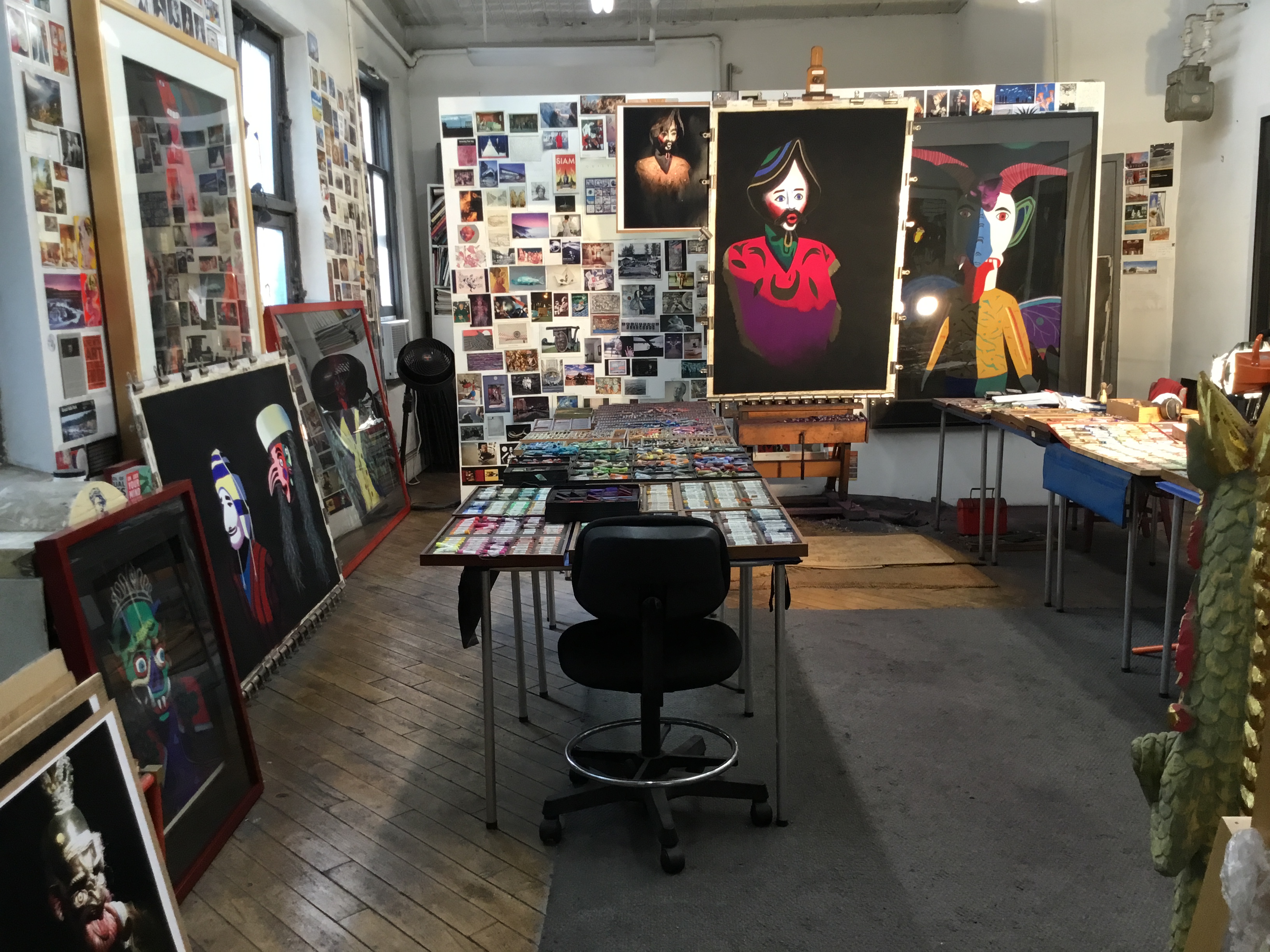
Barbara’s studio
A: I work exclusively in soft pastel on sandpaper. Pastel, which is pigment and a binder to hold it together, is as close to unadulterated pigment as an artist can get. It allows for very saturated color, especially as I utilize the self-invented techniques developed and mastered over more than thirty years as an artist. I believe my “science of color” to be unique, completely unlike how any other artist works. I spend three or four months on each painting, applying pastel and blending the layers together to mix new colors directly on the paper.
The sandpaper support allows the build up of 25 to 30 layers of pastel as I slowly and meticulously work for hundreds of hours to complete a painting. The paper is extremely forgiving. I can change my mind, correct, refine, etc. as much as I want until a painting is the best I can create at that moment in time.
Comments are welcome!


 barbararachkoscoloreddust.com
Q: What kind of internal conversations do you tend to have when you are in the process of making art? (Question from Vedica Art Studios and Gallery)
Jan 10
Posted by barbararachkoscoloreddust
A: When standing at my easel creating a pastel painting, I focus on formal properties: composition, shape, color, and line. I always strive to produce a painting I’ve never seen before. Even as (perhaps especially as) the creator, I want to be surprised by the final result. My studio days are spent thinking, looking, reacting, and adjusting colors and composition as I refine increasingly tiny details, ensuring all elements work harmoniously. I determine which areas need to recede or advance, which require intricate details to appear three-dimensional, and which are better left as flat areas of color.
These countless adjustments ensure viewers’ eyes are guided around the finished painting in intriguing ways. I often recall something collectors of my pastel paintings shared: they mentioned a New York Times review of a Nan Goldin exhibition, in which the writer stated, “All of the pleasure circuits are fired in looking.” The collectors agreed this is exactly how they feel when viewing my work. Artists live for appreciative comments like these!
Comments are welcome!
Share this:
Posted in 2026, An Artist's Life, Creative Process, Studio, Working methods
Comments Off on Q: What kind of internal conversations do you tend to have when you are in the process of making art? (Question from Vedica Art Studios and Gallery)
Tags: adjusting, adjustments, advance, agreed, always, appear, appreciative, areas, around, artists, “Magisterial”, “New York Times”, better, circuits, collectors, colors, comments, composition, countless, creating, creator, details, determine, elements, ensure, ensuring, especially, exactly, exhibition, finished, fired, formal, guided, harmoniously, increasingly, intricate, intriguing, looking, mentioned, Nan Goldin, painting, pastel painting, perhaps, pleasure, produce, properties, question, reacting, recall, recede, refine, require, result, review, shared, something, stated, strive, Studio, surprised, thinking, three-dimensional, Vedica Art Studios and Gallery, viewers, viewing, working, writer