Blog Archives
Q: How do you experience art in New York?

Lower Manhattan
A: As a New York artist I am very fortunate to live in a city with a vibrant, exciting cultural scene. Simply put, art is in the air here and I take inspiration from everything I see and experience: painting, photography, sculpture, installation, performance art, public art, dance, theater, film, opera, jazz, etc. This city itself is an endlessly fascinating place. Visually it is always thrilling! I never know what I am going to see – good and bad – whenever I leave my apartment.
I have been living here since April 1997. The city provides a heady mix to ponder and this mix mysteriously enriches, influences, and somehow finds its way into the work. I have been an artist for nearly thirty years and I continue to be intrigued with watching the intricacies of how my creative process evolves and grows.
Comments are welcome!
Q: You have spoken about learning to fly at the age of 25. What airplanes did you fly?
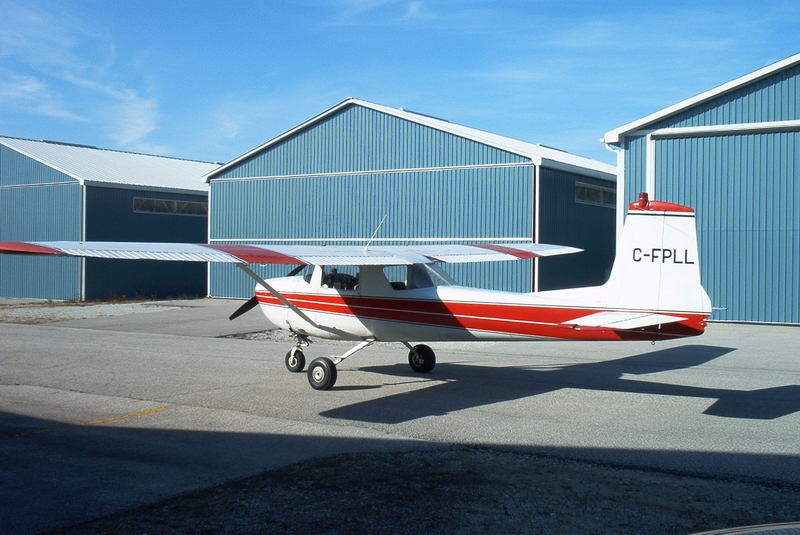
Cessna 150
A: I learned to fly at a small airport in Caldwell, NJ. Flying is expensive and since I didn’t have much money, I sought a job at Liberty Aviation, the local flight school, in exchange for flying lessons. For every three hours I worked, I earned a flying lesson. At the time it cost $25/hour to rent a plane, plus $10/hour for an instructor, and I was fortunate to find an excellent flight instructor who offered to teach me for free.
After I completed ground school at Clifton High School, I took my first flying lesson. It was on April 1, 1978 in a (two-seat) Cessna 150. During the following months I flew every chance I could, in Cessna 150s and newer Cessna 152s, and also occasionally in Piper Cherokees. On September 24, 1978 I received my private pilot’s license.
Then I got checked-out in a larger (four-seat) Cessna 172. For my instrument training I flew Cessna 150s and 172s. I received my instrument rating in April 1979.
Next I trained for a commercial pilot’s license and a multi-engine rating. I flew Cessna 172s and a twin-engine Piper Seminole and obtained my license and rating in May 1980.
In December 1980 I began Boeing 727 flight engineer training at Flight International in Atlanta, GA. Most of this was in Boeing-727 flight simulators with Delta airline pilots as instructors. My check-ride was in a Boeing-727 owned by FedEx. I received my flight engineer’s certificate in February 1981. At the time I was the only woman in the entire school!
Comments are welcome!
Pearls from artists* # 82
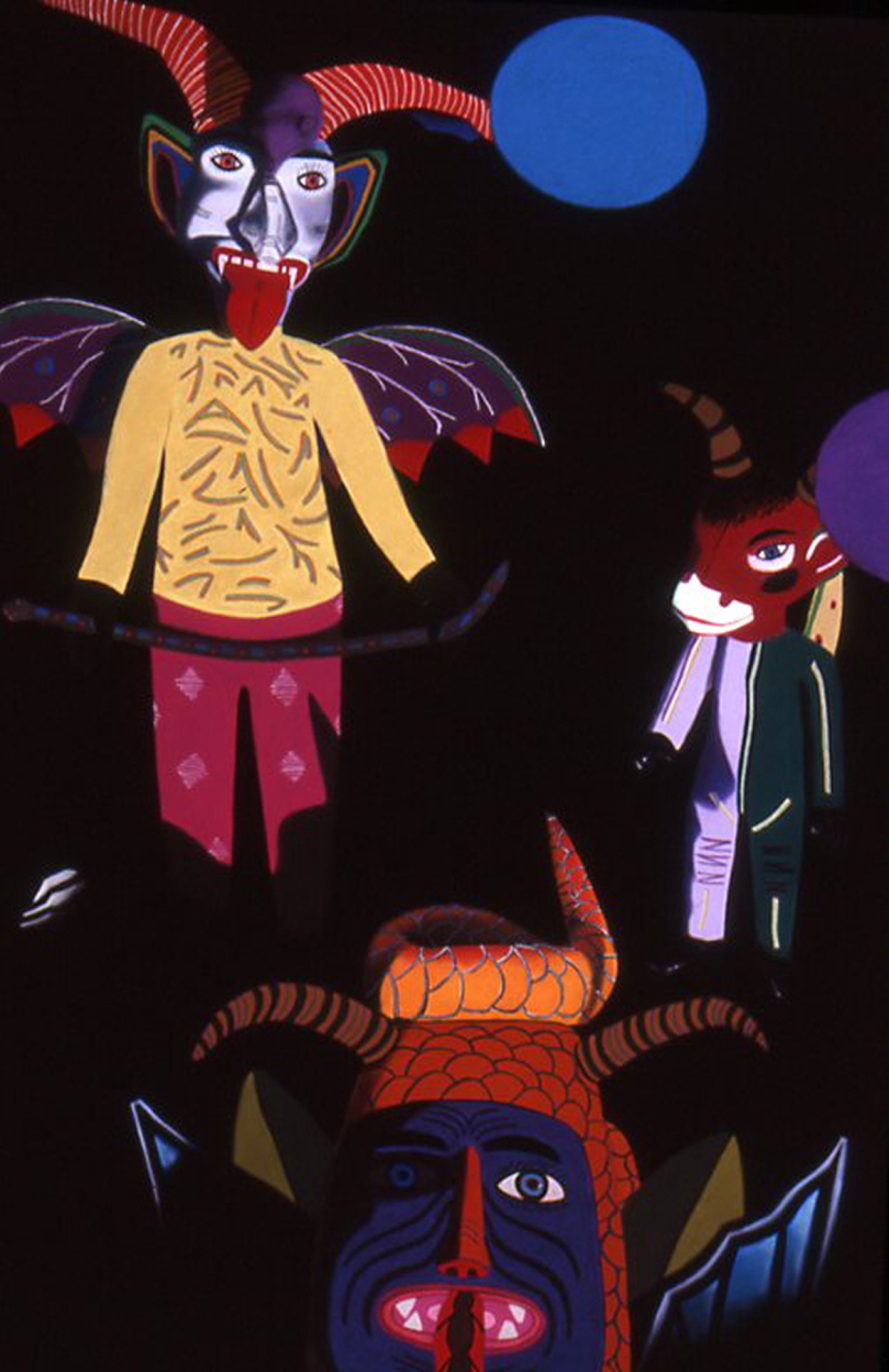
“The Sovereign,” soft pastel on sandpaper, 58″ x 38″
* an ongoing series of quotations – mostly from artists, to artists – that offers wisdom, inspiration, and advice for the sometimes lonely road we are on.
Art isn’t psychology. For one thing art deals in images, not language. Images precede language and are closer to feelings. They summon feelings before they’re named and categorized, when they’re still fresh and sometimes hard to recognize or identify.
For another thing, to translate his vision an artist uses materials that are, for lack of a better word, alchemical. Paint, for example, has this wonderful, mysterious quality – a smell and a sensuous, velvety feel and an ability to hold color and light – that unlocks and speeds up one’s creative metabolism. And paint captures my every impulse – from my broadest conceptions to the tiniest ticks and tremors of my wrist.
There are literally no words to describe what occurs when an image suddenly and unexpectedly appears on the canvas. Sometimes it’s serendipity, the result of a fortunate brushstroke. Sometimes I think it has to do with the inherent qualities of paint, or the slickness of a surface, or the fullness or acuity of a brush. And sometimes when I’ve got a good rhythm going and everything comes together, I feel as though it produces the purest expression of who I am and what I am and how I perceive the world.
Eric Fischl and Michael Stone in Bad Boy: My Life on and off the Canvas
Comments are welcome!
Q: I just got home from my first painting experience… three hours and I am exhausted! Yet you, Barbara, build up as many as 30 layers of pastel, concentrate on such intricate detail, and work on a single painting for months. How do you do it?
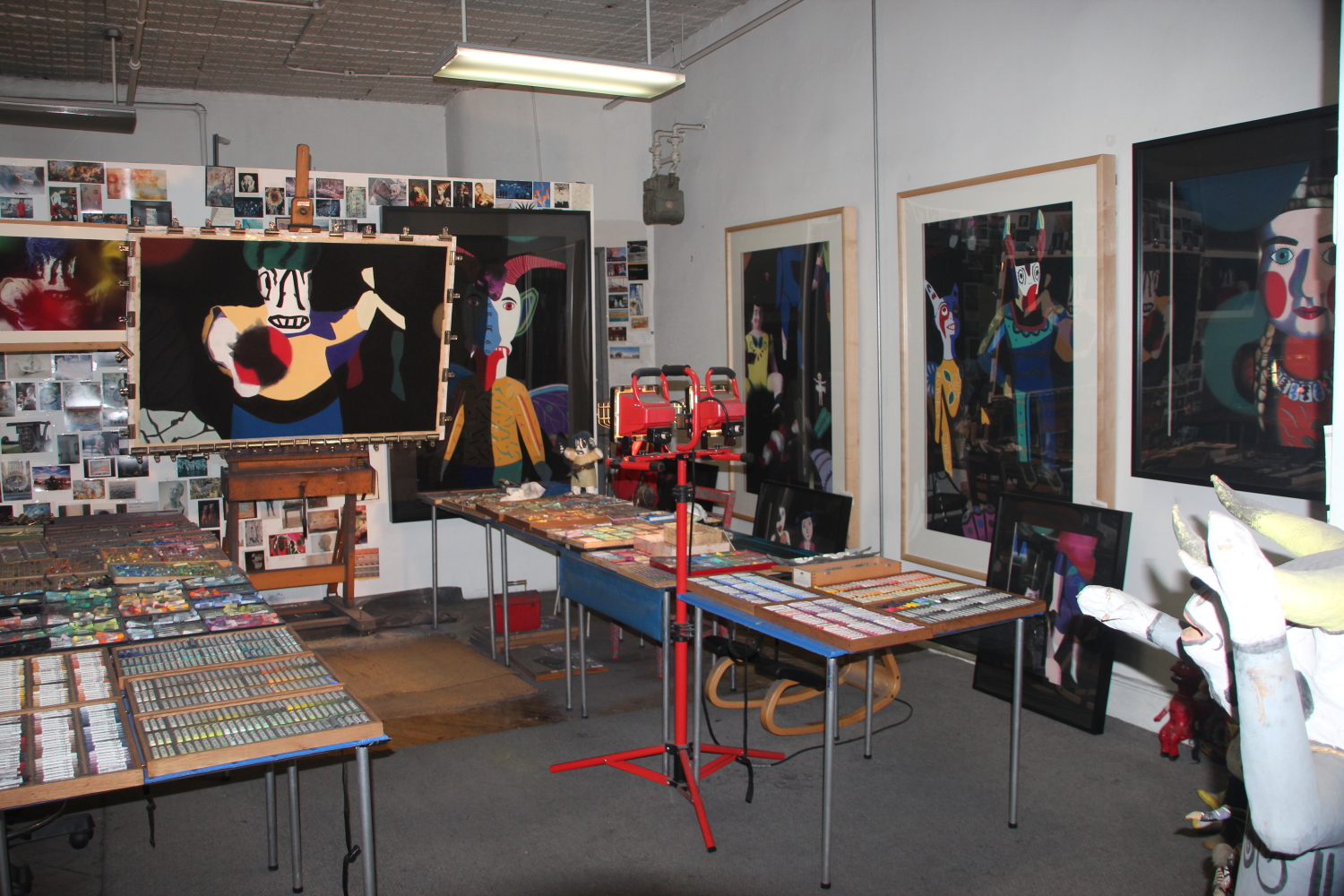
Barbara’s studio
A: The short answer is that I absolutely love making art in my studio and on the best days I barely even notice time going by!
Admittedly, it’s a hard road. Pursuing life as an artist takes a very special and rare sort of person. Talent and having innate gifts are a given, merely the starting point. We must possess a whole cluster of characteristics and be unwavering in displaying them. We are passionate, hard-working, smart, devoted, sensitive, self-starting, creative, hard-headed, resilient, curious, persistent, disciplined, stubborn, inner-directed, tireless, strong, and on and on. Into the mix add these facts. We need to be good business people. Even if we are, we are unlikely to make much money. We are not respected as a profession. People often misunderstand us: at best they ignore us, at worst they insult our work and us, saying we are lazy, crazy, and more.
The odds are stacked against any one individual having the necessary skills and stamina to withstand it all. So many artists give up, deciding it’s too tough and just not worth it, and who can blame them? This is why I believe artists who persevere over a lifetime are true heroes. It’s why I do all I can to help my peers. Ours is an extremely difficult life – it’s impossible to overstate this – and each of us finds our own intrinsic rewards in the work itself. Otherwise there is no reason to stick with it. Art is a calling and for those of us who are called, the work is paramount. We build our lives around the work until all else becomes secondary and falls away. We are in this for the duration.
In my younger days everything I tried in the way of a career eventually became boring. Now with nearly thirty years behind me as a working artist, I can still say, “I am never bored in the studio!” It’s difficult to put into words why this is true, but I know that I would not want to spend my time on this earth doing anything else. How very fortunate that I do not have to do so!
Comments are welcome!
Q: How do you feel about accepting commissions?

“Reunion,” soft pastel on sandpaper, 38″ x 58″, 1990
A: By the time I left the Navy in 1989 to devote myself to making art, I had begun a career as a portrait painter. I needed to make money, this was the only way I could think of to do so, and I had perfected the craft of creating photo-realistic portraits in pastel. It worked for a little while.
A year later I found myself feeling bored and frustrated for many reasons. I didn’t like having to please a client because their concerns generally had little to do with art. Once I ensured that the portrait was a good (and usually flattering) likeness, there was no more room for experimentation, growth, or creativity. I believed (and still do) that I could never learn all there was to know about soft pastel. I wanted to explore color and composition and take this under-appreciated medium as far as possible. It seemed likely that painting portraits would not allow me to accomplish this. Also, I tended to underestimate the amount of time needed to make a portrait and charged too small a fee.
So I decided commissioned portraits were not for me and made the last one in 1990 (above). I feel fortunate to have the freedom to create work that does not answer to external concerns.
Comments are welcome!
Q: How do you define success as an artist?
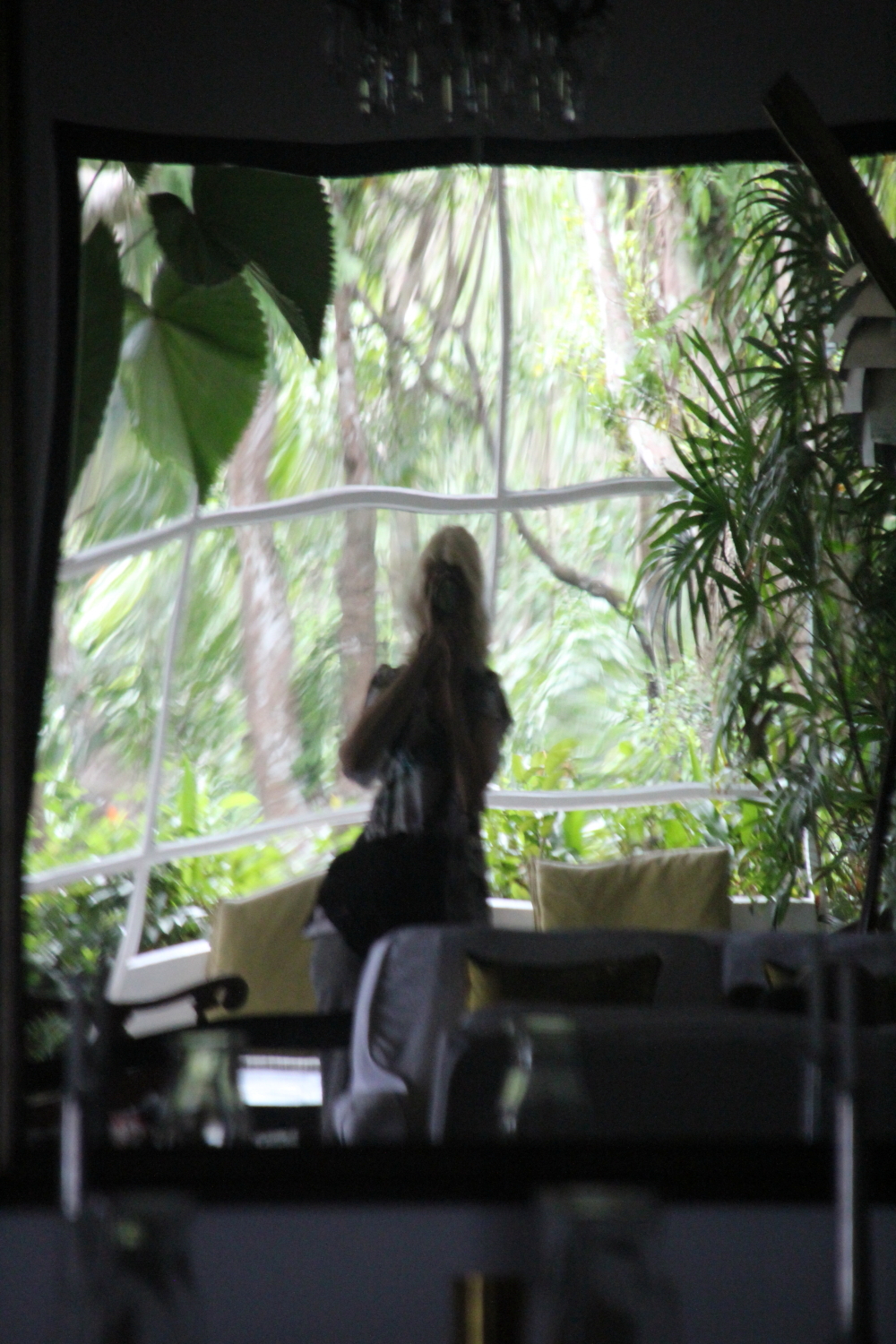
Self-portrait at an architect’s estate in Sri Lanka
A: This is another question that has many answers depending more or less on how things are progressing in the studio. I’d say that you are a successful artist if you are able to keep working and evolving, and are mostly living by your own rules, using your time as you see fit to become a better artist. This means navigating through all the ups and downs, the obstacles – and we know there are many – to art-making and finding joy and on-going discovery in your own particular creative process. The work is everything, as we always say, but hopefully, you have found an appreciative audience and do sell a piece of art now and then.
I know that I am more fortunate than many. Over time I’ve realized that money, i.e., sales, is one of the less important aspects of being an artist. The richness that being a professional artist brings to my life goes far beyond anything that can be acquired with cash!
Comments are welcome!
Pearls from artists* # 12

Grand Falls, AZ
* an ongoing series of quotations – mostly from artists, to artists – that offers wisdom, inspiration, and advice for the sometimes lonely road we are on.
People who set their sails into art tend to work very hard. They train themselves in school; they practice and they read and they think and they talk. But for most of them there seems to be a more or less conscious cutoff point. It can be a point in time: “I will work until I am twenty-one (twenty-five, thirty, or forty).” Or a point in effort: “I will work three hours a day (or eight or ten).” Or a point in pleasure: “I will work unless…” and here the “enemies of promise” harry the result. These are personal decisions, more or less of individual will. They depend on the scale of values according to which artists organize their lives. Artists have a modicum of control. Their development is open-ended. As the pressure of their work demands more and more of them. they can stretch to meet it. They can be open to themselves, and as brave as they can be to see who they are, what their work is teaching them. This is never easy. Every step forward is a clearing through a thicket of reluctance and habit and natural indolence. And all the while they are at the mercy of events. They may have a crippling accident, or may find themselves yanked into a lifelong responsibility such as the necessity to support themselves and their families. Or a war may wipe out the cultural context on which they depend. Even the most fortunate have to adjust the demands of a personal obsession to the demands of daily life.
Anne Truitt, Daybook: The Journal of an Artist
Comments are welcome.
Pearls from artists* # 10

West 28th Street
* an ongoing series of quotations – mostly from artists, to artists – that offers wisdom, inspiration, and advice for the sometimes lonely road we are on.
That art that matters to us – which moves the heart, or revives the soul,or delights the senses, or offers courage for living, however we choose to describe the experience – that work is received by us as a gift is received. Even if we are touched by a work of art something comes to us which has nothing to do with the piece. I went to see a landscape painter’s works, and that evening, walking among pine trees near my home, I could see the shapes and colors I had not seen the day before. The spirit of an artist’s gifts can wake our own. The work appeals, as Joseph Conrad says, to a part of our being which is itself a gift and not an acquisition. Our sense of harmony can hear the harmonies that Mozart heard. We may not have the power to profess our gifts as the artist does,and yet we come to recognize, and in a sense to receive, the endowments of our being through the agency of his creation. We feel fortunate, even redeemed. The daily commerce of our lives – “sugar for sugar and salt for salt,” as the blues singers say – proceeds at its own constant level, but a gift revives the soul. When we are moved by art we are grateful that the artist lived, grateful that he labored in the service of his gift.
If a work of art is the emanation of its maker’s gift and if it is received by its audience as a gift, then is it, too, a gift? I have framed the question to imply an affirmative answer, but I doubt we can be so categorical. Any object, any item of commerce, becomes one kind of property or another depending on how we use it. Even if a work of art contains the spirit of the artist’s gift, it does not follow that the work itself is a gift. It is what we make of it.
And yet, that said, it must be added that the way we treat a thing can sometimes change its nature. For example, religions often prohibit the sale of sacred objects, the implication being that their sanctity is lost if they are bought and sold. A work of art seems to be a hardier breed; it can be sold in the market and still emerge a work of art. But if it is true that in the essential commerce of art a gift is carried by the work from the artist to his audience, if I am right to say that where there is no gift there is no art, then it is possible to destroy a work of art by converting it into a commodity. Such, at any rate, is my position. I do not maintain that art cannot be bought and sold; I do maintain that the gift portion of the work places a constraint upon our merchandising.
Lewis Hyde, The Gift
Comments are welcome.


 barbararachkoscoloreddust.com