Category Archives: Working methods
Pearls from artists* # 59

Studio
* an ongoing series of quotations – mostly from artists, to artists – that offers wisdom, inspiration, and advice for the sometimes lonely road we are on.
Friends sometimes ask, “Don’t you get lonely sitting by yourself all day?” At first it seemed odd to hear myself say No. Then I realized that I was not alone; I was in the book; I was with the characters. I was with my Self.
Not only do I not feel alone with my characters; they are more vivid and interesting to me than the people in my real life. If you think about it, the case can’t be otherwise. In order for a book (or any project or enterprise) to hold our attention for the length of time it takes to unfold itself, it has to plug into some internal perplexity or passion that is of paramount importance to us. The problem becomes the theme of our work, even if we can’t at the start understand or articulate it. As the characters arise, each embodies infallibly an aspect of that dilemma, that perplexity. These characters might not be interesting to anyone else but they’re absolutely fascinating to us. They are us. Meaner, smarter, sexier versions of ourselves. It’s fun to be with them because they’re wrestling with the same issue that has its hooks into us. They’re our soul mates, our lovers, our best friends. Even the villains. Especially the villains.
Stephen Pressfield in The War of Art
Comments are welcome!
Q: What’s on the easel today?
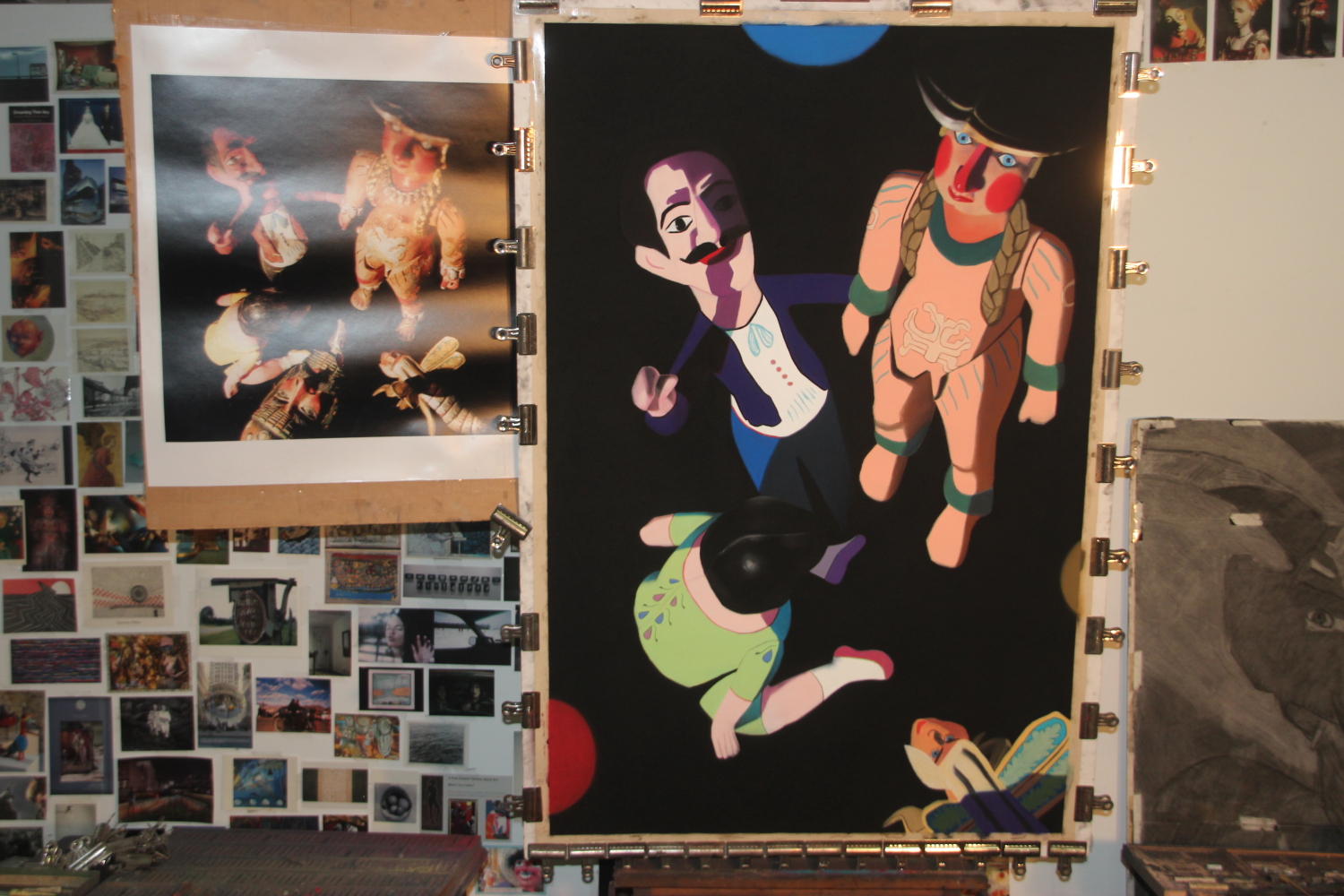
“The Ancestors,” soft pastel on sandpaper, 58″ x 38″, in progress
A: I’m putting in details on “The Ancestors.” At this stage I am doing very meticulous work and progress is difficult to see in photographs (above).
Comments are welcome!
Pearls from artists* # 56
Utah
* an ongoing series of quotations – mostly from artists, to artists – that offers wisdom, inspiration, and advice for the sometimes lonely road we are on.
Balancing intuition against sensory information, and sensitivity to one’s self against pragmatic knowledge of the world, is not a stance unique to artists. The specialness of artists is the degree to which these precarious balances are crucial backups for their real endeavor. Their essential effort is to catapult themselves wholly, without holding back one bit, into a course of action without having any idea where they will end up. They are like riders who gallop into the night, eagerly leaning on their horse’s neck, peering into a blinding rain. And they have to do it over and over again. When they find that they have ridden and ridden – maybe for years, full tilt – in what is for them a mistaken direction, they must unearth within themselves some readiness to turn direction and to gallop off again. They may spend a little time scraping off the mud, resting the horse, having a hot bath, laughing and sitting in candlelight with friends. But in the back of their minds they never forget that the dark, driving run is theirs to make again. They need their balances in order to support their risks. The more they develop an understanding of all their experience – the more it is at their command – the more they carry with them into the whistling wind.
Anne Truitt in Daybook: The Journal of an Artist
Q: Would you speak about the practical realities – time and expenses – involved in making your pastel-on-sandpaper paintings? What might people be surprised to learn about this aspect of art-making?
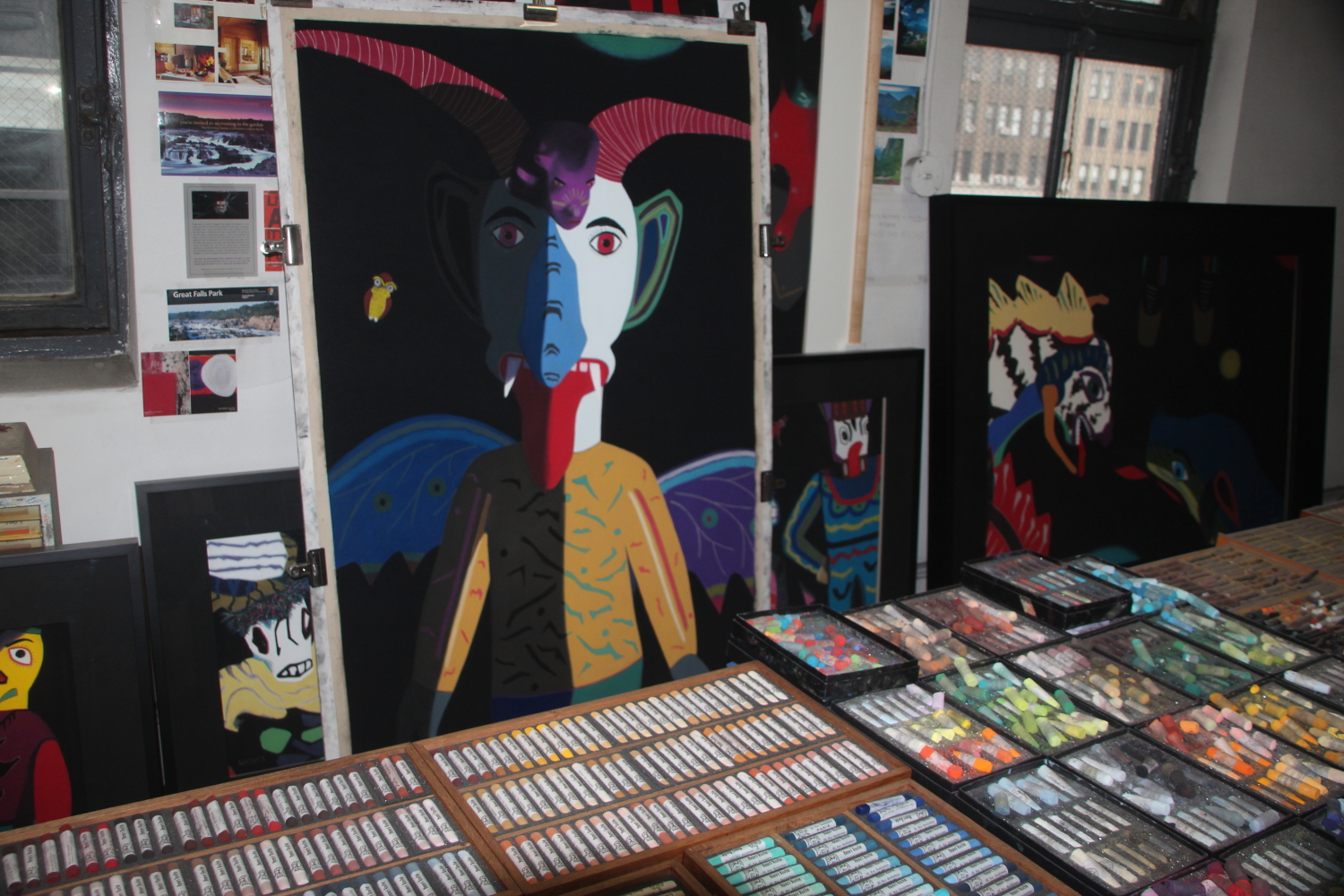
Studio
A: I have often said that this work is labor-intensive. In a good year I can complete five or six large (38″ x 58″) pastel paintings. In 2013 I am on track to make four, or, on average, one completed painting every three months. I try to spend between thirty-five and forty hours a week in the studio. Of course, I don’t work continuously all day long. I work for awhile, step back, look, make changes and additions, think, make more changes, step back, etc. Still, hundreds of hours go into making each piece in the “Black Paintings” series, if we count only the actual execution. There is also much thinking and preparation – there is no way to measure this – that happen before I ever get to stand before an empty piece of sandpaper and begin.
As far as current expenses, they are upwards of $12,000 per painting. Here is a partial breakdown:
$4500 New York studio, rent and utilities ($1350/month) for three months
$2500 Supplies, including frames (between $1500 – $1700), photographs, pastels (pro-rated), paper
$2000 Foreign travel to find the cultural objects, masks, etc. depicted in my work (approximate, pro-rated)
$3000 Business expenses, such as computer-related expenses, website, marketing, advertising, etc.
This list leaves out many items, most notably compensation for my time, shipping and exhibition expenses, costs of training (i.e. ongoing photography classes), photography equipment, etc. Given my overhead, the paintings are always priced at the bare minimum that will allow me to continue making art.
I wonder: ARE people surprised by these numbers? Anyone who has ever tried it knows that art is a tough road. Long ago I stopped thinking about the cost and began doing whatever is necessary to make the best paintings. The quality of the work and my evolution as an artist are paramount now. This is my life’s work, after all.
Comments are welcome!
Pearls from artists* # 54
Pier 40, NYC
* an ongoing series of quotations – mostly from artists, to artists – that offers wisdom, inspiration, and advice for the sometimes lonely road we are on.
In the cemetery all the vultures began to circle, and the sky filled with birds. It was then that I began my series of birds – many of my bird photos came from that moment. All this is to say that in life everything is connected: your pain and your imagination, which perhaps can help you forget reality. It’s a way of showing how you connect what you live with what you dream, and what you dream with what you do, and this is what remains on paper…
Graciela Iturbide in Eyes to Fly With
Comments are welcome!
Pearls from artists* # 50

The Getty Museum, Los Angeles
The important thing is the intersection between intuition and discipline, because you have to be alert and at the same time invisible. The eye has to be alert and capture very quickly everything you have inside you – I don’t know how to explain it. What the eye sees is the synthesis of what you are or what you’ve learned to do, this is the language of photography…
Graciela Iturbide in Eyes to Fly With
Comments are welcome!
Q: Your pastel-on-sandpaper paintings are very labor intensive. Do you typically have just one in progress at any given time?

Works in progress, soft pastel on sandpaper, 58″ x 38″
A: For many years I always worked on one at a time because I have only one or two ideas – never more than that – about what I will make next. Also, I believe that “all art is the result of one’s having gone through an experience to the end.” (It’s on a note taped to the wall near my easel). So I would work on one painting at a time until all of the problems in it were resolved. Each piece that I undertake represents an investment of several months of my life and after nearly three decades as an artist, I know that once I start a piece I will not abandon it for any reason. When it is the best painting that I can make – when adding or subtracting anything would be a diminishment – I pronounce it “finished.” In the past I would start the next one only when the completed piece was out of my sight and at the frame shop.
But a few years ago I began working on two pastel paintings at a time. When I get stuck – or just need a break from looking at the same image day after day (I am in my studio 5 days a week) – I switch to the other one. This helps me work more efficiently. The two paintings interact with each other; they play off of each other and one suggests solutions that help me to resolve problem areas in the other. I’m not sure exactly how this happens – maybe putting a piece aside for awhile alerts my unconscious to begin working deeply on it – but having two in progress at the same time is my preferred way of working now.
A note about the painting on the left above, which was previously called, “Judas.” I happen to be reading “Cloud Atlas,” by David Mitchell and came across the word “judasing” used as a verb meaning, “doing some evil to a person who profoundly trusted you.” I’d never heard the word before, but it resonated with an event in my personal life. So the new title of my painting is “Judasing.” This is a good reminder that work and life are inextricably (and inexplicably) woven together and that titles can come from anywhere!
Comments are welcome!
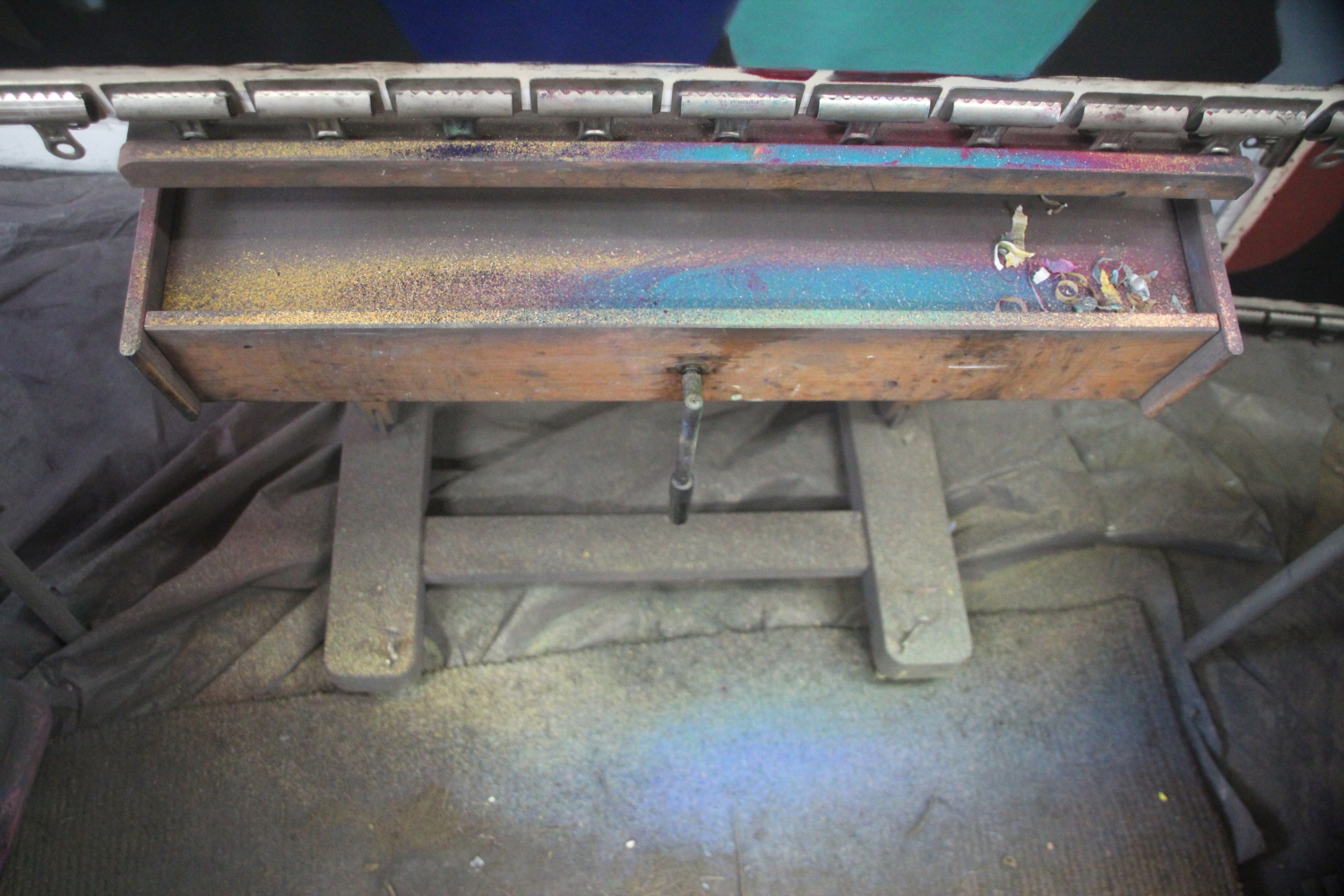
Q: How do you remove pastel dust from your clothing, fingers, etc.?
Pastel dust
A: Pastel usually comes out of my clothes easily in the laundry, unless I have had an intense studio session where I let it make a total mess. I try not to wear good clothes to the studio. Getting it off my hands is easy with Artguard, a barrier cream I always apply before working. A good scrub with soap and water washes the pastel right off.
The worst occupational hazard, believe it or not, is what happens to the tops of my shoes! As I work, the dust falls onto my feet and I usually don’t notice until the end of the day. Whether made of canvas, leather, or whatever, shoes can be a problem when it comes to removing the dust.
Comments are welcome!
Pearls from artists* # 48

“Big Deal,” with double portrait of the author
* an ongoing series of quotations – mostly from artists, to artists – that offers wisdom, inspiration, and advice for the sometimes lonely road we are on.
Until the invention of photography, the painted (or sculptural) portrait was the only means of recording and presenting the likeness of a person. Photography took over this role from painting and at the same time raised our standards for judging how much an informative likeness should include.
This is not to say that photographs are in all ways superior to painted portraits. They are more informative, more psychologically revealing, and in general more accurate. But they are less tensely unified. Unity in a work of art is achieved as a result of the limitations of the medium. Every element has to be transformed in order to have its proper place within these limitations. In photography the transformation is to a considerable extent mechanical. In a painting each transformation is largely the result of a conscious decision by the artist. Thus the unity of a painting is permeated by a far higher degree of intention. The total effect of a painting (as distinct from its truthfulness) is less arbitrary than that of a photograph; its construction is more intensely socialized because it is dependent on a greater number of human decisions. A photographic portrait may be more revealing and accurate about the likeness and character of the sitter; but it is likely to be less persuasive, less (in the very strict sense of the word) conclusive. For example, if the portraitist’s intention is to flatter or idealize, he will be able to do so far more convincingly in a painting than with a photograph.
Geoff Dyer, editor, Selected Essays: John Berger
Comments are welcome!
Q: Have you ever worked outside?

Reproductions of “Cardinal Rule” (top) and “Blue Ego,” originals are soft pastel on sandpaper, 30″ x 38″
A: As a pastel artist I’ve never worked outside – with so many pastels, it’s just not practical – but early on in the “Domestic Threats” series, I created two outdoor setups. Works in the series derived from elaborate scenes that I arranged and then photographed.
I used to take long walks along the Potomac River in Alexandria, VA, and there was a tree stump that was fascinating. It was mostly twisted roots, knotty branches, dark hidden spaces, etc. (top painting in photo). One morning I took several hand puppets and stuffed animals (my subject matter at the time) and carefully arranged them on the tree. Around me people were busy exercising their dogs. Soon I attracted quite a bit of attention – a tall blonde woman playing with puppets on a tree stump! Dogs came over to sniff. Their owners came over, too, and I was pressed into explaining, again and again, that I was an artist, that I was photographing this scene so I could paint it, etc. The interruptions were very annoying.
The second time I tried an outdoor setup was again along the Potomac River, but this time I selected a secluded strip of beach where I was undisturbed. I had forgotten to consider the light and inadvertently chose a cloudy day. I remember being disappointed that the light was flat and lacking shadows. The painting (bottom in photo) turned out to be one of my least favorites.
I resolved from then on to focus on interiors. Alfred Hitchcock famously used rear projection so that he could work in a studio rather than on location. One reason, he said, was that in a studio he had total control. I know what he meant. When I set up an interior scene and position the lights to make interesting shadows, indeed, I have control over the whole look. No aspect is left to chance. The accidents – improvements! – happen later when I work on the painting.
Comments are welcome!


 barbararachkoscoloreddust.com