Blog Archives
Pearls from artists* # 659

*an ongoing series of quotations – mostly from artists, to artists – that offers wisdom, inspiration, and advice for the sometimes lonely road we are on.
Your only goal is to be the purest and strongest version of yourself, and to articulate that as fully as possible through your creations. Avoid any enticements that threaten to eclipse the priority of your work, to lure you off in another direction toward a different goal. You are here to spend a lifetime exploring and refining what excites you.
Like Olympic athletes, trailblazing artists do not waste a second looking around at their competition to measure how they are doing. They do not look to the sidelines to measure their applause. They just keep moving forward, in the focused direction of their vision. When you possess a quiet, solid confidence and you are completely unshaken (not even a twitch) when someone looks at your work and says, ‘I don’t really like it,’ you have arrived. If you are not there yet, keep practicing. The opinions of others are simply the ever-shifting clouds, moving across your infinite azure sky.
Kate Kretz in Art From Your Core: A Holistic Guide to Visual Voice
Comments are welcome!
Pearls from artists* # 651

*an ongoing series of quotations – mostly from artists, to artists – that offers wisdom, inspiration, and advice for the sometimes lonely road we are on.
We are engaged in a mission that can be perplexing to those around us. We are playing a long game that no one else can see. Every time we walk into the studio, it is a mini act of defiance against all of those who believe we are wasting our time. If you do not shore up and internalize this right to make art until it becomes a part of you, outside forces will repeatedly rise up to challenge it, creating conflict. Understand deep in your being that making art is a vital part of who you are, to be your own strongest advocate. Be greedy for the time and space your work requires to be actualized.
Kate Kretz in Art From Your Core: A Holistic Guide to Visual Voice
Comments are welcome!
Q: What art project(s) are you working on currently? What is your inspiration or motivation for this? (Question from artamour)

A: While traveling in Bolivia in 2017, I visited a mask exhibition at the National Museum of Ethnography and Folklore in La Paz. The masks were presented against black walls, spot-lit, and looked eerily like 3D versions of my Black Paintings, the series I was working on at the time. I immediately knew I had stumbled upon a gift. To date I have completed seventeen pastel paintings in the Bolivianos series. One awaits finishing touches, another is in progress, and I am planning the next two, one large and one small pastel painting.
The following text is from my “Bolivianos” artist’s statement.
“My long-standing fascination with traditional masks took a leap forward in the spring of 2017 when I visited the National Museum of Ethnography and Folklore in La Paz, Bolivia. One particular exhibition on view, with more than fifty festival masks, was completely spell-binding.
The masks were old and had been crafted in Oruro, a former tin-mining center about 140 miles south of La Paz on the cold Altiplano (elevation 12,000’). Depicting important figures from Bolivian folklore traditions, the masks were created for use in Carnival celebrations that happen each year in late February or early March.
Carnival in Oruro revolves around three great dances. The dance of “The Incas” records the conquest and death of Atahualpa, the Inca emperor when the Spanish arrived in 1532. “The Morenada” dance was once assumed to represent black slaves who worked in the mines, but the truth is more complicated (and uncertain) since only mitayo Indians were permitted to do this work. The dance of “The Diablada” depicts Saint Michael fighting against Lucifer and the seven deadly sins. The latter were originally disguised in seven different masks derived from medieval Christian symbols and mostly devoid of pre-Columbian elements (except for totemic animals that became attached to Christianity after the Conquest). Typically, in these dances the cock represents Pride, the dog Envy, the pig Greed, the female devil Lust, etc.
The exhibition in La Paz was stunning and dramatic. Each mask was meticulously installed against a dark black wall and strategically spotlighted so that it became alive. The whole effect was uncanny. The masks looked like 3D versions of my “Black Paintings,” a pastel paintings series I have been creating for ten years. This experience was a gift… I could hardly believe my good fortune!
Knowing I was looking at the birth of a new series – I said as much to my companions as I remained behind while they explored other parts of the museum – I spent considerable time composing photographs. Consequently, I have enough reference material to create new pastel paintings in the studio for several years. The series, entitled “Bolivianos,” is arguably my strongest and most striking work to date.”
Comments are welcome!
Q: What kind of art do you create?
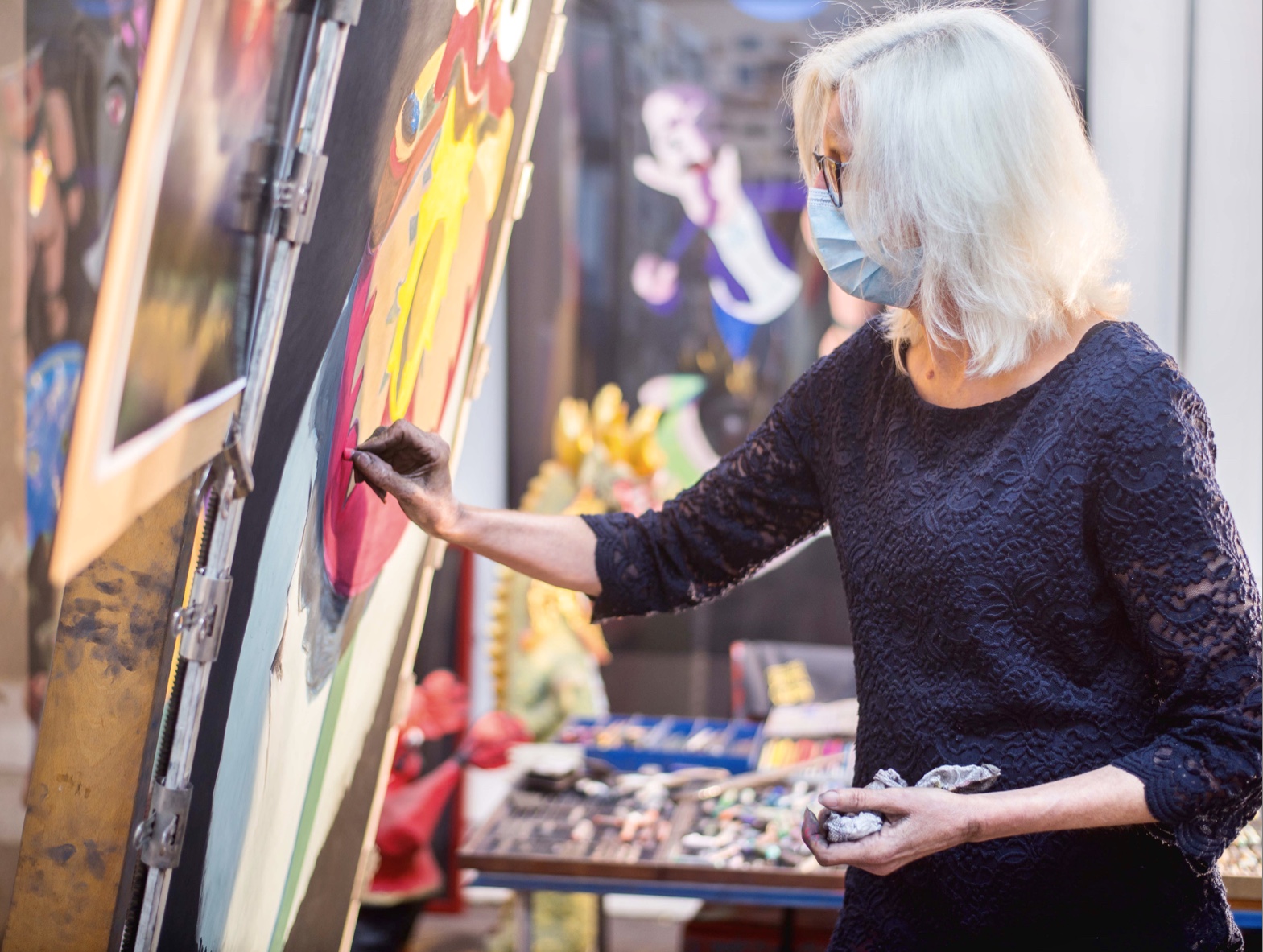
At work
A: I live in the West Village in New York City and have been a working artist for thirty-four years. I create original pastel paintings that use my large collection of Mexican and Guatemalan folk art – masks, carved wooden animals, papier mache figures, and toys – as subject matter. Blending with my fingers, I spend months painstakingly applying dozens of layers of soft pastel onto acid-free sandpaper. My self-invented technique achieves extraordinarily rich, vibrant color and results in paintings that uniquely combine reality, fantasy, and autobiography. Please see https://barbararachko.art/en/
For the last three years I have been working on a series called, “Bolivianos,” based on an exhibition of Carnival masks seen in La Paz. Art critics and others have said that these are my strongest pastel paintings so far. As I write I am working on the fifteenth piece in the series.
Comments are welcome!
Q: What more would you wish to bring to your work?

Tile worker in South India
A: I tend to follow wherever the work leads, rather than directing it. I have never been able to predict where it will lead or what more might be added.
Travel is essential for inspiration. Besides many Mexican sojourns, I have been to Bali, Sri Lanka, South India, Guatemala, Honduras, Brazil, Peru, Argentina, Paraguay, and other places. A second trip to India is upcoming, to Gujarat and Rajistan this time.
Last year I had the opportunity to go to Bolivia. In La Paz I visited the Museum of Ethnography and Folklore, where a stunning mask exhibition was taking place. As soon as I saw it, I knew this would be the inspiration for my next series, “Bolivianos.” So far I have completed six “Bolivianos” pastel paintings with two more in progress now. This work is getting a lot of press and several critics have declared it to be my strongest series yet.
Comments are welcome!
Pearls from artists* # 42
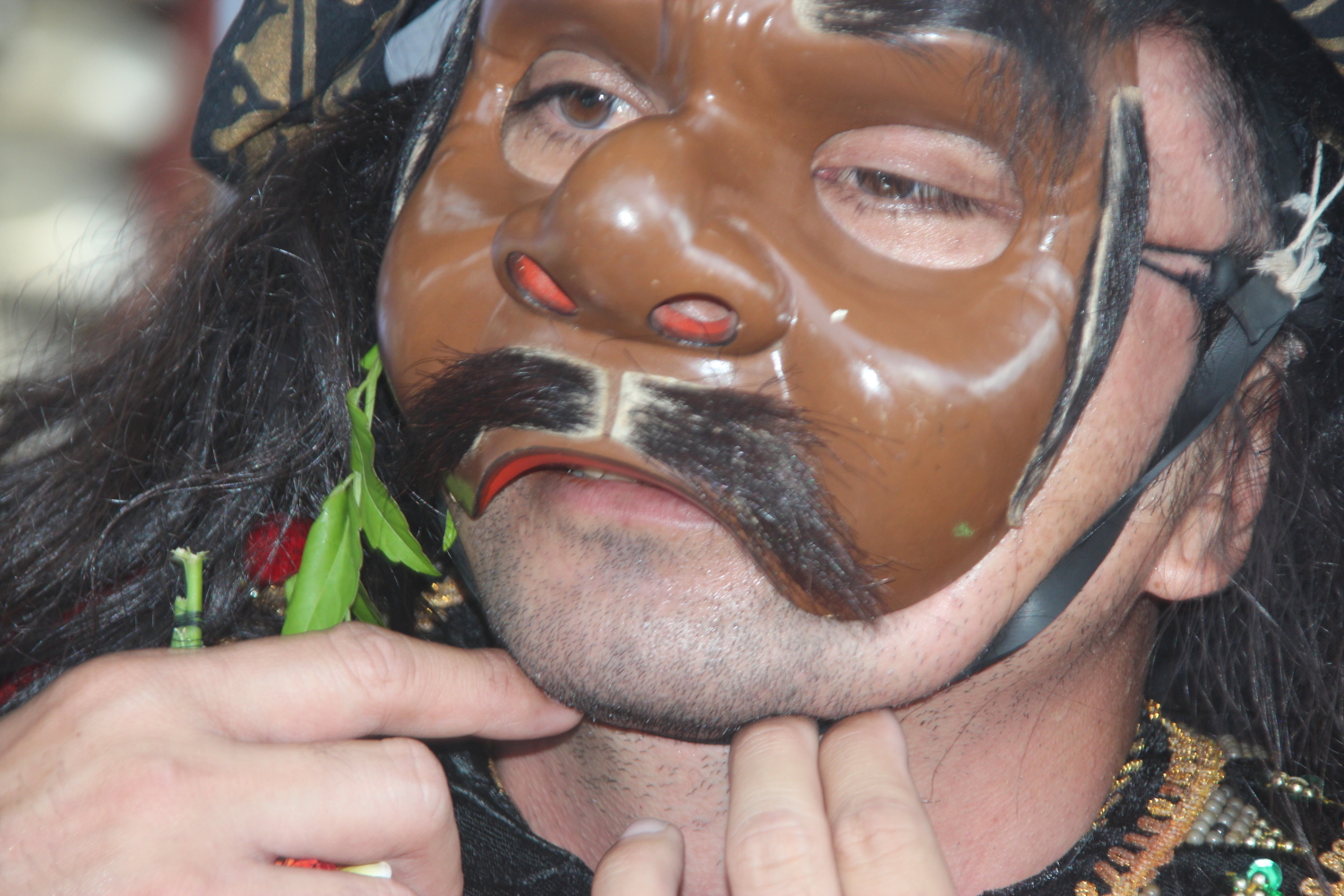
Balinese dancer
* an ongoing series of quotations – mostly from artists, to artists – that offers wisdom, inspiration, and advice for the sometimes lonely road we are on.
Things-as-they-are offer such an abundance of material that a photographer must guard against the temptation of trying to do everything. It is essential to cut from the raw material of life – to cut and cut, but to cut with discrimination. While working, a photographer must reach a precise awareness of what he is trying to do. Sometimes you have the feeling that you have already taken the strongest possible picture of a particular situation or scene; nevertheless, you find yourself compulsively shooting, because you cannot be sure in advance exactly how the situation, the scene is going to unfold. You must stay with the scene, just in case elements of the situation shoot off from the core again. At the same time, it’s essential to avoid shooting like a machine-gunner and burdening yourself with useless recordings which clutter your memory and spoil the exactness of the reportage as a whole.
Henri Cartier-Bresson in Images a la sauvette
Comments are welcome!


 barbararachkoscoloreddust.com