Blog Archives
Pearls from artists* # 361

“The Champ,” soft pastel on sandpaper, 26″ x 20″
* an ongoing series of quotations – mostly from artists, to artists – that offers wisdom, inspiration, and advice for the sometimes lonely road we are on.
It seems to me in the end, as far as expressing yourself is concerned, you just have to plunge in, fears and all. There is something courageous about it. If a person is too timid even to start, I’m not sure what it would take to get that person started.I;m not a big believer in books and courses that advocate going into creativity rituals and altar-making and mask-making in order to get unstuck and get started. Maybe that stuff works. I don’t know. It just seems like more strategies to avoid getting on with it.
Ian Roberts in Creative Authenticity: 16 Principles to Clarify and Deepen Your Artistic Vision
Comments are welcome!
Q: What’s on the easel today?
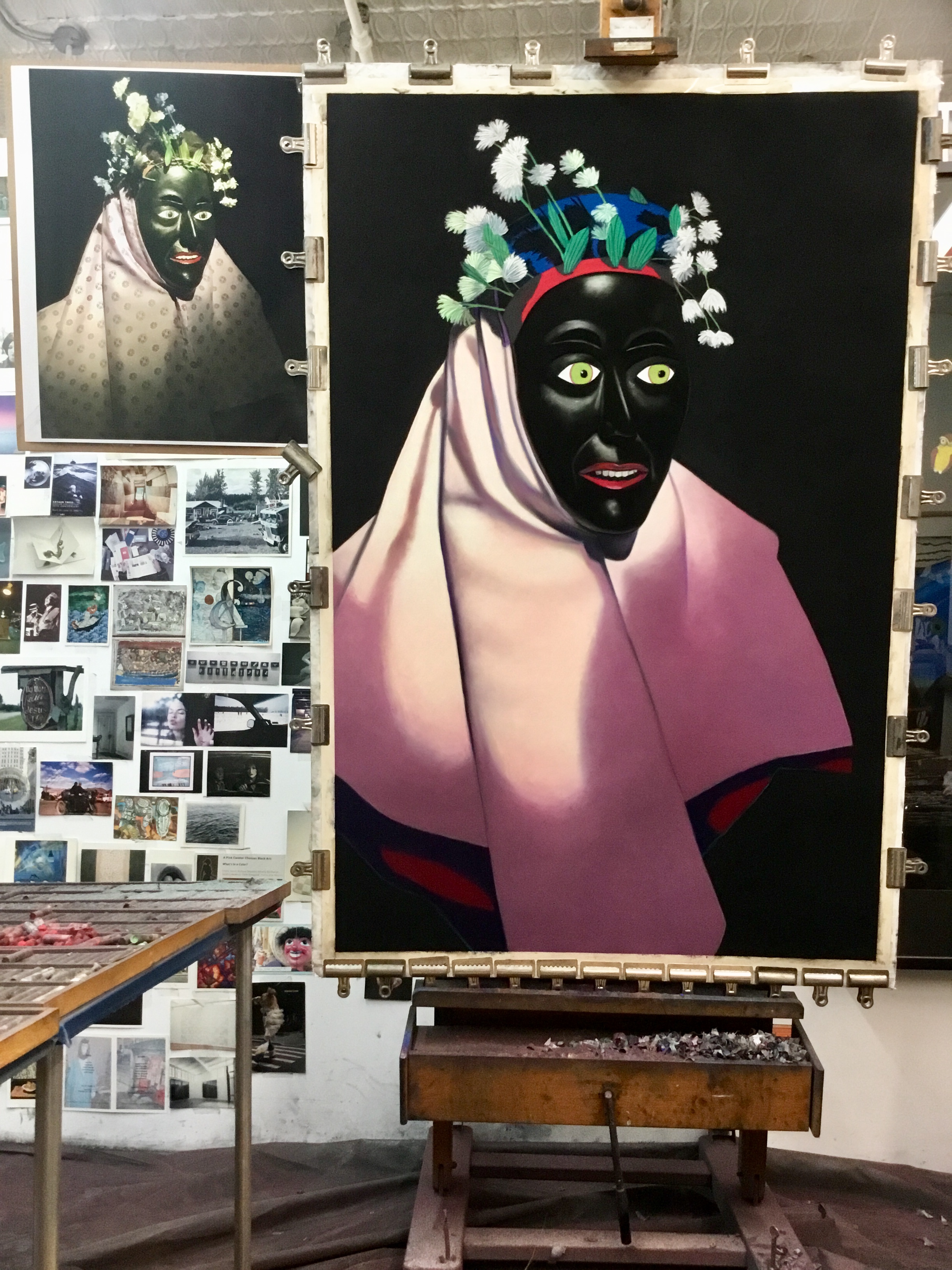
Work in progress
A: “Poseur,” Soft Pastel on Sandpaper, 58’ x 38” is awaiting finishing touches… at last!
Comments are welcome!
Q: Did your military experience become a building block on which you formed your artistic ideas?
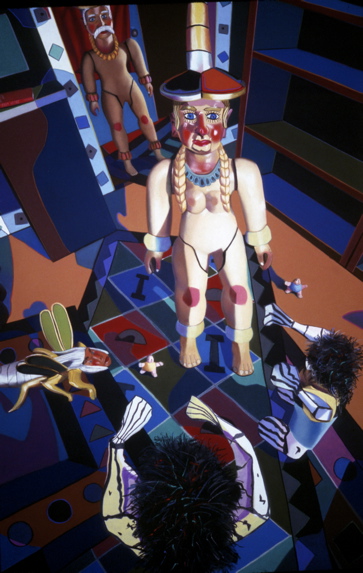
“Answering the Call,” 58″ x 38,” soft pastel on sandpaper, 2000
A: In my younger days boredom was a strong motivator. I left the active duty Navy out of boredom. I couldn’t bear not being intellectually challenged (most of my jobs consisted of paper-pushing), not using my flying skills, and not developing my artistic talent. In what must be a first, by spending a lot of time and money training me for jobs I hated, the Navy turned me into a hard-working, devoted, and disciplined artist! Once I left the Navy there was no plan B. It was “full speed ahead” to become an accomplished artist.
Comments are welcome!
Q: You earned a degree in psychology. From that I’m sure you gained an in-depth understanding of humans and their stories. How has that influenced your art?
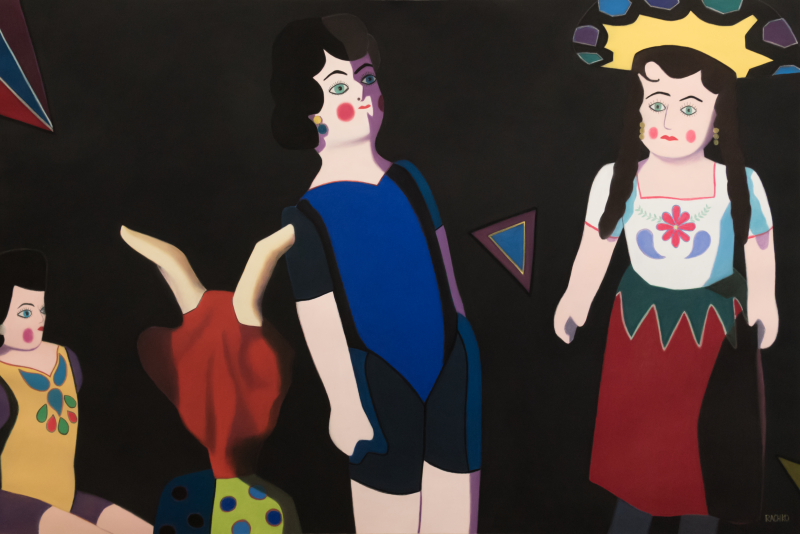
“Conundrum,” soft pastel on sandpaper, 38″ x 58″
A: I suppose there must be some deep connection, but I have never seen much of a correspondence between my psychology degree and the art I create. As an undergraduate psych major at the University of Vermont, my intent was to become a clinical psychologist. However, by the time I received my BA, I was no longer interested in making that my life’s work.
Comments are welcome!
Pearls from artists* # 355
“The Champ,” soft pastel on sandpaper, 26″ x 20″
*an ongoing series of quotations – mostly from artists, to artists – that offers wisdom, inspiration, and advice for the sometimes lonely road we are on.
True art provides us with truth in a manner analogous to science. Its prophetic dimension – its knack for showing us the side of things that our interests blind us to – make it a source of knowledge, even though it is knowledge of a kind that instrumental reason has little time for. The psychologists who revolutionized our understanding of human psychology in the earliest twentieth century drew on two principal sources to build their concepts: the dream life of their patients and the great art of the past. Without this recognition of the primacy of imagination, Freud and Jung could never have drawn their maps of the psyche. Those who work for a better world would do well to follow their example and find the guiding patterns of life in the prophetic artistic works of the past and present. Only art can act as a counter-weight to that uniquely modern mentality that, wherever it becomes the only game in town, seeks to persuade us that the proper goal of human beings is to contain, dissect, and control everything – that even the most persistent mysteries are just problems to be solved.
J.F. Martel in Reclaiming Art in the Age of Artifice: A Treatise, Critique, and Call to Action
Comments are welcome!
Pearls from artists* # 354

“Epiphany,” soft pastel on sandpaper, 38″ x 58″
*an ongoing series of quotations – mostly from artists, to artists – that offers wisdom, inspiration, and advice for the sometimes lonely road we are on.
My earlier work had taught me that artistic activity is a form of reasoning, in which perceiving and thinking are indivisibly intertwined. A person who paints, writes, composes, dances, I felt compelled to say, thinks with his senses. This union of perception and thought turned out to be not merely a specialty of the arts. A review of what is known about perception, and especially about sight, made me realize that the remarkable mechanisms by which the senses understand the environment are all but identical with the operations described by the psychology of thinking. Inversely, there was much evidence that truly productive thinking in whatever area of cognition takes place in the realm of imagery. This similarity of what the mind does in the arts and what it does elsewhere suggested taking a new look at the long-standing complaint about the isolation and neglect of the arts in society and education. Perhaps the real problem was more fundamental: a split between sense and thought, which caused various deficiency diseases in modern man.
Rudolph Arnheim in Visual Thinking
Comments are welcome!
Q: What’s on the easel today?
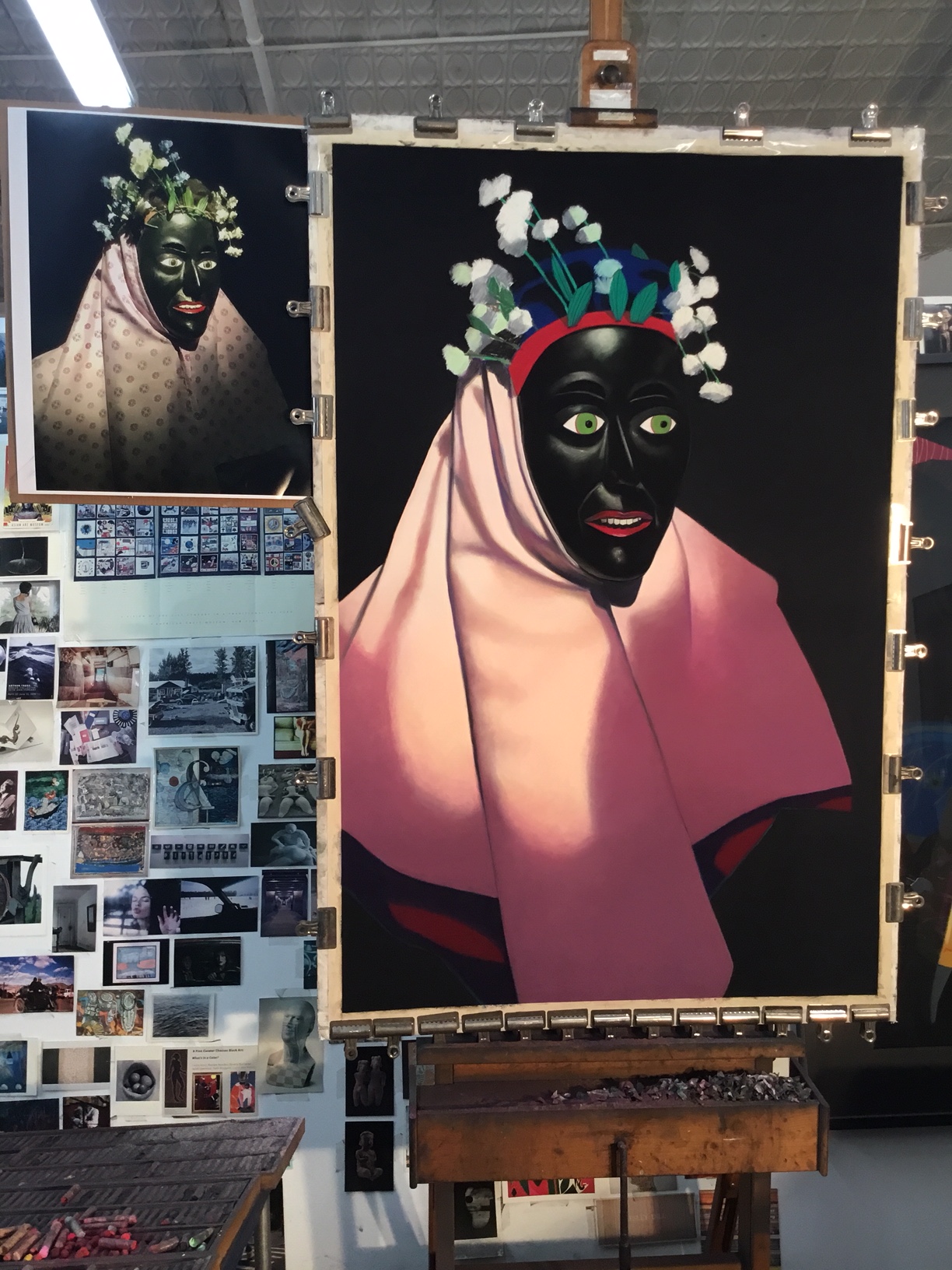
Work in progress
A: I continue working on the latest in the “Bolivianos” series, “Poseur,” Soft Pastel on Sandpaper, 58” x 38.” I haven’t decided yet whether to put a pattern on the fabric.
Comments are welcome!
Q: Are you certain that the art materials you use are light- and color-fast?
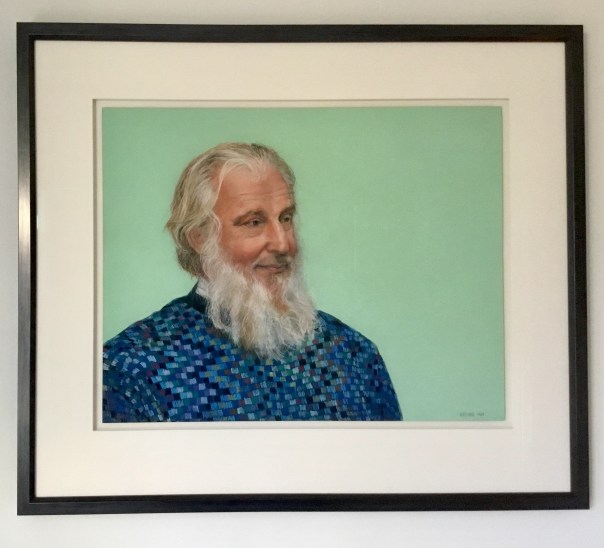
“John,” Soft Pastel on Sandpaper, 22” x 26” (image), 1989.
A: Yes, I am. Recently I came into possession of a pastel portrait that I had not seen in thirty years. How fantastic to report that it looks exactly the same as in 1989 when I made It!
Comments are welcome!
Pearls from artists* # 345

Barbara working on an interview. Photo: Maria Cox
*an ongoing series of quotations – mostly from artists, to artists – that offers wisdom, inspiration, and advice for the sometimes lonely road we are on.
You begin your journey as an artist from sacred motives, with dreams and high hopes, and also, perhaps, from a place of painful turmoil or other inner necessity. From these powerful drives comes your conscious decision to pursue a life in art, your resolve to call yourself an artist whatever the consequences. You are the one nodding in agreement when the painter John Baldessari says, “Art is about bloody-mindedness. It’s not about living the good life. In the end, it’s just you and the art.”
Eric Maisel in A Life in the Arts: Practical Guidance and Inspiration for Creative and Performing Artists
Comments are welcome!
Q: What do you see when you look back at your early efforts?
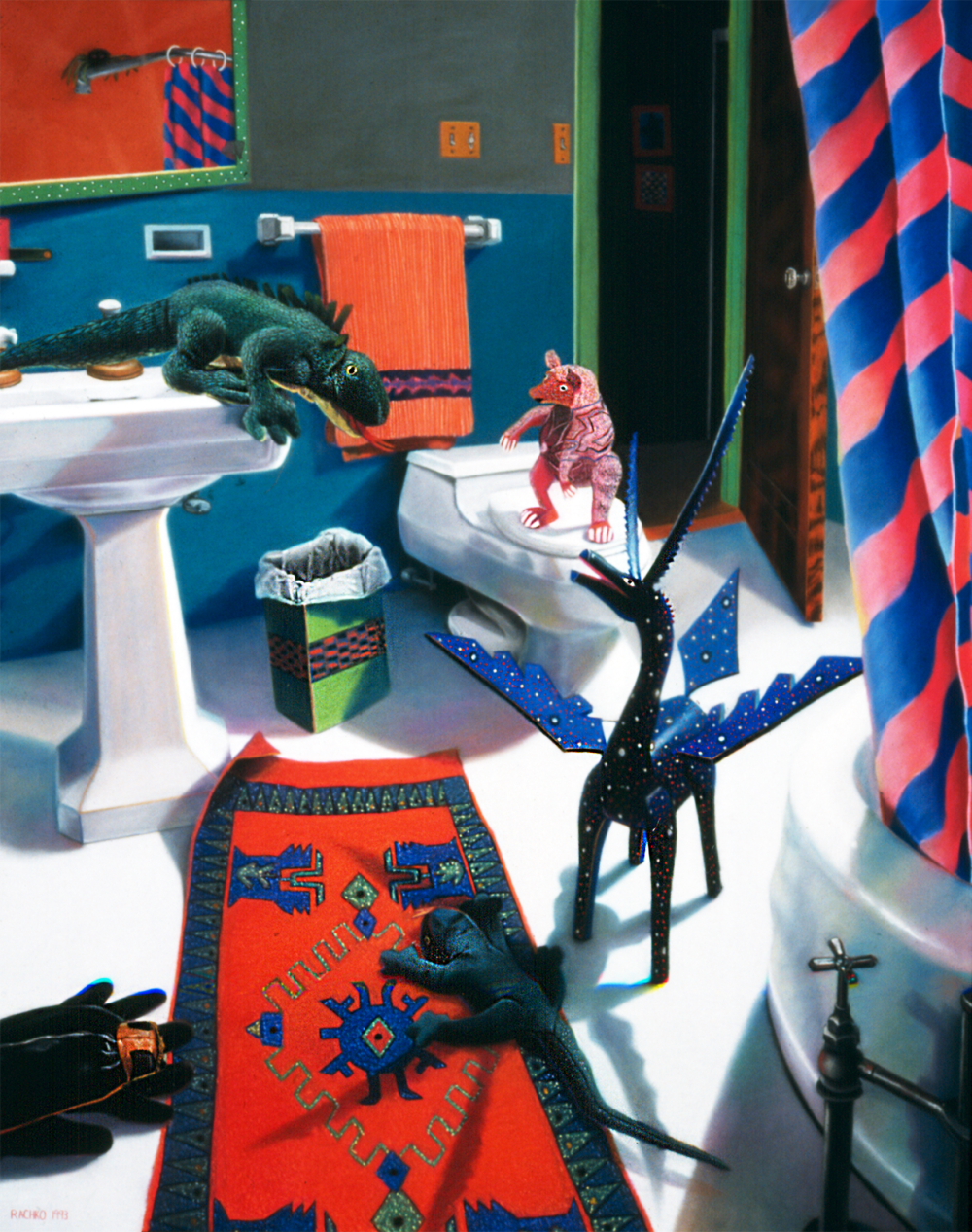
“Myth Meets Dream,” soft pastel on sandpaper, 47″ x 38,” 1993
A: I see continuity in subject matter and in medium, surely. For thirty-three years I have been inspired by foreign travel and research. In addition, I remain devoted to pushing the limits of what soft pastel can do and to promoting its merits as a fine art medium.
Here and there I see details I would render differently now; not exactly mistakes, but things that maybe could be done better. Fortunately, I think, all of my work is framed behind glass or plexiglas, making it extremely difficult to attempt revisions.
Perhaps most important of all, I see the long personal road that has advanced my work to its present state. Each gain has been hard-fought.
Comments are welcome!


 barbararachkoscoloreddust.com