Blog Archives
Pearls from artists* # 160

“A Promise, Meant to be Broken,” soft pastel on sandpaper, 58″ x 38″
* an ongoing series of quotations – mostly from artists, to artists – that offers wisdom, inspiration, and advice for the sometimes lonely road we are on.
When I get asked what one piece of advice I have for young photographers, this is what I tell them: if you are working on a project, and you’re thinking maybe it’s time to put it out into the world, make sure you have already started your next body of work. Not just started, either; you should be well along on it. You will know that the first project is finished when you find yourself joylessly going through the motions to eke out a few more pictures while, like a forbidden lover, the new ones call seductively to you. This new lover should be irresistible, and when it calls, you will be in its urgent thrall, making the work of your heart.
Sally Mann in Hold Still: A Memoir with Photographs
Comments are welcome!
Pearls from artists* # 152

“Between,” soft pastel on sandpaper, 20″ x 26″
* an ongoing series of quotations – mostly from artists, to artists – that offers wisdom, inspiration, and advice for the sometimes lonely road we are on.
The first picture I took of a black man was easy.
That’s the way it sometimes goes for me: I start on a new series of pictures and right away, in some kind of perverse bait-and-switch, I get a good one. This freak of a good picture inevitably inspires a cocky confidence, making me think this new project will be a stroll in the park. But, then, after sometimes two or three more good ones, the next dozen are duds, and that cavalier stroll becomes an uphill slog. It isn’t long before I have to take a breather, having reached the first significant plateau of doubt and lightweight despair. The voice of that despair suggests seducingly to me that I should give up, that I’m a phony, that I’ve made all the good pictures I’m ever going to, and I have nothing more worth saying.
That voice is easy to believe, and, as photographer and essayist (and my early mentor) Ted Orland has noted, it leaves me with only two choices: I can resume the slog and take more pictures, thereby risking further failure and despair, or I can guarantee failure and despair by not making more pictures. It’s essentially a decision between uncertainty and certainty and, curiously, uncertainty is the comforting choice.
Sally Mann in Hold Still: A Memoir with Photographs
Comments are welcome!
Pearls from artists* # 59

Studio
* an ongoing series of quotations – mostly from artists, to artists – that offers wisdom, inspiration, and advice for the sometimes lonely road we are on.
Friends sometimes ask, “Don’t you get lonely sitting by yourself all day?” At first it seemed odd to hear myself say No. Then I realized that I was not alone; I was in the book; I was with the characters. I was with my Self.
Not only do I not feel alone with my characters; they are more vivid and interesting to me than the people in my real life. If you think about it, the case can’t be otherwise. In order for a book (or any project or enterprise) to hold our attention for the length of time it takes to unfold itself, it has to plug into some internal perplexity or passion that is of paramount importance to us. The problem becomes the theme of our work, even if we can’t at the start understand or articulate it. As the characters arise, each embodies infallibly an aspect of that dilemma, that perplexity. These characters might not be interesting to anyone else but they’re absolutely fascinating to us. They are us. Meaner, smarter, sexier versions of ourselves. It’s fun to be with them because they’re wrestling with the same issue that has its hooks into us. They’re our soul mates, our lovers, our best friends. Even the villains. Especially the villains.
Stephen Pressfield in The War of Art
Comments are welcome!
Pearls from artists* # 39

Great Salt Lake
* an ongoing series of quotations – mostly from artists, to artists – that offers wisdom, inspiration, and advice for the sometimes lonely road we are on.
When you think of paying an author for his work you ought to think generously. It is the author who makes your magazine. If you cannot pay in cold cash, why don’t you write the author and ask what you could do for him? Offer to do something in the nature of a personal sacrifice, I would say. He may need to have some typing done, or some printing; he may need a table to write on, or books to reference; he may need some research work done for him. There are a thousand and one things he may need and appreciate much more than cold cash, especially when it constitutes a sum which, by American standards of living, means absolutely nothing. It costs me, for example, almost five dollars a week for postage. It costs me much more than that for the gifts of books and water colors I am obliged to make to enthusiastic admirers who are too poor to buy my work.
… But this, it seems to me, is the way one good artist should treat another. And you who are editors of small magazines are mostly artists yourselves, I take it. You all expect to become celebrated writers some day; you identify yourselves with the men whose work you admire and hope to publish. Well, carry out the identification to the nth degree, I say. Think how you would feel if, after years of labor and struggle, you are asked to accept a trivial sum. It is far, far better to say: “We have no money at all. We believe in you and your work… will you help us? We are willing to make any sacrifice in order to make your name known.” Most authors would be touched by such an appeal; they would offer their work gladly; they would probably offer to help in other ways. I am thinking naturally of the kind of writers whom you wish to interest in your project. There can be a magnificent collaboration between author and editor, author an publisher. But you, as editor, must first begin by giving, not demanding. Give the shirt off your back, or offer to give it, and then see what sort of response you will get form the author. I have often noticed with beggars that when they ask for something and you offer them twice or ten times as much, they are so overwhelmed that they often refuse to accept anything, or else they offer to become your slave. Writers, in a way, are like beggars. They are continually begging to be heard, to be recognized. Really they are simply begging for a chance to give of their great gifts – which is the most heart-rending begging of all and a disgrace to any civilized community in which it happens. Which is to say, almost the entire civilized world.
Henry Miller in Stand Still Like the Hummingbird
Comments are welcome!
Pearls from artists* # 31
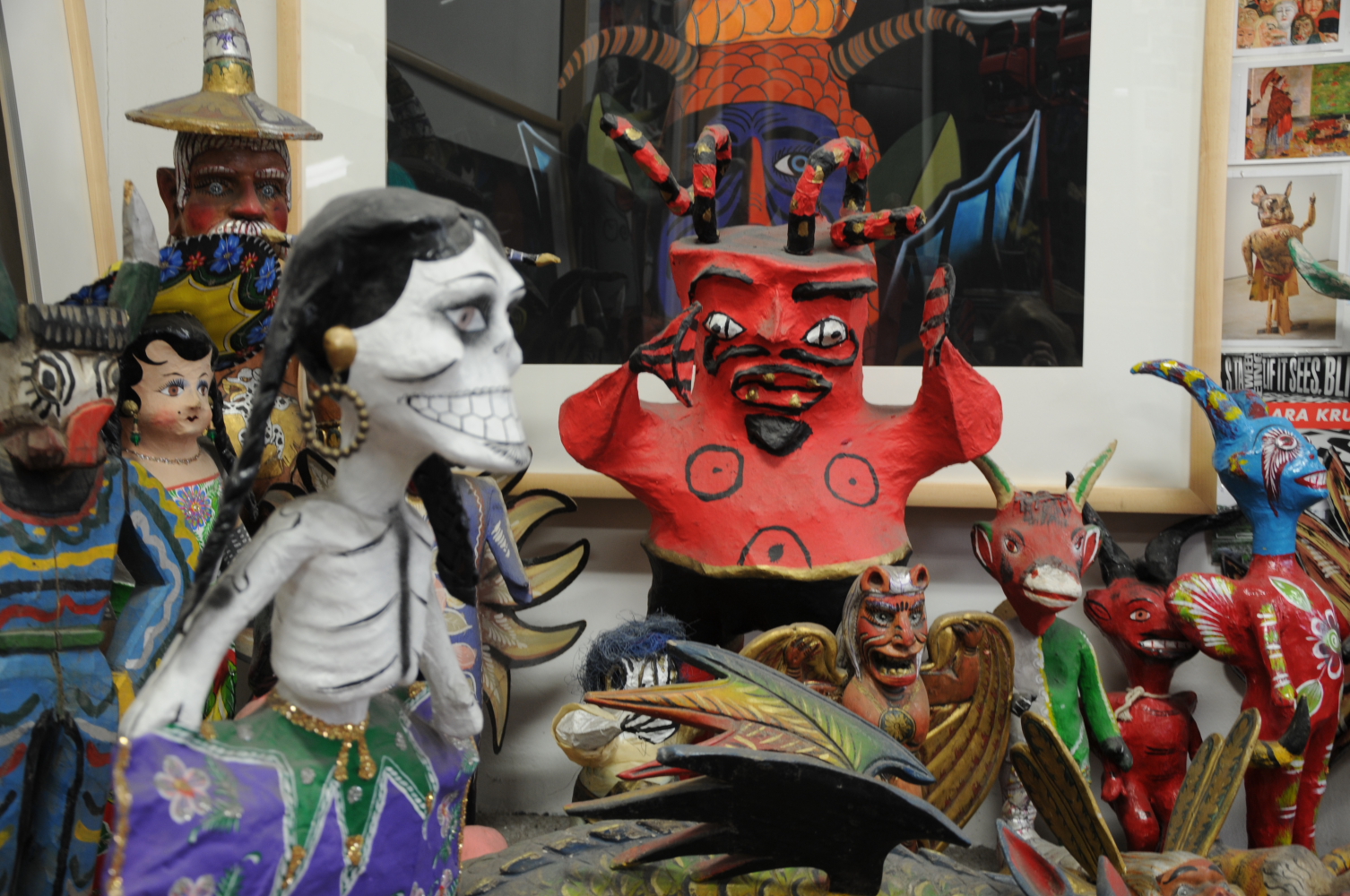
A corner of Barbara’s studio
* an ongoing series of quotations – mostly from artists, to artists – that offers wisdom, inspiration, and advice for the sometimes lonely road we are on.
When we are children we unquestioningly see the objects around us as alive; we speak to them, give them names, breathe life into them. The imagination knows no bounds. As we grow up, we gradually lose this facility, until we finally arrive in an utterly “demystified” world that draws clear boundaries between what is alive and what is not, between subjective and objective perception. According to Sigmund Freud, culture is the only domain in our modern society that gives a measure of legitimacy to the persistence of this infantile desire to see things as animate. In the field of art, imagination is the precondition on which fiction of any sort rests; in art, mental states can be projected onto objects and images, but not in social reality or the sciences.
Dietrich Karner in Animism: Modernity Through the Looking Glass
Comments are welcome!
Q: When you set up your figures to photograph, do you create a story?
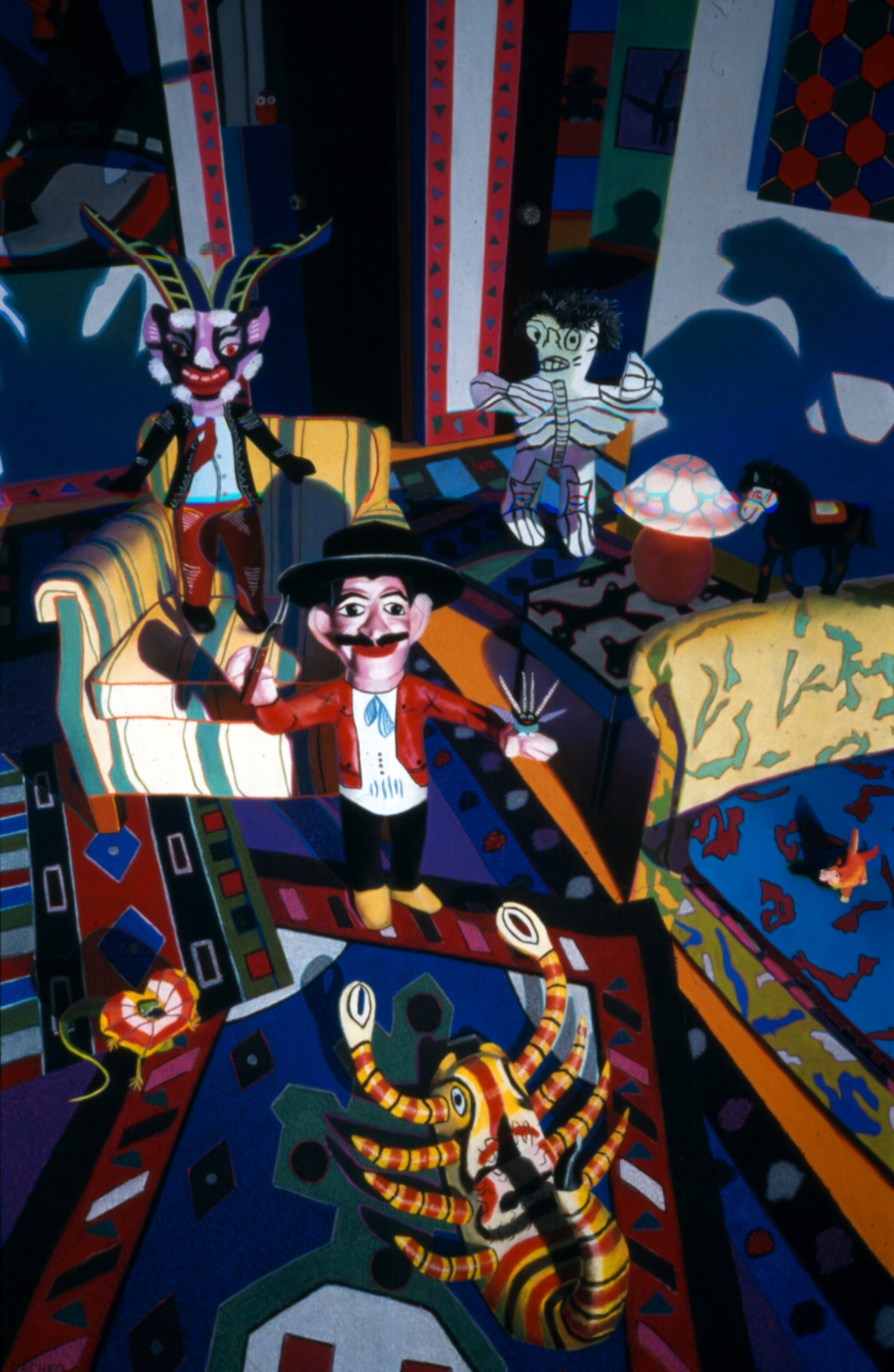
“He Just Stood There Grinning,” soft pastel on sandpaper, ” 58″ x 38″
A: I always did so with my “Domestic Threats” paintings, but not with my current work. As I set up a group of figures to photograph, I would make up a story about what was happening between them: what the Day of the Dead skeleton I bought in Mexico City was saying to the frog/fish/human mask from Guerrero, for example. I was a big kid playing with my favorite toys! The stories were the spark to get me started on a new project, but I usually forgot about them afterwards. They were necessary, yet incidental to my creative process, which is probably why I have never written them down.
Years ago I had the experience of being at one of my solo shows when a group of elementary school children came along with their teacher. The teacher asked them to act out one of the stories in a particular painting. Ever curious about how people relate to my work, I didn’t introduce myself as the creator of the pieces hanging on the walls. I no longer remember the details, but their interpretations soon had me laughing. It is a constant surprise to hear from people encountering my work for the first time what they see in it, especially when those people are young kids with wild imaginations!
Comments are welcome!


 barbararachkoscoloreddust.com