Blog Archives
Q: Can you talk a little bit about your process? What happens before you even begin a pastel painting?

Barbara in Bali (far right)
A: My process is extremely slow and labor-intensive.
First, there is foreign travel – often to Mexico, Guatemala or someplace in Asia – to find the cultural objects – masks, carved wooden animals, paper mâché figures, and toys – that are my subject matter. I search the local markets, bazaars, and mask shops for these folk art objects. I look for things that are old, that look like they have a history, and were probably used in religious festivals of some kind. Typically, they are colorful, one-of-a- kind objects that have lots of inherent personality. How they enter my life and how I get them back to my New York studio is an important part of my art-making practice.
My working methods have changed dramatically over the nearly thirty years that I have been an artist. My current process is a much simplified version of how I used to work. As I pared down my imagery in the current series, “Black Paintings,” my creative process quite naturally pared down, too.
One constant is that I have always worked in series with each pastel painting leading quite naturally to the next. Another is that I always set up a scene, plan exactly how to light and photograph it, and work with a 20″ x 24″ photograph as the primary reference material.
In the setups I look for eye-catching compositions and interesting colors, patterns, and shadows. Sometimes I make up a story about the interaction that is occurring between the “actors,” as I call them.
In the “Domestic Threats” series I photographed the scene with a 4″ x 5″ Toyo Omega view camera. In my “Gods and Monsters” series I shot rolls of 220 film using a Mamiya 6. I still like to use an old analog camera for fine art work, although I have been rethinking this practice.
Nowadays the first step is to decide which photo I want to make into a painting (currently I have a backlog of photographs to choose from) and to order a 19 1/2″ x 19 1/2″ image (my Mamiya 6 shoots square images) printed on 20″ x 24″ paper. They recently closed, but I used to have the prints made at Manhattan Photo on West 20th Street in New York. Now I go to Duggal. Typically I have in mind the next two or three paintings that I want to create.
Once I have the reference photograph in hand, I make a preliminary tonal charcoal sketch on a piece of white drawing paper. The sketch helps me think about how to proceed and points out potential problem areas ahead.
Only then am I ready to start actually making the painting.
Comments are welcome!
Q: Can you discuss your process, including how you actually use Mexican and Guatemalan folk art figures in your art?

A corner of Barbara’s studio
A: When I set up the figures to photograph for a painting, I work very intuitively, so how I actually cast them in an artwork is difficult to say. Looks count a lot – I select an object and put it in a particular place, look at it, move it or let it stay, and sometimes develop a storyline. I spend time arranging lights and looking for interesting cast shadows. With my first “Domestic Threats” series, all of this was done so that Bryan, my late husband, or I could shoot a couple of negatives with his Toyo Omega 4″ x 5″ view camera. For my “Black Paintings” series, begun in 2007, I shoot medium format negatives with a Mamiya 6 camera.
I always look at a 20″ x 24″ photograph for reference as I make a pastel-on-sandpaper painting, plus I also work from the ‘live’ objects. The photograph is mainly a catalyst because finished paintings are always quite different from their associated reference photos. Also, since I spend months creating them, the paintings’ interpretative development goes way beyond that of the photo.
I once completed 6 large (58” x 38”) pastel paintings in a single year, but more recently 4 or 5 per year is common. It takes approximately 3 months to make each one. During that time I layer and blend together as many as 25 to 30 layers of pastel. Of course, the colors get more intense as the painting progresses and the pigment accumulates on the sandpaper.
Comments are welcome!
Q: How do you select a photograph to use as reference material to make a pastel painting?
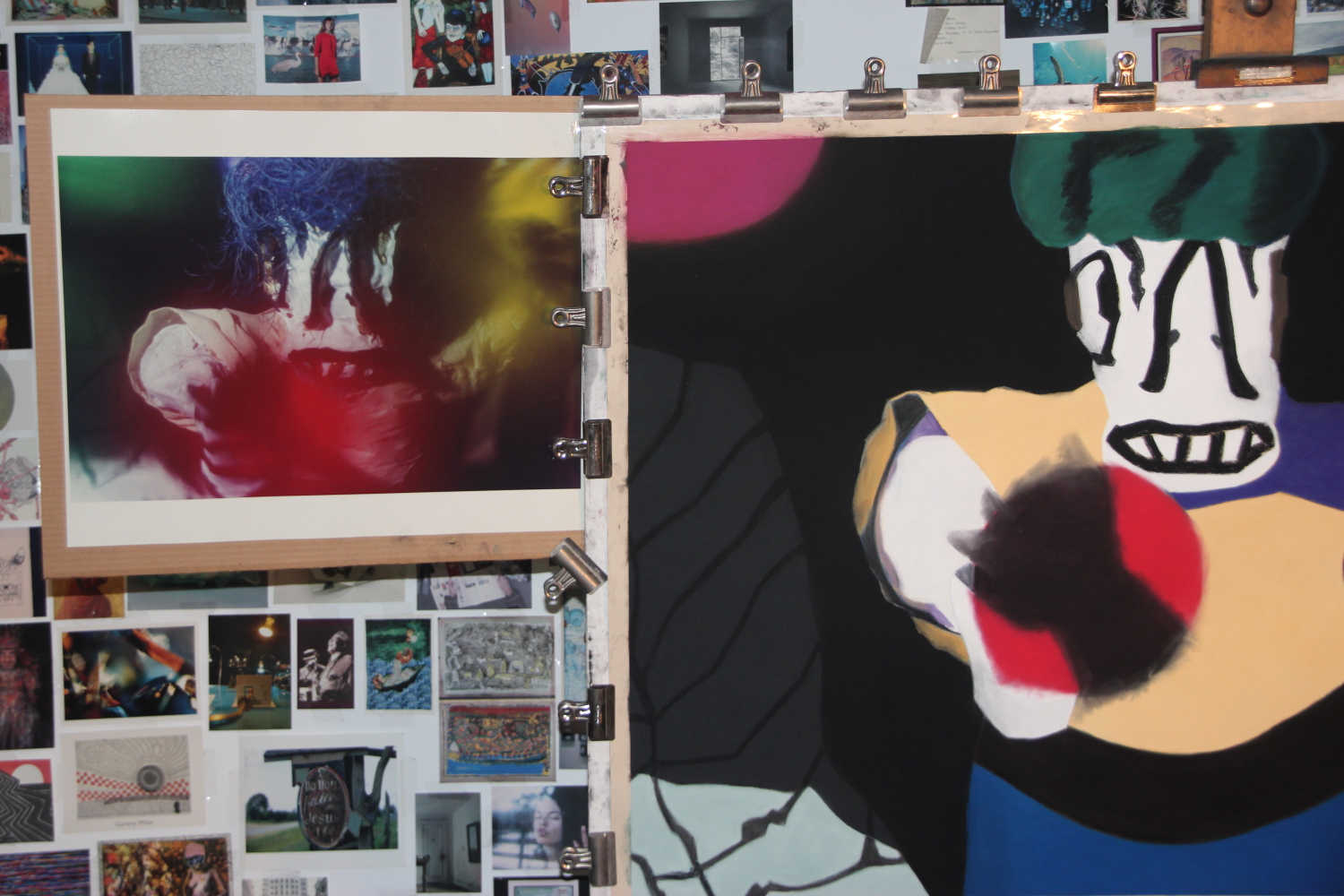
Photograph, left, and work in progress
A: Like everything else associated with my studio practice, my use of photographs from which to work has changed considerably. Beginning in the early 1990s all of the paintings in my first series, “Domestic Threats,” started out as elaborately staged, well-lit scenes that either my husband, Bryan, or I photographed with Bryan’s Toyo Omega 4 x 5 view camera using a wide-angle lens. Depending on where I was living at the time, I set up the scenes in one of three places: our house in Alexandria, VA, a six-floor walkup apartment on West 13th Street in New York, or my current Bank Street condominium. Then one of us shot two pieces of 4 x 5 film at different exposures and I’d usually select the more detailed one to be made into a 20″ x 24″ photo to use as a reference.
Just as the imagery in my paintings has simplified and emptied out over the years, my creative process has simplified, too. I often wonder if this is a natural progression that happens as an artist gets older. More recently I have been shooting photos independently of how exactly I will use them in my work. Only later do I decide which ones to make into paintings; sometimes it’s YEARS later. For example, the pastel painting that is on my easel now is based on a relatively old (2002) photograph that I have always liked, but only now felt ready to tackle in pastel.
Comments are welcome!
Q: Have you ever worked outside?

Reproductions of “Cardinal Rule” (top) and “Blue Ego,” originals are soft pastel on sandpaper, 30″ x 38″
A: As a pastel artist I’ve never worked outside – with so many pastels, it’s just not practical – but early on in the “Domestic Threats” series, I created two outdoor setups. Works in the series derived from elaborate scenes that I arranged and then photographed.
I used to take long walks along the Potomac River in Alexandria, VA, and there was a tree stump that was fascinating. It was mostly twisted roots, knotty branches, dark hidden spaces, etc. (top painting in photo). One morning I took several hand puppets and stuffed animals (my subject matter at the time) and carefully arranged them on the tree. Around me people were busy exercising their dogs. Soon I attracted quite a bit of attention – a tall blonde woman playing with puppets on a tree stump! Dogs came over to sniff. Their owners came over, too, and I was pressed into explaining, again and again, that I was an artist, that I was photographing this scene so I could paint it, etc. The interruptions were very annoying.
The second time I tried an outdoor setup was again along the Potomac River, but this time I selected a secluded strip of beach where I was undisturbed. I had forgotten to consider the light and inadvertently chose a cloudy day. I remember being disappointed that the light was flat and lacking shadows. The painting (bottom in photo) turned out to be one of my least favorites.
I resolved from then on to focus on interiors. Alfred Hitchcock famously used rear projection so that he could work in a studio rather than on location. One reason, he said, was that in a studio he had total control. I know what he meant. When I set up an interior scene and position the lights to make interesting shadows, indeed, I have control over the whole look. No aspect is left to chance. The accidents – improvements! – happen later when I work on the painting.
Comments are welcome!
Q: When you set up your figures to photograph, do you create a story?
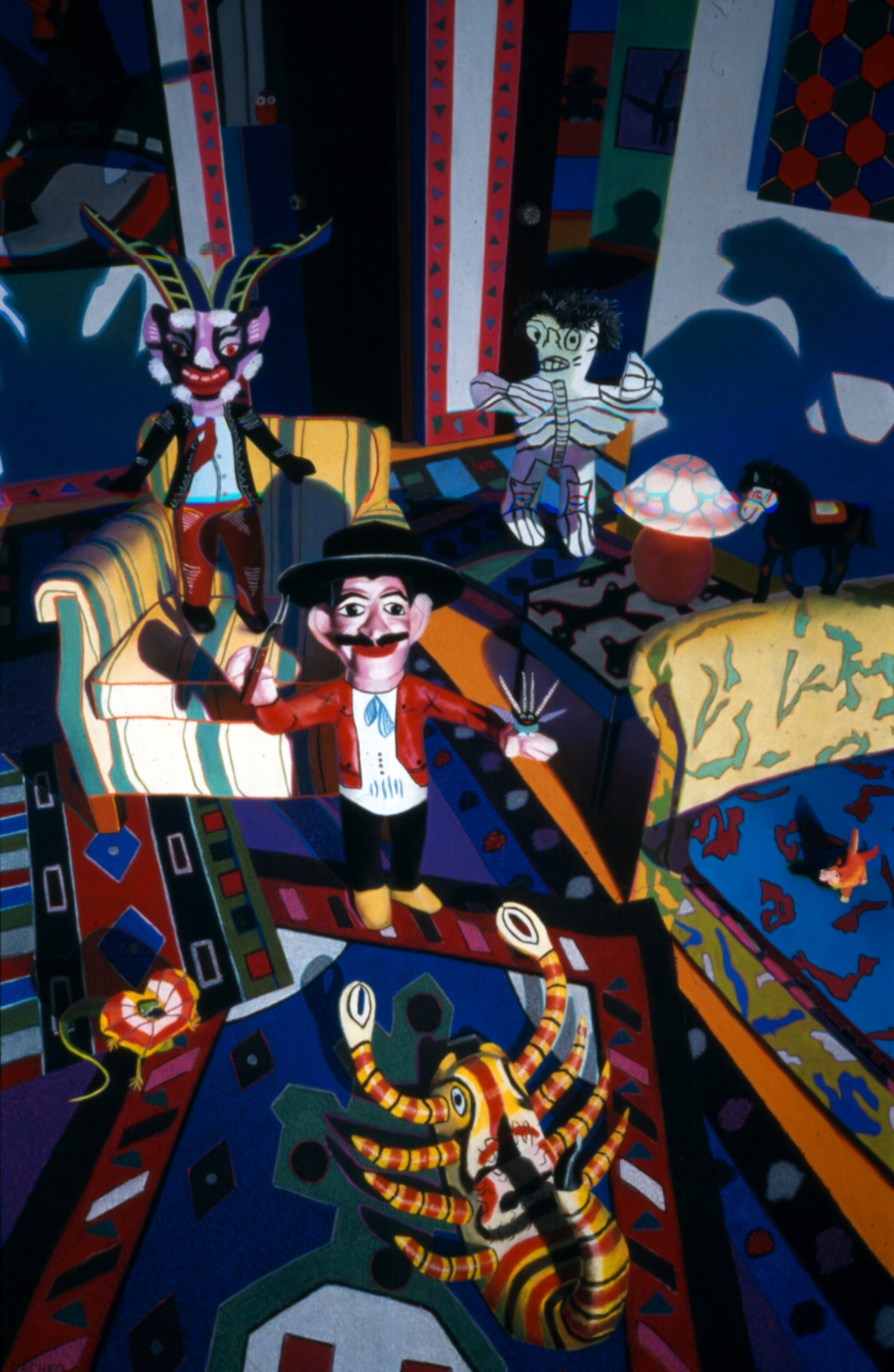
“He Just Stood There Grinning,” soft pastel on sandpaper, ” 58″ x 38″
A: I always did so with my “Domestic Threats” paintings, but not with my current work. As I set up a group of figures to photograph, I would make up a story about what was happening between them: what the Day of the Dead skeleton I bought in Mexico City was saying to the frog/fish/human mask from Guerrero, for example. I was a big kid playing with my favorite toys! The stories were the spark to get me started on a new project, but I usually forgot about them afterwards. They were necessary, yet incidental to my creative process, which is probably why I have never written them down.
Years ago I had the experience of being at one of my solo shows when a group of elementary school children came along with their teacher. The teacher asked them to act out one of the stories in a particular painting. Ever curious about how people relate to my work, I didn’t introduce myself as the creator of the pieces hanging on the walls. I no longer remember the details, but their interpretations soon had me laughing. It is a constant surprise to hear from people encountering my work for the first time what they see in it, especially when those people are young kids with wild imaginations!
Comments are welcome!
Q: Do you name your characters?
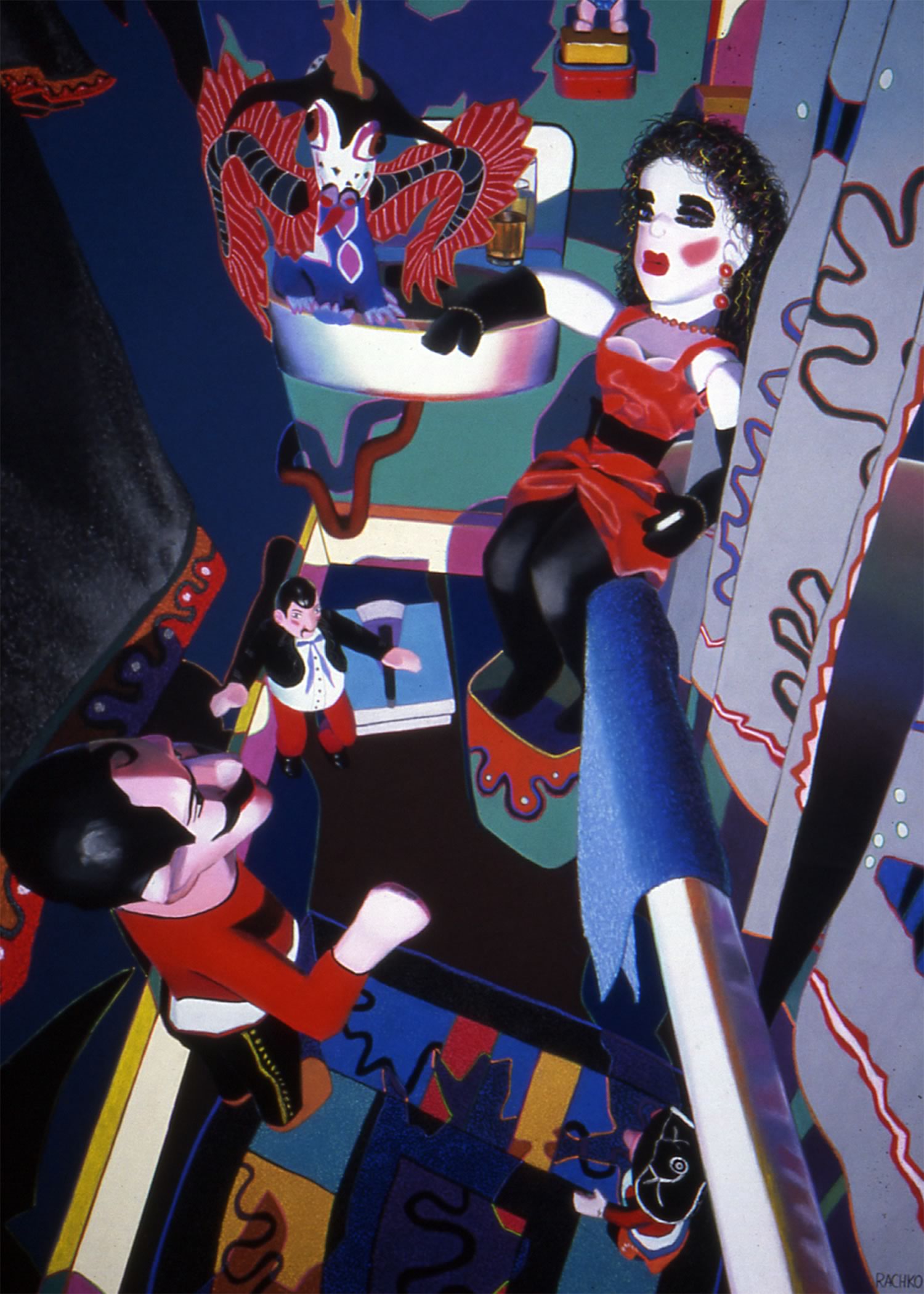
Lola in “He Urged Her to Abdicate,” soft pastel on sandpaper
A: No, normally I don’t, but there is one notable exception. Lola – I could hardly call her any other name – is a red-dressed, cigarette-smoking, black-stocking cloth doll made by an artist in Mexico City. I never met her creator, but years ago a man came into my Alexandria, Virginia studio (where I had a studio at the Torpedo Factory, an art center that is open to the public), and announced that he knew Lola’s maker and he, the maker, would be extremely pleased with what I’d done with her – made her the star of several of my pastel-on-sandpaper paintings. Many years later Lola continues to be one of my favorite characters and “He Urged Her to Abdicate,” set in the bathroom of a six floor walk-up I rented when I first moved to New York, is my favorite Lola painting.
To learn more about this painting, please read the essay by Britta Konau on page 10 at:
Click to access DomesticThreats.pdf
Comments are welcome!
Q: When did you begin seriously studying photography?
Exhibition catalogue, 2009 solo exhibition at HP Garcia Gallery, NYC; click
“Exhibition catalogue” under Blogroll to view inside pages
A: After I lost my husband, Bryan, on 9/11 – as I’ve discussed elsewhere, Bryan photographed most of the setups for my “Domestic Threats” series – I needed to find a way to continue making art. In June 2002 I began studying photography at the International Center of Photography (ICP) in New York. I took a one week 4 x 5 view camera workshop because Bryan had photographed the setups with a Toyo-Omega view camera. I was surprised to discover that I had absorbed quite a bit of technical information just by watching him. Once I completed the workshop, I decided to start over and to learn as much as I could about photography. So I enrolled in Photography I. Over the next several years I completed about a dozen courses at ICP, eventually learning to make my own large-scale chromogenic prints. Around 2007 I began working seriously as a photographer, creating my photographic series, “Gods and Monsters,” with Bryan’s Mamiya 6 camera. In October 2009 HP Garcia Gallery in New York gave me my first solo photography exhibition (see “Exhibition catalogue” under Blogroll).
I’m busy getting ready for my next solo show there in October. This exhibition will be fairly comprehensive and will include recent photographs (diptychs and single images), new work from the “Black Paintings” series, and a selection of Mexican and Guatemalan figures. There will be an exhibition catalogue and later in the fall, the gallery will publish the first book about my work. I am particularly thrilled about the book, a new, but long overdue, career milestone!
Q: Can you elaborate on the series title, “Domestic Threats?”
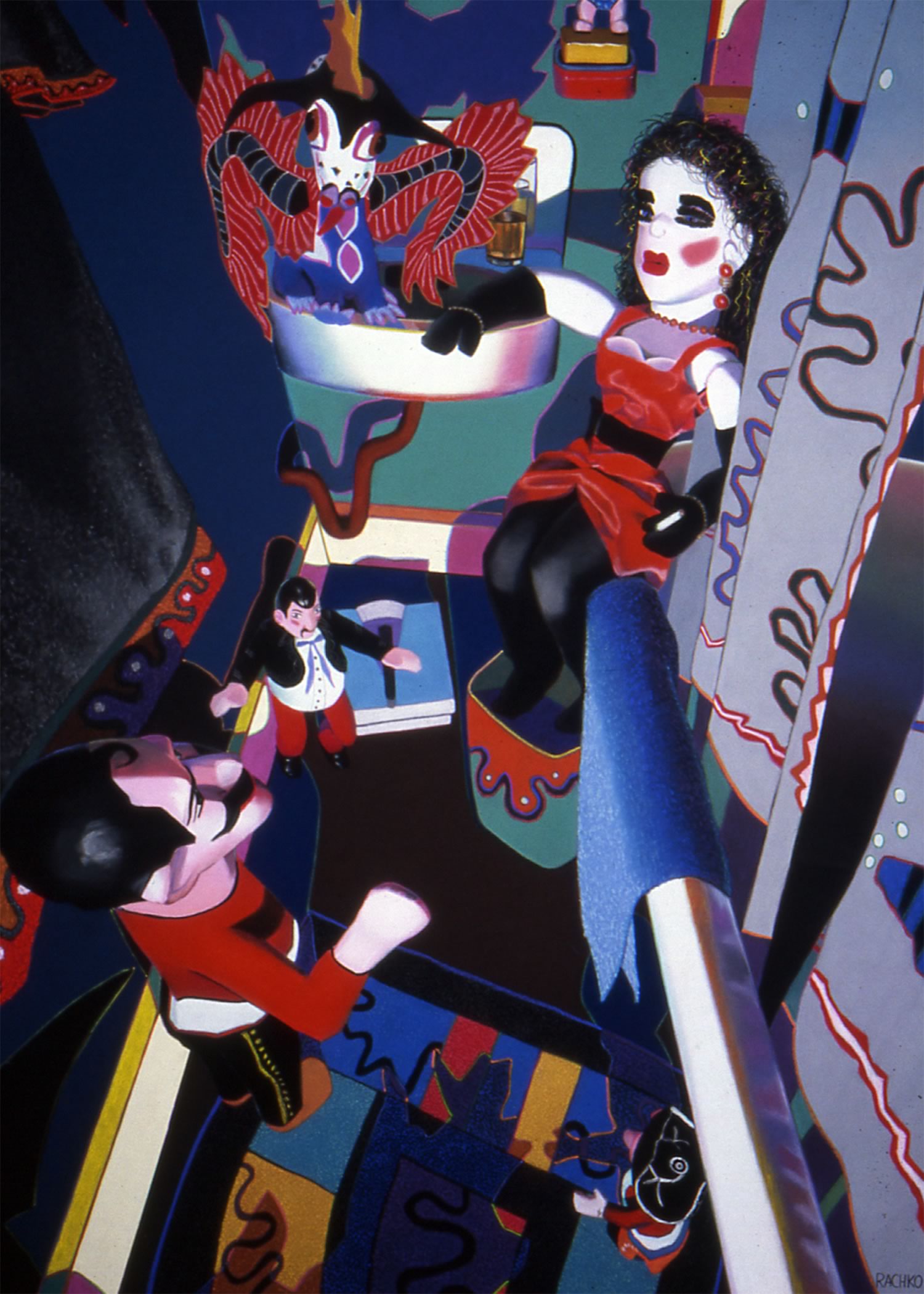
“He Urged Her To Abdicate,” soft pastel on sandpaper
A: All of the paintings in this series are set in places where I reside or used to live, either a Virginia house or New York apartments, i.e., domestic environments. Each painting typically contains a conflict of some sort, at least one figure who is being menaced or threatened by a group of figures. So I named the series “Domestic Threats.” Depending on what is going on in the country at a particular moment in time, however, people have seen political associations in my work. Since my husband was killed on 9/11, many people thought the title, “Domestic Threats,” was prescient. They have ascribed all kinds of domestic terrorism associations to it, but that is not really what I had in mind. For a time some thought I was hinting at scenes of domestic violence, but that also is not what I had intended. “Domestic Threats” seems to be fraught with associations that I never considered, but it’s an apt title for this work.
Q: In your earlier “Domestic Threats” series, you liken your paintings to scenes in a movie. Is there an audition process? What qualities must a figure possess to be cast in one of your paintings?

Negotiating with Tomas in Panajachel, Guatemala; photo by Donna Tang
A: There’s not an audition process, but I do feel like the masks and figures call out to me when I’m searching the markets of Mexico and Guatemala. Color is very important – the brighter and the more eye-catching the better – plus they must have lots of “personality.” I try not to buy anything mass-produced or obviously made for tourists. How and where these objects come into my life is an important part of the process. Getting them back to the U.S. is always an adventure. For example, in 2010 I was in Panajachel on the shores of Lake Atitlan in Guatemala. After returning from a boat ride across the lake, my friends and I were walking back to our hotel when we noticed a mask store. This store contained many beautiful things so I spent a long time looking around. Finally, I made my selections and was ready to buy five standing wooden figures, when I learned that Tomas, the store owner, did not accept credit cards. Not having enough cash, I was heart-broken and thought, “Oh, no. I can’t bring these home.” However, thanks to my friend, Donna, whose Spanish was much more fluent than mine, Tomas and she came up with a plan. I would pay for the figures at a nearby hotel and once the owner was paid by the credit card company, he would pay Tomas. Fabulous! Tomas, Donna, and I walked to the hotel, where the transaction was completed. Packing materials are not so easy to find in remote parts of Guatemala so the packing and shipping arrangements took another hour. During the negotiations Tomas and I became friends. We exchanged telephone numbers (he didn’t have a telephone so he gave me the phone number of the post office next door, saying that when I called, he could easily run next door). When I returned to New York ten days later, the package was waiting for me.
While setting up a scene for a painting, I work very intuitively so how the objects are actually “cast” is difficult to say. Looks count a lot – I select an object and put it in a particular place, move it around, and develop a storyline. I spend time arranging lights and looking for interesting cast shadows. I shoot two exposures with a 4 x 5 view camera and order a 20″ x 24″ photograph to use for reference. I also work from the “live” objects. My series, “Domestic Threats,” was initially set in my Virginia house, but in 1997, I moved to a six floor walk-up in New York. For the next few years the paintings were set there, until 2001 when I moved to my current apartment. In a sense the series is a visual autobiography that hints at what my domestic surroundings were like.


 barbararachkoscoloreddust.com
Q: Another interesting series of yours that has impressed me is your recent “Black Paintings.” The pieces in this series are darker than the ones in “Domestic Threats.” You create an effective mix between the dark background and the few bright tones, which establish such a synergy rather than a contrast, and all the dark creates a prelude to light. It seems to reveal such a struggle, a deep tension, and intense emotions. Any comments on your choice of palette and how it has changed over time?
Dec 6
Posted by barbararachkoscoloreddust
West 29th Street studio
A: That is a great question!
You are correct that my palette has darkened. It’s partly from having lived in New York for so long. This is a generally dark city. We famously dress in black and the city in winter is mainly greys and browns.
Also, the “Black Paintings” are definitely post-9/11 work. My husband, Bryan, was tragically killed onboard the plane that crashed into the Pentagon. Losing Bryan was the biggest shock I ever have had to endure, made even harder because it came just 87 days after we had married. We had been together for 14 ½ years and in September 2001 were happier than we had ever been. He was killed so horribly and so senselessly. Post 9/11 was an extremely difficult, dark, and lonely time.
In the summer of 2002 I resumed making art, continuing to make “Domestic Threats” paintings. That series ran its course and ended in 2007. Around then I was feeling happier and had come to better terms with losing Bryan (it’s something I will never get over but dealing with loss does get easier with time). When I created the first “Black Paintings” I consciously viewed the background as literally, the very dark place that I was emerging from, exactly like the figures emerging in these paintings. The figures themselves are wildly colorful and full of life, so to speak, but that black background is always there.
Comments are welcome!
Share this:
Posted in 2014, An Artist's Life, Art in general, Art Works in Progress, Black Paintings, Creative Process, Domestic Threats, Inspiration, Painting in General, Pastel Painting, Photography, Studio, Working methods
Comments Off on Q: Another interesting series of yours that has impressed me is your recent “Black Paintings.” The pieces in this series are darker than the ones in “Domestic Threats.” You create an effective mix between the dark background and the few bright tones, which establish such a synergy rather than a contrast, and all the dark creates a prelude to light. It seems to reveal such a struggle, a deep tension, and intense emotions. Any comments on your choice of palette and how it has changed over time?
Tags: after, always, another, around, art, background, better, between, biggest, black, Black Paintings, bright, browns, Bryan, changed, choice, city, colorful, comments, consciously, continuing, contrast, correct, course, crashed, create, dark, dealing, deep, difficult, Domestic Threats, dress, easier, effective, emerging, emotions, ended, endure, establish, exactly, extremely, famously, feeling, figures, first, full, generally, great, greys, happier, harder, horribly, however, husband, impressed, intense, interesting, killed, life, light, literally, lived, lonely, losing, loss, mainly, making, married, mix, New York, onboard, paintings, palette, partly, Pentagon, pieces, plane, post-9/11, prelude, question, rather, recent, resumed, reveal, senselessly, September, series, shock, something, speak, struggle, summer, synergy, tension, terms, themselves, time, together, tones, tragically, viewed, wildly, winter, work