Blog Archives
Pearls from artists* # 667

“Magisterial,” soft pastel on sandpaper, 58” x 38”, in progress
*an ongoing series of quotations – mostly from artists, to artists – that offers wisdom, inspiration, and advice for the sometimes lonely road we are on.
This is the eternal origin of art – that a human being confronts a form that wants to be one a work of art through him. Not a figment of his soul, but something that appears to the soul and demands the soul’s creative power. What is required is a deed that a man does with his whole being […] and the work is imperious: if I do not serve it properly, it breaks, or it breaks me. The form that confronts me I cannot experience nor describe: I can only actualize it. And yet I see it, radiant in the splendor of the confrontation, far more clearly than all the clarity of the experienced world.
Martin Buber quoted in Art From Your Core: A Holistic Guide to Visual Voice by Kate Kretz
Comments are welcome!
Pearls from artists* # 644

Barbara’s Studio
*an ongoing series of quotations – mostly from artists, to artists – that offers wisdom, inspiration, and advice for the sometimes lonely road we are on.
Making the work you were born to make is a radical act of resistance in the current social climate. It refuses to hold money or power as its highest value. It takes as much time as it needs. It demands quiet and stillness. It involves deep reflection and reverence. It prioritizes uncool traits of curiosity, wonder, and earnestness. It shuns the superficial, contorting to reach far beyond it for the significant. It answers to no one but itself and has not been diluted by corporate committee. It doesn’t pander. It can tell stories that make people uncomfortable. And, despite all attempts to frame it as such, unlike most other activities, art is not a competitive sport.
Kate Kretz in Art From Your Core: A Holistic Guide to Visual Voice
Comments are welcome!
Pearls from artists* # 618

Lower Manhattan
*an ongoing series of quotations – mostly from artists, to artists – that offers wisdom, inspiration, and advice for the sometimes lonely road we are on.
Today, instead of one voice, we have dozens issuing demands. There is no longer one truth, no single authority – instead there is a score of would-be masters who would usurp their place. All are full of histories, statistics, proofs, demonstrations, facts, and quotations. First they read and exhort, and finally they resort to intimidation by threats and moral imprecations. Each pulls the artist this way and that, telling him what he must do if he is to fill his belly and save his soul.
Mark Rothko in The Artists’ Reality: Philosophies of Art
Comments are welcome!
Pearls from artists* # 610
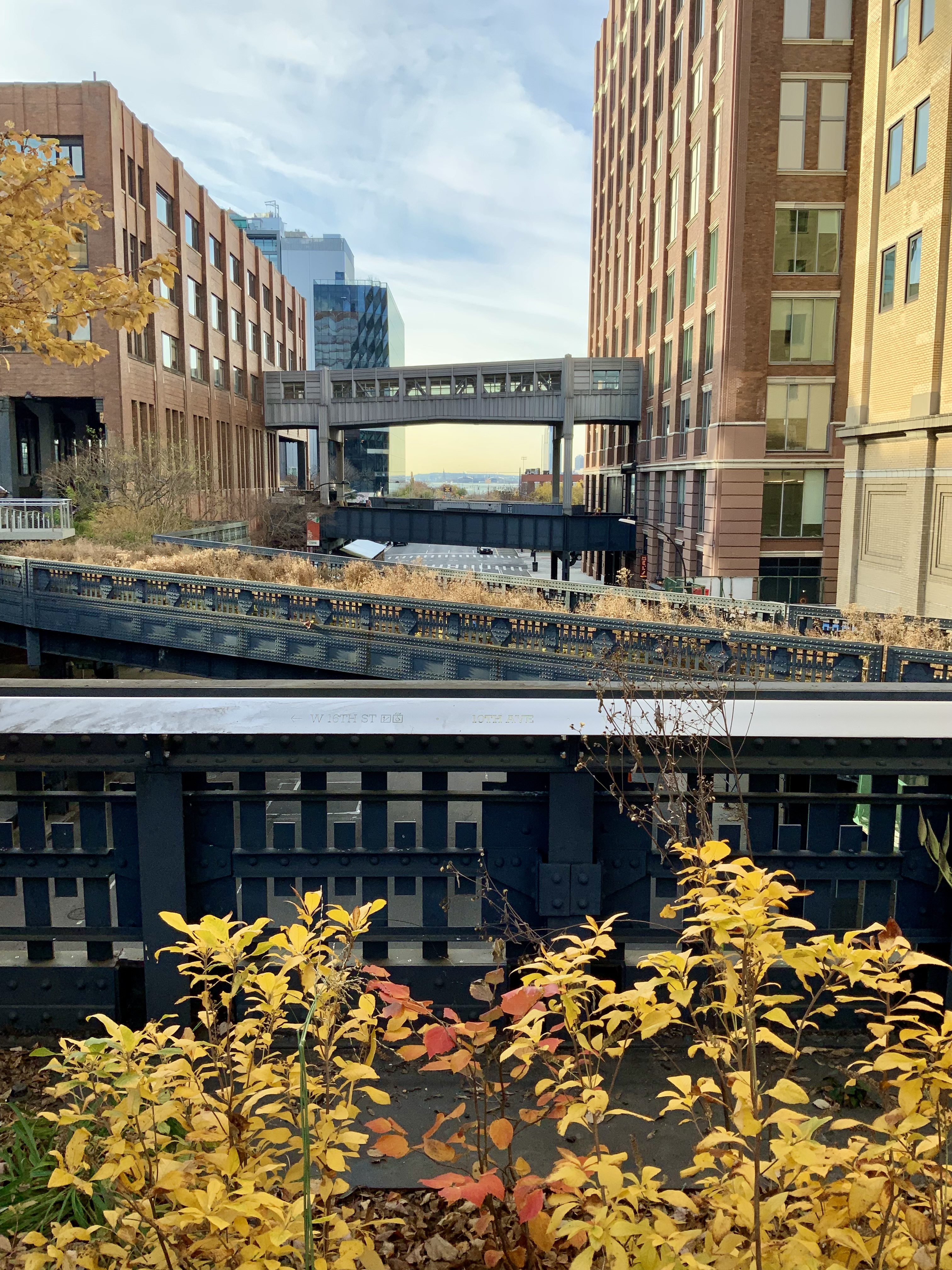
View from the High Line, New York NY
*an ongoing series of quotations – mostly from artists, to artists – that offers wisdom, inspiration, and advice for the sometimes lonely road we are on.
Just as the restless, committed, curious, and perhaps obsessed explorer follows the river from bend to bend, shooting rapids and pulling himself out of the water, so the self-dedicated artist launches himself on an exploratory art journey. He judges which fork in the river he will take, when he will rest and when he will push on, who he will take with him or whether he will travel alone. While he doesn’t possess unlimited freedom as he journeys, bound as he is by the demands of his personality, by his time and place, and by circumstances beyond his control, he does possess unrestricted permission from himself to explore every available avenue.
The contemporary artist must especially direct and trust himself because he lives in a constantly changing art environment. … as Pablo Picasso put it, “Beginning with Van Gogh we are all in a measure, autodidacts.” Painters no longer live within a tradition and so each of us must create an entire language.
Eric Maisel in A Life in the Arts: Practical Guidance and Inspiration for Creative and Performing Artists
Comments are welcome!
Pearls from artists* # 488
*an ongoing series of quotations – mostly from artists, to artists – that offers wisdom, inspiration, and advice for the sometimes lonely road we are on.
To be astonished is to be caught unawares by the revelation of realities denied or repressed in the everyday. Astonishment has an intellectual as well as an emotional component – in it, the brain and the heart come together. Far from distracting us from the strange and the uncanny in life, the astonishment evoked by great artistic works puts them square in our sights. The work demands that we feel and think the mystery of our passage through this body, on this earth, in this universe. We realize afterward that the world is not what we thought it was: something hidden, impossible to communicate though clearly expressed in the work has risen into the light of awareness, and the share of the Real to which we are privy is proportionately expanded.
JF Martel in Reclaiming Art in the Age of Artifice: A Treatise, Critique, and Call to Action
Comments are welcome!
Pearls from artists* # 478

*an ongoing series of quotations – mostly from artists, to artists – that offers wisdom, inspiration, and advice for the sometimes lonely road we are on.
Artists, because of the demands of their personality, their sense of personal mission, and their need to create or perform, are driven people. Mixed with the love of work can be a terrible pressure to work. For many artists, and especially for the most productive ones, the line between love and obsession and between love and compulsion blurs or disappears entirely. Are such artists free or are they slaves to their work?
In The Artist and Society the psychiatrist Lawrence Hatterer said of such an artist:
His most recognizable trait is his recurring daily preoccupation with translating artistic activity into accomplishment. The consuming intensity of this artistic pursuit brooks no interference or obstacles. His absorption with the creative act is such that he experiences continually what the average artist feels only infrequently when he reaches unusual levels of creative energy with accompanying output. He appears to be incapable of willful nonproductivity.
This is Picasso working for 72 hours straight. This is van Gogh turning out 200 finished paintings during his 444 days in Arles. The artist who is “incapable of willful nonproductivity” is a workaholic for whom little in life, apart from his artistic productivity and accomplishment, may have any meaning.
Eric Maisel in A Life in the Arts: Practical Guidance and Inspiration for Creative and Performing Artists
Comments are welcome!
Pearls from artists* # 446

*an ongoing series of quotations – mostly from artists, to artists – that offers wisdom, inspiration, and advice for the sometimes lonely road we are on.
What stops us in our tracks? I am rarely stopped by something or someone I can instantly know. In fact, I have always been attracted to the challenge of getting to know what I cannot instantly categorize or dismiss, whether an actor’s presence, a painting, a piece of music, or a personal relationship. It is the journey towards the object of attraction that interests me. We stand in relation to one another. We long for the relationship that will change our vistas. Attraction is an invitation to an evanescent journey, to a new way of experiencing life or perceiving reality.
An authentic work of art embodies intense energy. It demands response. You can either avoid it, shut it out, or meet it and tussle. It contains attractive and complicated energy fields and a logic all its own. It does not create desire or movement in the receiver, rather it engenders what James Joyce labelled ‘aesthetic interest.’ You are stopped in your tracks. You cannot easily walk by it and go on with your life. You find yourself in relation to something that you cannot readily dismiss.
Anne Bogart in A Director Prepares: Seven Essays on Art and Theater
Comments are welcome!
Pearls from artists* # 444

*an ongoing series of quotations – mostly from artists, to artists – that offers wisdom, inspiration, and advice for the sometimes lonely road we are on.
Artists are individuals willing to articulate in the face of flux and transformation. And the successful artist finds new shapes for our present ambiguities and uncertainties. The artist becomes the creator of the future through the violent act of articulation. I say violent because articulation is a forceful act. It demands an aggressiveness and an ability to enter into the fray and translate that experience into expression. In the articulation begins a new organization of the inherited landscape.
Anne Bogart in A Director Prepares: Seven Essays on Art and Theater
Comments are welcome!
Pearls from artists* # 408

“No Cure for Insomnia,” pastel on sandpaper, 58″ x 38″ image, 70” x 50” framed
* an ongoing series of quotations – mostly from artists, to artists – that offers wisdom, inspiration, and advice for the sometimes lonely road we are on.
Classics have nothing to do with aesthetic sophistication. They use the aesthetic as a springboard to something else. The creation of a classic will often require the artist to deviate from prevailing standards in order to push the ordinary vision through. If there is one prerequisite for producing a classic, it is the willingness to follow the vision wherever it leads, even if it demands a breach of convention, technique, or popular taste. (It may not even be a question of if or when, for how can one produce a truly singular work without reinventing the medium to some extent?) We often hear that the master artist is “in love” with her material: that the sculptor loves the marble, the dancer loves the body, the musician loves his instrument. For the maker of classics, however, the medium always seems to be an obstacle; love is never without a tinge of spite. William S. Burroughs was so contemptuous of language that he took to describing it as a disease. He conceived his work as an attempt to confront language in hopes to cure the mind of the “word virus.” Indeed, if the goal of art is to take us beyond the ordinary preoccupations to reach the heart of the Real, it would seem essential that there be a fight, a struggle to wrest from the medium something to which Consensus dictates it is not naturally inclined.
J.F. Martel in Reclaiming Art in the Age of Artifice: A Treatise, Critique, and Call to Action
Comments are welcome!
Q: I especially enjoy your “Black Paintings” series. You mention being influenced by the story of how Miles Davis developed cool jazz, making this work uniquely American all around. How did you use jazz history in this series?

“Between,” soft pastel on sandpaper, 20″ x 26″
A: In 2007 I finished the Domestic Threats series and was blocked, certain that a strong body of work was behind me. But what would come next?
The idea for the Black Paintings began when I attended a jazz history course at Lincoln Center and learned how Miles Davis developed cool jazz from bebop. In bebop the notes were played hard and fast as musicians showcased their musical virtuosity. Cool jazz was a much more relaxed style with fewer notes being played. In other words, the music was pared down to its essentials. Similarly, the Black Paintings evolved from dense, intricate compositions into paintings that depicted only the essential elements. As the series evolved, what was left out became more important, resulting in more demands being placed on the viewer.
Eventually, after much reflection, I had an epiphany and my painful creative block ended. “Between,” with drastically simplified imagery, was the first in a new series called Black Paintings. I like to think this series includes work that is richer and more profound than the previous Domestic Threats.
Comments are welcome!


 barbararachkoscoloreddust.com