Blog Archives
Pearls from artists* # 644

Barbara’s Studio
*an ongoing series of quotations – mostly from artists, to artists – that offers wisdom, inspiration, and advice for the sometimes lonely road we are on.
Making the work you were born to make is a radical act of resistance in the current social climate. It refuses to hold money or power as its highest value. It takes as much time as it needs. It demands quiet and stillness. It involves deep reflection and reverence. It prioritizes uncool traits of curiosity, wonder, and earnestness. It shuns the superficial, contorting to reach far beyond it for the significant. It answers to no one but itself and has not been diluted by corporate committee. It doesn’t pander. It can tell stories that make people uncomfortable. And, despite all attempts to frame it as such, unlike most other activities, art is not a competitive sport.
Kate Kretz in Art From Your Core: A Holistic Guide to Visual Voice
Comments are welcome!
Q: It must be tricky moving pastel paintings from your New York studio to your framer in Virginia. Can you explain what’s involved? (Question from Ni Zhu via Instagram)
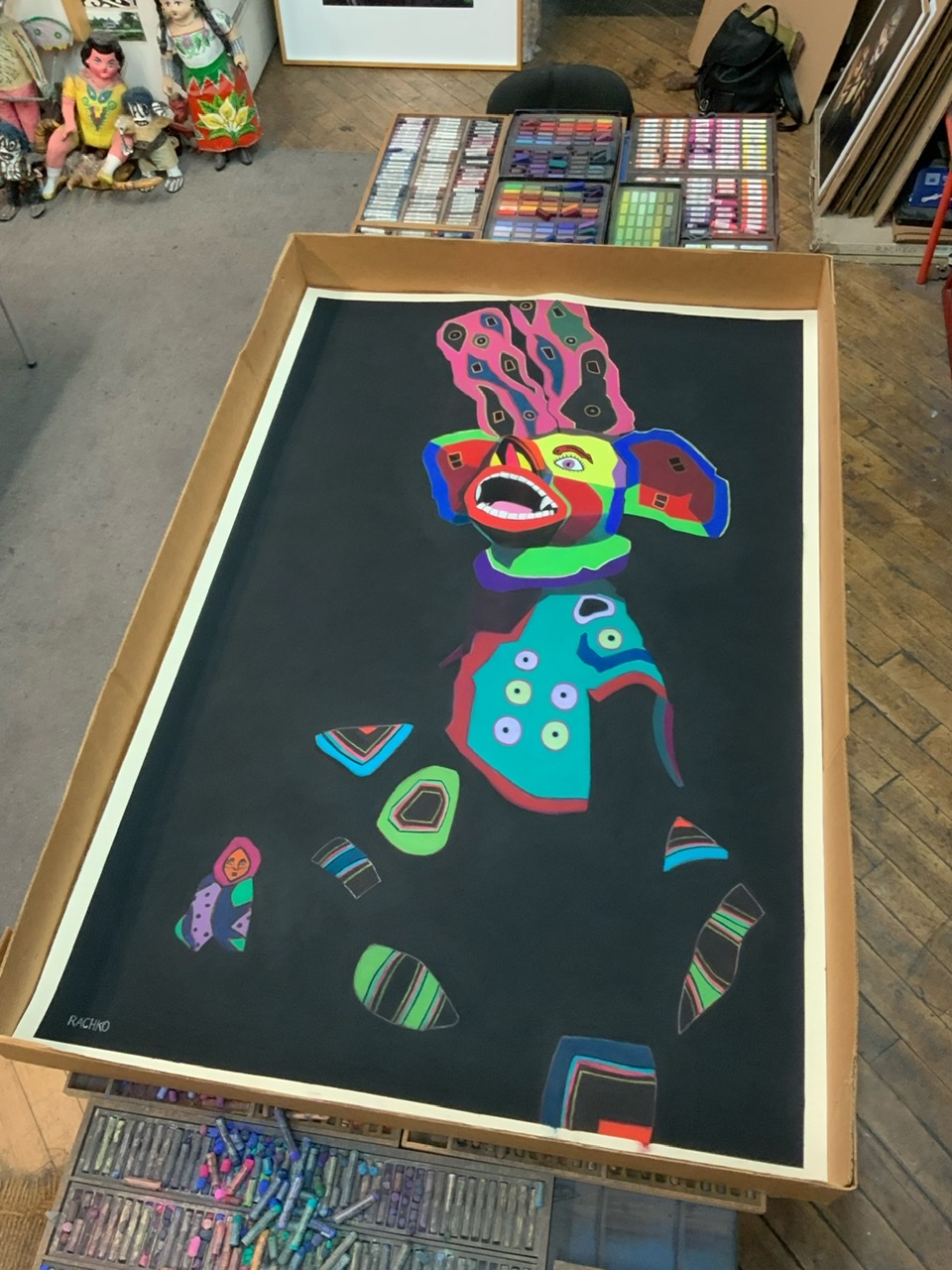
“Impresario” partially boxed for transport to Virginia
A: Well, I have been working with the same framer for three decades so I am used to the process.
Once my photographer photographs a finished, unframed piece, I carefully remove it from the 60” x 40” piece of foam core to which it has been attached (with bulldog clips) during the months I worked on it. I carefully slide the painting into a large covered box for transport. Sometimes I photograph it in the box before I put the cover on (see above).
My studio is in a busy part of Manhattan where only commercial vehicles are allowed to park, except on Sundays. Early on a Sunday morning, I pick up my 1993 Ford F-150 truck from Pier 40 (a parking garage on the Hudson River at the end of Houston Street) and drive to my building’s freight elevator. I try to park relatively close by. On Sundays the gate to the freight elevator is closed and locked so I enter the building around the corner via the main entrance. I unlock my studio, retrieve the boxed painting, bring it to the freight elevator, and buzz for the operator. He answers and I bring the painting down to my truck. Then I load it into the back of my truck for transport to my apartment.
I drive downtown to the West Village, where I live, and double park my truck. (It’s generally impossible to park on my block). I hurry to unload the painting, bring it into my building, and up to my apartment, all the while hoping I do not get a parking ticket. The painting will be stored in my apartment, away from extreme cold or heat, until I’m ready to drive to Virginia. On the day I go to Virginia, I load it back into my truck. Then I make the roughly 5-hour drive south.
Who ever said being an artist is easy was lying!
Comments are welcome!
Q: You had a terrific interview published in the July Issue # 44 of “Art Market.” How did that happen?
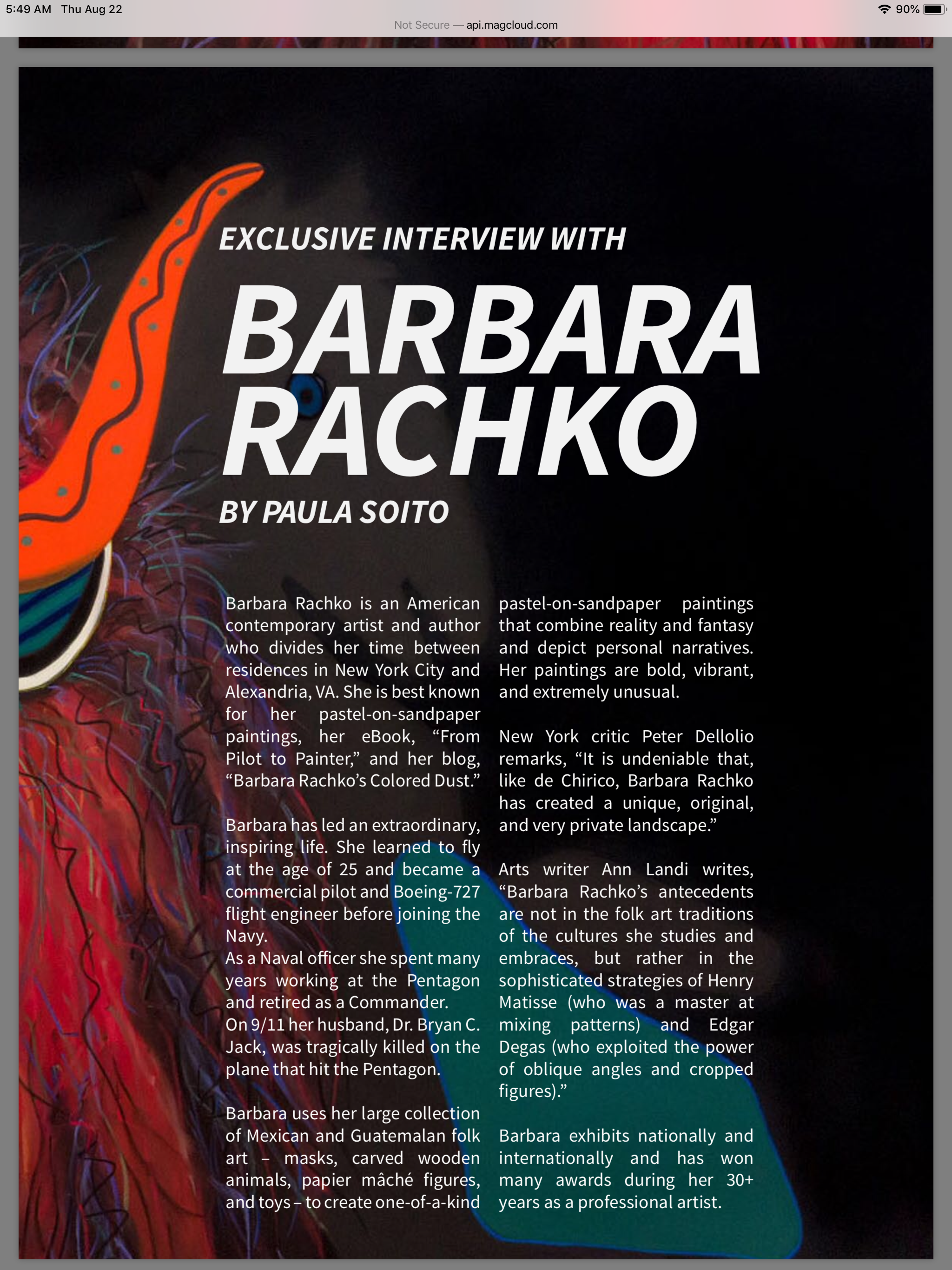
First page of Barbara’s interview in “Art Market”
A: You know, my business strategy is to get my work onto as many websites as possible in hopes of eventually reaching the right collectors. ArtsRow has not gotten me a sale yet, but wow, what press! The print copy of “Art Market is gorgeous.” I was stunned by the quality of the reproductions, the layout, and the fact that the publisher did not cut any of my 18-page interview!
This is how it happened. I cannot remember if Paula Soito found me or vice versa. Somehow we connected, I sent my work for her ArtsRow website, and shortly after, she asked to interview me for her blog. Paula deeply connected to something in my work or my bio. I may be mistaken, but I do not believe she asks many artists for an interview.
As I do with every interview request, I enthusiastically said, “Yes!” Paula proceeded to ask great questions. I prepared my written answers to her questions as though I were writing an article for “The New York Times,” because once an interview is published, you never know who will read it. And we had no word limits since the interview was being published on her blog, not in print.
So last spring my in-depth interview was published on Paula’s blog. Sometime later she let me know that she had met Dafna Navarro, CEO and Founder of “Art Market,” and was arranging for our interview to be published there. I thought, “Gee, that’s nice,” thinking there’s no way they will publish the whole article. When I received my print copy in the mail I was thrilled! Not only did my interview look great, but it was sandwiched between a piece about an exhibition at The Metropolitan Museum and one at The Whitney Museum of American Art! So, of course, I am sharing it with everyone and encouraging people to purchase a print copy.
Q: Why do you make art?

Barbara’s studio
A: This is an excellent question and one I like to revisit because with all the day-to-day frustrations and disappointments that are a normal part of an artist’s life, it is easy to forget what is important.
First, I make art because I have a gift and a desire to share it with others. To not develop, express, and share all that I have to say through my work is unthinkable.
Second, I make art because it is what gives my life direction and purpose. I believe that each human being has his or her own quest, driven by passion, to fulfill a certain duty. Recall Joseph Campbell’s, “The Hero’s Journey.” I need to make art in order to feel that I am living up to my highest potential.
Third, for inexplicable reasons (to me, anyway) soft pastel is an undervalued medium. I fell in love with pastel above all other media and hope to demonstrate that great art can be created with it. This is one of the drives that keeps me steadily working.
Comments are welcome!
Pearls from artists* # 122
Sanur, Bali
* an ongoing series of quotations – mostly from artists, to artists – that offers wisdom, inspiration, and advice for the sometimes lonely road we are on.
Most significant growth in my life has been the direct result of errors, mistakes, accidents, faulty assumptions and wrong moves. I have generally learned more from my mistakes and my so-called failures than any successes or instances of “being right.” I would venture to propose that this equation is also true in the world at large. Error is a powerful animating ingredient in political, scientific and historical evolution as well as in art and mythology. Error is a necessity. The question I had to ask myself was: how can I cultivate a tolerance and an appetite for being wrong, for error?
In the face of an exceedingly complicated world, there are too many people who are invested in “being right.” These people are dangerous. Their authority is based on their sense of certainty. But innovation and invention do not only happen with smart people who have all of the answers. Innovation results from trial and error. The task is to make good mistakes, good errors, in the right direction.
There are many reasons that we get things as wrong as often as we do. Failures of perception, the cause of most error, are far more common in our daily lives than we like to think. We make errors because of inattention, because of poor preparation and because of haste. We err as a result of hardened prejudices about how things are. We err because we neglect to think things through. Our senses betray us constantly. But the chaos caused by being wrong also awakens energy and consciousness in us. In the moments that we realize our faults of perception, we are jerked into an awareness of our humanity. The Slovenian philosopher Slavoj Zizek wrote, “Consciousness originates with something going terribly wrong.”
Anne Bogart in “What’s the Story: Essays about art, theater, and storytelling
Comments are welcome!
Pearls from artists* # 38
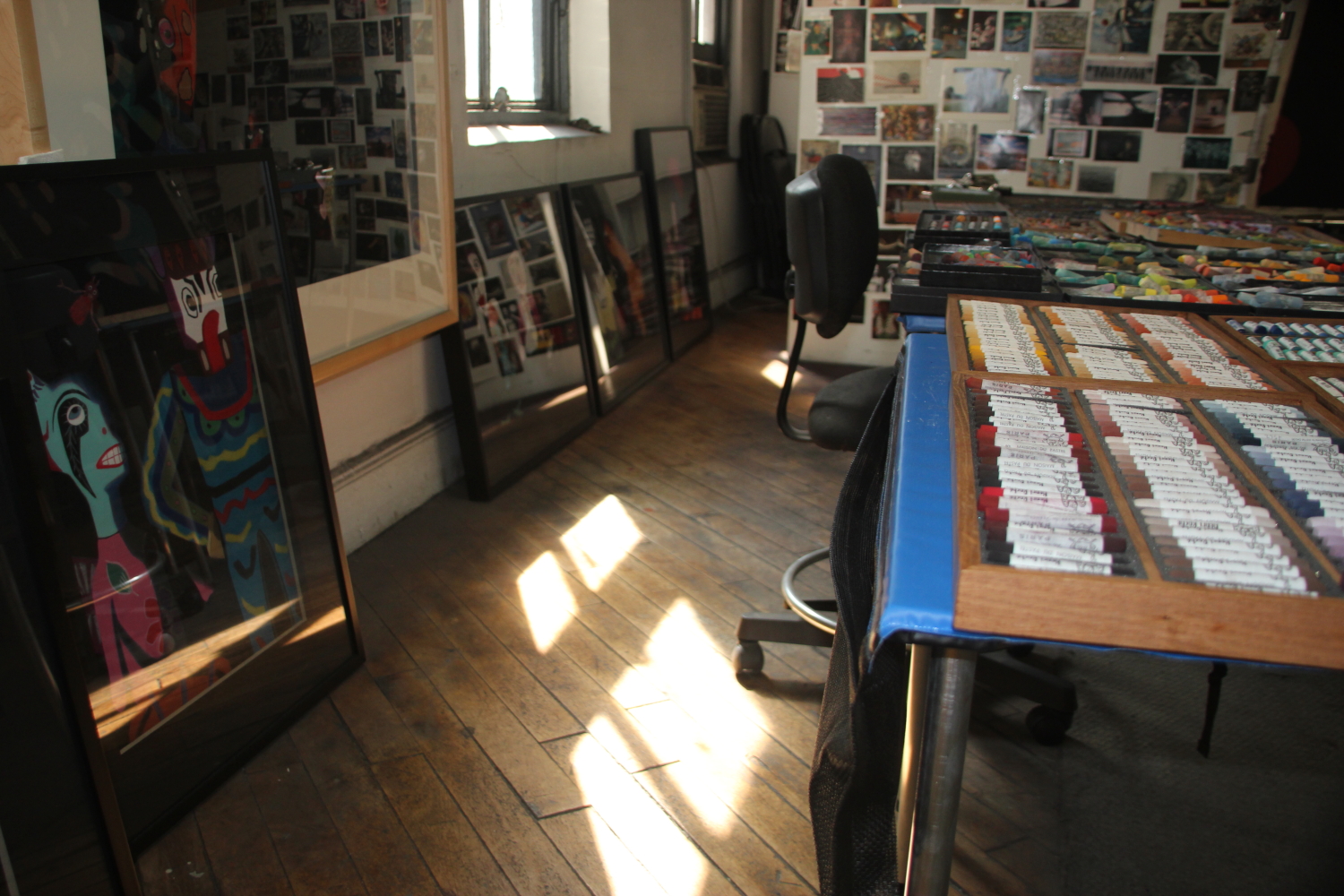
Morning sun at the studio
* an ongoing series of quotations – mostly from artists, to artists – that offers wisdom, inspiration, and advice for the sometimes lonely road we are on.
It’s one thing to be intelligent and it’s another to enjoy thinking, to relish the time spent alone with one’s thoughts, to happily muse, imagine, and analyze. Artists, who are introspective by nature, typically enjoy spending time in this fashion and may even prefer solitude to the company of others. Able to work by themselves, artists are often lost in a state of dreamy thoughtfulness of the sort described by the painter Hans Hofmann when he wrote, ” The first red spot on a white canvas may at once suggest to me the meaning of ‘morning redness,’ and from there I dream further with my color.” Artists are not introspective, thoughtful, lost in time and space because they wish to ignore the world. They’re introspective because out of that attitude artistic answers flow.
Eric Maisel in A Life in the Arts
Comments are welcome!
Q: Is there an overarching narrative in your photographs with Mexican and Guatemalan figures?
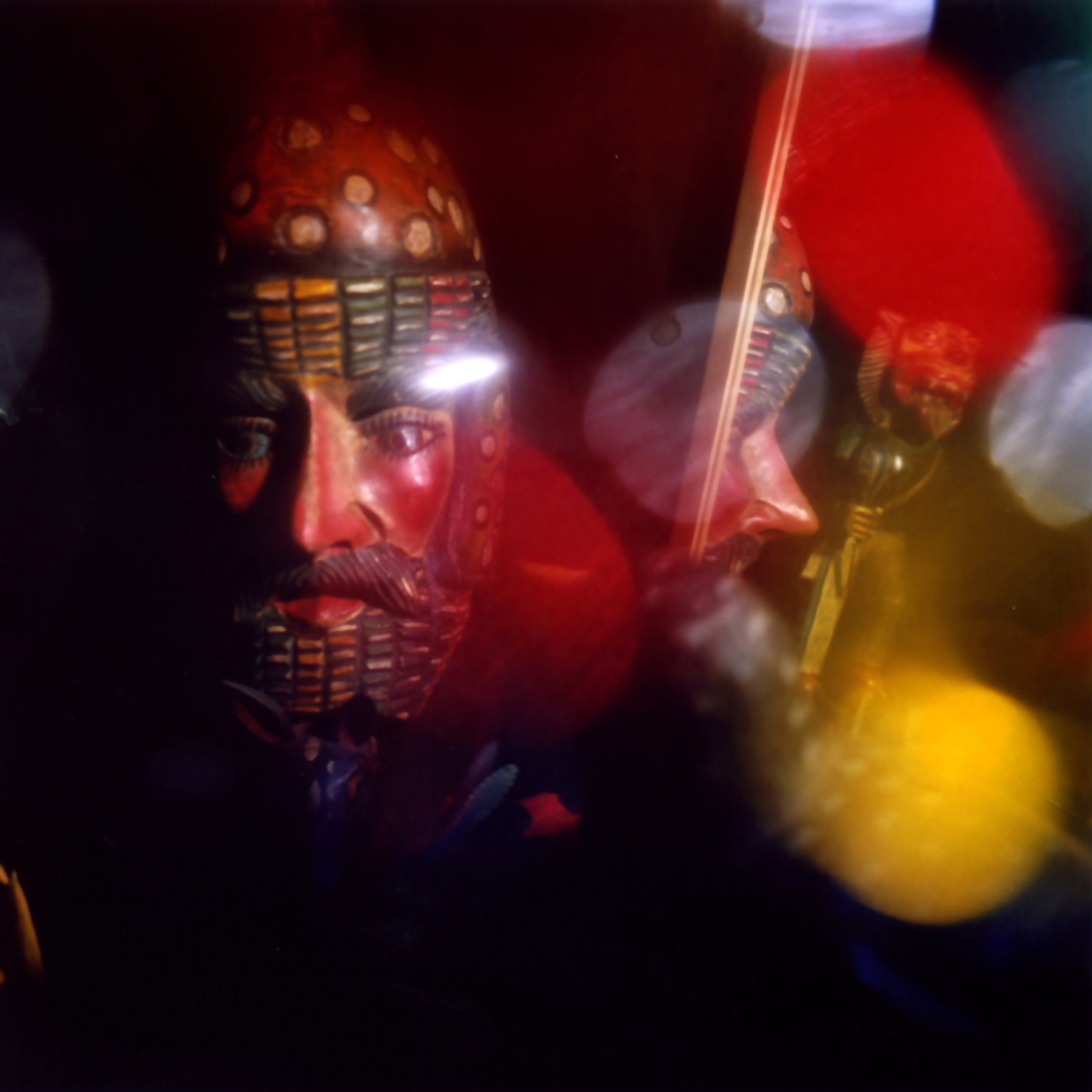
Untitled chromogenic print, 24″ x 24,” edition of 5
A: Maybe, but that’s something for the viewer to judge. I never specify exactly what my work is about for a couple of reasons: my thinking about the meaning of my work constantly evolves, plus I wouldn’t want to cut off other people’s interpretations. Everything is equally valid. I heard Annie Leibovitz interviewed some time ago on the radio. She said that after 40 years as a photographer, everything just gets richer. It doesn’t get easier, it just gets richer. I’ve been a painter for 27 years, a photographer for 11, and I agree completely. Creating this work is an endlessly fascinating intellectual journey. I realize that I am only one voice in a vast art world, but I hope that through the ongoing series of questions and answers on my blog, I am conveying some sense of how artists work and think.
Comments are welcome!


 barbararachkoscoloreddust.com