Category Archives: Domestic Threats
Pearls from artists* # 137

“She Embraced It and Grew Stronger,” soft pastel on sandpaper, 58″ x 38″
* an ongoing series of quotations – mostly from artists, to artists – that offers wisdom, inspiration, and advice for the sometimes lonely road we are on.
I was a determined young woman. I was driven. My problem was not in being an artist. I didn’t realize how much my being a woman would get in the way of being an artist in the world. I wasn’t aware of it. I was just doing my thing. My pain came from being treated like I was a bad woman, in my personal life. That being driven and assertive and doing my vision was really bad because I was not a supporter and a nurturer of men. The men were the ones who made me feel bad. It could just be that they were not strong men. It was very painful and the way that I took it was as if there was something the matter with me. Yet, there was no way I was not going to pursue my vision. It was not negotiable.
Conversations with Meredith Monk by Bonnie Marranca
Comments are welcome!
Q: Why do you call the small paintings in your “Domestic Threats” series, “Scenes?”
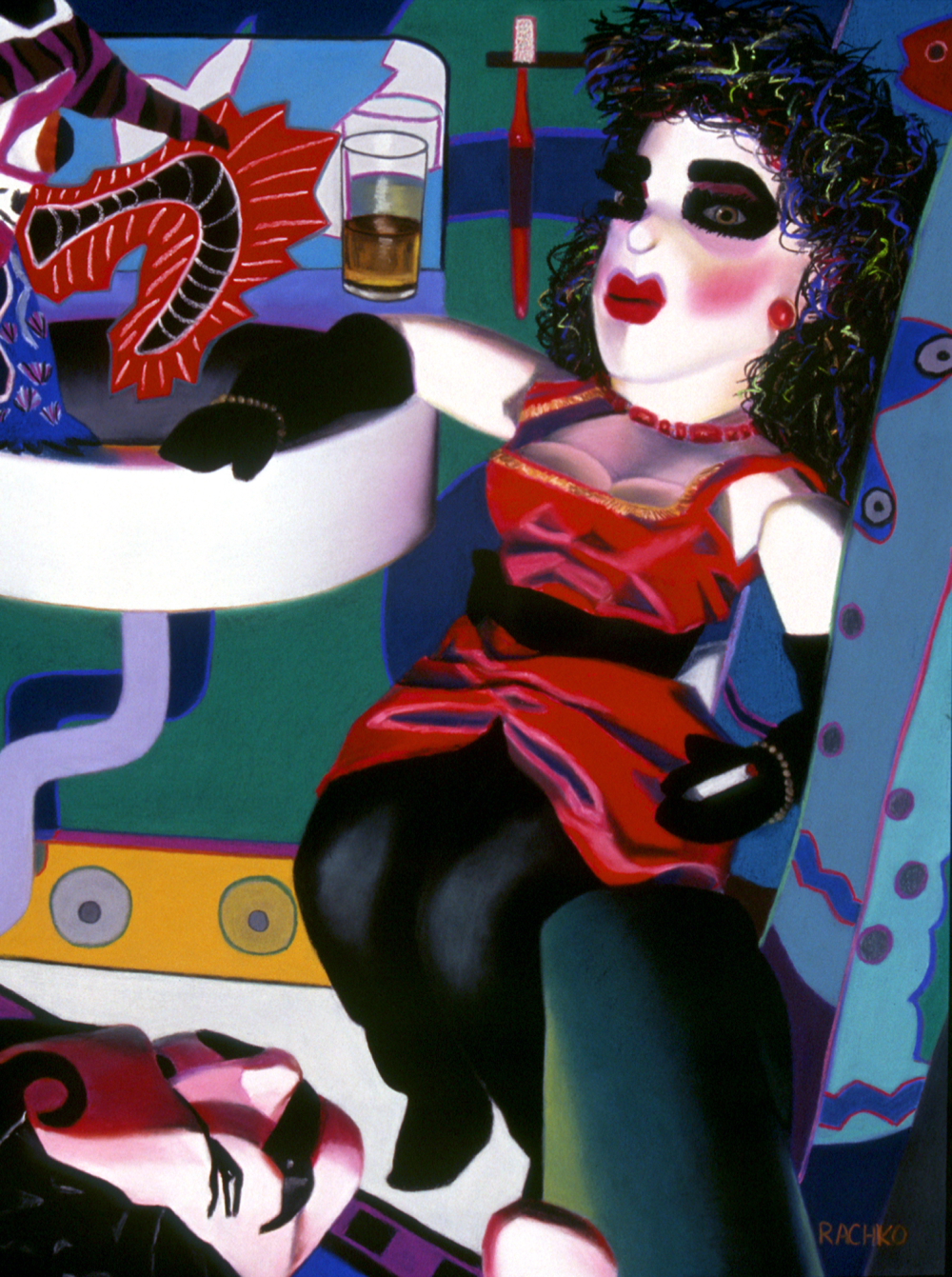
“Scene Thirteen: Bathroom,” 26″ x 20″, soft pastel on sandpaper
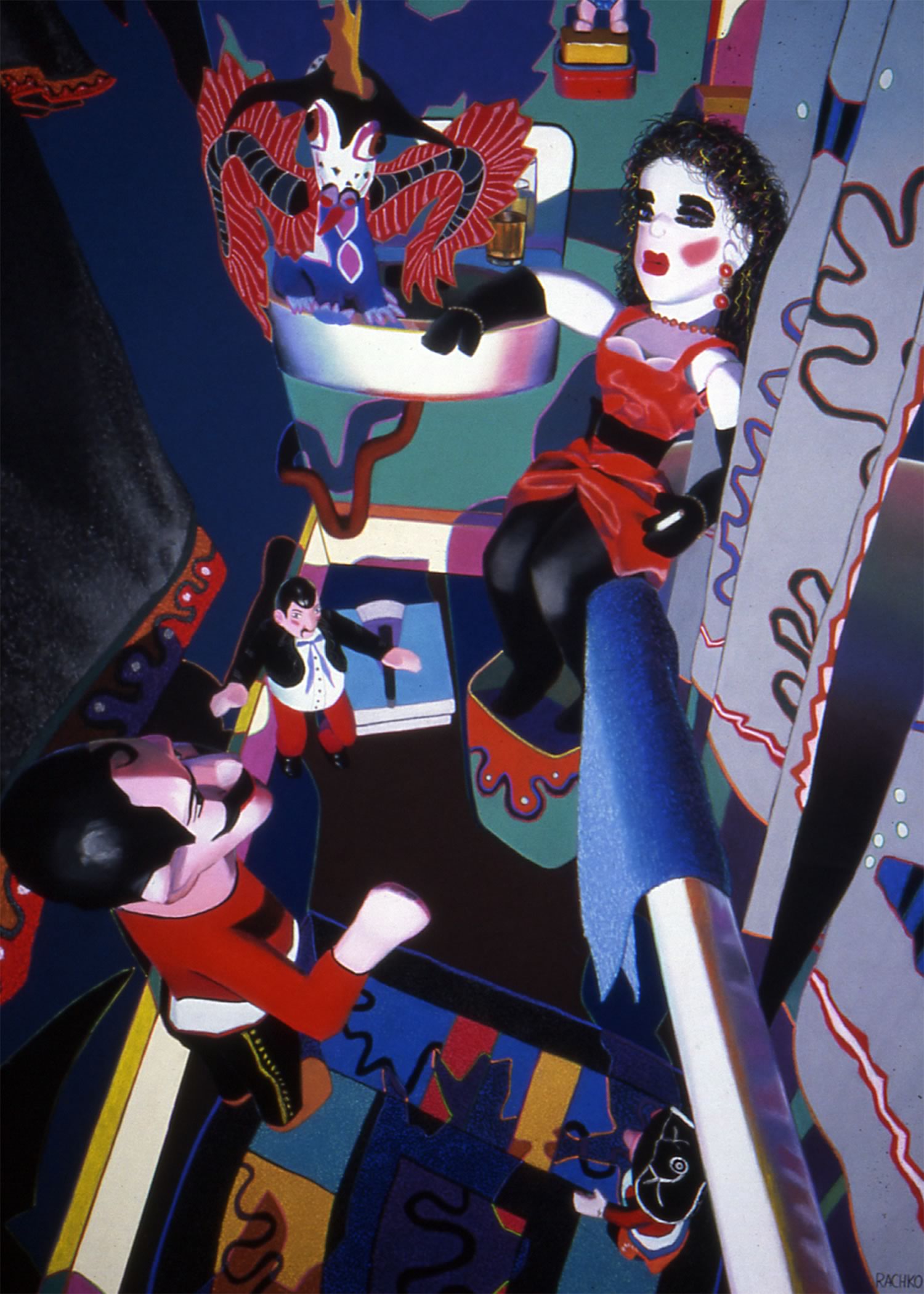
“He Urged Her to Abdicate,” 58″ x 38,” soft pastel on sandpaper
A: At first I didn’t know what to call them. I was looking for a word that meant “a piece of some larger whole.” Initially the word “shard” – a fragment of pottery – came to mind. However, that didn’t capture the meaning I was seeking, since my paintings have little to do with pottery.
My large “Domestic Threats” paintings are theatrical. There is substantial labor and much thought involved in their creation, so I often think of myself as a director and each image as a play.
Small “Domestic Threats” paintings are made from a portion of a photograph that I use as reference for a larger painting. For example, “Scene Thirteen: Bathroom” (above, top) is a small version of “He Urged Her to Abdicate” (above, bottom).
A “portion” of a play is a “Scene” so that’s what I finally named them. Additionally, I numbered the paintings in order of their creation and added the room where each takes place.
Comments are welcome!
Q: You often speak about the Mexican and Guatemalan figures in your paintings as serving a function analogous to actors in a repertory company. In other words, a particular figure plays a different role each time it appears in one of your pastel paintings. Would you choose a figure and show how you have painted it through the years?
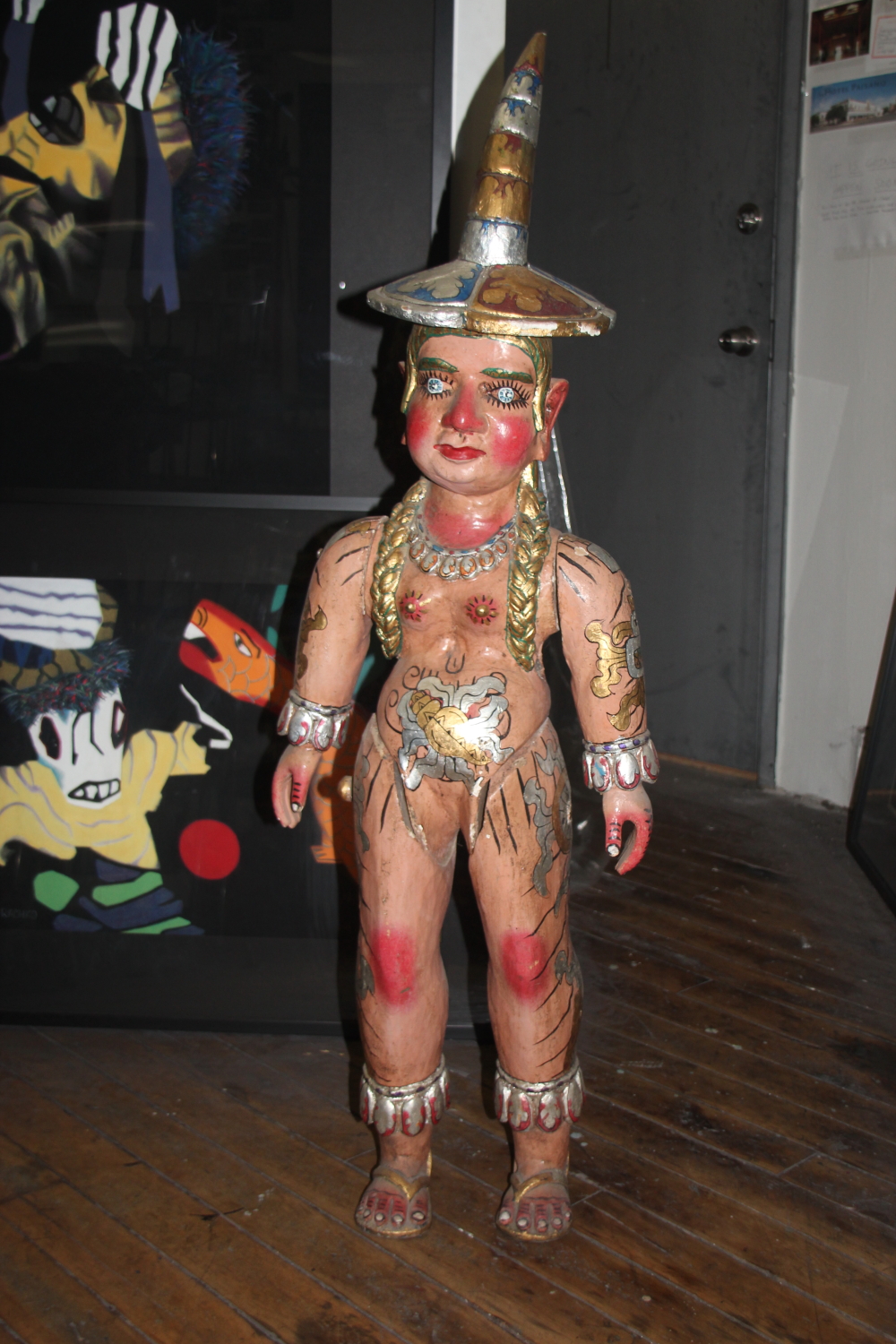
A Chinese-influenced figure Barbara brought home from Mexico City in 1999.
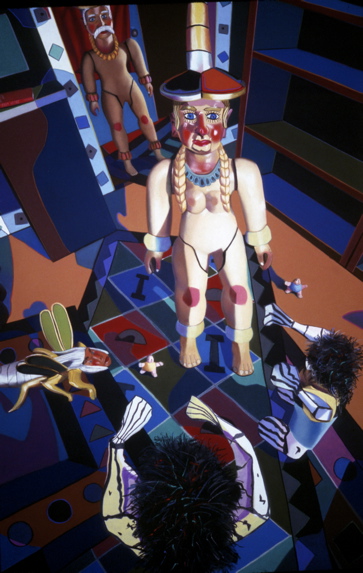
“Answering the Call,” 58″ x 38,” soft pastel on sandpaper, 2000
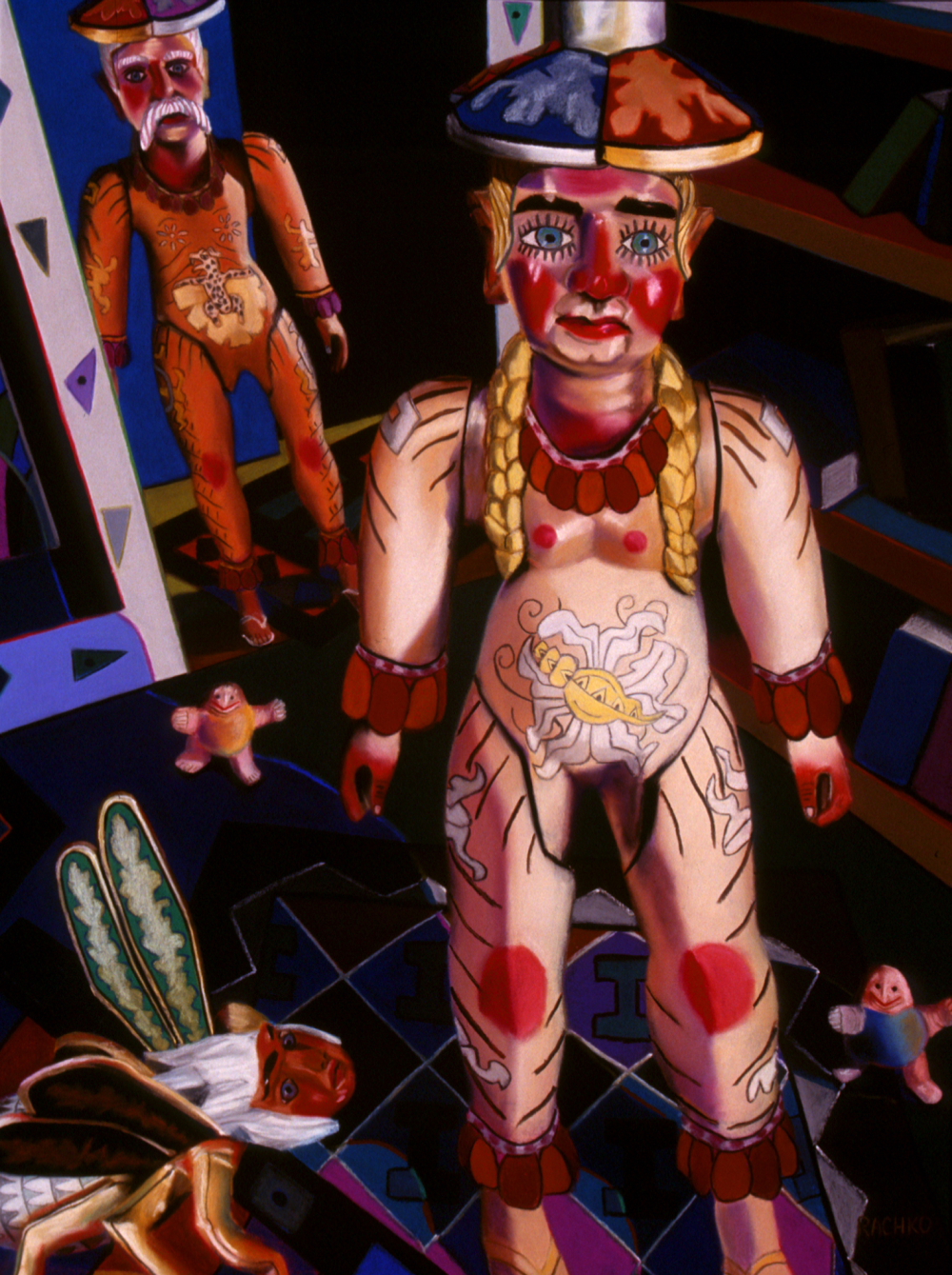
“Scene Fifteen: Living Room,” 26″ x 20″ soft pastel on sandpaper, 2002
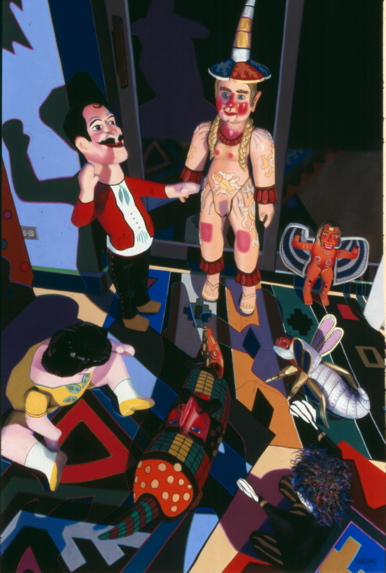
“Sometimes He Still Tried to Restrain Her,” 58″ x 38,” soft pastel on sandpaper, 2005
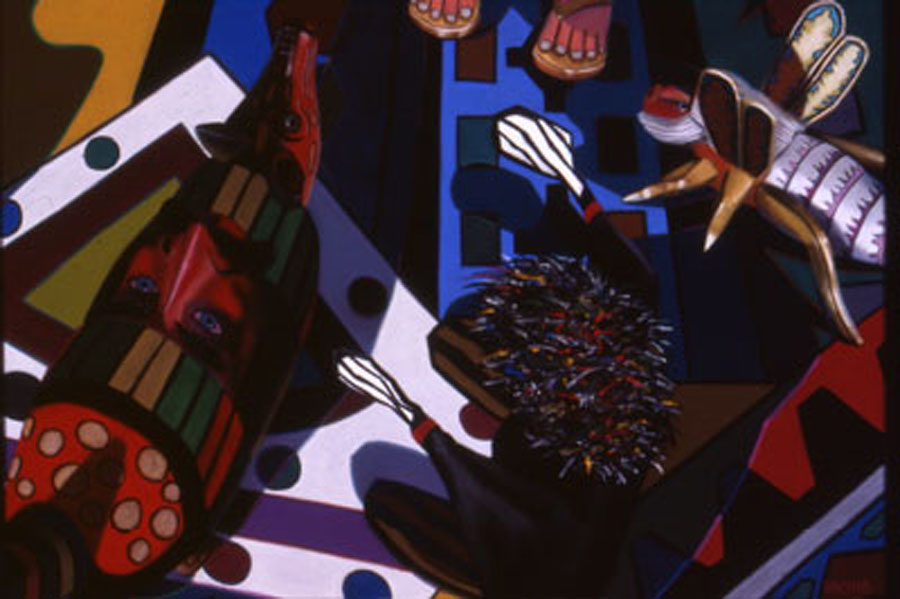
“Scene Twenty-One: Living Room,” 20″ x 26,” soft pastel on sandpaper, 2006 (see feet at top)
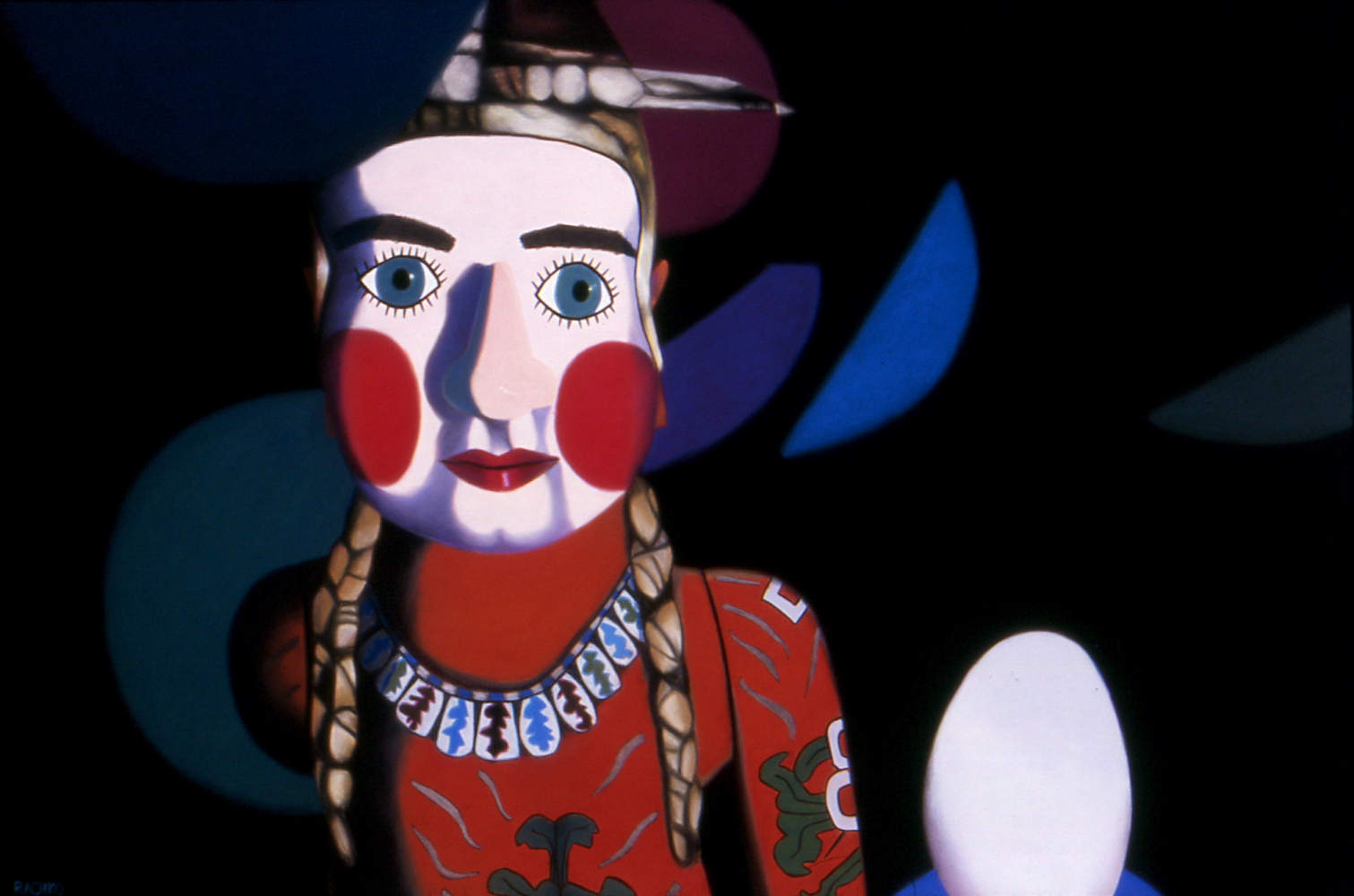
“Epiphany,” 38″ x 58,” soft pastel on sandpaper, 2012

“The Ancestors,” soft pastel on sandpaper, 58″ x 38,” 2013
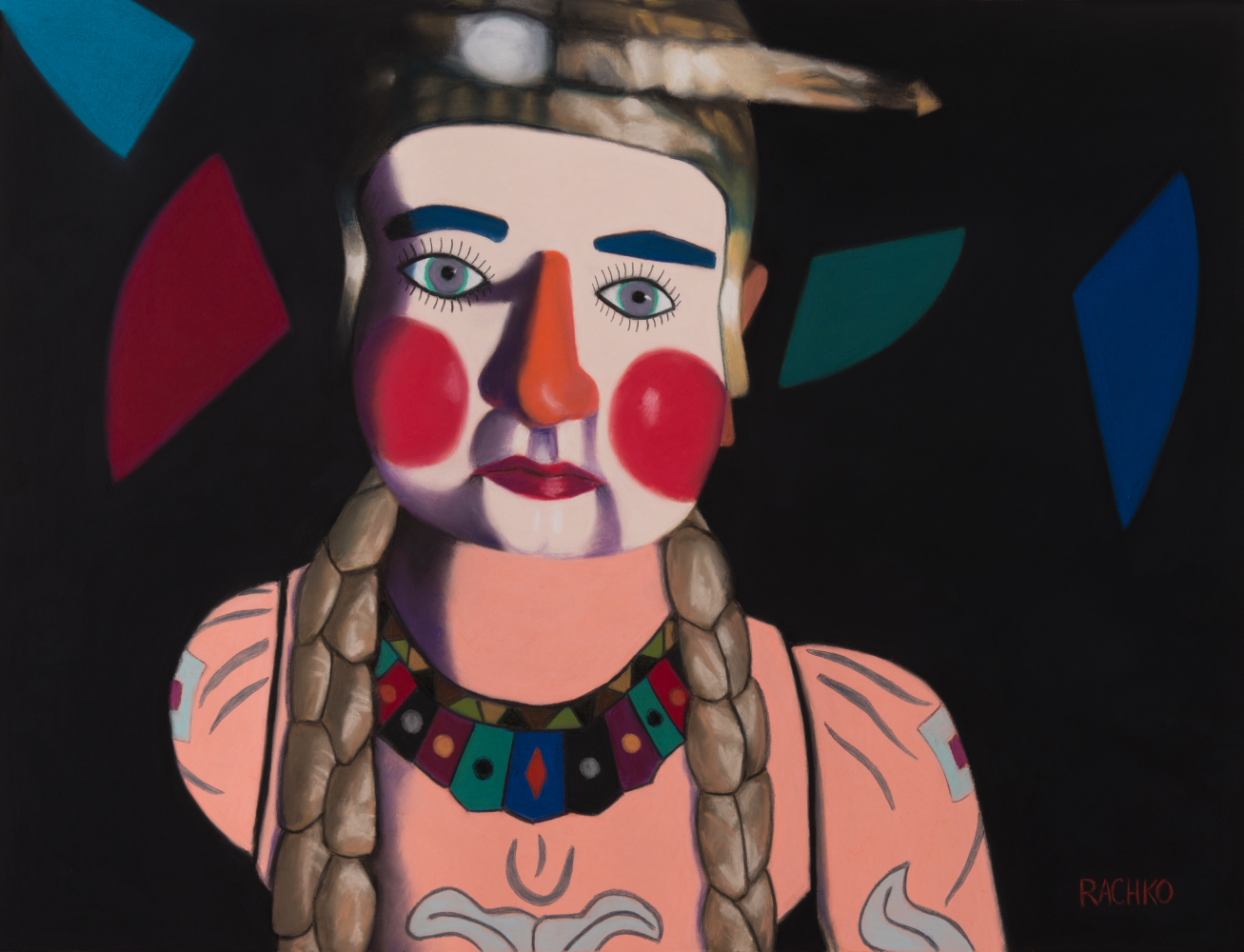
“The Storyteller,” soft pastel on sandpaper, 20″ x 26,” 2014
And she is in the painting that is on my easel now. See my February 14 blog post.
Comments are welcome!
Q: Can you talk a little bit about your process? What happens before you even begin a pastel painting?

Barbara in Bali (far right)
A: My process is extremely slow and labor-intensive.
First, there is foreign travel – often to Mexico, Guatemala or someplace in Asia – to find the cultural objects – masks, carved wooden animals, paper mâché figures, and toys – that are my subject matter. I search the local markets, bazaars, and mask shops for these folk art objects. I look for things that are old, that look like they have a history, and were probably used in religious festivals of some kind. Typically, they are colorful, one-of-a- kind objects that have lots of inherent personality. How they enter my life and how I get them back to my New York studio is an important part of my art-making practice.
My working methods have changed dramatically over the nearly thirty years that I have been an artist. My current process is a much simplified version of how I used to work. As I pared down my imagery in the current series, “Black Paintings,” my creative process quite naturally pared down, too.
One constant is that I have always worked in series with each pastel painting leading quite naturally to the next. Another is that I always set up a scene, plan exactly how to light and photograph it, and work with a 20″ x 24″ photograph as the primary reference material.
In the setups I look for eye-catching compositions and interesting colors, patterns, and shadows. Sometimes I make up a story about the interaction that is occurring between the “actors,” as I call them.
In the “Domestic Threats” series I photographed the scene with a 4″ x 5″ Toyo Omega view camera. In my “Gods and Monsters” series I shot rolls of 220 film using a Mamiya 6. I still like to use an old analog camera for fine art work, although I have been rethinking this practice.
Nowadays the first step is to decide which photo I want to make into a painting (currently I have a backlog of photographs to choose from) and to order a 19 1/2″ x 19 1/2″ image (my Mamiya 6 shoots square images) printed on 20″ x 24″ paper. They recently closed, but I used to have the prints made at Manhattan Photo on West 20th Street in New York. Now I go to Duggal. Typically I have in mind the next two or three paintings that I want to create.
Once I have the reference photograph in hand, I make a preliminary tonal charcoal sketch on a piece of white drawing paper. The sketch helps me think about how to proceed and points out potential problem areas ahead.
Only then am I ready to start actually making the painting.
Comments are welcome!
Q: What are your most significant professional accomplishments to date?

“Big Deal,” soft pastel on sandpaper, 58″ x 38″
A: I will mention these: my 1996 solo exhibition at a venerable New York gallery that specialized in Latin American-influenced art, Brewster Arts Ltd. at 41 West 57th Street; completion of Aljira’s Emerge 2000 business program for professional artists; and a solo exhibition at the Walton Art Center in Fayetteville, AR, in 2005. All three were very important factors in my artistic and professional development.
In January I published my first eBook, From Pilot to Painter, on Amazon.
In February I was interviewed by Brainard Carey for his Yale University Radio program. It can be heard at
http://museumofnonvisibleart.com/interviews/barbara-rachko/
Most recently I was interviewed for a fourteen-page article (the longest they have ever published on a single artist!) in ARTiculAction Art Review. Please see
http://issuu.com/articulaction/docs/articulaction_art_review_-_july_201/30
Comments are welcome!
Pearls from artists* # 97

“No Cure for Insomnia,” pastel on sandpaper, 58″ x 38″
* an ongoing series of quotations – mostly from artists, to artists – that offers wisdom, inspiration, and advice for the sometimes lonely road we are on.
“Art should be independent of all clap-trap – should stand alone, and appeal to the artistic sense of eye or ear, without confounding this with emotions entirely foreign to it, as devotion, pity, love, patriotism, and the like,” he wrote in The Gentle Art of Making Enemies.
Take the picture of my mother, exhibited at the Royal Academy as an “Arrangement in Grey and Black.” Now that is what it is. To me it is interesting as a picture of my mother; but what can or ought the public to care about the identity of the portrait?
James McNeill Whistler quoted in Whistler: The Enraged Genius by Christopher Benfey in The New York Review of Books, June 5, 2014
Comments are welcome!
Q: What impact do you hope to have on viewers of your work?
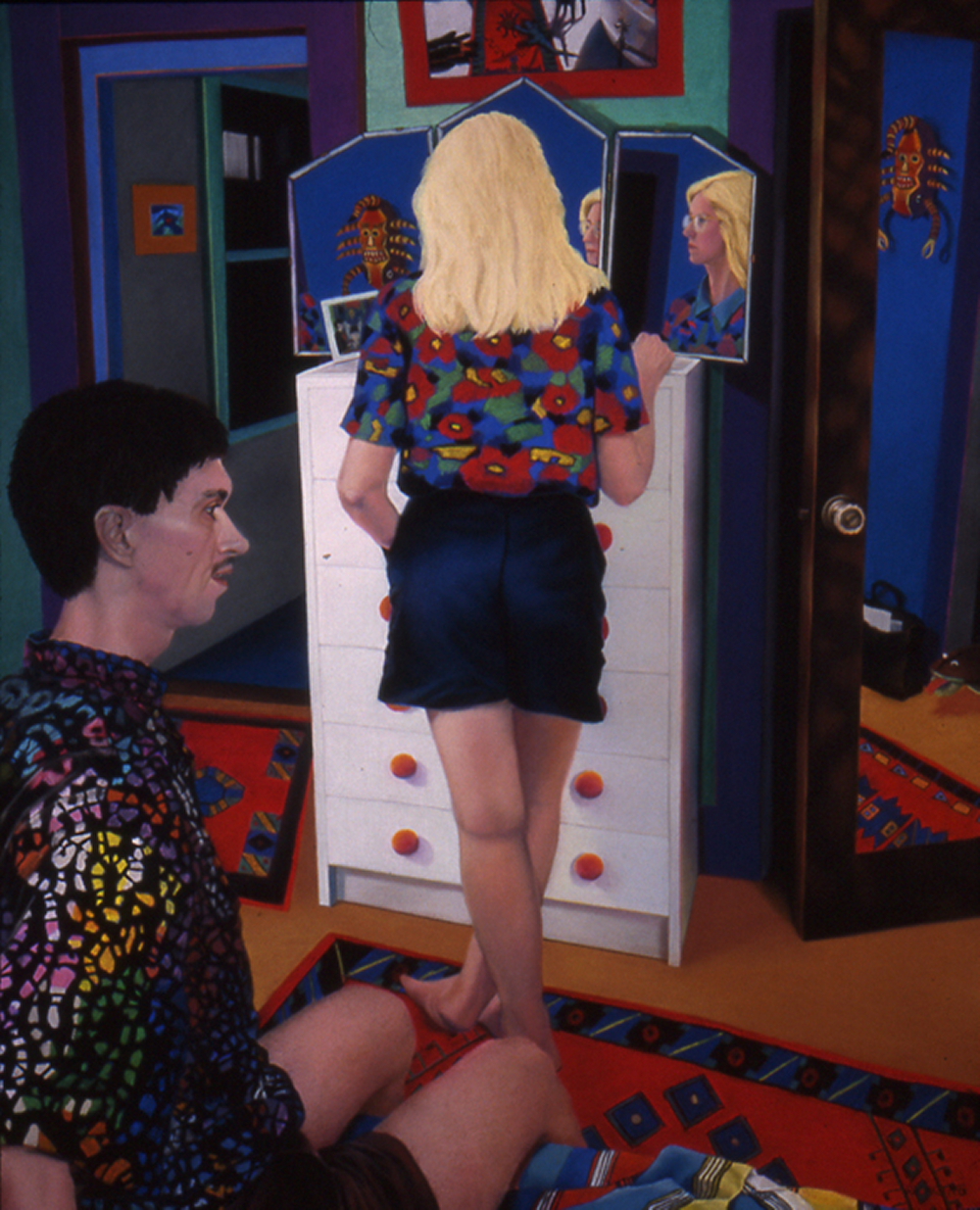
“Us and Them,” soft pastel on sandpaper, 47″ x 38″, 1993
A: I am pushing soft pastel to its limits, using it in ways that no artist has done before. I want people to see what is possible to accomplish with this medium. Because I have experienced unspeakable heartache – the loss of my husband on 9/11, onboard the high-jacked airplane that crashed into the Pentagon – when viewers learn about my life story, I hope to serve as an inspiration to keep forging ahead regardless of what tragedies life may bring. These are the main reasons that I wrote my eBook.
Comments are welcome!
New eBook!
Cover
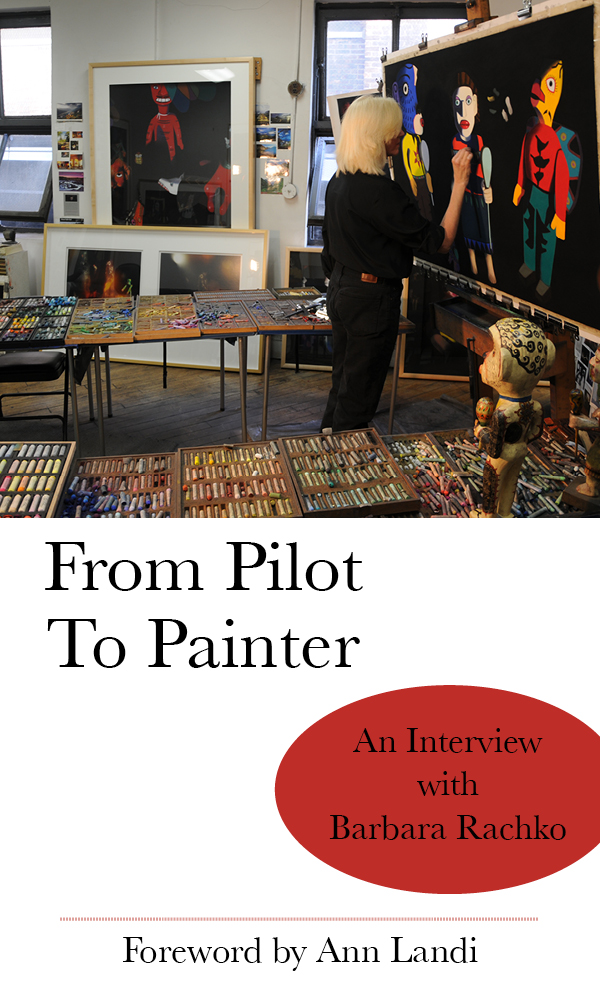
I am pleased to announce that my first eBook, FROM PILOT TO PAINTER, is available now on Amazon!
It is based on my blog and is part memoir, including my personal loss on 9/11, insights into my creative practice, and intimate reflections on what it’s like to be an artist living in New York City now.
The eBook includes new material not found on the blog: 25+ reproductions of my vibrant pastel-on-sandpaper paintings, a Foreword by Ann Landi (who writes for ARTnews and The Wall Street Journal), and more.
Thank you for your support!
Note: If you do not own a Kindle, you can download a free Kindle app.
Here is the one for MACs:
http://www.amazon.com/gp/feature.html?docId=1000464931
Here is a link for the rest:
Kindle Cloud Reader – Read instantly in your browser
Smartphones – iPhone & iPod touch, Android, Windows Phone, BlackBerry
Computers – Mac, Windows 8, Windows 7, XP & Vista
Tablets – iPad, Android Tablet, Windows 8
http://www.amazon.com/gp/feature.html/ref=sv_kstore_3?ie=UTF8&docId=1000493771
Comments are welcome!
Q: Can you discuss your process, including how you actually use Mexican and Guatemalan folk art figures in your art?

A corner of Barbara’s studio
A: When I set up the figures to photograph for a painting, I work very intuitively, so how I actually cast them in an artwork is difficult to say. Looks count a lot – I select an object and put it in a particular place, look at it, move it or let it stay, and sometimes develop a storyline. I spend time arranging lights and looking for interesting cast shadows. With my first “Domestic Threats” series, all of this was done so that Bryan, my late husband, or I could shoot a couple of negatives with his Toyo Omega 4″ x 5″ view camera. For my “Black Paintings” series, begun in 2007, I shoot medium format negatives with a Mamiya 6 camera.
I always look at a 20″ x 24″ photograph for reference as I make a pastel-on-sandpaper painting, plus I also work from the ‘live’ objects. The photograph is mainly a catalyst because finished paintings are always quite different from their associated reference photos. Also, since I spend months creating them, the paintings’ interpretative development goes way beyond that of the photo.
I once completed 6 large (58” x 38”) pastel paintings in a single year, but more recently 4 or 5 per year is common. It takes approximately 3 months to make each one. During that time I layer and blend together as many as 25 to 30 layers of pastel. Of course, the colors get more intense as the painting progresses and the pigment accumulates on the sandpaper.
Comments are welcome!


 barbararachkoscoloreddust.com
Q: Another interesting series of yours that has impressed me is your recent “Black Paintings.” The pieces in this series are darker than the ones in “Domestic Threats.” You create an effective mix between the dark background and the few bright tones, which establish such a synergy rather than a contrast, and all the dark creates a prelude to light. It seems to reveal such a struggle, a deep tension, and intense emotions. Any comments on your choice of palette and how it has changed over time?
Dec 6
Posted by barbararachkoscoloreddust
West 29th Street studio
A: That is a great question!
You are correct that my palette has darkened. It’s partly from having lived in New York for so long. This is a generally dark city. We famously dress in black and the city in winter is mainly greys and browns.
Also, the “Black Paintings” are definitely post-9/11 work. My husband, Bryan, was tragically killed onboard the plane that crashed into the Pentagon. Losing Bryan was the biggest shock I ever have had to endure, made even harder because it came just 87 days after we had married. We had been together for 14 ½ years and in September 2001 were happier than we had ever been. He was killed so horribly and so senselessly. Post 9/11 was an extremely difficult, dark, and lonely time.
In the summer of 2002 I resumed making art, continuing to make “Domestic Threats” paintings. That series ran its course and ended in 2007. Around then I was feeling happier and had come to better terms with losing Bryan (it’s something I will never get over but dealing with loss does get easier with time). When I created the first “Black Paintings” I consciously viewed the background as literally, the very dark place that I was emerging from, exactly like the figures emerging in these paintings. The figures themselves are wildly colorful and full of life, so to speak, but that black background is always there.
Comments are welcome!
Share this:
Posted in 2014, An Artist's Life, Art in general, Art Works in Progress, Black Paintings, Creative Process, Domestic Threats, Inspiration, Painting in General, Pastel Painting, Photography, Studio, Working methods
Comments Off on Q: Another interesting series of yours that has impressed me is your recent “Black Paintings.” The pieces in this series are darker than the ones in “Domestic Threats.” You create an effective mix between the dark background and the few bright tones, which establish such a synergy rather than a contrast, and all the dark creates a prelude to light. It seems to reveal such a struggle, a deep tension, and intense emotions. Any comments on your choice of palette and how it has changed over time?
Tags: after, always, another, around, art, background, better, between, biggest, black, Black Paintings, bright, browns, Bryan, changed, choice, city, colorful, comments, consciously, continuing, contrast, correct, course, crashed, create, dark, dealing, deep, difficult, Domestic Threats, dress, easier, effective, emerging, emotions, ended, endure, establish, exactly, extremely, famously, feeling, figures, first, full, generally, great, greys, happier, harder, horribly, however, husband, impressed, intense, interesting, killed, life, light, literally, lived, lonely, losing, loss, mainly, making, married, mix, New York, onboard, paintings, palette, partly, Pentagon, pieces, plane, post-9/11, prelude, question, rather, recent, resumed, reveal, senselessly, September, series, shock, something, speak, struggle, summer, synergy, tension, terms, themselves, time, together, tones, tragically, viewed, wildly, winter, work