Blog Archives
Q: What’s on the easel today?
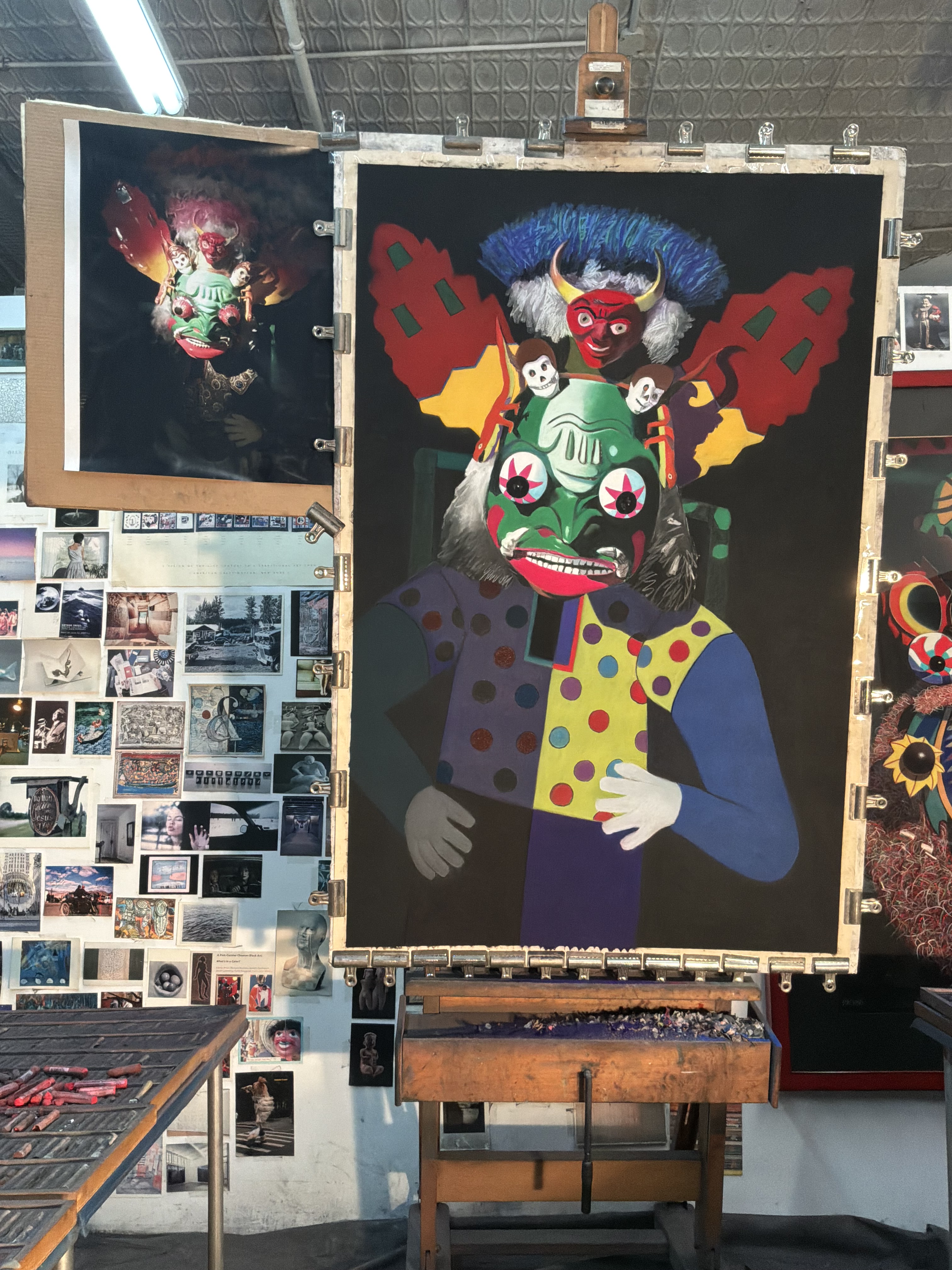
Work in progress
A: I continue working on “Gatecrasher,” soft pastel on sandpaper, 58” x 38.” In February I was privileged to visit this mask on exhibit at MUSEF La Paz in Bolivia. It was my second visit to the museum; the first was in 2017. Even more so this time, I was bowled over with how spectacular this particular mask is in person. Plus, I had forgotten its huge size. So I am absolutely determined to bump up my game and even more inspired to make this painting as strong and powerful as I possibly can!
Comments are welcome!
Q: You started the Bolivianos series in 2017. It has been 8 years since you created The Champ. This endeavor of focussing on a series for almost a decade’s timeline shows that you embody stability as against many artists who tend to hop on to the next inspiration they find. How has discipline, stability, focus and punctuality defined your works apart from being inspired by Bolivian culture for the series Bolivianos? (Question from Vedica Art Studios and Gallery)
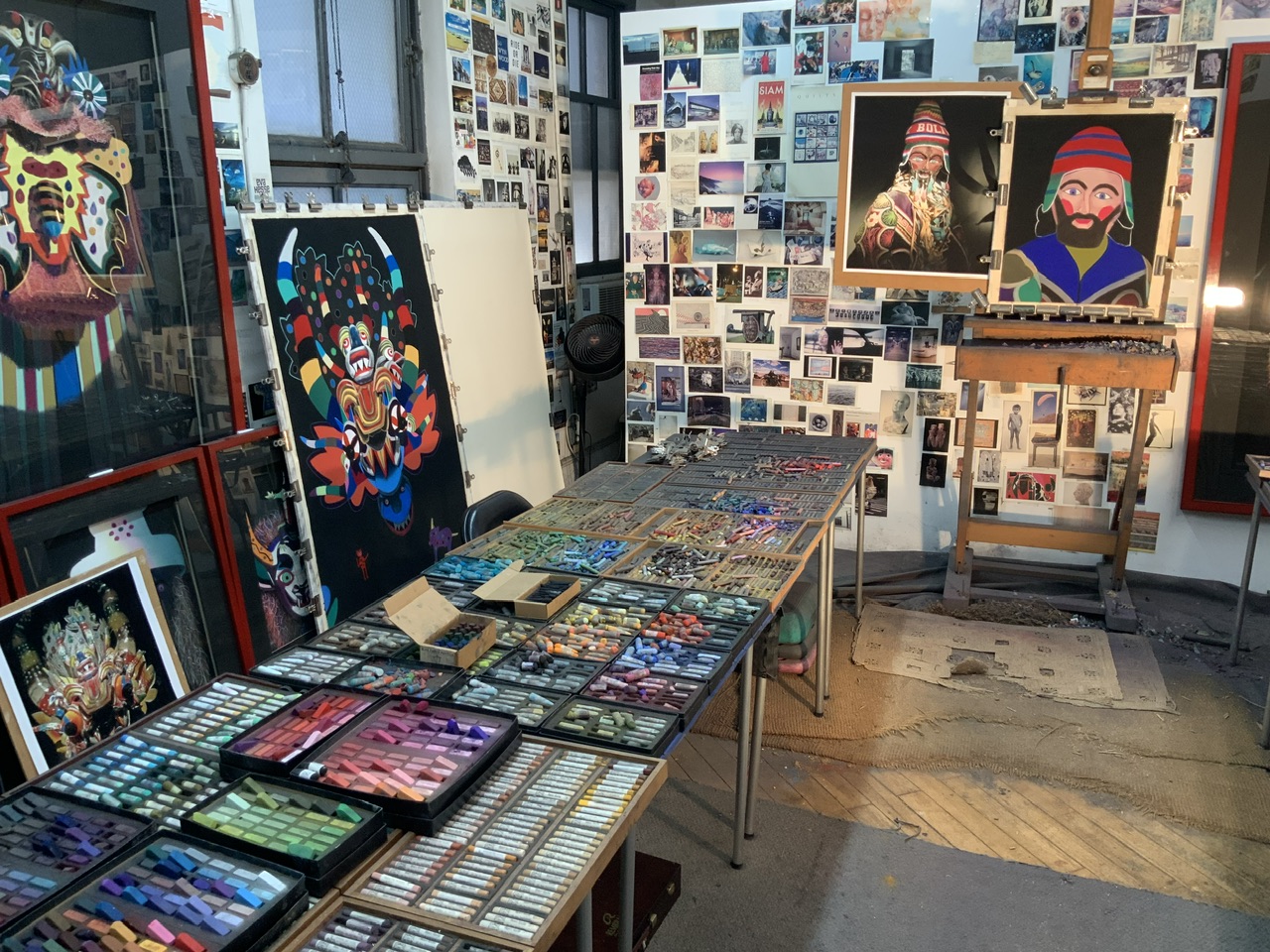
A: My first series, Domestic Threats, lasted fifteen years, and my second, Black Paintings, lasted ten. Stability and related qualities are likely natural parts of my personality, reinforced by my previous professional life. My prior careers as a Navy Commander, commercial pilot, and Boeing-727 Flight Engineer undoubtedly helped develop discipline, stability, focus, and punctuality. Details matter deeply to me; as a Naval Officer for twenty-one years, “attention to detail” was paramount. From my earliest days as an artist, I have been meticulous and dedicated to inventing new techniques and refining the craft of soft pastel.
I dislike wasting precious time. As a goal-oriented person, I continually strive to accomplish as much as possible. These qualities were influenced by my Navy career and further deepened by the tragic loss of my husband onboard the plane that crashed into the Pentagon on 9/11. I understand firsthand that life can change in an instant. Whenever I finish one task, I immediately look around and ask, “OK, what’s next?” I devote my studio time to pushing myself and pastel to new technical heights. There’s always more to accomplish as an artist!
Comments are welcome!
Travel photo of the month*

On the road above Lake Titicaca in Bolivia, May 2017
*favorite travel photos that have not yet appeared in this blog
Lately my thoughts are turning to Bolivia as we continue to plan a research trip to see the Oruro Carnival in February and to make a second documentary!
Comments are welcome!
Pearls from artists* # 659

*an ongoing series of quotations – mostly from artists, to artists – that offers wisdom, inspiration, and advice for the sometimes lonely road we are on.
Your only goal is to be the purest and strongest version of yourself, and to articulate that as fully as possible through your creations. Avoid any enticements that threaten to eclipse the priority of your work, to lure you off in another direction toward a different goal. You are here to spend a lifetime exploring and refining what excites you.
Like Olympic athletes, trailblazing artists do not waste a second looking around at their competition to measure how they are doing. They do not look to the sidelines to measure their applause. They just keep moving forward, in the focused direction of their vision. When you possess a quiet, solid confidence and you are completely unshaken (not even a twitch) when someone looks at your work and says, ‘I don’t really like it,’ you have arrived. If you are not there yet, keep practicing. The opinions of others are simply the ever-shifting clouds, moving across your infinite azure sky.
Kate Kretz in Art From Your Core: A Holistic Guide to Visual Voice
Comments are welcome!
Pearls from artists* # 600
*an ongoing series of quotations – mostly from artists, to artists – that offers wisdom, inspiration, and advice for the sometimes lonely road we are on.
I am always between two currents of thought: first the material difficulties, turning round and round and round to make a living; and second, the study of color. I am always hoping to make a discovery here, to express the feelings of two lovers by a marriage of two complementary colors, their mingling and their opposition, the mysterious vibrations of kindred tones. To express the thought behind a brow by radiance of a bright tone against a somber background. To express hope by some star, the eagerness of a soul by a sunset glow.
Vincent van Gogh quoted by Stephen Nachmanovitch in “Free Play: Improvisation in Life and Art
Comments are welcome!
Q: Can you explain how your current work relates to Jungian archetypes?

In progress: “Wise One,” soft pastel on sandpaper, 58” x 38”
A: Here’s an example. The passage below is from Carl Jung: Knowledge in a Nutshell by Gary Bobroff.
The Wise Old Man or Woman is a figure found throughout folklore and mythology. They possess superior understanding and also often a more developed spiritual or moral character. Frequently, such characters provide the information or learning that the Hero needs to move forward in their quest. In Star Wars, Ben Kenobi plays the teacher to Luke, introducing purpose and knowledge into the young Hero’s life. Where the Hero brings drive, courage, and direct action, the Wise Old One introduces the importance of the opposing values of thought and questioning. Jung describes it thus: ‘Often the old man in fairytales asks questions like who? Why? Whence? Wither? For the purpose of inducing self-reflection and mobilizing the moral forces.’
The Wise One may appear in disguise to test the character of others. In the second Star Wars film, The Empire Strikes Back (1980), Luke’s mentor Yoda does not reveal himself as such when they first meet. He waits, asking questions that test Luke’s motivation for being there. Jung associated the Trickster archetype with the Wise One, and the use of disguise emphasizes this correlation.
Comments are welcome!
Q: Why do you sometimes depict the same subject matter twice?

“Trickster” (left) and “Sacrificial,” while the latter was in-progress
A: It is fascinating to play around with scale. For starters, it helps demonstrate how my pastel techniques and my approach to the subject matter are evolving. I’ve noticed that I always see and depict more details the second time around.
Typically, I prefer the second pastel painting over the first one depicting the same subject. Man Ray famously said:
“There is no progress in art, any more than there is progress in making love. There are simply different ways of doing it.”
I disagree with him. I am an optimist who believes that artists cannot help but improve over time. It’s one of the things that gets me into my studio: the idea that my creative process and my ways of using pastel are changing for the better. I like to think this represents some sort of creative progress. But still I sometimes have to wonder, is the idea of ‘progress’ just something artists tell ourselves in order to keep going?
Comments are welcome!
Pearls from artists* # 540

*an ongoing series of quotations – mostly from artists, to artists – that offers wisdom, inspiration, and advice for the sometimes lonely road we are on.
The Wise Old Man or Woman is a figure found throughout folklore and mythology. They possess superior understanding and also often a more developed spiritual or moral character. Frequently, such characters provide the information or learning that the Hero needs to move forward in their quest. In “Star Wars,” Ben Kenobi plays the teacher to Luke, introducing purpose and knowledge into the young Hero’s life. Where the Hero brings a drive, courage, and direct action, the Wise Old One introduces the importance of the opposing values of thought and questioning. Jung describes it thus: ‘Often the old man in fairytales asks questions like who? Why? Whence? Wither? For the purpose of inducing self-reflection and mobilizing the moral force.’
The Wise One may appear in disguise to test the character of others. In the second “Star Wars” film, “The Empire Strikes Back” (1980), Luke’s mentor Yoda does not reveal himself as such when they first meet. He waits, asking questions that test Luke’s motivation for being there. Jung associated the Trickster archetype with the Wise One, and the use of disguise emphasizes this correlation.
Gary Bobroff in Carl Jung: Knowledge in a Nutshell
Comments are welcome!
Pearls from artists* # 539
*an ongoing series of quotations – mostly from artists, to artists – that offers wisdom, inspiration, and advice for the sometimes lonely road we are on.
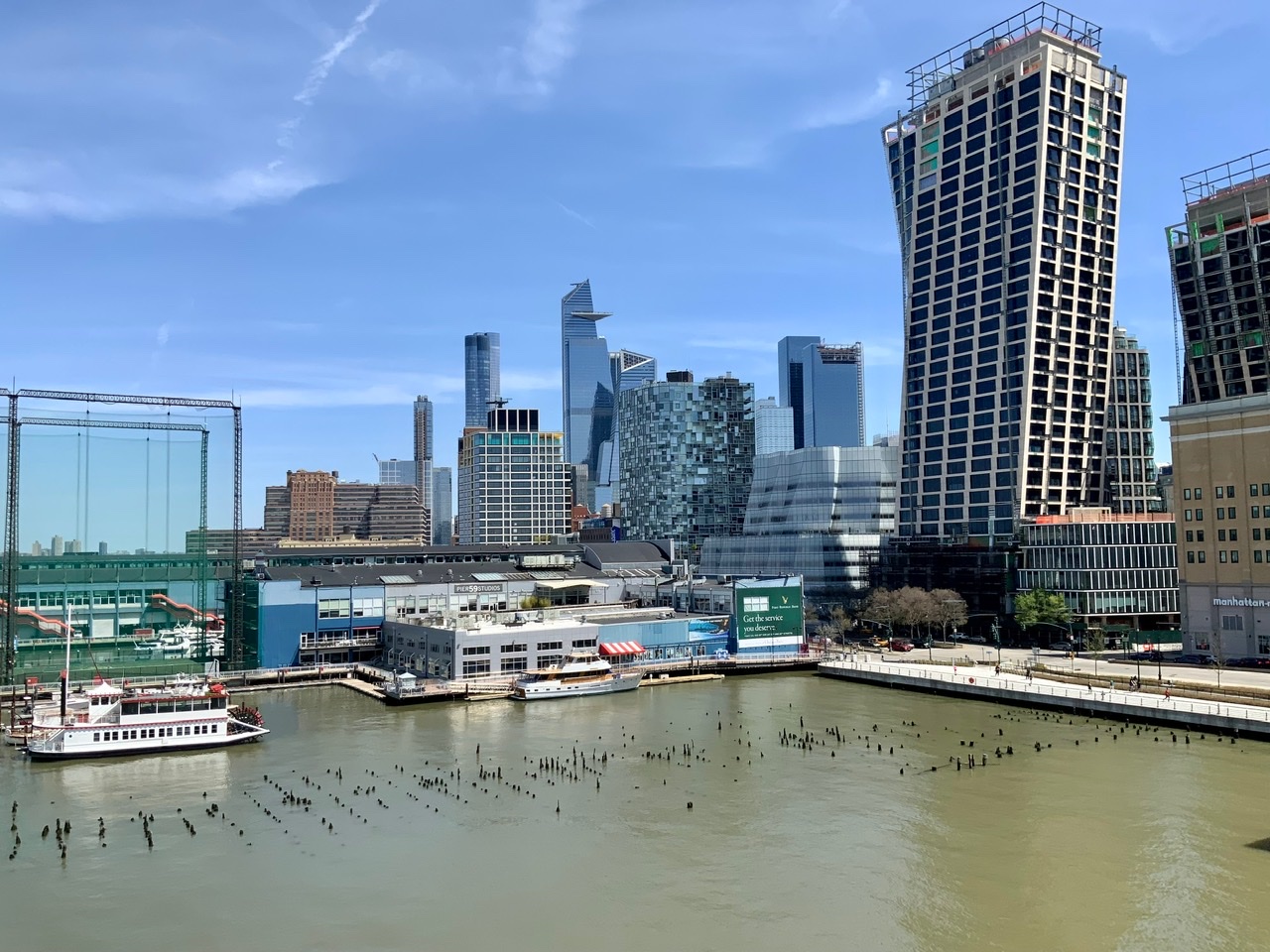
It is important to consider, when cities like New York continue a process of gentrification that make them unlivable for most artists and intellectuals, that the community Schloss describes was to some extent brought into being by a number of radically different circumstances: first, immigration – in some cases, such as de Kooning, illegal, and in others, such as Schloss, forced by war and politics – and second, the existence in post-Great Depression New York of cheap rents for run-down spaces that no one other than artists would consider or would be able to make not just livable but eventually fashionable.
Mira Schor in The Loft Generation: From the de Koonings to Twombly, Portraits and Sketches 1942-2011 edited by Mary Venturini
Comments are welcome!
Pearls from artists* # 521

*an ongoing series of quotations – mostly from artists, to artists – that offers wisdom, inspiration, and advice for the sometimes lonely road we are on.
But on the whole, I’m taking into consideration, at the point of the cut, where the audience’s eye is and what direction it’s moving, and with what speed. The editor has to imagine the audience’s point of attention when the film is projected, and has to be able to predict where ninety-nine percent of the audience is looking at any moment… I have to be able to say with some certainty that at such-and-such a moment ninety-nine percent of the audience will be looking at this point on the screen, and in the next second they will be looking here. That means that their eye is travelling, say, left to right, to the upper corner of the frame, at a certain speed. If I choose to cut at this point – at frame 17 – I know that at that moment their eye is right here, in the Cartesian grid of the screen.
That’s a very valuable piece of information. When I select the next shot, I choose a frame that has an interesting visual at exactly that point, where the audience’s eye is at the moment of the cut, to catch and redirect their attention somewhere else. Every shot has its own dynamic. One of the editor’s obligations is to carry, like a sacred vessel, the focus of attention of the audience and move it in interesting ways around the surface of the screen.
This is exactly what I do as I work to compose my pastel paintings! – BR
In The Conversations: Walter Murch and the Art of Editing Film by Michael Ondaatje
Comments are welcome!


 barbararachkoscoloreddust.com