Blog Archives
Q: How many pastel paintings do you have in progress now?
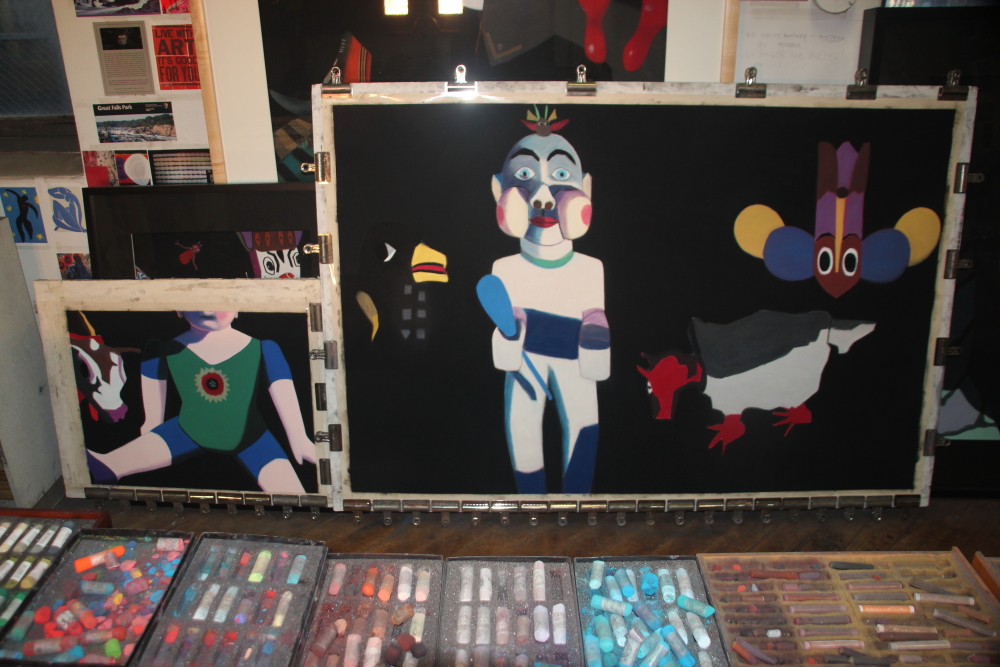
Work in progress
A: Making pastel-on-sandpaper paintings is a slow and meticulous process. I work full-time in my studio so that in a good year I can produce five finished pieces. Typically two are in progress at a time so that I can switch off when problems develop.
A downside to looking at a painting for months is that there comes a point when I can’t see the flaws any more. Then it’s definitely time to take a break.
When I put a painting that has been resting back onto my easel, I see it with fresh eyes again. Areas that need work immediately stand out. Problem areas become easily resolvable because I have continued to think about them while the painting was out of my sight.
Comments are welcome!
Q: What’s on the easel today?
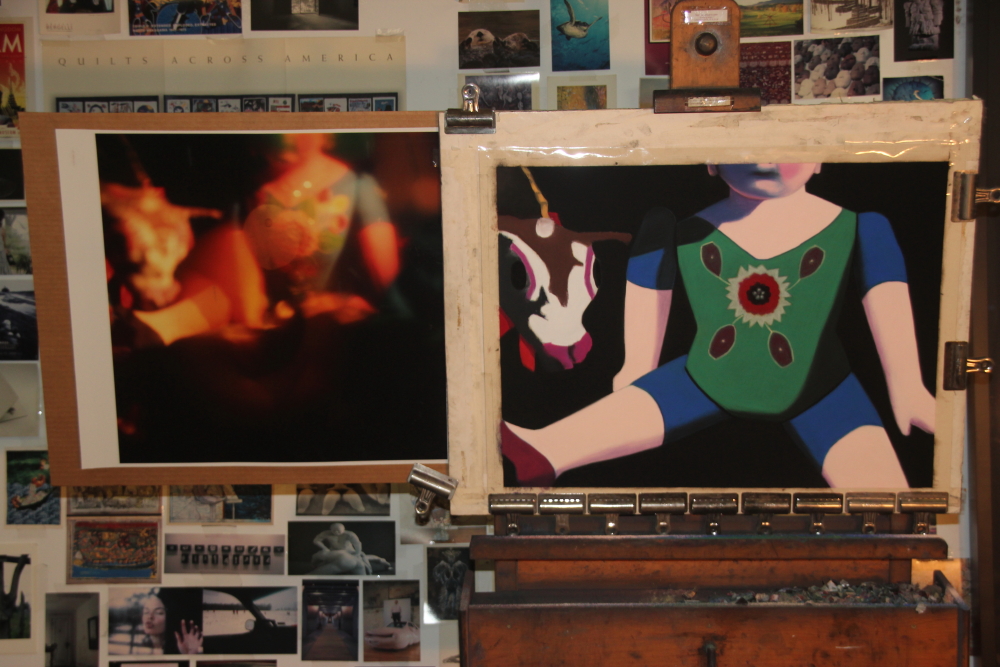
Work in progress
A: I am at work on a small (20″ x 26″) pastel-on-sandpaper painting tentatively called, “Duo.” My previous painting, “Charade,” was a breakthrough of sorts; at least I hope so, because it was such an ordeal to complete!
That’s why I am giving myself a break and making a relatively simple piece now. It’s a way of resting and also of re-filling the well.
Recently something happened that broke my heart: I had to put my beloved cat to sleep. When I look at this image I am reminded of Kit Kat, who was always by my side. He and I were another “Duo” alluded to in the title of this painting.
Comments are welcome!
Q: Have any artists influenced you technically?

Barbara at work, Photo: Marianne Barcellona
A: I’d have to say no one, because my technique of using soft pastel on sandpaper is largely self-invented and it continues to slowly evolve. I apply up to thirty layers of pigment, blending it with my fingers, and creating new colors directly on the sandpaper. It is a rather meticulous process that suits my personality.
My unique way of applying and mixing pastel is a richly complex science of color. This intricate technique is one of the reasons that my pastel paintings cannot be forged by anyone.
Every great artist throughout history has invented their own techniques and created a world that is uniquely theirs, with its own iconography, its own laws, and its own specific concerns. Artists who are most worthy of the name create their own tasks and make and break their own rules.
Comments are welcome!
Q: What was the first painting you ever sold?
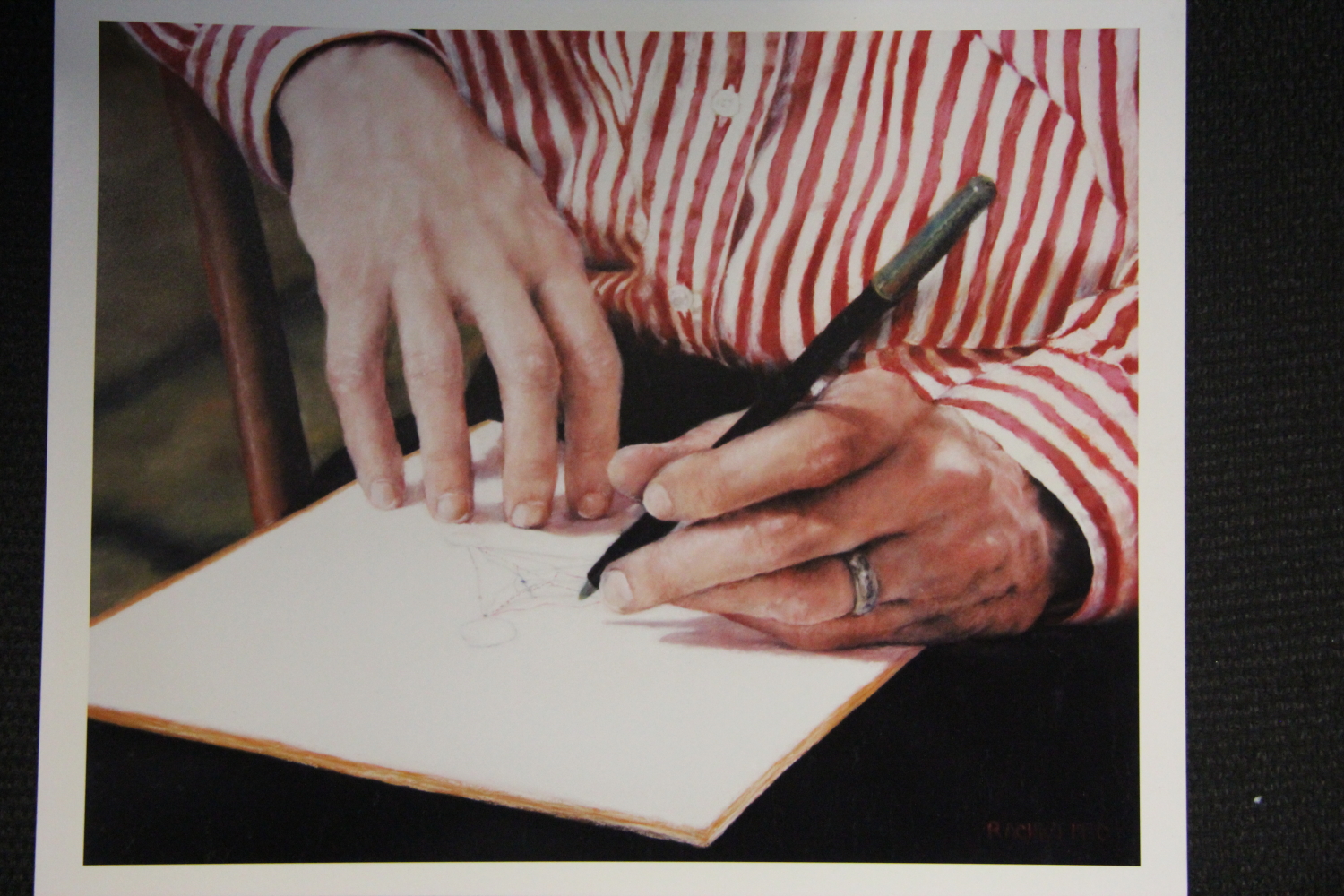
“Bryan’s Ph.D.”, 11″ x 13 1/2″, soft pastel on sandpaper
A: I believe my first sale was “Bryan’s Ph.D.” I made it in 1990 as one of several small paintings created to improve my skills at rendering human hands in pastel. I had recently left the Navy and was building a career as a portrait artist. Bryan, my late husband, was often my model for these studies, not only because it was convenient, but because he had such beautiful hands.
In 1990 Bryan was working on his Ph.D. in economics at the University of Maryland. In this painting he is drawing a diagram that illustrates a theoretical point about “international public goods,” the subject of his research. He was sitting in an old wooden rocking chair in our backyard in Alexandria, VA. I still own the chair and the house. I photographed his hands close-up and then created the painting. I don’t remember which of Bryan’s cameras I used, but it was one that took 35 mm film; perhaps his Nikon F-2. Somewhere I must still have the negative and the original reference photo.
“Bryan’s Ph.D.” is 11″ x 13 1/2″ and it sold for $500 at a monthly juried exhibition at The Art League in Alexandria. I have not seen it since 1990. (Above is a photograph of “Bryan’s Ph.D.” from my portfolio book).
Not long ago the owner contacted me, explaining that she had received the painting as a gift from her now ex-husband. She was selling it because it evoked bitter memories of her divorce. Her phone call was prompted by uncertainty about the painting’s value now. She had a likely buyer and needed to know what price to charge.
I was saddened because I have so many beautiful memories of this particular painting and of an idyllic time in my life with Bryan. He was on a leave of absence from the Pentagon to work on his dissertation, while I was finished with active duty. At last I was a full time artist, busily working in the spare bedroom that we had turned into my first studio.
My conversation with the owner was a reminder that once paintings are let out into the world, they take on associations that have nothing to do with the personal circumstances surrounding their creation. In short, what an artist creates solely out of love, stands a good chance of not being loved or appreciated by others. This is one reason to only sell my work to people I select personally. I ended the telephone conversation hoping that “Bryan’s Ph.D.” fares better in its new home.
Comments are welcome!
Q: Would you say there is a unifying quality to all of the work you have produced in the last thirty years?
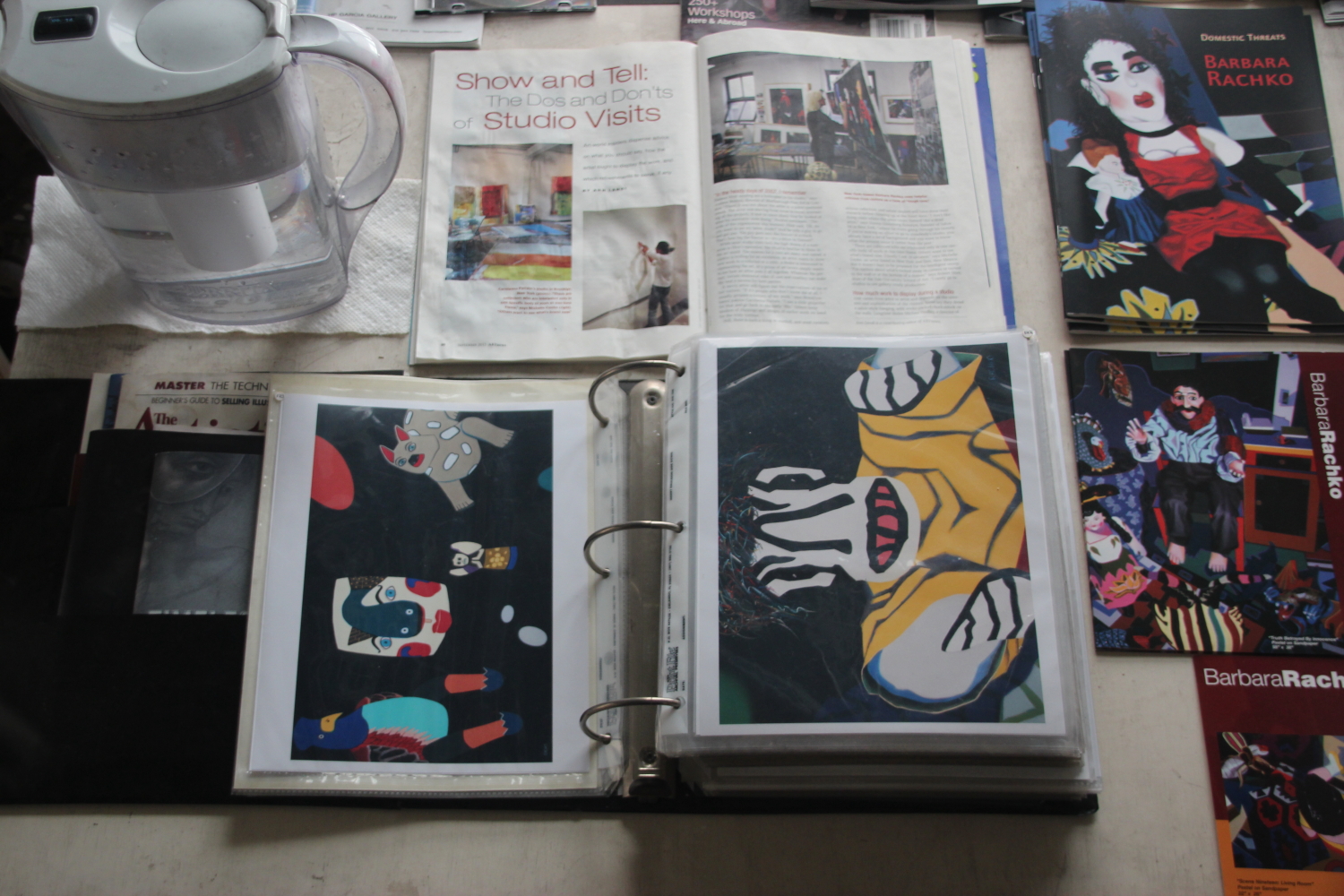
Barbara’s portfolio book
A: Yes, I can think of several. Whether making pastel paintings or printing photographs in the darkroom, I have always been concerned with quality and craftsmanship and never pronounce a work finished until it is the best thing I can make.
Although I started out as a maker of photorealist portraits in pastel, for twenty-odd years I have worked with Mexican folk art as my primary subject matter, treating these objects very differently in three separate series: “Black Paintings,” “Domestic Threats,” and “Gods and Monsters.” The first two are pastel-on-sandpaper paintings while the last is comprised of chromogenic photographs (c-prints). A few years ago I also started making “Teleidoscopes” using an iPad app to photograph my Mexican and Guatemalan folk art collection. This last one is just for fun; I do not offer them for sale.
Soft pastel is my first love and the two series of pastel paintings are my best-known work. My technique for using pastel continues to evolve in intriguing ways. I doubt I can ever learn all there is to know not only about color, but also about this medium. Pastel is endlessly fascinating, which is why I have never wanted to switch to anything else.
Comments are welcome!
Pearls from artists* # 165
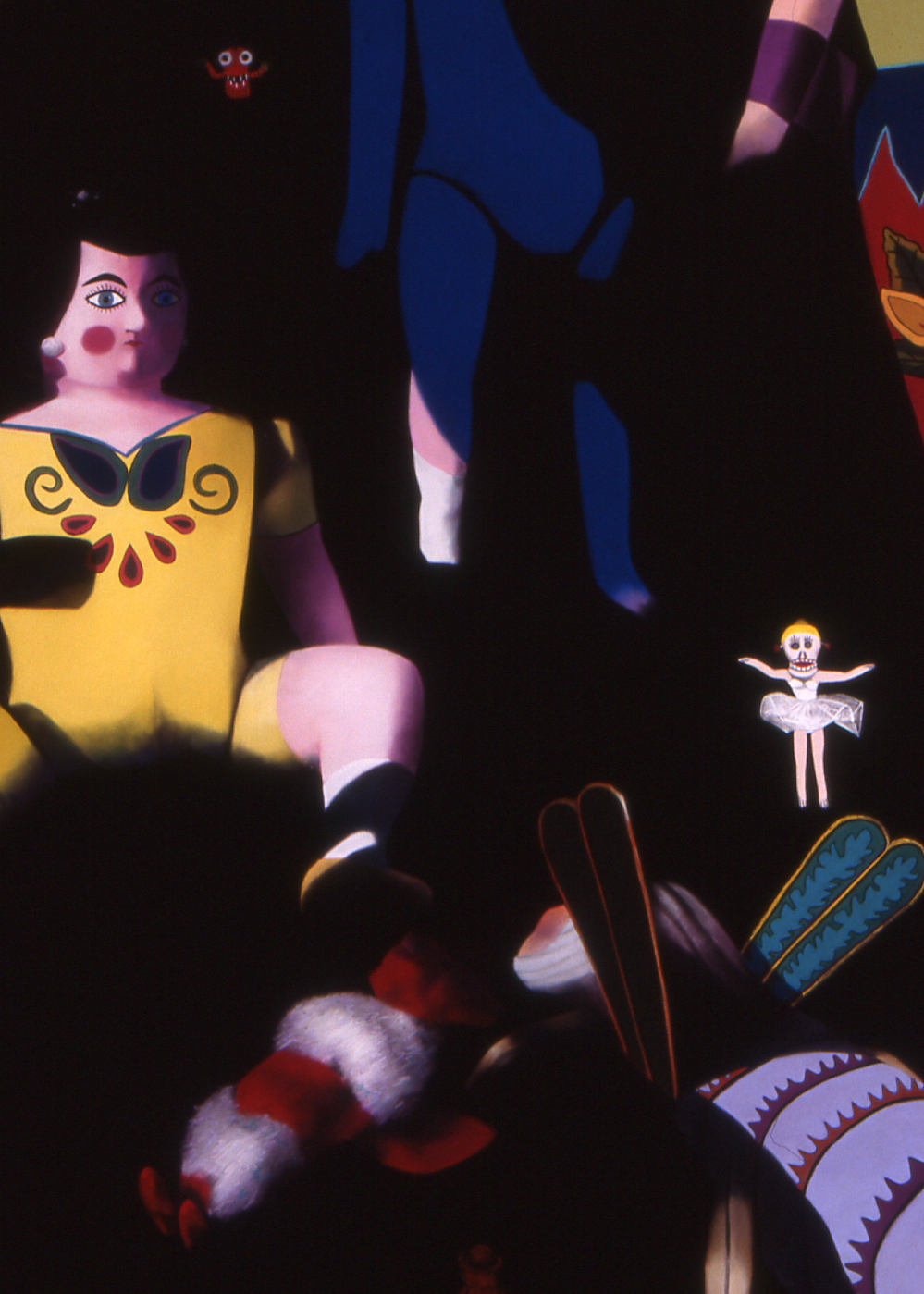
“The Space Between,” soft pastel on sandpaper, 58″ x 38″
* an ongoing series of quotations – mostly from artists, to artists – that offers wisdom, inspiration, and advice for the sometimes lonely road we are on.
When I have painted a fine picture I have not given expression to a thought! That is what they say. What fools people are! They would strip painting of all its advantages. A writer has to say almost everything in order to make himself understood, but in painting it is as if some mysterious bridge were set up between the spirit of the persons in the picture and the beholder. The beholder sees figures, the external appearance of nature, but inwardly he meditates; the true thinking that is common to all men. Some give substance to it in writing, but in so doing they lose the subtle essence. Hence, grosser minds are more easily moved by writers than by painters or musicians. The art of the painter is all the nearer to man’s heart because it seems to be more material. In painting, as in external nature, proper justice is done to what is finite and to what is infinite, in other words, to what the soul finds inwardly moving in objects that are known through the senses alone.
The Journal of Eugene Delacroix edited by Hubert Wellington
Comments are welcome!
Q: What do you think are the most important qualities in an artist?

“Big Deal,” soft pastel on sandpaper, 58″ x 38″
A: Two essentials immediately come to mind. I believe imagination and curiosity are very important qualities, not only for artists, but for anyone who hopes to look back on a well-lived life. As Lauren Bacall famously said, “Imagination is the highest kite one can fly.”
It is curiosity that keeps people laser-focused on a lifetime journey of learning. I’d venture to say that curiosity is the not-so-secret quality of accomplished people in every profession. We humans can never know enough!
Comments are welcome!
Q: What one piece of artistic “equipment” could you not live without?
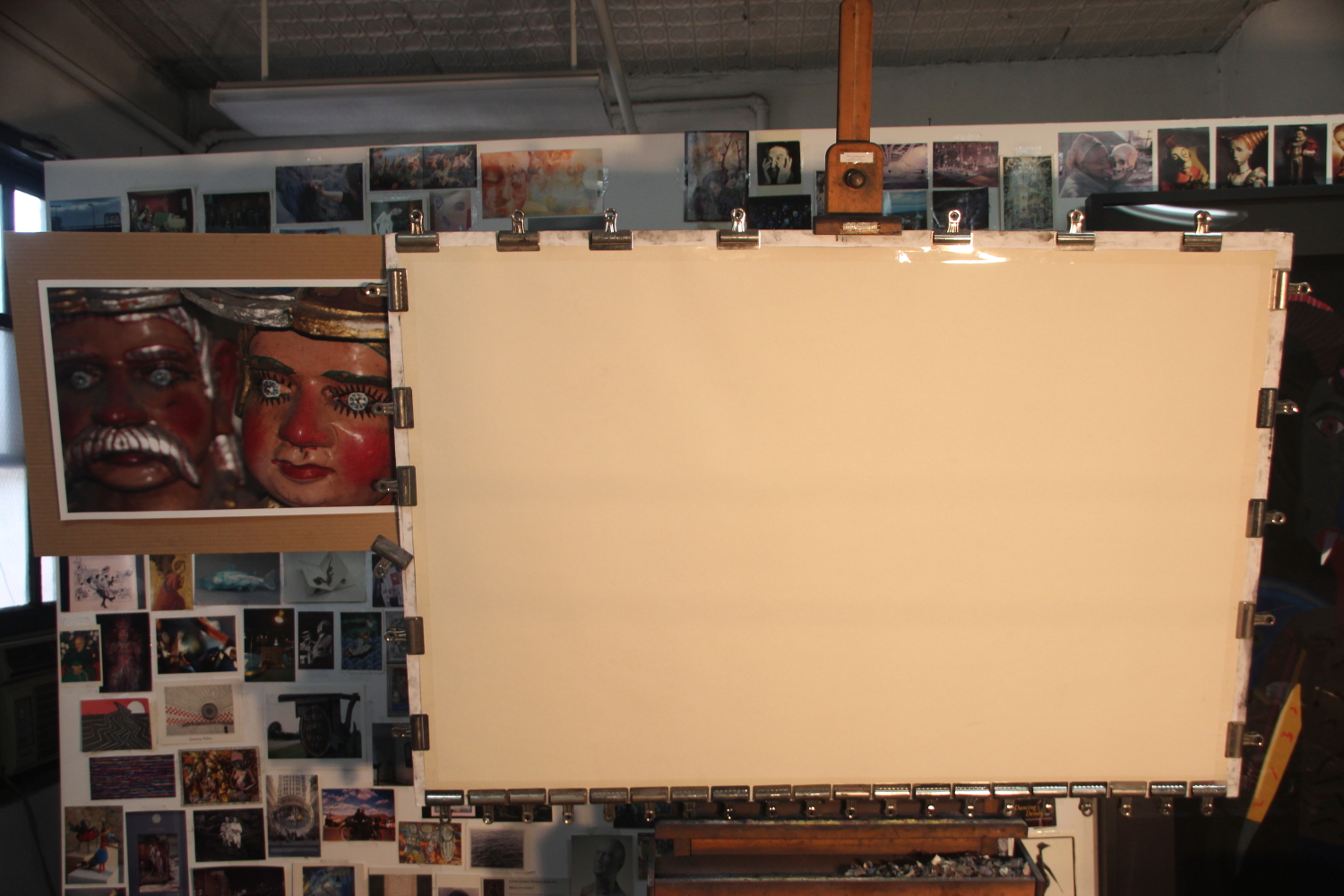
Untouched sandpaper
A: Undoubtedly, I could not make my work without UART sandpaper. Over the many months I spend creating a painting, I build layer upon layer of soft pastel. Because this paper is so “toothy,” it accepts all of the pastel the painting needs.
As many people know, I own and use a lot of soft pastel! My entire technique evolved around this sandpaper, which allows me to add and blend as many as thirty layers.
Comments are welcome!
Pearls from artists* # 162

“The Sovereign,” soft pastel on sandpaper, 58″ x 38″
* an ongoing series of quotations – mostly from artists, to artists – that offers wisdom, inspiration, and advice for the sometimes lonely road we are on.
Particle after particle of the living self is transferred into the creation, until at last it is an external world that corresponds to the inner world and has the power of outlasting the author’s life.
I suspect that some such dream is shared by many authors, but among those interviewed it is Faulkner who has come closest to achieving it, and he is also the author who reveals it most candidly. “Beginning with Sartoris,” he says, I discovered that my own little postage stamp of native soil was worth writing about and that I would never live long enough to exhaust it, and that by sublimating the actual into the apocryphal I would have complete liberty to use whatever talent I might have to its absolute top. It opened up a mine of other people, so I created a cosmos of my own. I can move these people around like God, not only in space but in time.” And then he says, looking back on his work as if on the seventh day, “I like to think of the world I created as being a kind of keystone in the universe; that, small as that keystone is, if it were ever taken away the universe itself would collapse. My last book will be the Doomsday Book, the Golden Book, of Yoknapatawpha County. Then I shall break the pencil and I’ll have to stop.”
Malcolm Cowley in Writers at Work: The Paris Review Interviews, First Series
Comments are welcome!
Pearls from artists* # 160

“A Promise, Meant to be Broken,” soft pastel on sandpaper, 58″ x 38″
* an ongoing series of quotations – mostly from artists, to artists – that offers wisdom, inspiration, and advice for the sometimes lonely road we are on.
When I get asked what one piece of advice I have for young photographers, this is what I tell them: if you are working on a project, and you’re thinking maybe it’s time to put it out into the world, make sure you have already started your next body of work. Not just started, either; you should be well along on it. You will know that the first project is finished when you find yourself joylessly going through the motions to eke out a few more pictures while, like a forbidden lover, the new ones call seductively to you. This new lover should be irresistible, and when it calls, you will be in its urgent thrall, making the work of your heart.
Sally Mann in Hold Still: A Memoir with Photographs
Comments are welcome!


 barbararachkoscoloreddust.com