Blog Archives
Pearls from artists* # 623

The Studio
*an ongoing series of quotations – mostly from artists, to artists – that offers wisdom, inspiration, and advice for the sometimes lonely road we are on.
Jealousy? Hmmm. Jealousy links up with competition. It’s hard to compete, really compete, in the art world. That’s why award ceremonies are a little suspect. Athletes can compete. I don’t know how much you can really compete as an artist. You can compete with yourself.
You are an explorer. You understand that every time you go into the studio you are after something that does not yet exist. Maybe it’s the same for a runner. I don’t know. But with running, or swimming, or gymnastics, or tennis, the achievement is measurable. Forget about competition. Rather, commit yourself to find out the true nature of your art. How does it really work; what’s the essence of it? Go for that thing that no one can teach you. Go for that communion, that real communion with your soul, and the discipline of expressing that communion with others. That doesn’t come from competition. That comes from being one with what you are doing. It comes from concentration, and from your own ability to be fascinated endlessly with the story, the song, the jump, the color you are working with.
I know this sounds a little monkish or even sort of “holier than thou,” but I really do believe it. And that said, jealousy is a human sentiment. Few of us are above it. John Lahr, a writer, told me that the major emotion in Los Angeles is envy. I have to say he’s probably right. And a lot of it has to do with how close or far from an Academy Award one is. And LA, the capital of smoke and mirrors, would have sone believe that the award is just a step away. When you drive down Hollywood Boulevard, some of the dreamers look as though the dream ate them alive.
Anna Deavere Smith in Letters to a Young Artist: Straight-Up Advice on Making a Life in the Arts
Comments are welcome!
Q: Can you elaborate on the title of your very first series, “Domestic Threats”?

A: All of the paintings in this series are set in places where I reside or used to live, either a Virginia house or New York apartments, i.e., domestic environments. Each painting typically contains a conflict of some sort, at least one figure who is being menaced or threatened by a group of figures. So I named the series “Domestic Threats.”
Depending on what is going on in the country at a particular moment in time, however, people have seen political associations in my work. When my husband, Bryan, was killed on 9/11, many people thought the title, “Domestic Threats,” was prescient. They have ascribed all kinds of domestic terrorism associations to it, but that is not really what I had in mind. For a time some thought I was hinting at scenes of domestic violence, but that also is not what I had intended. “Domestic Threats” seems to be fraught with associations that I never considered, but it’s an apt title for this body of work.
Comments are welcome!
Pearls from artists* # 614

*an ongoing series of quotations – mostly from artists, to artists – that offers wisdom, inspiration, and advice for the sometimes lonely road we are on.
The artist has accepted his fate with open eyes, and I do not believe that he wishes any charity in relation to his self-assumed sacrifice. He wants nothing but the understanding and love of what he does. There can be no other rewards. The foregoing therefore is not in the spirit of asking for a charitable contribution, but rather the clearing of the way for what is really the motivating factor for this strange phenomenon: the creation of art.
Mark Rothko in The Artist’s Reality: Philosophies of Art
Comments are welcome!
Pearls from artists* # 560

*an ongoing series of quotations – mostly from artists, to artists – that offers wisdom, inspiration, and advice for the sometimes lonely road we are on.
In describing her technique, Joan [Mitchell] once said, “I don’t go off and slop and drip. I ‘stop, look, and listen!’ at railroad tracks. I really want to be accurate.” One can imagine every stroke applied, every drizzle of pigment – both those visible in the finished work and those buried beneath its many layers – being the result of just such consideration. The majesty of Joan’s painting, which she would call City Landscape, was a quality it shared with all great art – the sense that it had always existed, and that during one inspired moment it had been dredged from the subconscious depths by a hand and mind graced with the talent and vision to retrieve it for the rest of us. That revealing work, so exuberant, so deep, so masterful, and so unlike the shards and violent explosions that had been her signature, was the result of Joan’s having survived a personal hell and her own imperfections. It was her prize for having persevered, and all who saw it were the beneficiaries.
Mary Gabriel in Ninth Street Women
Comments are welcome!
Pearls from artists* # 528

*an ongoing series of quotations – mostly from artists, to artists – that offers wisdom, inspiration, and advice for the sometimes lonely road we are on.
There are so many good reasons to stop complaining if you want to live a more creative life.
First of all, it’s annoying. Every artist complains, so it’s a dead and boring topic. (From the volume of complaints that emerges from the professional creative class, you would think these people had been sentenced to their vocations by an evil dictator, rather than having chosen their line of work with a free will and open heart).
Second, of course it’s difficult to create things; if it wasn’t difficult, everyone would be doing it, and it wouldn’t be special or interesting.
Third, nobody ever really listens to anybody else’s complaints, anyhow, because we’re all too focused on our own holy struggle, so basically, you’re just talking to a brick wall.
Fourth, and most important, you’re scaring away inspiration. Every time you express a complaint about how difficult and tiresome it is to be creative, inspiration takes another step away from you, offended. It’s almost like inspiration puts up its hands and says, “Hey, sorry buddy! I didn’t realize my presence was such a drag. I’ll take my business elsewhere.”
Elizabeth Gilbert in Big Magic: Creative living Beyond Fear
Comments are welcome!
Pearls from artists* # 499

*an ongoing series of quotations – mostly from artists, to artists – that offers wisdom, inspiration, and advice for the sometimes lonely road we are on.
Life is a journey back to where you started from, Le Guin always said. True voyage is return. When you get there, you might know a little more than when you began.
Isn’t the real question this: Is the work worth doing? Am I, a human being, working for what I really need and want – or for what the State or the advertisers tell me I want? Do I choose? I think that’s what anarchism comes down to. Do I let my choices be made for me, and so go along with the power game, or do I choose? In other words, am I going to be a machine-part, or a human being?
Ursula K. Le Guin: The Last Interview and Other Conversations edited and with an introduction by David Streitfeld
Comments are welcome!
Pearls from artists* # 494
*an ongoing series of quotations – mostly from artists, to artists – that offers wisdom, inspiration, and advice for the sometimes lonely road we are on.
Emile Cartailhac was a man who could admit when he was wrong. This was fortunate, because in 1902 the French prehistorian found himself writing an article for L’Anthropolgie in which he did just that. In “Mea culpa d’un sceptique” he recanted the views he had spent the previous 20 years forcefully and scornfully maintaining: that prehistoric man was incapable of fine artistic expression and that the cave paintings found in Altmira, northern Spain, were forgeries.
The Paleothithic paintings at Altamira, which were produced around 14,000 B.C., were the first examples of prehistoric cave art to be officially discovered. It happened by chance in 1879, when a local landowner and amateur archaeologist was busily brushing away at the floor of the caves, searching for prehistoric tools. His nine-year-old daughter, Maria Sanz de Sautuola – a grave little thing with cropped hair and lace-up booties – was exploring farther on when she suddenly looked up, exclaiming, “Look, Papa, bison!” She was quite right: a veritable herd, subtly colored with black charcoal and ocher, ranged over the ceiling. When her father published the finding in 1880, he was met with ridicule. The experts scoffed at the very idea that prehistoric man – savages really – could have produced sophisticated polychrome paintings. The esteemed Monsieur Cartailhac and the majority of his fellow experts, without troubling to go and see the cave for themselves, dismissed the whole thing as a fraud. Maria’s father died, a broken and dishonored man, in 1888, four years before Cartailhac admitted his error.
After the discovery of many more caves and hundreds of lions, handprints, horses, women, hyenas, and bison, the artistic abilities of prehistoric man are no longer in doubt. It is thought that these caves were painted by shamans trying to charm a steady supply of food for their tribes. Many were painted using the pigment most readily available in the caves at the time: the charred stick remnants of their fires. At its simplest, charcoal is the carbon-rich by-product of organic matter – usually wood – and fire. It is purest and least ashy when oxygen has been restricted during it’s heating.
In The Secret Lives of Color by Kassia St. Clair
Comments are welcome!
Pearls from artists* # 476
*an ongoing series of quotations – mostly from artists, to artists – that offers wisdom, inspiration, and advice for the sometimes lonely road we are on.
For a great many artists solitude is the time when they feel most real and alive. It is when they have their most intense experiences, when they can vicariously live out any adventure, any dream. Tennessee Williams said, “I’m only really alive when I’m writing.” The painter Robert Motherwell wrote, “I feel most real to myself in the studio.” The young, exuberant Russian painter Marie Bashkirtseff exclaimed at the end of the last century:
In the studio all distinctions disappear. One has neither name nor family; one is no longer the daughter of one’s mother, one is oneself and individual, and one has before one art, and nothing else. One feels so happy, so free, so proud!
We may think of his aliveness as the accumulation of al the above-listed benefits, as the artist working out her life, manifesting her creativity, suiting her personality, playing, avoiding unwanted social interactions, working authentically and integrity, living intensely – as the artist being her grandest self.
Eric Maisel in A Life in the Arts: Practical Guidance and Inspiration for Creative and Performing Artists
Comments are welcome!
Pearls from artists* # 441
*an ongoing series of quotations – mostly from artists, to artists – that offers wisdom, inspiration, and advice for the sometimes lonely road we are on.
The most perennially popular category of art is the cheerful, pleasant, and pretty kind: meadows in spring, the shade of trees on hot summer days, pastoral landscapes, smiling children. This can be deeply troubling to people of taste and intelligence.
… The worries about prettiness are twofold. First, pretty pictures are alleged to feed sentimentality. Sentimentality is a symptom of insufficient engagement with complexity, by which one really means problems. The pretty picture seems to suggest that in order to make life nice, one merely has to brighten up the apartment with a depiction of some flowers. If we were to ask the picture what is wrong with the world, it might be taken as saying ‘You don’t have enough Japanese water gardens’ – a response that appears to ignore all the more urgent problems that confront humanity (primarily economic, but also moral, political, and sexual). The very innocence and simplicity of the picture seems to mitigate against any attempt to improve life as a whole. Secondly, there is the related fear that prettiness will numb us and leave us insufficiently critical and alert to the injustices surrounding us.
Alain de Botton and John Armstrong in Art as Therapy
Comments are welcome!
Pearls from artists* # 212
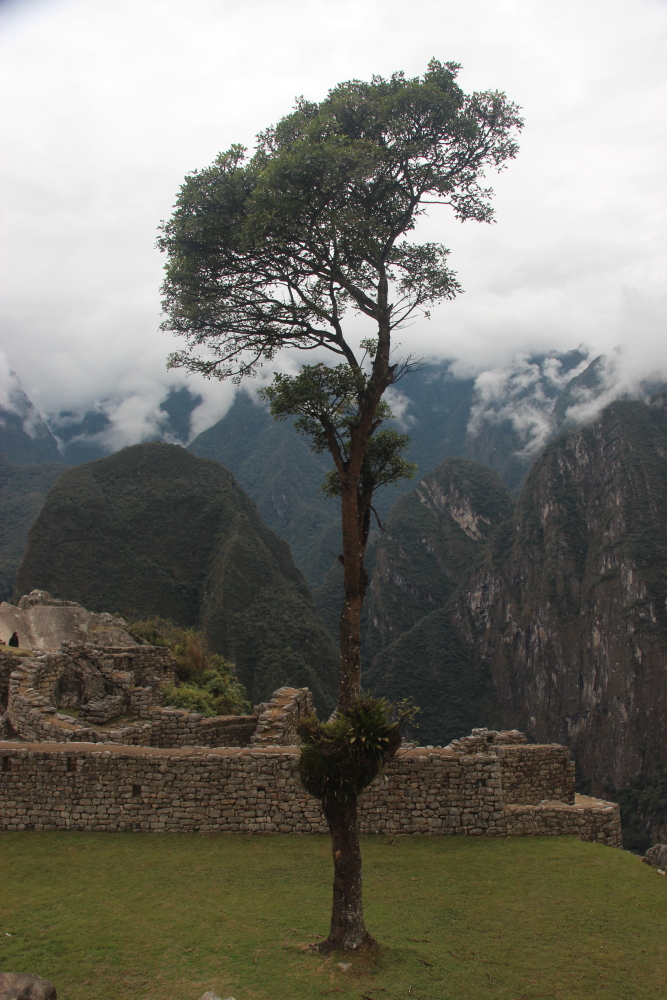
Machu Picchu
* an ongoing series of quotations – mostly from artists, to artists – that offers wisdom, inspiration, and advice for the sometimes lonely road we are on.
… the anthropologist Ellen Disanayake… in Homo Aestheticus, argues that art and aesthetic interest belong with rituals and festivals – offshoots of the human need to ‘make special,’ to extract objects, events, and human relations from everyday uses and to make them a focus of collective attention. This ‘making special’ enhances group cohesion and also leads people to treat those things which really matter for the survival of community – be it marriage or weapons, funerals, or offices – as things of public note, with an aura that protects them from careless disregard and emotional erosion. The deeply engrained need to ‘make special’ is explained by the advantage that it has conferred on human communities, holding them together in times of threat, and furthering their reproductive confidence in times of peaceful flourishing.
Beauty: A Very Short Introduction, by Roger Scruton
Comments are welcome!


 barbararachkoscoloreddust.com