Blog Archives
Q: Would you talk about your first solo exhibition in a commercial gallery?

“Big Deal,” soft pastel on sandpaper, 58″ x 38″
A: Although I had exhibited in a number of non-profit galleries in Virginia, Washington, DC, Maryland, New Jersey, and New York, my first solo in a commercial gallery was at 479 Gallery, 520 Broadway, in July 1996. The previous summer I had entered a juried exhibition there. My work won first prize and I was awarded a solo show the following July.
This exhibition was soon followed by representation at an important New York gallery, Brewster Fine Arts, at 41 West 57th Street. I had my first two-person exhibition at Brewster in October 1996. The gallery specialized in art by Latin American artists. Besides myself, the sole non-Latina represented by Brewster was Leonora Carrington! I quickly began exhibiting alongside a group of illustrious artists: Leonora, Rufino Tamayo, Francisco Toledo, Francisco Zuniga, and other Latin American masters. I could hardly believe my good fortune!
Comments are welcome!
Pearls from artists* # 590

Barbara’s Studio: when you fall in love with pastel!
*an ongoing series of quotations – mostly from artists, to artists – that offers wisdom, inspiration, and advice for the sometimes lonely road we are on.
We see again and again in the lives of special artists a profound youthful infatuation with their medium, with everything and anything connected with it – the good, the bad, the indifferent. If books have mesmerized them, they will read everything; if painting, they will frequent every gallery, running to every visiting show. They may have no idea that they are about to devote their life to that medium; they simply fell in love. The actor Len Cariou said:
“I didn’t have any thoughts about being an actor. I always was an actor. I’d go to films every Saturday. I had an insatiable appetite for films. You could see four films and a serial for half a buck. In 1959 when I read an ad in the local paper, ‘Young actors wanted for summer stock,’ all of a sudden I knew; there was a crunch in my head.”
… The artist is transported by his medium, is delighted and astonished. That his medium is able to speak to him in this way is almost a proof of the existence of god, or at least a special affirmation in the realm of the spirit.
Eric Maisel in A Life in the Arts: Practical Guidance and Inspiration for Creative and Performing Artists
Comments are welcome!

Q: I saw your book of photos. Very nice. How do you keep track of inventory? I have struggled with that. (Question from Laura Fischer Saxon via Facebook).
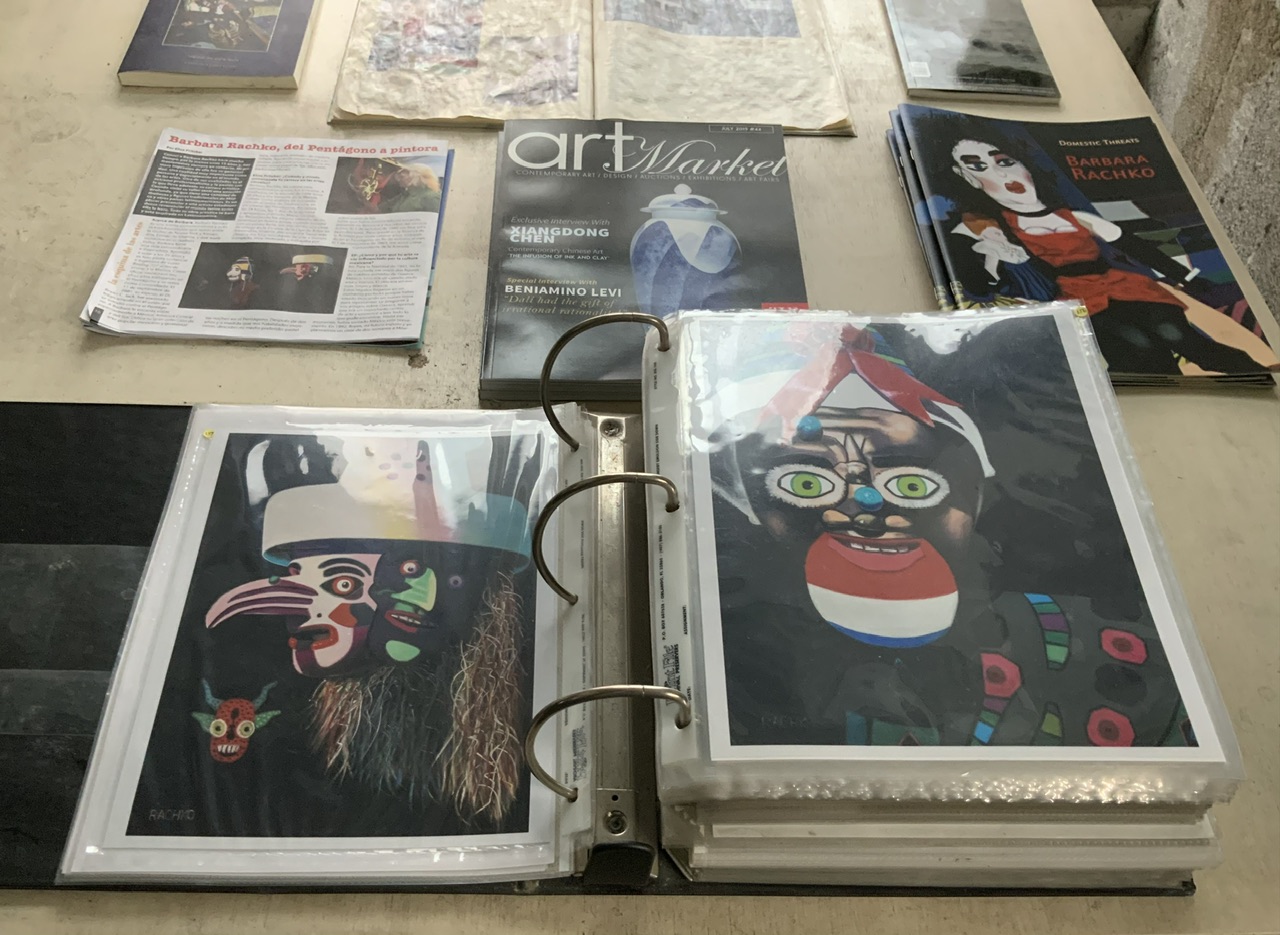
Barbara’s portfolio book
A: Every time I finish a pastel painting I order an 8” x 10” c-print at Duggal Visual Solutions. I started doing this in the 1980s when I was a portrait artist and the company that represented me needed photos of my work to show to potential clients. I’ve just continued making 8” x 10”photos all these years in order to document my work!
Pastel is an extremely slow medium so even though I have been working more than 37 years, the two pastel paintings in progress now are numbers 160 and 161. The portfolio book also has early press clippings, reviews from before the internet (when everything was on paper), and a few photos of early solo exhibitions in the 1990s.
BTW what a great question! No one has ever asked me this before!
Comments are welcome!
Q: How do you get such fine detail with soft pastel? Do they make pencil-size pastels? (Question from Lucia Sommer via Facebook)

A: After 37 years as a pastel artist, I have learned all sorts of techniques and can do whatever I want with it. I used regular Rembrandt white pastels for the sweater in “Sam and Bobo,” above.
There are several brands of pastel pencils that are made especially for drawing fine details. Sam’s face, hair, and hands are mostly pastel pencil. (Now I probably would not use pastel pencils as much. These days I only use them to draw lines and sign my name).
Another technique for making fine lines is to break a pastel stick and work with an edge.
Years ago I used to sharpen my pastels into a point with a small handheld sharpener (I still have one that allows me to change the blades). Sometimes I rub a pastel stick against a sandpaper pad until I get a somewhat sharp point. The problem with both of these methods is they waste so much pastel and pastels are not cheap! For example, my favorite French brand is nearly $20 per stick. I would never think of sharpening those!
Comments are welcome!
Q: Do you ever erase the color? Can you do that with pastel? (Question from Hollis Hildebrand-Mills via Facebook)
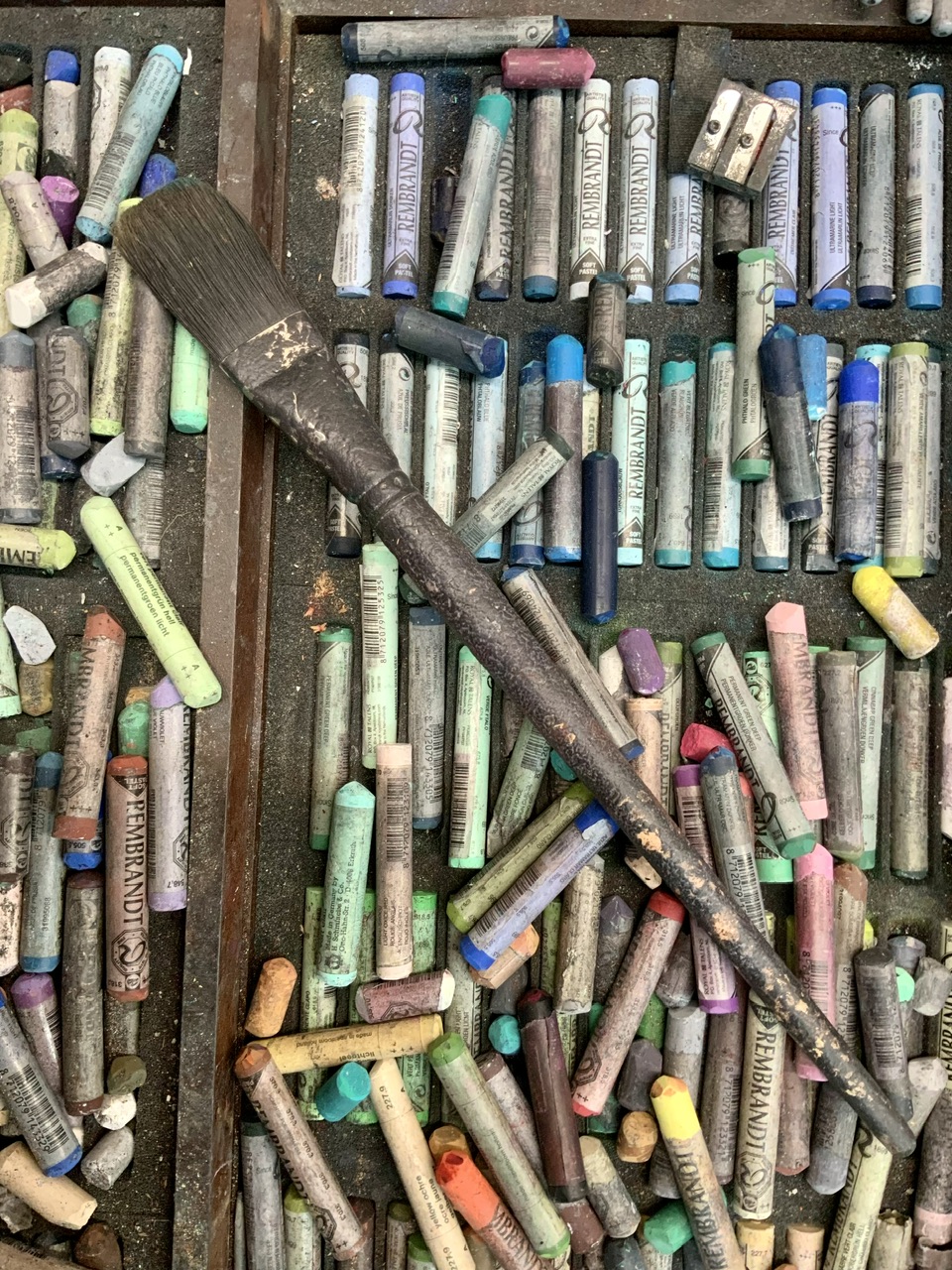
My “eraser”
A: Yes, sort of. I take a bristle brush and wipe it off. I do this only occasionally, when the sandpaper’s tooth is filled up and the paper will no longer accept more pastel. So I brush off what’s there and then I can start over.
Comments are welcome!
Q: Many of the world’s cultures have a mask tradition. Is there something special about Bolivian masks that first attracted you to them?

Bolivian Carnival Mask
A: My subject matter emerges directly from my travels. I visited Bolivia in 2017. What I especially liked then – and now – about Bolivian Carnival masks, is that they include additional textures – feathers, fur, costume jewelry, sequins, fabric, etc. that add to their physical presence. Masks from most of the other countries I’ve visited tend to be made of wood and/or paper mache and nothing else. In my view such masks are not as dramatic nor do they offer much expressive potential. They feel dead. They lack a certain “soulfulness.”
Furthermore, textures are challenging to render in soft pastel. For more than three decades I have been striving to improve my pastel techniques. By now I have a vast repertoire from which to select. As was true in my earlier series, with “Bolivianos” an important personal goal is to keep adding to the repertoire.
It takes months to create a pastel painting, which means I need masks that will hold my attention every day over the course of three or four months. I never want to be bored in the studio. If I am bored while making the work, those feelings will be directly transferred and I will make a boring pastel painting, something I hope never to do! The masks need to have a really strong ‘presence.’ Then as I slowly make a pastel painting, one that is exciting to work on from start to finish, I can transform my subject into something surprising and powerful that has never existed before!
Comments are welcome!
Q: Why do you sometimes depict the same subject matter twice?

“Trickster” (left) and “Sacrificial,” while the latter was in-progress
A: It is fascinating to play around with scale. For starters, it helps demonstrate how my pastel techniques and my approach to the subject matter are evolving. I’ve noticed that I always see and depict more details the second time around.
Typically, I prefer the second pastel painting over the first one depicting the same subject. Man Ray famously said:
“There is no progress in art, any more than there is progress in making love. There are simply different ways of doing it.”
I disagree with him. I am an optimist who believes that artists cannot help but improve over time. It’s one of the things that gets me into my studio: the idea that my creative process and my ways of using pastel are changing for the better. I like to think this represents some sort of creative progress. But still I sometimes have to wonder, is the idea of ‘progress’ just something artists tell ourselves in order to keep going?
Comments are welcome!
Q: How do you determine what size to make your pastel paintings? (Question from Prince North via Facebook)

A: For three decades I have been making pastel paintings in two sizes: 26” x 20” and 58” x 38.” These sizes are dictated by practical considerations.
The smaller ones are because 28” x 22” sheets of acid-free sandpaper are what’s available. (I mask off an inch all around for mats so the paintings are 20″ x 26″). For large paintings I buy rolls of acid-free sandpaper that measure 54 inches wide by 30 feet. I cut this down to 40″ x 60″ for paintings and mask off an inch all around on these, too.
And why specifically make them 58” x 38”? This is the absolute largest size I can make and I prefer making big paintings!
Again, practical factors come into play: the size of my truck, the cost and size of mat board, and the weight of the frames.
My pastel paintings need to lie flat when they are moved. Framed paintings are 70” x 50,” the largest size that can fit flat in the back of my Ford F-150. 58” x 38” is the largest size that will fit in a 8 feet by 4 feet sheet of mat board. (60 inch wide mat board is available, but the cost goes up considerably). Lastly, I’ve never weighed them but my large framed paintings are already rather heavy. It takes two people to carry them.
Comments are welcome!
Q: What makes you feel most alive?

A: Making art makes me feel alive, using all my gifts, my brain, my heart, and my hands to create something that never existed before and that can never be duplicated; knowing I’m the only person, ever, who could or would make this particular thing, as I strive to push my pastel techniques further each time out. Whether it’s a painting or a photograph, I enjoy making something from nothing… art that is well-crafted and has never been seen before.
Travel is the other activity that excites me. I thrive on adventure and I especially love new vistas. When I am in a country I have never visited before, with every step and around every bend there is something new to see. I am an explorer at heart!
Comments are welcome!
Q: When did you start using the sandpaper technique and why (Question from “Arte Realizzata”)

A: In the late 1980s when I was studying at the Art League School in Alexandria, VA, I enrolled in a three-day pastel workshop with Albert Handel, an artist known for his southwest landscapes in pastel and oil paint. I had just begun working with soft pastel and was experimenting with paper. Handel suggested I try Ersta fine sandpaper. I did and nearly three decades later, I’ve never used anything else.
This paper is acid-free and accepts dry media, mainly pastel and charcoal. It allows me to build up layer upon layer of pigment and blend, without having to use a fixative. The tooth of the paper almost never gets filled up so it continues to hold pastel. (On the rare occasion when the tooth DOES fill up, which sometimes happens with problem areas that are difficult to resolve, I take a bristle paintbrush, dust off the unwanted pigment, and start again). My entire technique – slowly applying soft pastel, blending and creating new colors directly on the paper, making countless corrections and adjustments, rendering minute details, looking for the best and/or most vivid colors – evolved in conjunction with this paper.
I used to say that if Ersta ever went out of business and stopped making sandpaper, my artist days would be over. Thankfully, when that DID happen, UArt began making a very similar paper. I buy it in two sizes – 22″ x 28″ sheets and 56″ wide by 10-yard-long rolls. The newer version of the rolled paper is actually better than the old, because when I unroll it, it lays flat immediately. With Ersta I would lay the paper out on the floor for weeks before the curl would give way and it was flat enough to work on.
Comments are welcome!


 barbararachkoscoloreddust.com