Blog Archives
Q: Do you ever use other people’s photographs as reference material for your paintings?

Some Reference Photos
A: For a number of reasons, I never use anyone else’s photographs as reference material. It seems wrong on many levels. Besides the fact that it is theft of intellectual property, it would mean I did not have the all-important experience of finding and making the photograph. Each reference photograph is the beginning of an idea for a future pastel painting. How each photograph even comes to exist – the travel and adventure behind it and the memories and stories that result – is an essential first step in my months- and even years-long creative process.
Comments are welcome!
Q: The first pastel painting you see every morning when you arrive at your studio is “Myth Meets Dream.” It must have special meaning. Would you elaborate? (Question suggested by Marlissa Gardner via Facebook)

A: “Myth Meets Dream,” an early pastel painting from the “Domestic Threats” series, is one I have never wanted to sell. It marks the first time I included Mexican folk art figures in my work. In 1992 as a Christmas present, my future sister-in-law sent the two Oaxacan painted wooden figures you see depicted above – the blue winged creature and the red, white, and black figure behind it. The other three figures in this painting are hand-puppets.
Previously, I had been creating elaborate staged photographs in my Alexandria house using stuffed animals and hand-puppets. (The latter were made by a company called “Folk Tails”). I used the photos as reference material for pastel paintings. In other words, rather than work exclusively from life, I mostly looked at these photos while I made the painting. Although I have simplified my process since those early days, I still create pastel paintings using reference photographs.
In “Myth Meets Dream” you can see both puppets and my then new Oaxacan folk art figures. This pastel painting marks an important transition in subject matter and was the start of decades-worth of foreign travel, study, adventure, hard work, and yes, fun. It’s true that “Myth Meets Dream” hangs in my studio and is the first thing I see every morning. It brings back so many precious memories.
Every painting has a story!
If you’re interested to learn more, please see https://barbararachko.art/en/art-market
Comments are welcome!
Q: How has the use of photography in your work changed over the decades?
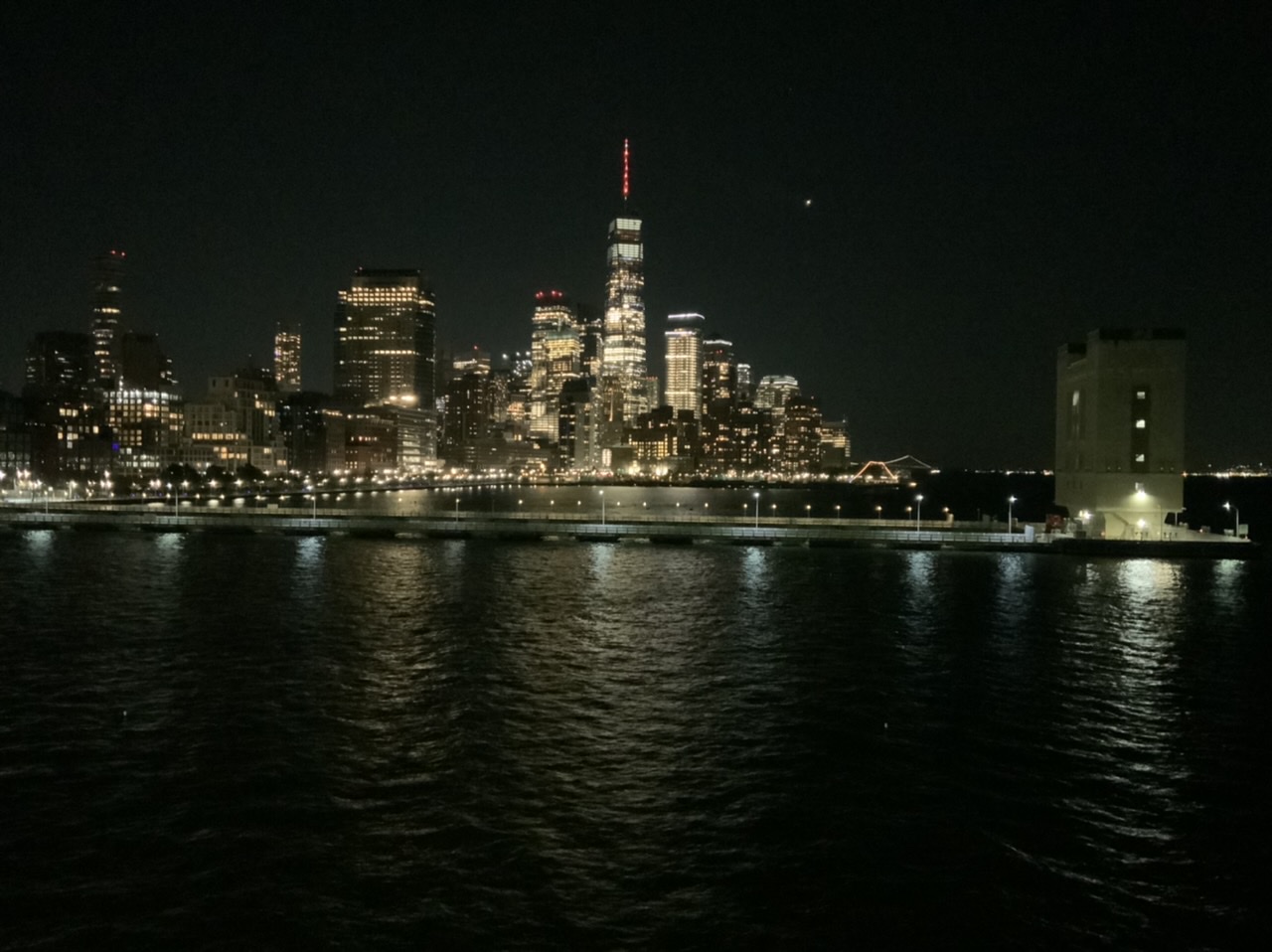
New York, NY
A: From the beginning in the mid-1980s I used photographs as reference material. My late husband, Bryan, would shoot 4” x 5” negatives of my elaborate setups using his Toyo-Omega view camera. In this respect Bryan was an integral part of my creative process as I developed the “Domestic Threats” pastel paintings. At that time I rarely picked up a camera, except to capture memories of our travels.
After Bryan was killed on 9/11, I inherited his extensive camera collection – old Nikons, Leicas, Graphlex cameras, and more. I wanted and needed to learn how to use them. Starting in 2002 I enrolled in a series of photography courses (about 10 over 4 years) at the International Center of Photography in New York. I learned how to use all of Bryan’s cameras and how to make my own big chromogenic prints in the darkroom.
Along the way I discovered that the sense of composition and color I had developed over many years as a painter translated well into photography. The camera was just another medium with which to express my ideas. Surprisingly, in 2009 I had my first solo photography exhibition at a gallery in New York. Bryan would have been so proud!
For several years now my camera of choice has been a 12.9” iPad Pro. It’s main advantage is that the large screen let’s me see every detail as I compose my photographs. I think of it as a portable, lightweight, and easy-to-use 8 x 10 view camera. My iPad is always with me when I travel and as I walk around exploring New York City.
It is a wonderful thing to be both a painter and a photographer! While pastel painting will always be my first love, photography has distinct advantages over my studio practice. Pastel paintings are labor-intensive, requiring months of painstaking work. Photography’s main advantage is speed. Photographs – from the initial impulse to hanging a print on a wall – can be made in minutes. Photography is instant gratification, allowing me to explore ideas much easier and faster than I ever could as a painter. Perhaps most importantly, composing photographs keeps my eye sharp whenever I am away from the studio. I credit photography as an important factor in the overall evolution of my work.
Comments are welcome!
Q: Do you enjoy being interviewed?
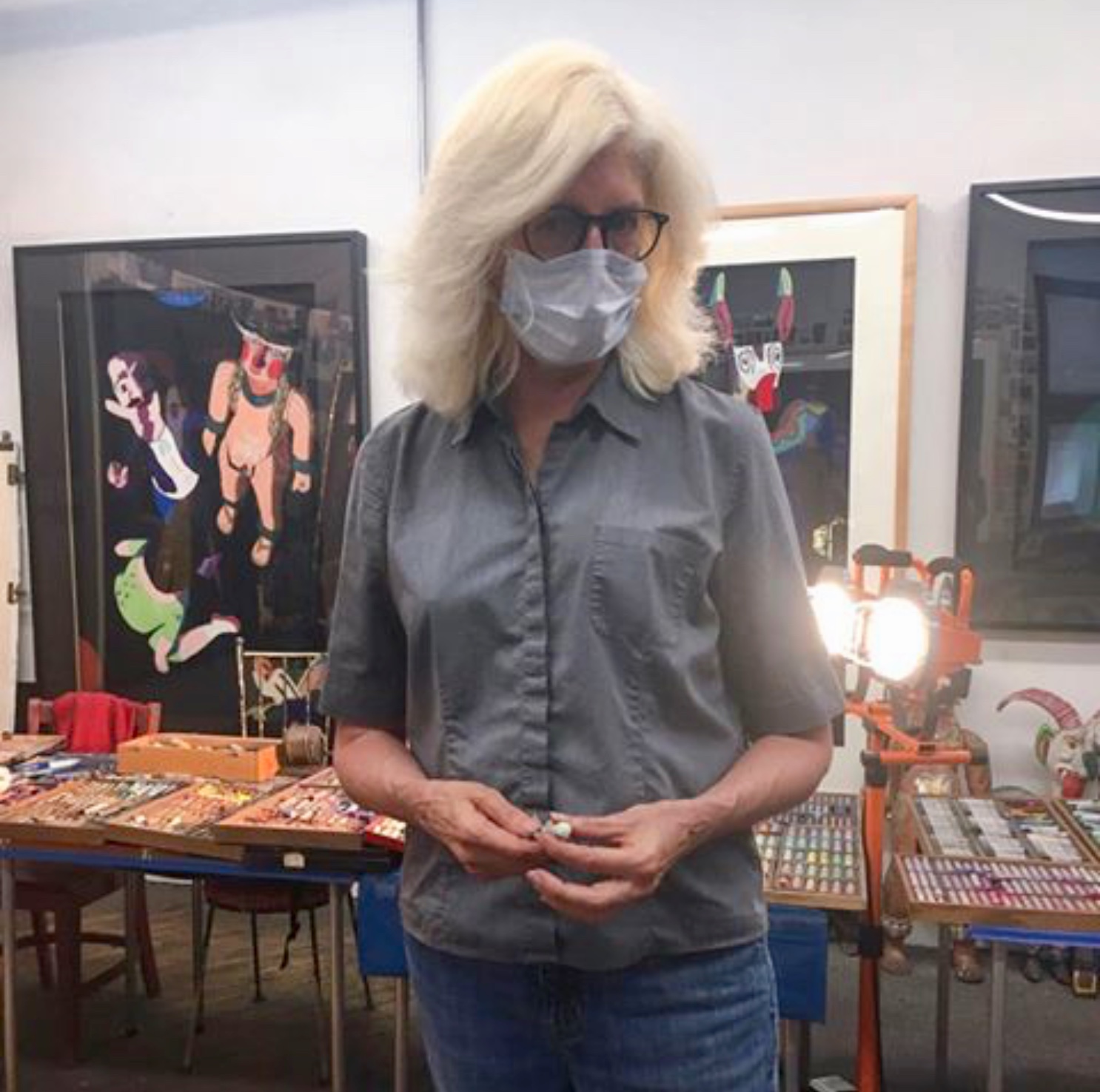
In the studio
A: I do very much. Each new interview is another opportunity to discover what is remembered, what is kept because it still seems important, and how certain details are selected from amongst all the accumulated memories of a lifetime. My own story is continually evolving as some facts are left out or rearranged, and others added. New connections keep being made while some others are discarded. I find it fascinating to read over old interviews and compare them with what I remember in the present.
Comments are welcome!
Q: Where did you grow up and what were some early milestones or experiences that contributed to you becoming an artist later in life?
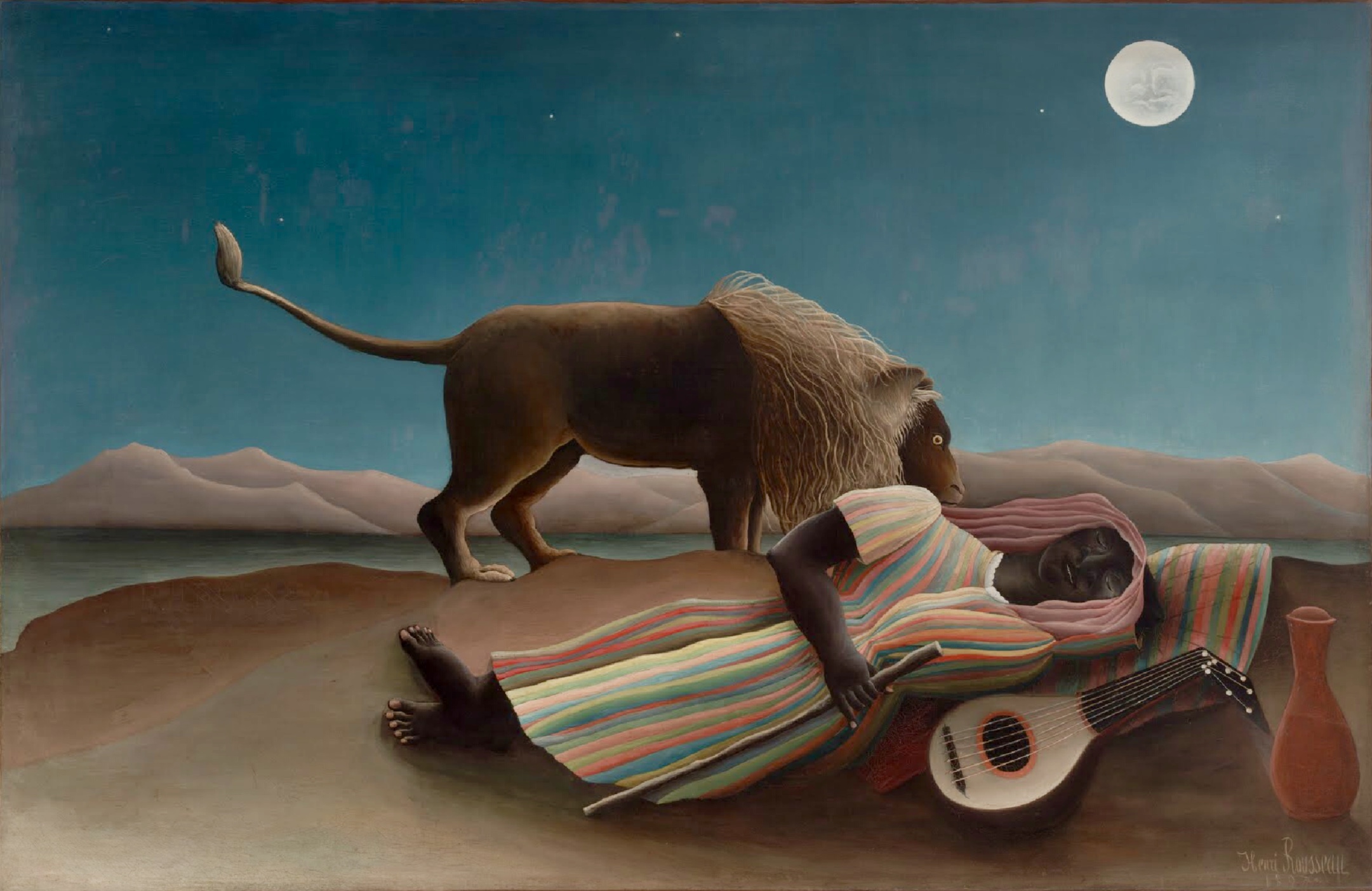
“The Sleeping Gypsy,” Henri Rousseau, oil on canvas, 1897
A: I grew up in a blue collar family in Clifton, New Jersey, a suburb about fifteen miles west of Manhattan. My father was a television repairman for RCA. My mother stayed home to raise my sister and me (at the time I had only one sister, Denise; my sister Michele was born much later). My parents were both first-generation Americans and no one in my extended family had gone to college yet. I was a smart kid who showed some artistic talent in kindergarten and earlier. I remember copying the Sunday comics, which in those days appeared in all the newspapers, and drawing small still lifes I arranged for myself. I have always been able to draw anything, as long as I can see it.
Denise, a cousin, and I enrolled in Saturday morning “art classes” at the studio of a painter named Frances Hulmes in Rutherford, NJ. I was about 6 years old. I continued the classes for 8 years and became a fairly adept oil painter. Since we lived so close to New York City, my mother often took us to museums, particularly to the Museum of Modern Art, the Metropolitan Museum of Art, and the Museum of Natural History. Like so many young girls, I fell in love with Rousseau’s “The Sleeping Gypsy” and was astonished by Picasso’s “Guernica” when it was on long-term loan to MoMA. I have fond memories of studying the dioramas at the Museum of Natural History (they are still my favorite part of the museum). As far as I know, there were no artists in my family so, unfortunately, I had no role models. At the age of 14 my father decided that art was not a serious pursuit – declaring, it is “a hobby, not a profession” – and abruptly stopped paying for my Saturday morning lessons. With no financial or moral support to pursue art, I turned my attention to other interests, letting my artistic abilities go dormant.
Comments are welcome!
Pearls from artists* # 169
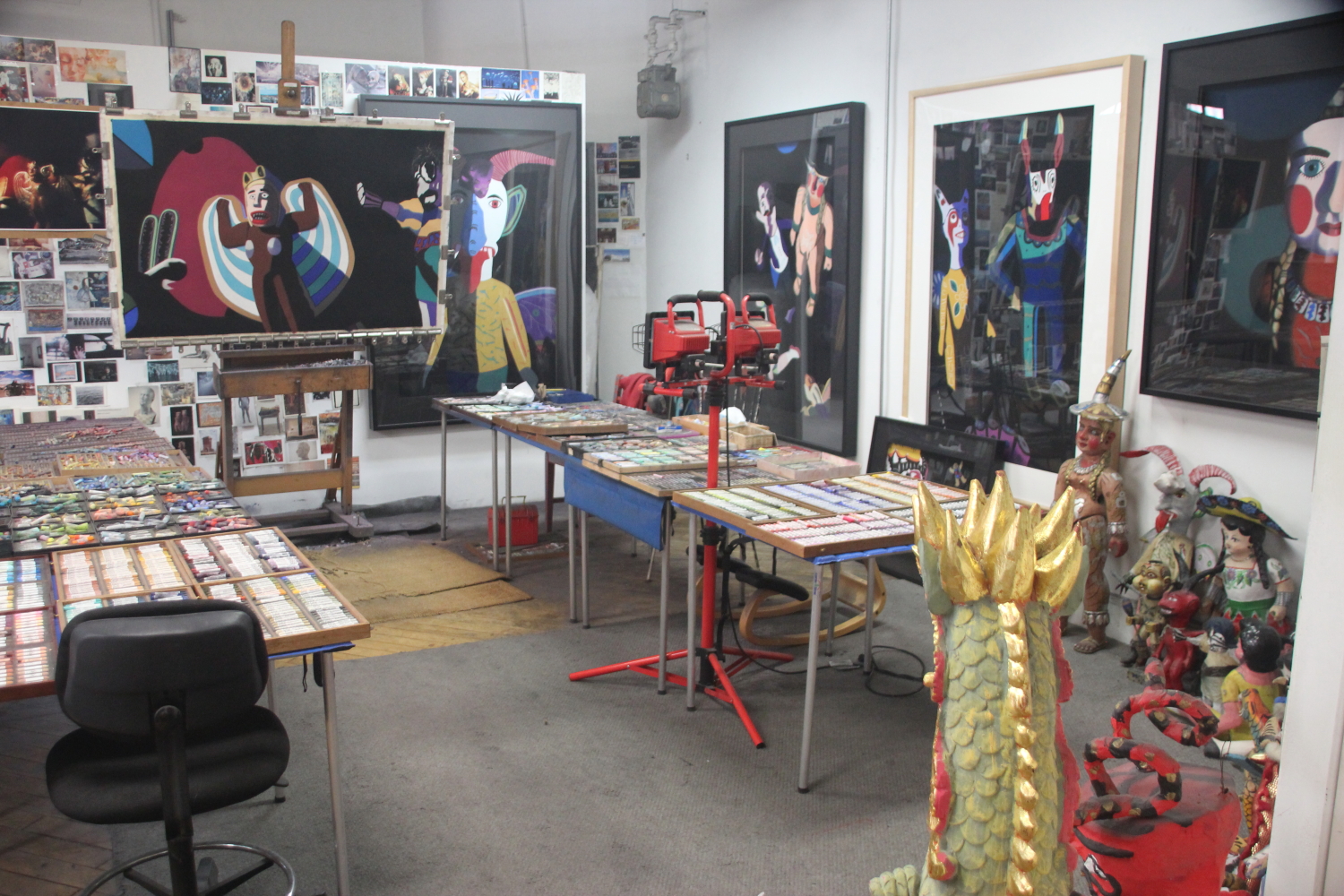
Barbara’s studio
* an ongoing series of quotations – mostly from artists, to artists – that offers wisdom, inspiration, and advice for the sometimes lonely road we are on.
For many, the familiar presence of things is a comfort. Things are valued not only because of their rarity or cost or their historical aura, but because they seem to partake in our lives; they are domesticated, part of our routine and so of us. Their long association with us seems to make them custodians of our memories; so that sometimes, as in Proust, things reveal us to ourselves in profound and unexpected ways.
The Tears of Things: Melancholy and Physical Objects by Peter Schwenger
Comments are welcome!
Q: What was the first painting you ever sold?
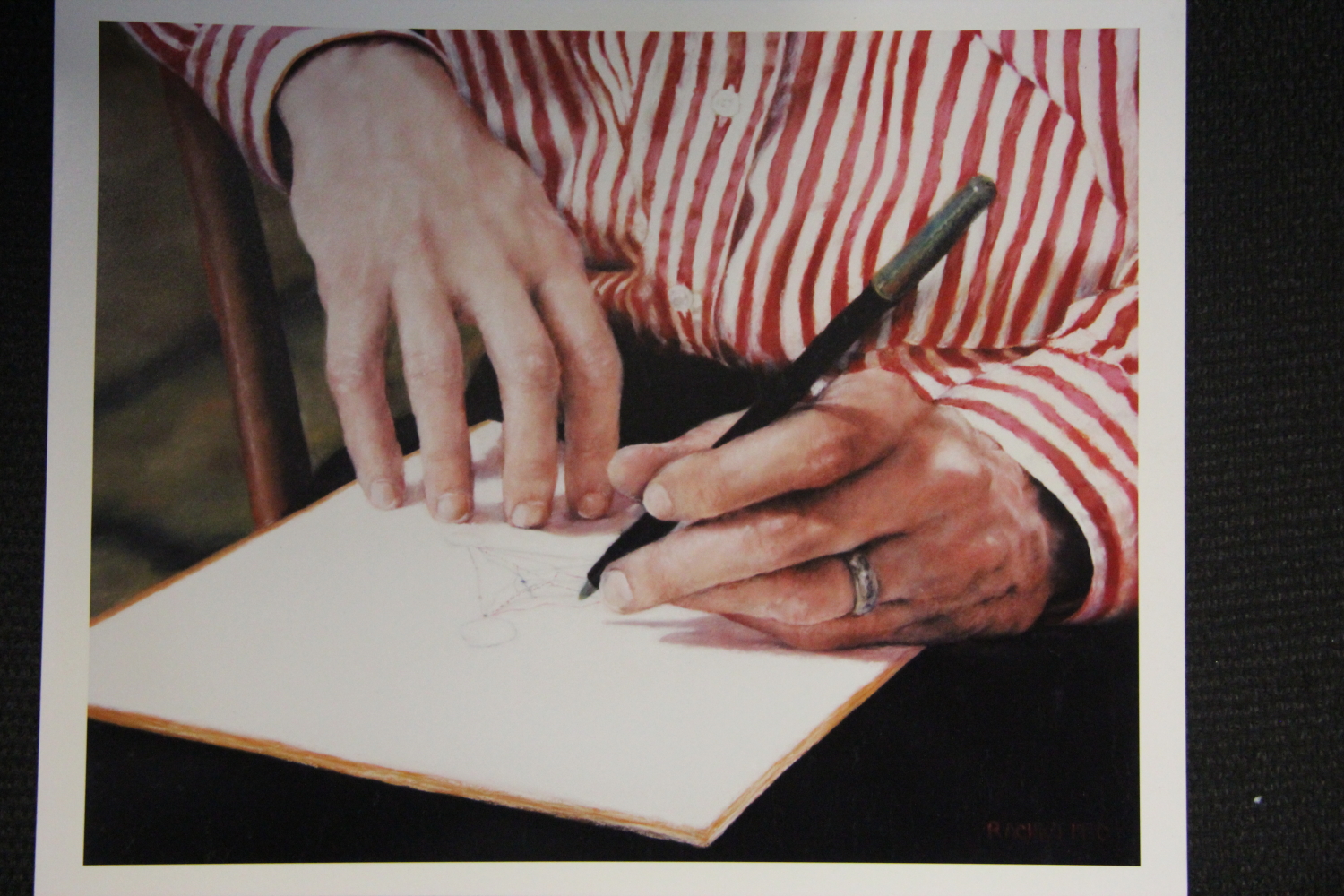
“Bryan’s Ph.D.”, 11″ x 13 1/2″, soft pastel on sandpaper
A: I believe my first sale was “Bryan’s Ph.D.” I made it in 1990 as one of several small paintings created to improve my skills at rendering human hands in pastel. I had recently left the Navy and was building a career as a portrait artist. Bryan, my late husband, was often my model for these studies, not only because it was convenient, but because he had such beautiful hands.
In 1990 Bryan was working on his Ph.D. in economics at the University of Maryland. In this painting he is drawing a diagram that illustrates a theoretical point about “international public goods,” the subject of his research. He was sitting in an old wooden rocking chair in our backyard in Alexandria, VA. I still own the chair and the house. I photographed his hands close-up and then created the painting. I don’t remember which of Bryan’s cameras I used, but it was one that took 35 mm film; perhaps his Nikon F-2. Somewhere I must still have the negative and the original reference photo.
“Bryan’s Ph.D.” is 11″ x 13 1/2″ and it sold for $500 at a monthly juried exhibition at The Art League in Alexandria. I have not seen it since 1990. (Above is a photograph of “Bryan’s Ph.D.” from my portfolio book).
Not long ago the owner contacted me, explaining that she had received the painting as a gift from her now ex-husband. She was selling it because it evoked bitter memories of her divorce. Her phone call was prompted by uncertainty about the painting’s value now. She had a likely buyer and needed to know what price to charge.
I was saddened because I have so many beautiful memories of this particular painting and of an idyllic time in my life with Bryan. He was on a leave of absence from the Pentagon to work on his dissertation, while I was finished with active duty. At last I was a full time artist, busily working in the spare bedroom that we had turned into my first studio.
My conversation with the owner was a reminder that once paintings are let out into the world, they take on associations that have nothing to do with the personal circumstances surrounding their creation. In short, what an artist creates solely out of love, stands a good chance of not being loved or appreciated by others. This is one reason to only sell my work to people I select personally. I ended the telephone conversation hoping that “Bryan’s Ph.D.” fares better in its new home.
Comments are welcome!
Q: Do you have any favorite memories of visiting museums when you were a child?
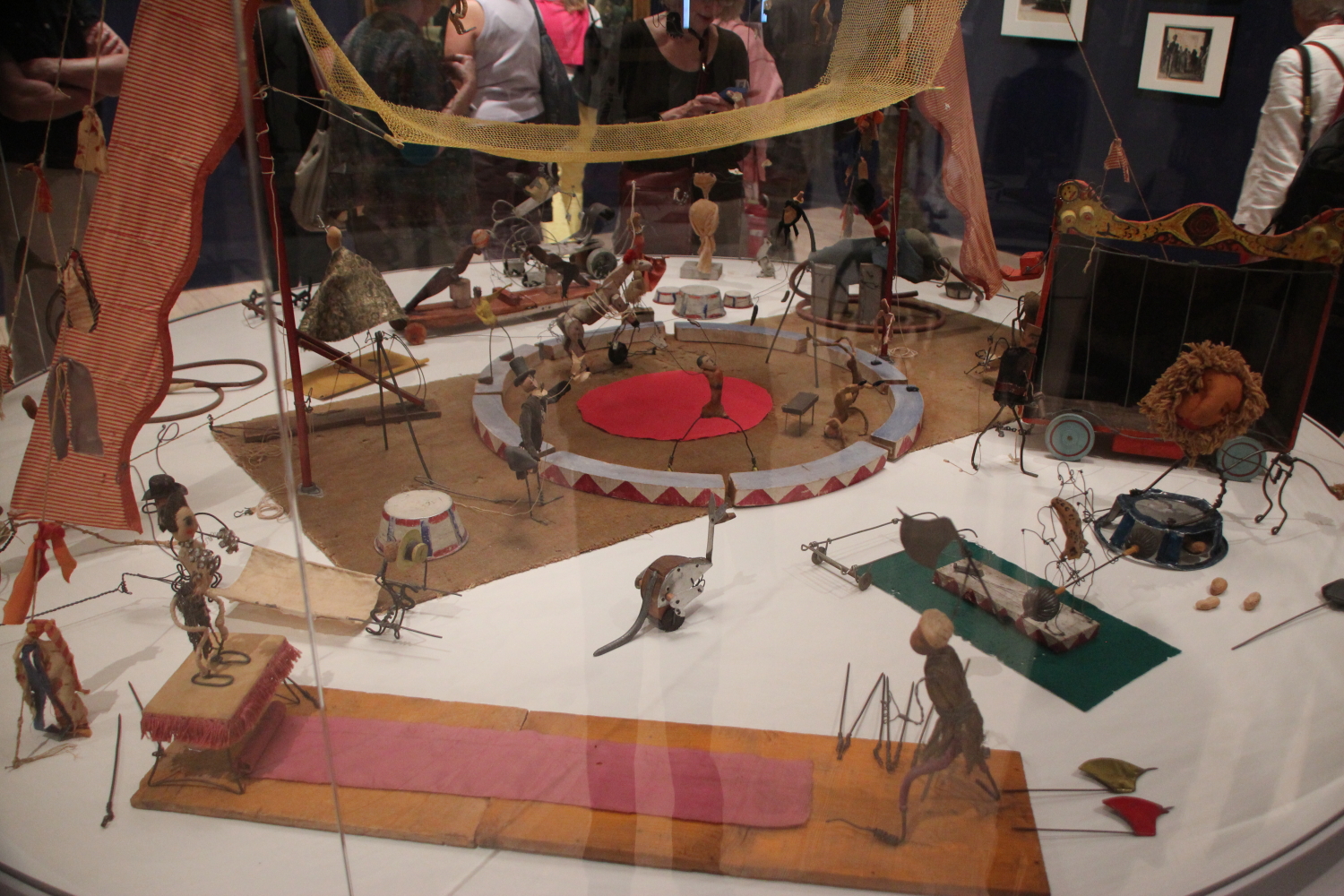
Calder’s circus at the new Whitney Museum of American Art
A: Yes, I loved seeing Alexander Calder’s wire circus at the Whitney Museum of American Art when I was a child. The circus, and the charming movie that he made with his long-suffering wife (to me she always looked bored and embarrassed that her husband was playing with his toys!) used to be on permanent display in a glass case on the ground floor. For many years Calder’s circus was in storage.
How thrilling to see it again, when the new Whitney Museum opened in May, just blocks from my apartment! Now any day of the week I can visit Calder’s circus – and other favorite works that have not been on exhibit for many years!
Comments are welcome!
Q: Were there any other artists in your family?

“The Ancestors,” soft pastel on sandpaper, 58″ x 38,” 2013
A: Unfortunately, I have not been able to reconstruct my family tree further back than two generations. So as far as I can tell, I am the first artist of any sort, whether musician, actor, dancer, writer, etc. in my family.
Both sets of grandparents emigrated to the United States from Europe. On my mother’s side my Polish grandparents died by the time my mother was 16, years before I was born.
My paternal grandparents both lived into their 90s. My father’s mother spoke Czech, but since I did not, it was difficult to communicate. I never heard any stories about the family she left behind. My grandfather spoke English, but I don’t remember him ever talking about his childhood or telling stories about his former life. My most vivid memories of my grandfather are seeing him in the living room watching Westerns on an old-fashioned television.
Sometimes I am envious of artists who had parents, siblings, or extended family who were artists. How I would have loved to grow up with a family member who was an artist and a role model!
Comments are welcome!
Pearls from artists* # 145

“Stalemate,” soft pastel on sandpaper, 38″ x 58″
* an ongoing series of quotations – mostly from artists, to artists – that offers wisdom, inspiration, and advice for the sometimes lonely road we are on.
It is a mistake for a sculptor or a painter to speak or write very often about his work. It releases tension needed for his job. By trying to express his aims with rounded-off logical exactness, he can easily become a theorist whose actual work is only a caged-in exposition of conceptions evolved in terms of logic and words.
But though the nonlogical, instinctive, subconscious part of the mind must play its part in his work, he also has a conscious mind which is not inactive. The artist works with a concentration of his whole personality, and the conscious part of it resolves conflicts, organizes memories, and prevents him from trying to walk in two directions at the same time.
Henry Moore: Notes on Sculpture in The Creative Process, edited by Brewster Ghiselin
Comments are welcome!


 barbararachkoscoloreddust.com