Blog Archives
Q: What are your favorite subject(s) and media? (Question from “Arts Illustrated”)
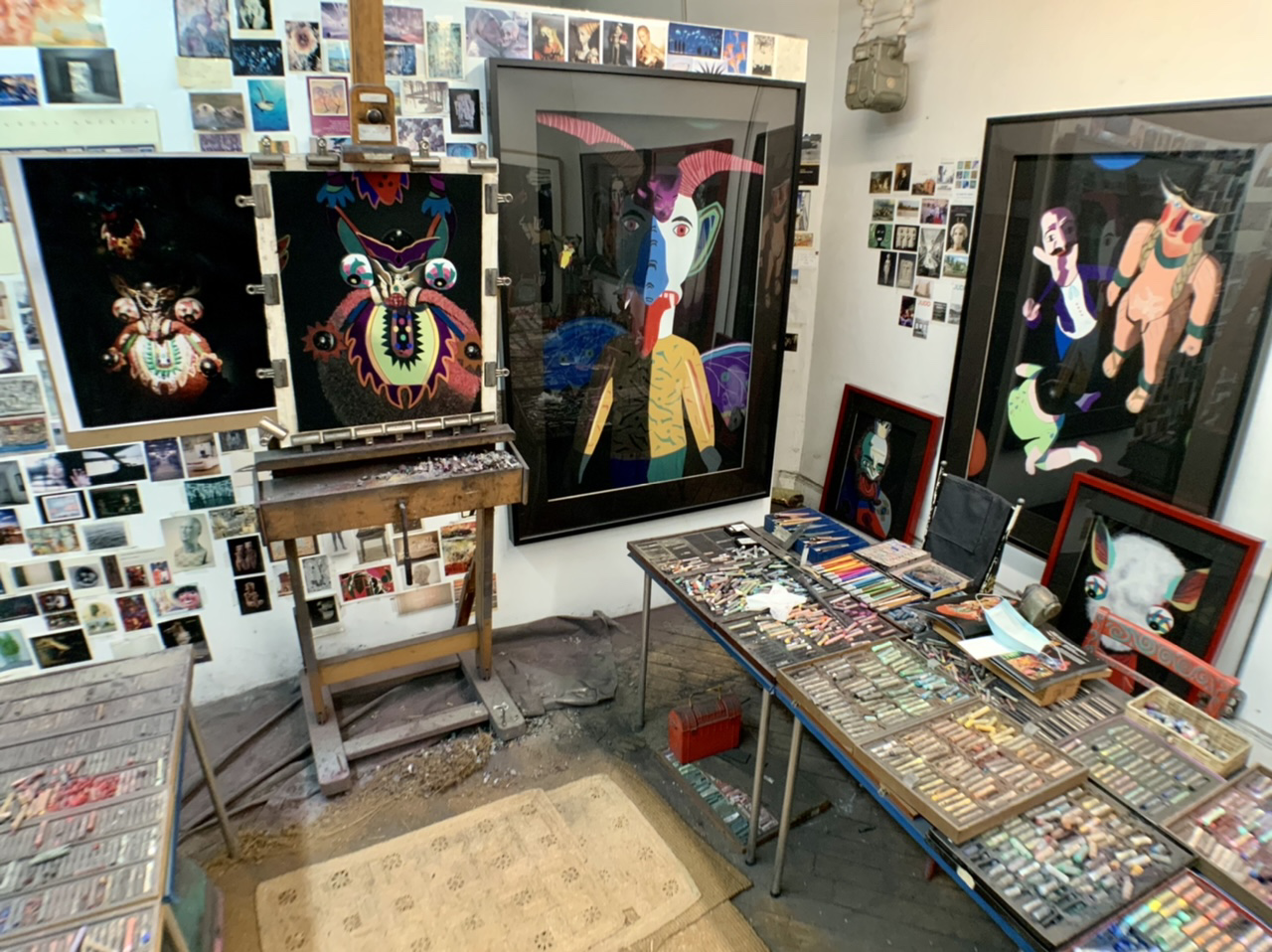
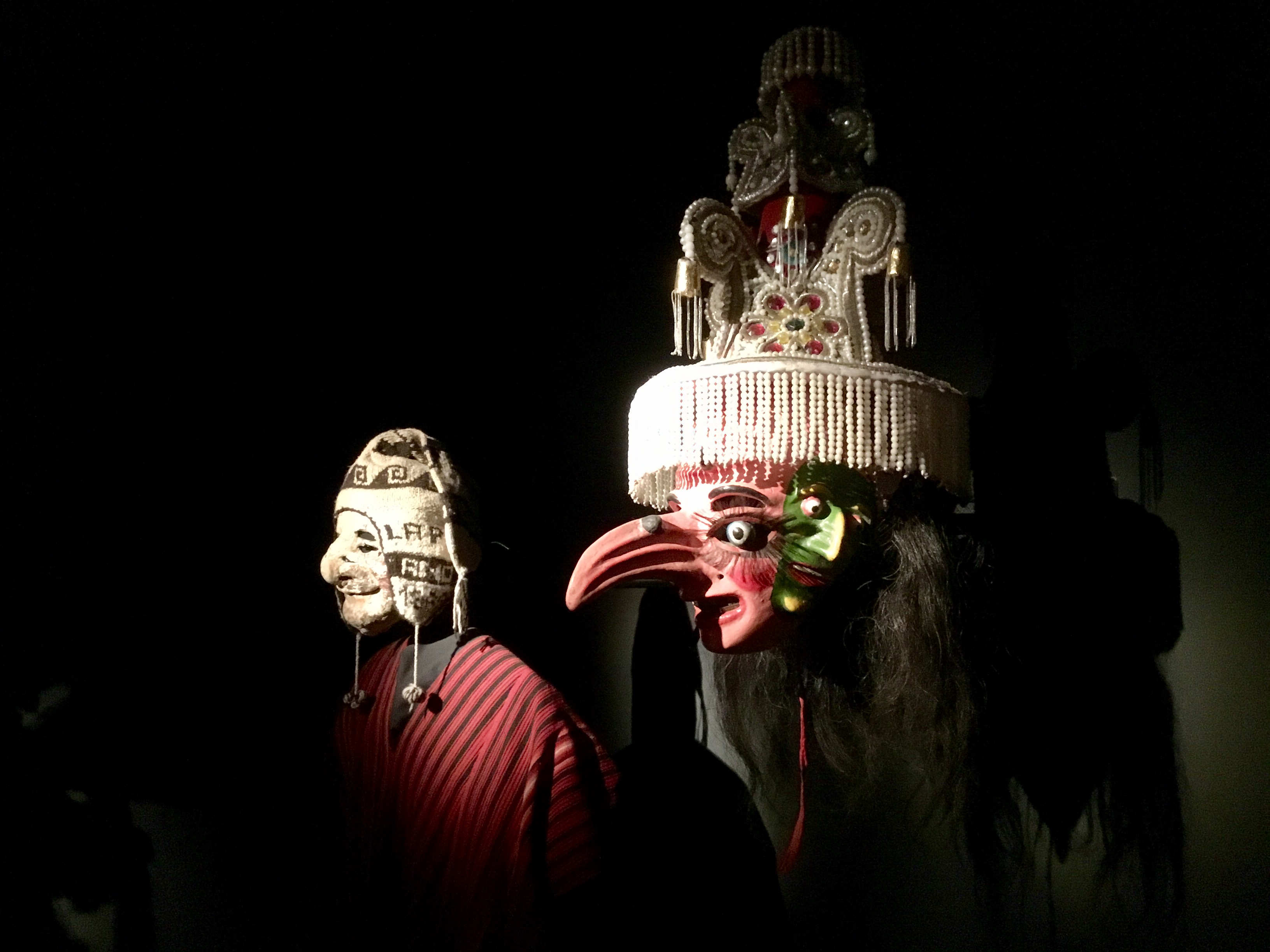
A: Here’s the short answer. I work exclusively in soft pastel on sandpaper, using self-invented pastel techniques that I have been refining for thirty-five years. Since 2017, I have depicted authentic Bolivian Carnival masks that I encountered and photographed at the Museum of Ethnography and Folklore In La Paz.
Comments are welcome!
Q: What’s on the easel today?

A: I’m working on another large (58” x 38”) “Bolivianos” pastel painting based on old Bolivian masks encountered at the Museum of Folklore and Ethnography in La Paz four years ago. The masks were made to be worn in annual Carnival celebrations that happen in the mountain town of Ouroro, about a three-hour drive from La Paz.
Comments are welcome!
Pearls from artists* # 453
*an ongoing series of quotations – mostly from artists, to artists – that offers wisdom, inspiration, and advice for the sometimes lonely road we are on.
Art begins in the struggle for equilibrium. One cannot create from a balanced state. Being off balance produces a predicament that is always interesting on stage. In the moment of unbalance, our animal instincts prompt us to struggle towards equilibrium and this struggle is endlessly engaging and fruitful. When you welcome imbalance in your work, you will find yourself instantly face to face with your own inclination towards habit. Habit is an artist’s opponent. In art, the unconscious repetition of familiar territory is never vital or exciting. We must try to remain awake and alive in the face of our inclinations towards habit. Finding yourself off balance provides you with an invitation to disorientation and difficulty. It is not a comfortable prospect. You are suddenly out of your element and out of control. And it is here the adventure begins. When you welcome imbalance, you will instantly enter new and unchartered territory in which you feel small and inadequate in relation to the task at hand. But the fruits of this engagement abound.
Anne Bogart in A Director Prepares: Seven Essays on Art and Theatre
Comments are welcome!
Q: What inspires you to start your next painting? (Question from Nancy Nikkal)

A: For my current series, “Bolivianos,” I am using as source/reference material c-prints composed at a La Paz museum in 2017. I began the series by picking my favorite from this group of photos (“The Champ” and later, “Avenger”) before continuing with others selected for prosaic reasons such as I like some aspect of the photo, to push my technical skills by figuring out how to render some item in pastel, to challenge myself to make a pastel painting that is more exciting than the photo, etc. I like to think I have mostly succeeded.
At this time I am running low on images and have not yet imagined what comes next. Do I travel to La Paz again in 2021 to capture new photos? This series was a surprise gift so I am reluctant to deliberately chase after it knowing that ‘lightning never strikes twice.’ Will travel even be possible this year with Covid-19? These are questions I am wrestling with now.
Comments are welcome!
Q: What kind of art do you create?
At work
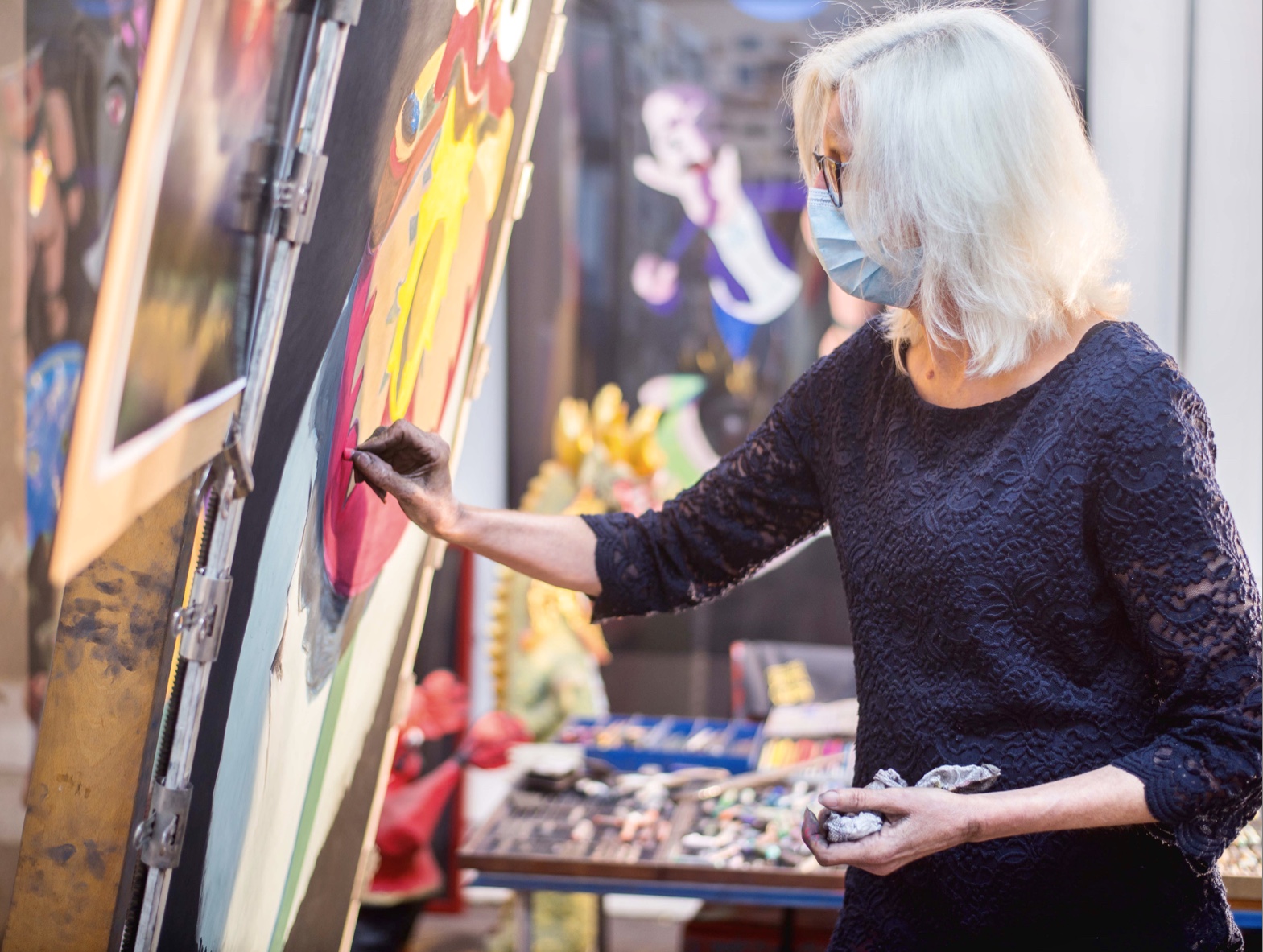
A: I live in the West Village in New York City and have been a working artist for thirty-four years. I create original pastel paintings that use my large collection of Mexican and Guatemalan folk art – masks, carved wooden animals, papier mache figures, and toys – as subject matter. Blending with my fingers, I spend months painstakingly applying dozens of layers of soft pastel onto acid-free sandpaper. My self-invented technique achieves extraordinarily rich, vibrant color and results in paintings that uniquely combine reality, fantasy, and autobiography. Please see https://barbararachko.art/en/
For the last three years I have been working on a series called, “Bolivianos,” based on an exhibition of Carnival masks seen in La Paz. Art critics and others have said that these are my strongest pastel paintings so far. As I write I am working on the fifteenth piece in the series.
Comments are welcome!
Q: Can you give us your current elevator pitch?
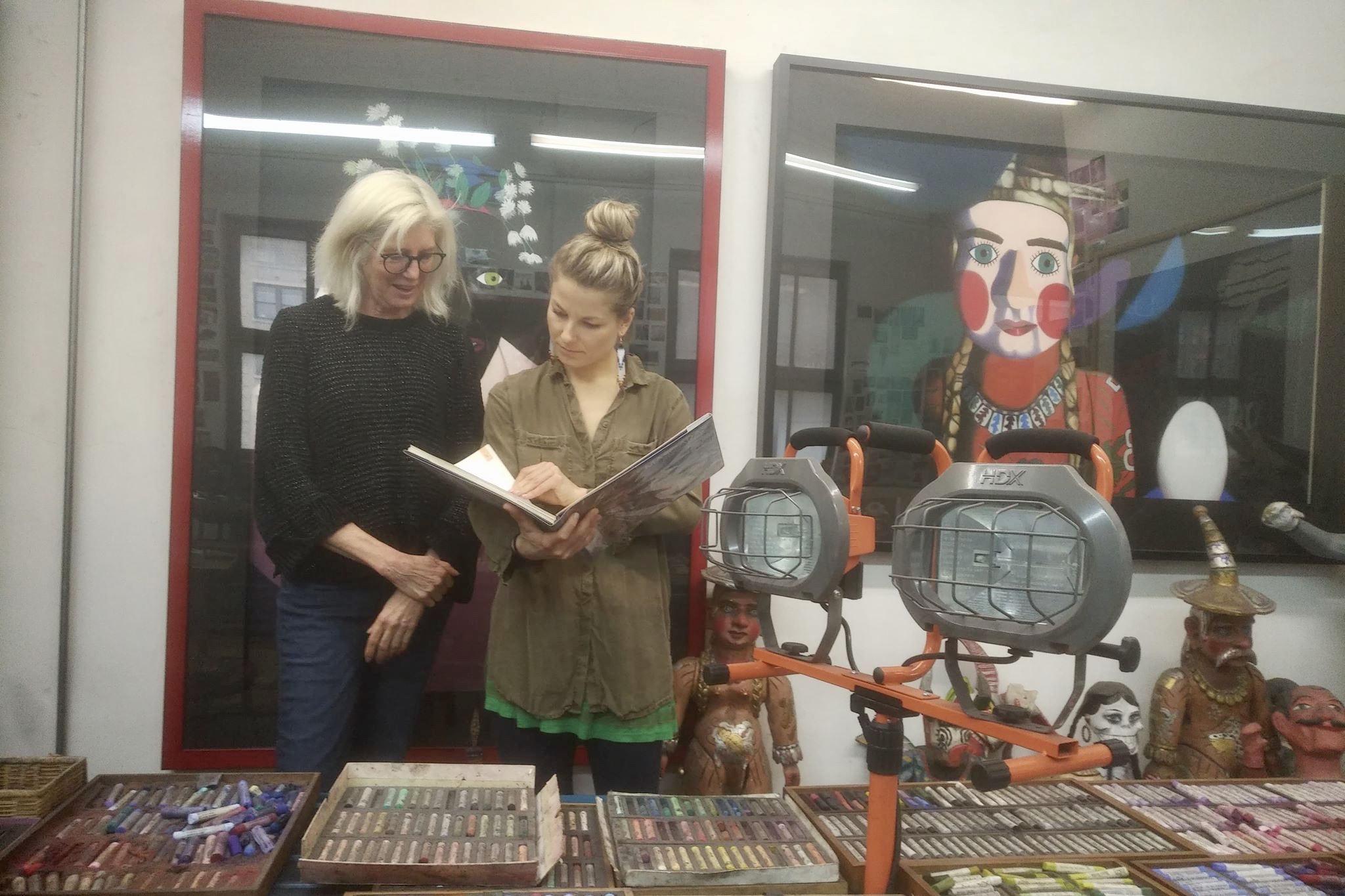
Discussing Bolivian masks with Nika, Photo: David De Hannay
A: Here it is:
I am a New York visual artist, blogger, and author. For thirty-four years I have been creating original pastel-on-sandpaper paintings that depict my large collection of Mexican and Guatemalan folk art – masks, carved wooden animals, papier mache figures, and toys. “Bolivianos,” my current series, is based on a mask exhibition I saw and photographed in La Paz in 2017 at the National Museum of Folklore and Ethnography.
My technique is self-invented and involves applying dozens of layers of soft pastel onto acid-free sandpaper to create new colors directly on the paper. Each pastel painting takes several months to complete. Typically, I make four or five each year. I achieve extraordinarily rich, vibrant color in pastel paintings that are a unique combination of reality, fantasy, and autobiography.
My background is unusual for an artist. I am a pilot, a retired Navy Commander, and a 9/11 widow. Besides making art, I am a published blogger and author best known for my popular blog, “Barbara Rachko’s Colored Dust” (53,000+ subscribers!) and my eBook, “From Pilot to Painter,” on Amazon and iTunes.
Please see images and more at http://barbararachko.art/en/
Comments are welcome!
Q: Travel is an essential aspect of your work. How do you decide where to travel next?
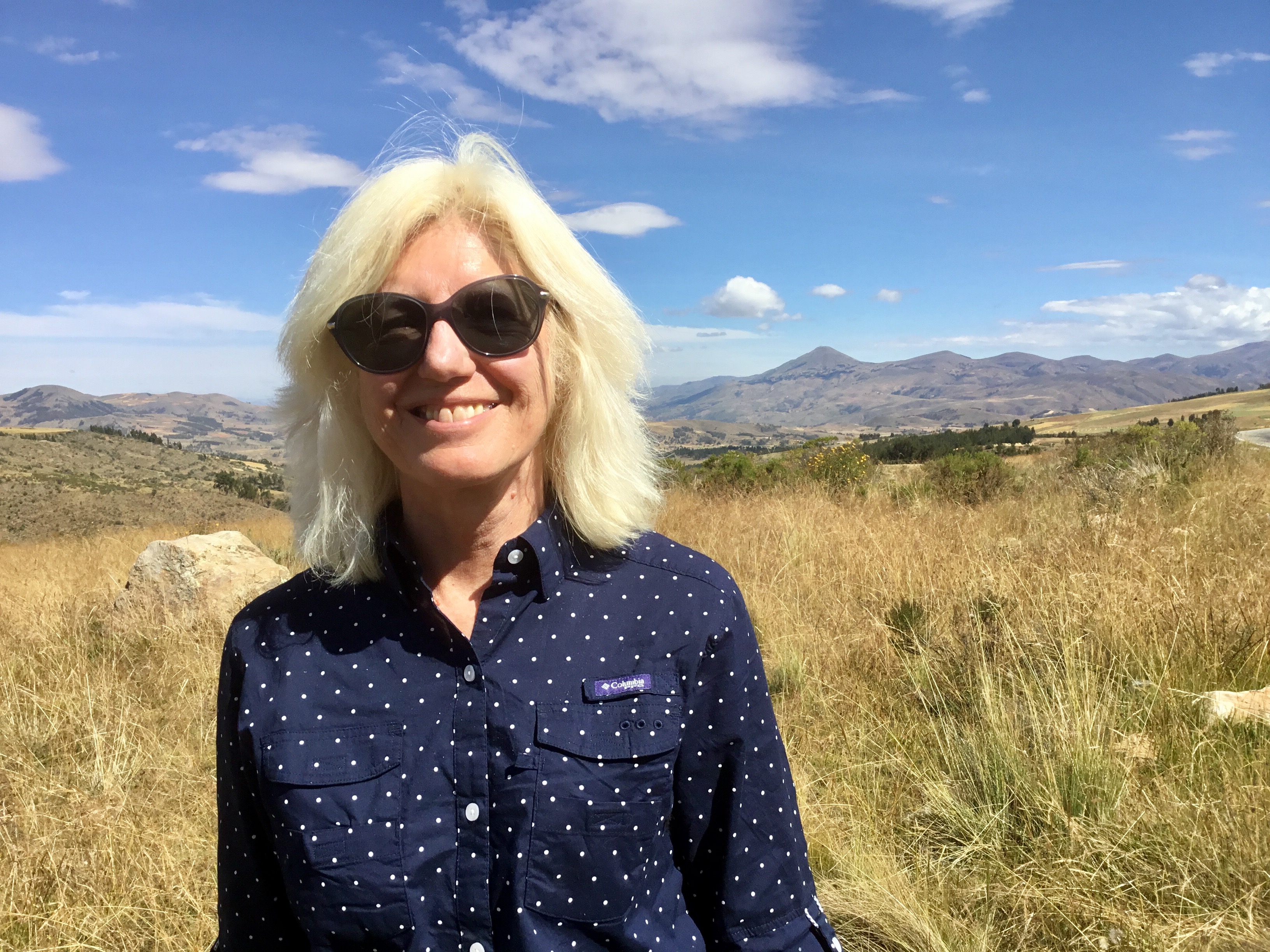
In the Bolivian Andes at about 14,000’
A: Generally, I am most interested in exploring Mexico and destinations in Central and South American because they offer endless inspiration to further my work. I’m not exactly certain why this is the case. I DO know that I cannot get enough of travel to points south!
My 2017 trip to Bolivia proved to be crucial for my current pastel painting series. “Bolivianos” is based on an exhibition of Carnival masks encountered at the National Museum of Ethnology and Folklore in La Paz.
I had high hopes of making a return visit – along with a private tour guide – last February. However, since President Moreno resigned last November, much political instability, violence, and turmoil resulted. I would not have felt safe traveling to Oruro to see Carnival celebrations this year.
In the mean time I look forward to traveling to Chile, the Atacama Desert, and Easter Island next winter!
Comnents are welcome!
Q: Can you briefly explain how the Bolivian Carnival masks you depict in your work are used?

Museum of Ethnography and Folklore, La Paz, Bolivia
A: The masks depict important figures from Bolivian folklore traditions and are used in Carnival celebrations in the town of Oruro. Carnival occurs every year in late February or early March. I had hoped to visit again this year, but political instability in Bolivia made a trip too risky.
Carnival in Oruro revolves around three great dances. The dance of “The Incas” records the conquest and death of Atahualpa, the Inca emperor when the Spanish arrived in 1532. “The Morenada” music and dance style from the Bolivian Andes was possibly inspired by the suffering of African slaves brought to work in the silver mines of Potosi. The dance of “The Diablada” depicts Saint Michael fighting against Lucifer and the seven deadly sins. Lucifer was disguised in seven different masks derived from medieval Christian symbols aor totemic animals that became nd mostly devoid of pre-Columbian elements (except that became attached to Christianity after the Conquest). Typically, in these dances the cock represents Pride, the dog Envy, the pig Greed, the female devil Lust, etc.
Comments are welcome!
Q: Can you tell us about the different series of work you have created and what they embody?
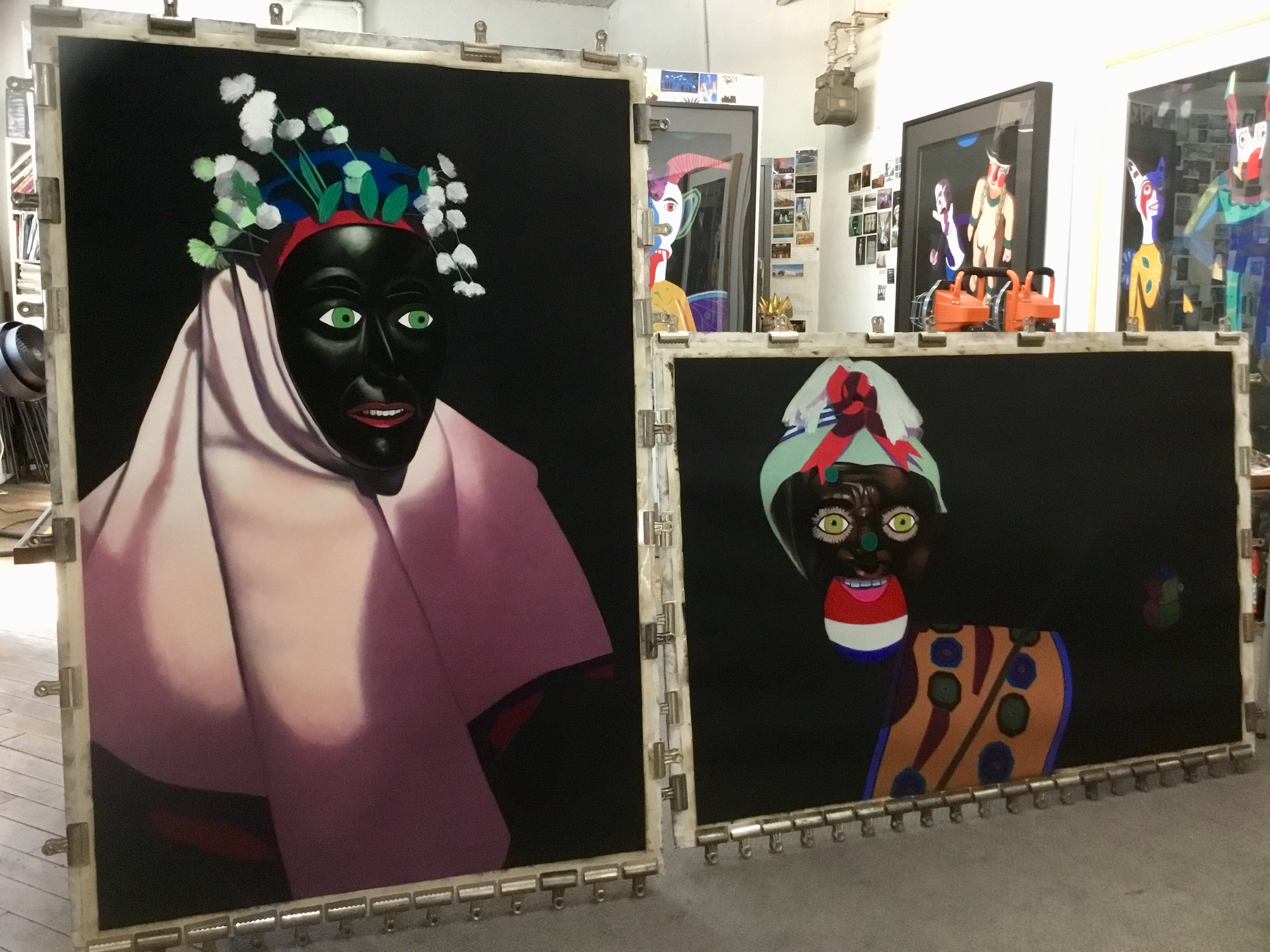
Barbara’s studio with work in progress
A: The Black Paintings series of pastel-on-sandpaper paintings grew directly from an earlier series, Domestic Threats. While both use cultural objects as surrogates for human beings acting in mysterious, highly-charged narratives, in the Black Paintings I replaced all background details of my actual setup (furniture, rugs, etc.) with lush black pastel. In this work the ‘actors’ are front and center.
While traveling in Bolivia two years ago, I visited a mask exhibition at the National Museum of Ethnography and Folklore in La Paz. The masks were presented against black walls, spot-lit, and looked eerily like 3D versions of my Black Paintings. I immediately knew I had stumbled upon a gift. So far I have completed nine pastel paintings in the Bolivianos series. One is awaiting finishing touches, one is in progress now, and I am planning the next one.
All of my pastel paintings are an example of a style called “contemporary conceptual realism” in which things are not quite as innocent as they seem. In this sense each painting is a kind of Trojan horse. There is plenty of backstory to my images, although I usually prefer not to over-explain them. Some mystery must always remain in art.
The world I depict is that of the imagination and this realm owes little debt to the natural world. I recently gave an art talk where I was reminded how fascinating it is to learn how others respond to my work. As New York art critic Gerrit Henry once remarked, “What we bring to a Rachko… we get back, bountifully.”
Comments are welcome!
Q: What’s on the easel today?
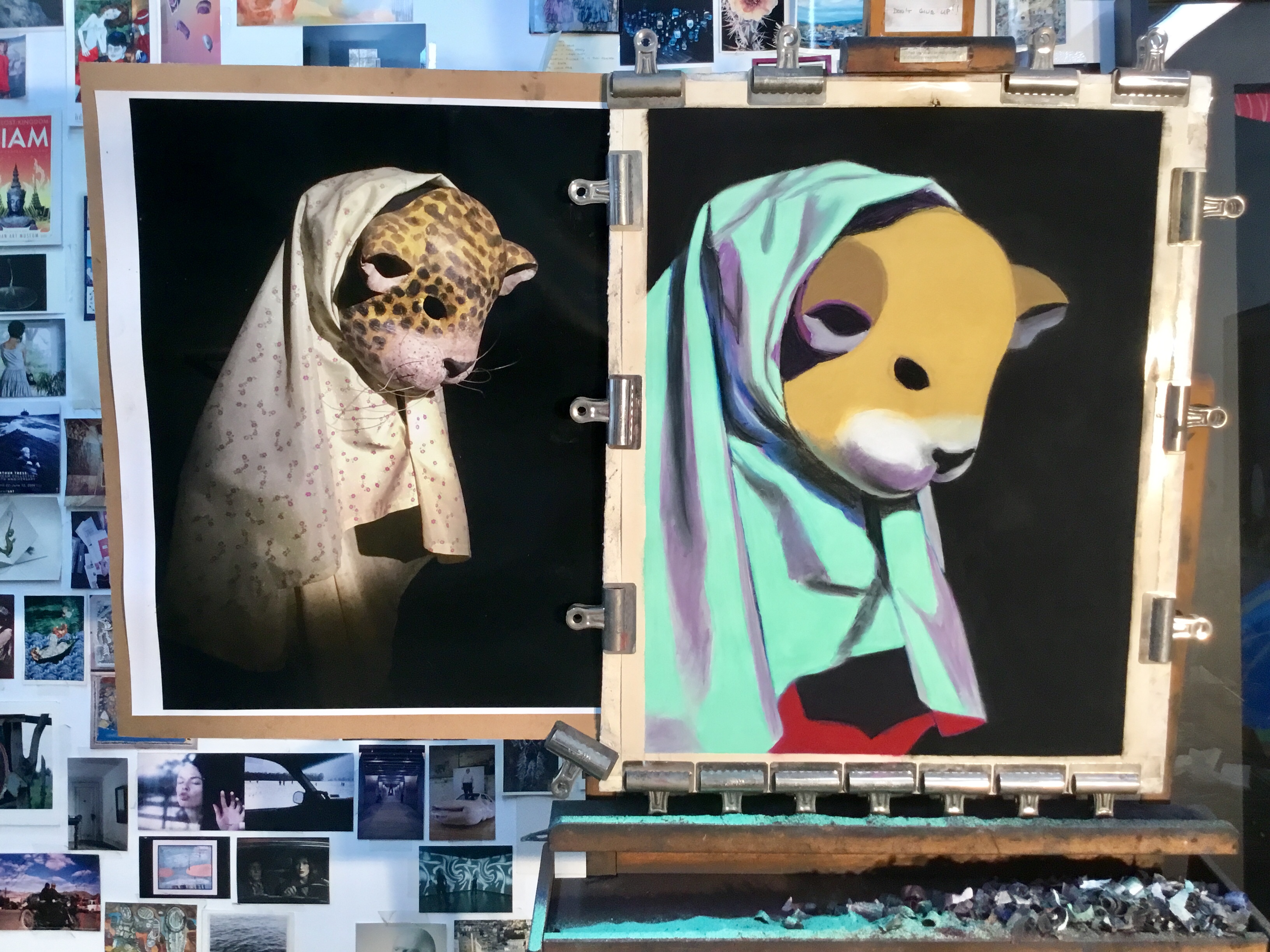
Work in progress
A: I’m at the beginning on a small (26” x 20”) pastel painting. The subject is a jaguar mask I photographed in La Paz. This is painting number eleven in the “Bolivianos” series. Lots of green colored dust now!
Comments are welcome!


 barbararachkoscoloreddust.com