Blog Archives
Pearls from artists* # 674
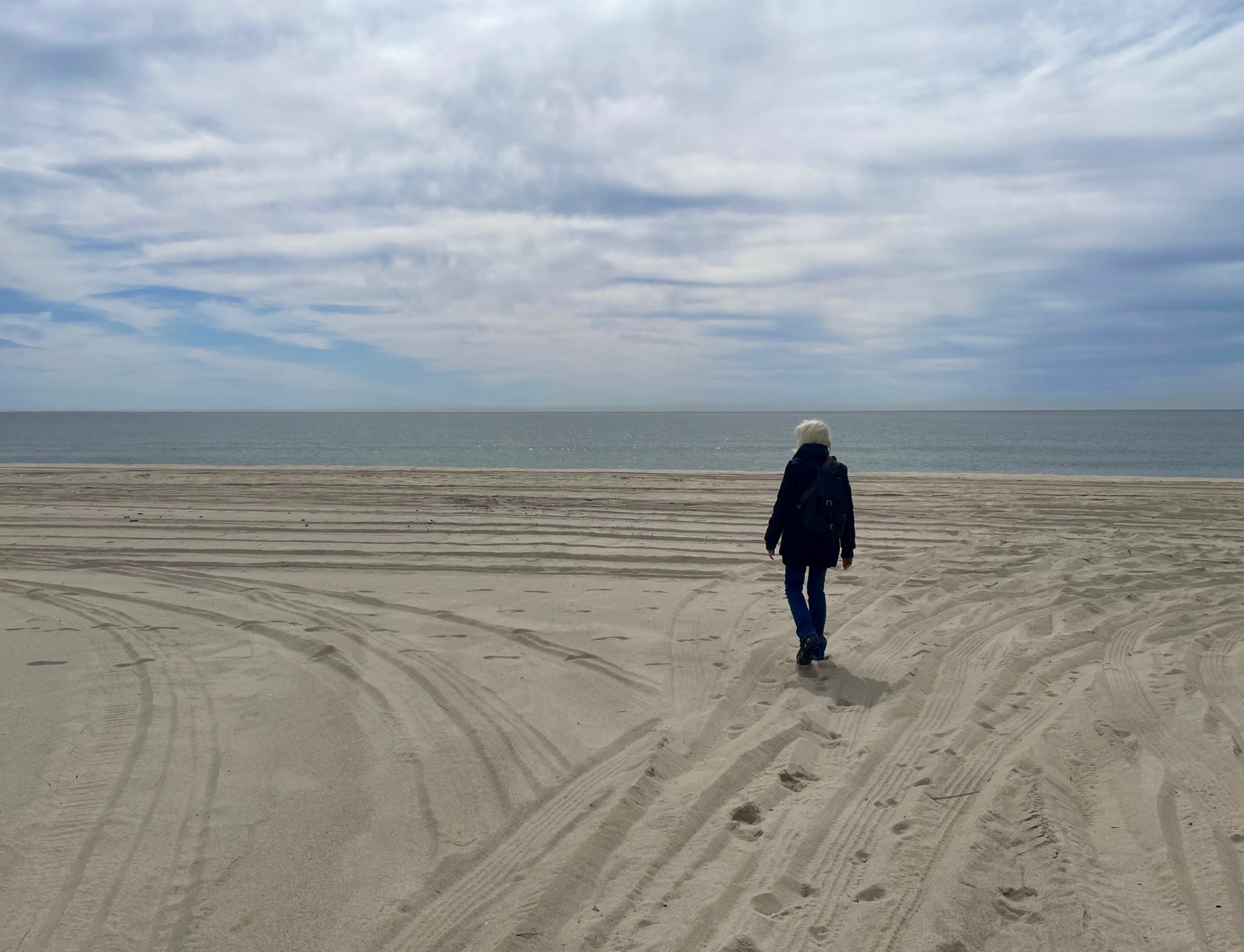
Southampton, New York Photo: Susan Erlichman
*an ongoing series of quotations – mostly from artists, to artists – that offers wisdom, inspiration, and advice for the sometimes lonely road we are on.
Everything about art requires dedication and presence. It is an intimate act, demanding the kind of sustained devotion we rarely lavish on other human beings. The artist’s generosity is highly impractical because there is no guarantee that it will ever be appreciated. Consider the level of optimism needed to repeatedly spend, even deplete, whatever reserves might be required to create the most superlative gift you could offer, one that is essentially given away to the world for free. The work we make is a love letter in a bottle, thrown into the ocean. It may or may not be read. We do not negotiate. like businesspeople, ‘You give me this, and I will give you that…’ We bequeath our pursuit of excellence and creative spirit to our audience, without reservation or qualification. We know what we have invested in it and sleep better because of it.
– Kate Kretz in Art From Your Core: A Holistic Guide to Visual Voice
Comments are welcome!
Pearls from artists* # 595

Film still from “Barbara Rachko: True Grit,” directed by Jennifer Cox, Moto Films LLC
*an ongoing series of quotations – mostly from artists, to artists – that offers wisdom, inspiration, and advice for the sometimes lonely road we are on.
One of the great paradoxes of the writing life is that our words – chosen carefully, so thoughtfully, with deep focus and concentration – those words once on the page go dead on us. Language is ours only when we are forming sentences, moving elements around, grappling with punctuation, speaking words aloud, feeling them on our lips. While we are shaping a scene into something we can hear and touch and see, that scene lives and breathes. We are inside language like painters, we are working in our medium: the tempera, the thin line, the wet oil on canvas, still in process, still alive.
But once we commit – once those words dry like paint, are affixed to the page – it becomes nearly impossible to see them. This? We think to ourselves. Our most loathsome critic emerges with a swirl of her cape. Really? What the hell is this? The sentences appear to have been written in another language – a dark dream language, tucked into some musty, inaccessible corner of our psyche. Attempting to discern its meaning is a bit like looking at our own face in the mirror. It is at once so familiar as to be invisible, and so intimate that we turn away, baffled, ashamed.
Can we ever see ourselves, really? Can we read ourselves?
It is a powerful conundrum because without the ability to see our writing afresh we cannot do the necessary work. How do we know whether a problem lies with the work, or with our inability to enter it? We need clarity, but not coldness. Openness, but not attachment. We want optimism, but that optimism must not go hand in hand with discernment. We’re not looking for a cheerleader, nor a fault-finding judge. We want to read ourselves with equanimity.
Dani Shapiro in Still Writing: The Pleasures and Perils of a Creative Life
Comments are welcome!
Pearls from artists* # 582

*an ongoing series of quotations – mostly from artists, to artists – that offers wisdom, inspiration, and advice for the sometimes lonely road we are on.
Strange, but the artist has never made a fuss about being denied those estimable virtues other men would not do without: intellectuality, good judgment, a knowledge of the world, and rational conduct. It may be charged, that he has even fostered the myth. In his intimate journals Vollard tells us that Degas feigned deafness to escape disputations and harangues concerning things he considered false and distasteful. If the speaker or subject changed, his hearing immediately improved. We must marvel at his wisdom since he must have only surmised what we know definitely today: tThat the constant repetition of falsehood is more convincing than the demonstration of truth. It is understandable, then, how the artist might actually cultivate this moronic appearance, this deafness, this inarticulateness, in an effort to evade the million irrelevancies which daily accumulate concerning his work. For, while the authority of the doctor or plumber is never questioned, everyone deems himself a good judge and an adequate arbiter of what a work of art should be and how it should be done.
Mark Rothko in The Artist’s Reality: Philosophies of Art, edited by Christopher Rothko
Comments are welcome!
Q: How did your ebook “From Pilot to Painter” come to be? (Question from “Arte Realizzata”)
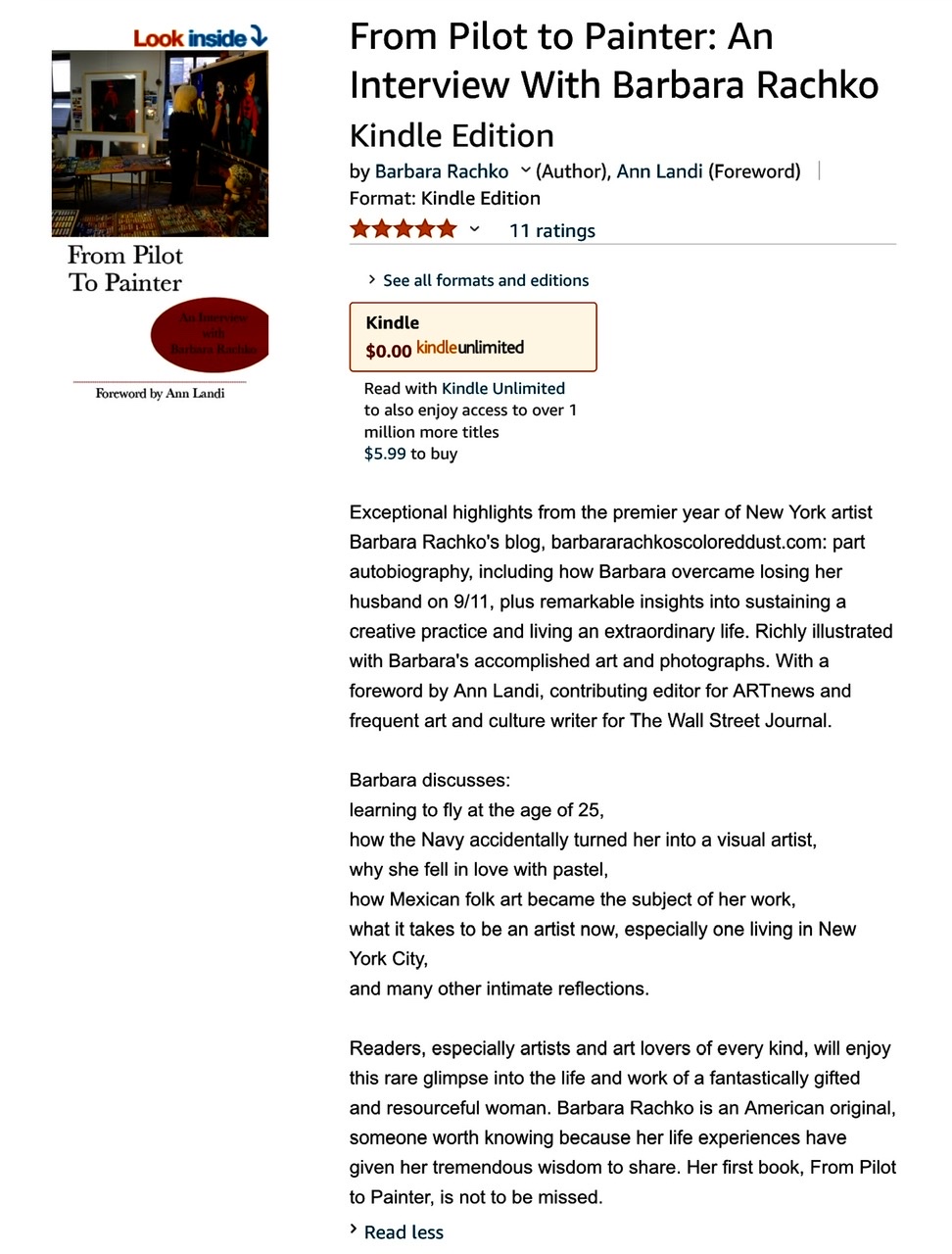
A: It was my longtime assistant, Barbra Drizin’s, idea and more than I’d care to admit, I was resistant. I said, “I am much too busy to write an ebook!” Barbra went on to explain that we could start with material I had already written for my blog, expand on it, add reproductions of my pastel paintings, etc. With her persuasion, I agreed! Barbra made the initial selections and together we added and revised text, organized the material, and worked out countless details. I asked my friend, Ann Landi, to write a foreword and Barbra found an editor to put everything into Amazon’s ebook format.
Now I am extremely pleased that my ebook FROM PILOT TO PAINTER is available not only on Amazon, but also on iTunes. It is based on my blog and is part memoir, including the loss of my husband on 9/11, insights into my creative practice, and intimate reflections on what it’s like to be an artist living in New York City. The ebook includes material not found on the blog, plus 25+ reproductions of my vibrant pastel-on-sandpaper paintings, a Foreword by Ann Landi, the founder of Vasari21.com and longtime critic for ARTnews, and more.
Comments are welcome!
Q: You are a multi-talented woman! Tell us about your book, “From Pilot to Painter,” and how writing, for you, compares to painting and photography. Which do you prefer?
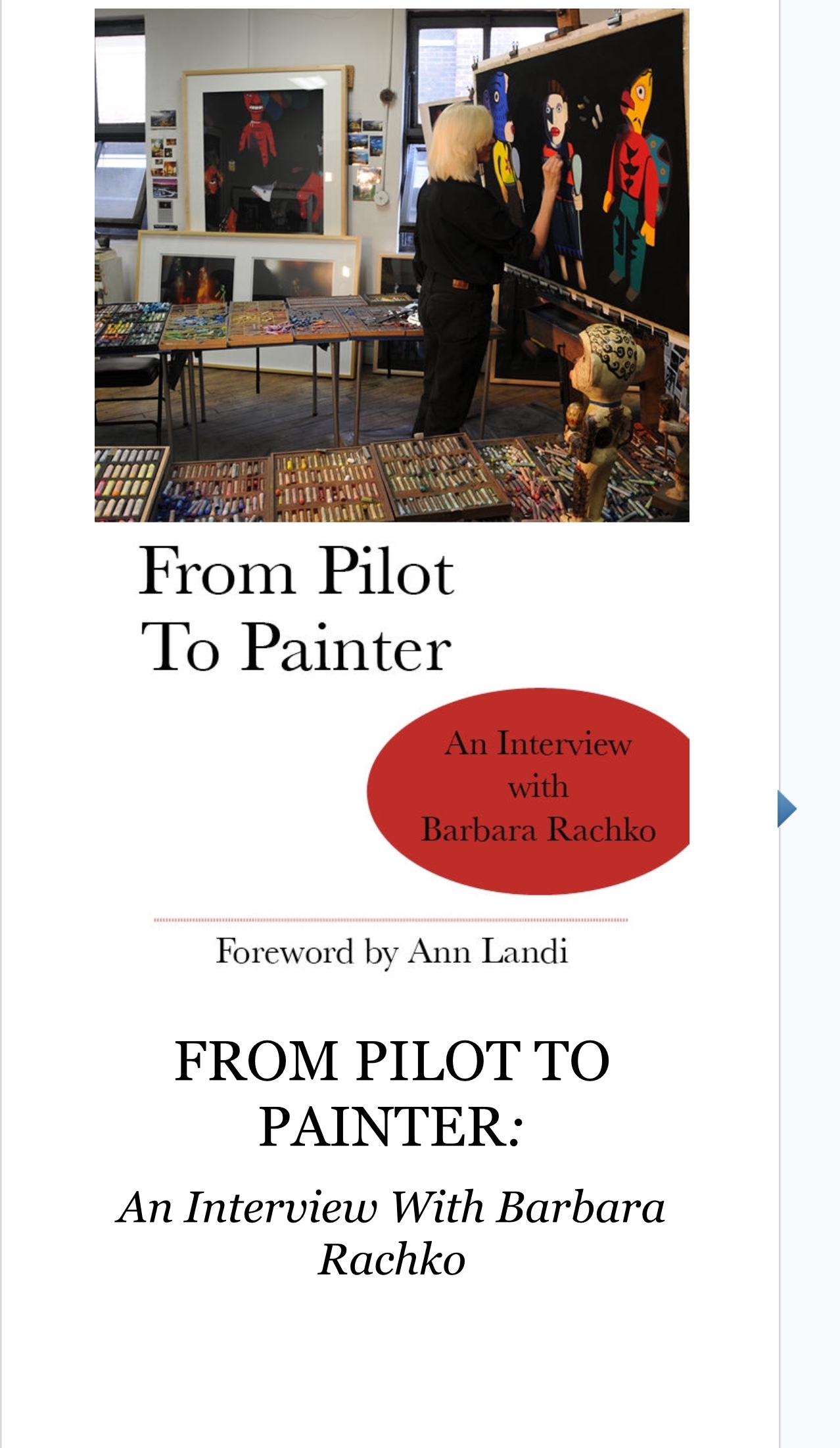
“From Pilot to Painter”
A: I am pleased that my eBook FROM PILOT TO PAINTER is available on Amazon and iTunes. It is based on my blog and is part memoir, including my personal loss on 9/11, insights into my creative practice, and intimate reflections on what it’s like to be an artist living in New York City now. The eBook includes new material not found on the blog, plus 25+ reproductions of my vibrant pastel-on-sandpaper paintings, a Foreword by Ann Landi (who writes for ARTnews and The Wall Street Journal), and more.
“Barbara Rachko’s Colored Dust” (the title of my blog) continues to be a crucial part of my overall art practice. Blogging twice a week forces me to think deeply about my work and to explain it clearly to others. The process has helped me develop a better understanding about why I make art and has encouraged me to become a better writer.
From the beginning in the 1980s I used photographs as reference material and Bryan would shoot 4” x 5” negatives of my elaborate setups with his Toyo-Omega view camera. In those days I rarely picked up a camera except when we were traveling. After Bryan was killed on 9/11, I inherited his extensive camera collection – old Nikons, Leicas, Graphlex cameras, etc. – and I wanted to learn how to use them. In 2002 I enrolled in a series of photography courses (about 10 over 4 years) at the International Center of Photography in New York. I learned how to use all of Bryan’s cameras and how to make my own big color prints in the darkroom. Along the way I discovered that the sense of composition, form, and color I developed over many years as a painter translated well into photography. The camera was just another medium with which to express my ideas. Astonishingly, in 2009 I had my first solo photography exhibition in New York.
It’s wonderful to be both a painter and a photographer. Pastel painting will always be my first love, but photography lets me explore ideas much faster than I ever could as a painter. Paintings take months of work. To me, photographs – from the initial impulse to hanging a framed print on the wall – are instant gratification.
For two years I have been using my iPad Pro to capture thousands of travel photographs. Most recently, I visited Gujarat and Rajasthan in India. I have never been inclined to use a sketchbook so composing photos on my iPad keeps my eye sharp while I’m halfway around the world, far from my studio practice.
Comments are welcome!
Pearls from artists* # 51
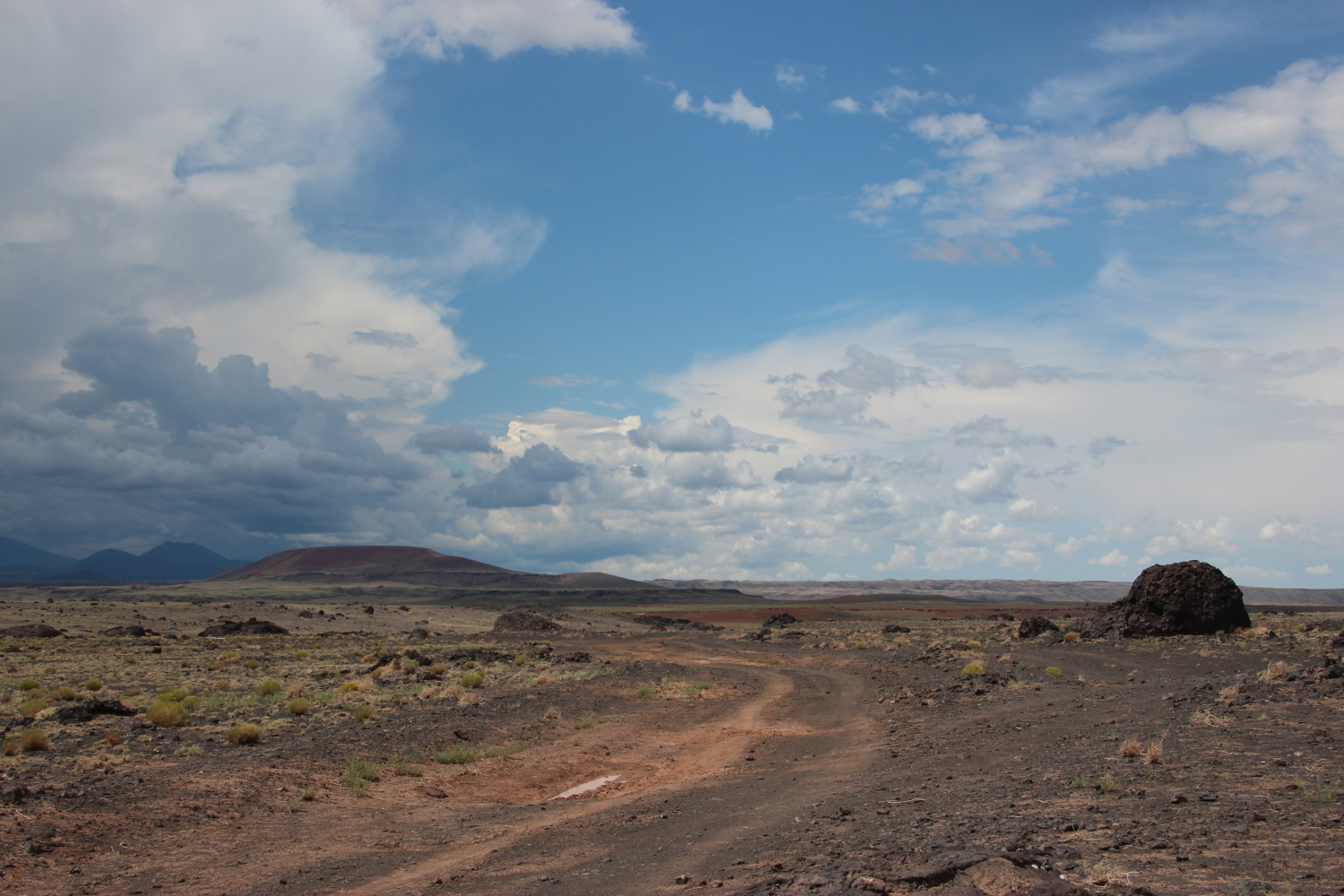
Road to Roden Crater in Arizona
* an ongoing series of quotations – mostly from artists, to artists – that offers wisdom, inspiration, and advice for the sometimes lonely road we are on.
The most demanding part of living a lifetime as an artist is the strict discipline of forcing oneself to work steadily along the nerve of one’s own most intimate sensitivity. As in any profession, facility develops. In most this is a decided advantage, and so it is with the actual facture of art; I notice with interest that my hand is more deft, lighter, as I grow more experienced. But I find that I have to resist the temptation to fall into the same kind of pleasurable relaxation I once enjoyed with clay. I have in some subtle sense to fight my hand if I am to grow along the reaches of my nerve.
And here I find myself faced with two fears. The first is simply that of the unknown – I cannot know where my nerve is going until I venture along it. The second is less sharp but more permeating: the logical knowledge that the nerve of any given individual is as limited as the individual. Under its own law, it may just naturally run out. If this happens, the artist does best, it seems to me, to fall silent. But by now the habit of work is so ingrained in me that I do not know if I could bear the silence.
Anne Truitt in Daybook: The Journal of an Artist


 barbararachkoscoloreddust.com
New eBook!
Jan 18
Posted by barbararachkoscoloreddust
Cover
I am pleased to announce that my first eBook, FROM PILOT TO PAINTER, is available now on Amazon!
It is based on my blog and is part memoir, including my personal loss on 9/11, insights into my creative practice, and intimate reflections on what it’s like to be an artist living in New York City now.
The eBook includes new material not found on the blog: 25+ reproductions of my vibrant pastel-on-sandpaper paintings, a Foreword by Ann Landi (who writes for ARTnews and The Wall Street Journal), and more.
Thank you for your support!
http://www.amazon.com/From-Pilot-Painter-Interview-Barbara-ebook/dp/B00HNVR200/ref=sr_1_1?ie=UTF8&qid=1389292390&sr=8-1&keywords=barbara+rachko
Note: If you do not own a Kindle, you can download a free Kindle app.
Here is the one for MACs:
http://www.amazon.com/gp/feature.html?docId=1000464931
Here is a link for the rest:
Kindle Cloud Reader – Read instantly in your browser
Smartphones – iPhone & iPod touch, Android, Windows Phone, BlackBerry
Computers – Mac, Windows 8, Windows 7, XP & Vista
Tablets – iPad, Android Tablet, Windows 8
http://www.amazon.com/gp/feature.html/ref=sv_kstore_3?ie=UTF8&docId=1000493771
Comments are welcome!
Share this:
Posted in 2014, An Artist's Life, Art in general, Art Works in Progress, Black Paintings, Creative Process, Domestic Threats, Gods and Monsters, Guatemala, Inspiration, Mexico, New York, NY, Painting in General, Pastel Painting, Photography, Quotes, Studio, Travel, Working methods
4 Comments
Tags: "From Pilot to Painter", "The Wall Street Journal", 9/11, Amazon, Ann Landi, announce, app, artist, ARTnews, available, blog, comments, cover, creative, easy, ebook, foreword, instructions, interview, intimate, Kindle, loss, material, memoir, New York City, paintings, pastel-on-sandpaper, personal, pleased, practice, reflections, reproductions, support, vibrant