Blog Archives
Pearls from artists* # 669

*an ongoing series of quotations – mostly from artists, to artists – that offers wisdom, inspiration, and advice for the sometimes lonely road we are on.
Pure creativity is magnificent expressly because it is the opposite of everything else in life that’s essential or inescapable (food, shelter, medicine, rule of law, social order, community and familial responsibility, sickness, loss, death, taxes, etc.). Pure creativity is something better than a necessity; it’s a gift. It’s the frosting. Our creativity is a wild and unexpected bonus from the universe. It’s as if all our gods and angels gathered together and said, “It’s tough down there as a human being, we know. Here – have some delights.”
It doesn’t discourage me in the least, in other words, to know that my life’s work is arguably useless.
All it does is make me want to play.
Elizabeth Gilbert in Big Magic: Creative Living Beyond Fear
Comments are welcome!
Pearls from artists* # 667

“Magisterial,” soft pastel on sandpaper, 58” x 38”, in progress
*an ongoing series of quotations – mostly from artists, to artists – that offers wisdom, inspiration, and advice for the sometimes lonely road we are on.
This is the eternal origin of art – that a human being confronts a form that wants to be one a work of art through him. Not a figment of his soul, but something that appears to the soul and demands the soul’s creative power. What is required is a deed that a man does with his whole being […] and the work is imperious: if I do not serve it properly, it breaks, or it breaks me. The form that confronts me I cannot experience nor describe: I can only actualize it. And yet I see it, radiant in the splendor of the confrontation, far more clearly than all the clarity of the experienced world.
Martin Buber quoted in Art From Your Core: A Holistic Guide to Visual Voice by Kate Kretz
Comments are welcome!
Pearls from artists* # 625

*an ongoing series of quotations – mostly from artists, to artists – that offers wisdom, inspiration, and advice for the sometimes lonely road we are on.
The artist not equipped with the necessary arrogance will be repeatedly sidetracked or subverted by the agendas of others. He will lack a sufficient sense of purpose, will frequently stall and block, and will bring a nagging passivity to his art career. His resolve to do great art may remain a potent idea only, a kind of unexplained force in his body. He is likely to accomplish much less than he otherwise might, support others rather than find support for himself, attempt the small rather than the large, and rebound less well from rejection.
The self-centered artist, on the other hand, is challenged to remember that he is neither god nor Superman, but a human being with human limitations. He hasn’t the time to turn every idea into a book, the ability to top each work with a greater one, the energy to toil ceaselessly at his art, nor the right to trample others as he pursues his goals. If he mistakes or oversteps these limits he will put himself in harm’s way and may find himself struck down by his own obsessional energy, by burnout, by depression, by self-abuse, or by the angry complaints of those whose rights he has cavalierly trampled.
Eric Maisel in A Life in the Arts: Practical Guidance and Inspiration for Creative and Performing Artists
Comments are welcome!
Pearls from artists* # 602
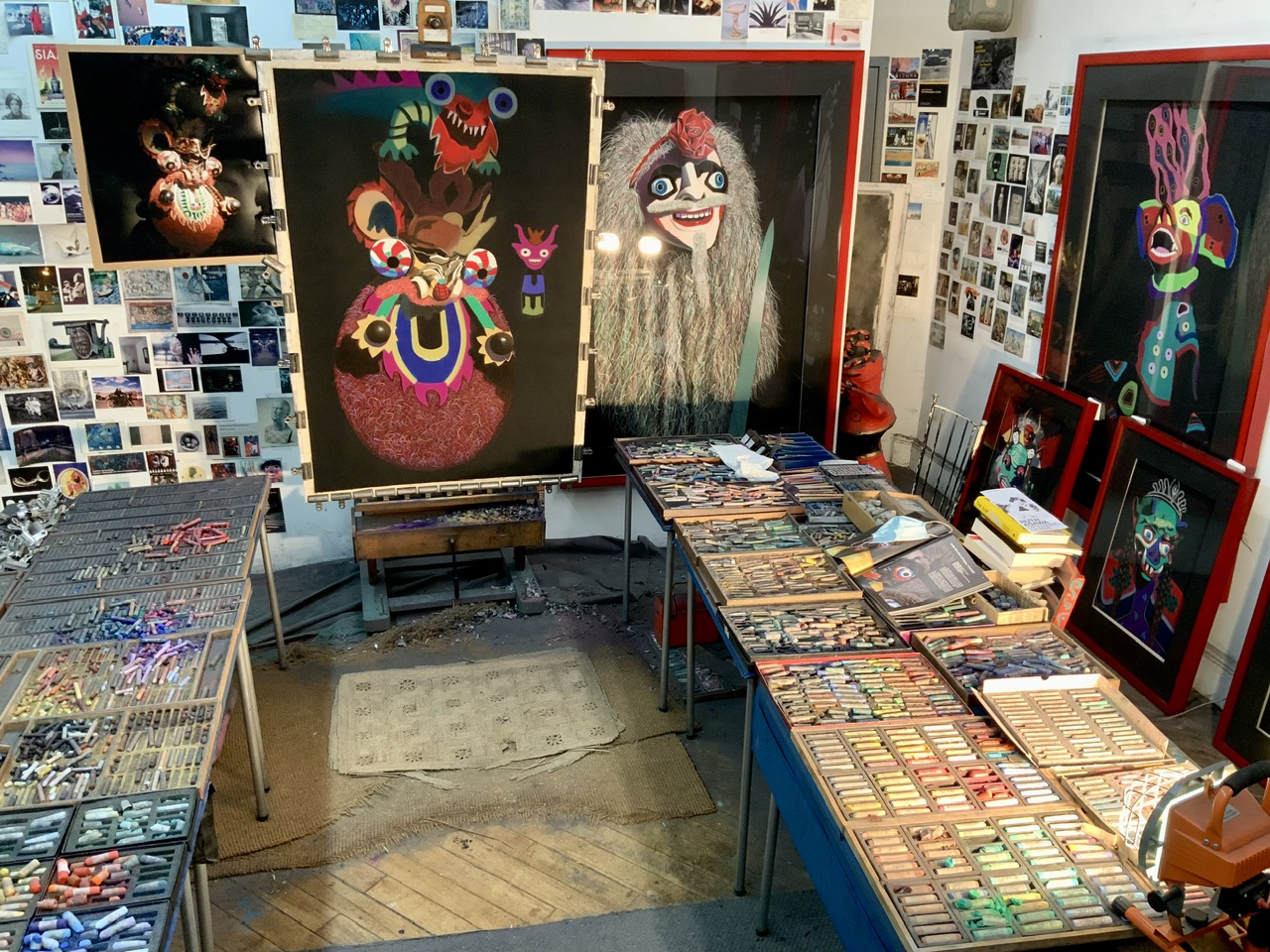
Barbara’s Studio
*an ongoing series of quotations – mostly from artists, to artists – that offers wisdom, inspiration, and advice for the sometimes lonely road we are on.
Anyone who studies an instrument, sport, or other art form must deal with practice, experiment, and training. We learn only by doing. There is a gigantic difference between the projects we imagine doing or plan to do and the ones we actually do. It is like the difference between a fantasied romance and one in which we really encounter another human being with all his or her complexities. Everyone knows this, yet we are inevitably taken aback by the effort and patience needed in the realization. A person may have great creative proclivities, glorious inspirations, and exalted feelings, but there is no creativity unless creations actually come into existence.
Stephen Nachmanovitch in Free Play: Improvisation in Art and Life
Comments are welcome!
Pearls from artists* # 499

*an ongoing series of quotations – mostly from artists, to artists – that offers wisdom, inspiration, and advice for the sometimes lonely road we are on.
Life is a journey back to where you started from, Le Guin always said. True voyage is return. When you get there, you might know a little more than when you began.
Isn’t the real question this: Is the work worth doing? Am I, a human being, working for what I really need and want – or for what the State or the advertisers tell me I want? Do I choose? I think that’s what anarchism comes down to. Do I let my choices be made for me, and so go along with the power game, or do I choose? In other words, am I going to be a machine-part, or a human being?
Ursula K. Le Guin: The Last Interview and Other Conversations edited and with an introduction by David Streitfeld
Comments are welcome!
Pearls from artists* # 220
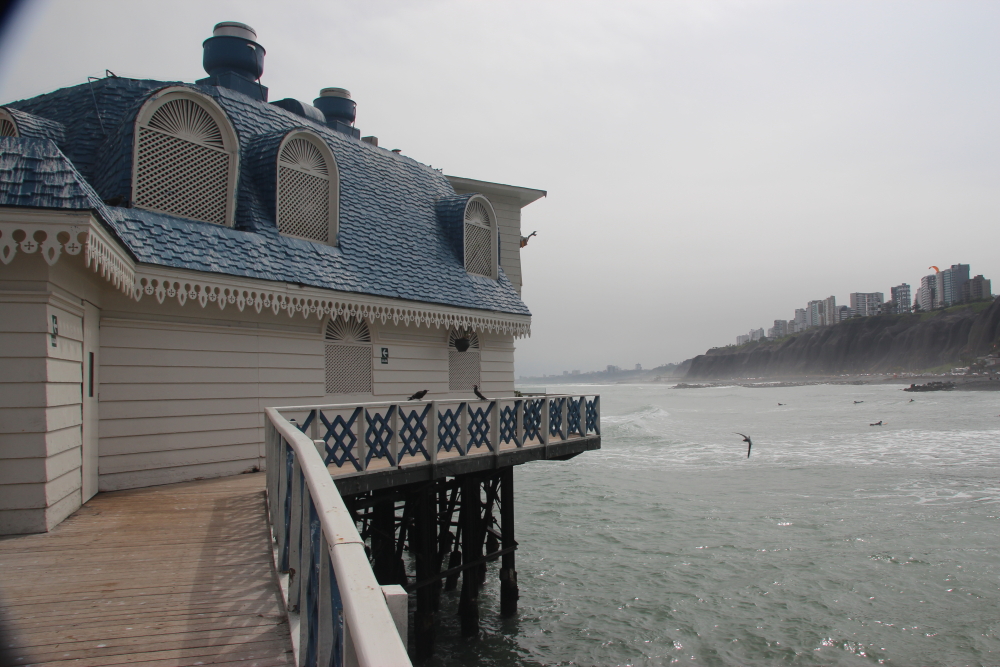
Lima, Peru
* an ongoing series of quotations – mostly from artists, to artists – that offers wisdom, inspiration, and advice for the sometimes lonely road we are on.
It is the job of the writer to say, look at that. To point. To shine a light. But it isn’t that which is already bright and beckoning that needs our attention. We develop our sensitivity – to use John Berger’s phrase, our “ways of seeing” – in order to bear witness to what is. Our tender hopes and dreams, our joy, frailty, grief, fear, longing, desire – every human being is a landscape. The empathic imagination glimpses the woman working the cash register at a convenience store, the man coming out of the bathroom at the truck stop, the mother chasing her toddler up and down the aisle of the airplane, and knows what it sees. Look at that. This human catastrophe, this accumulation of ordinary blessings, of unbearable losses. And still, a ray of sunlight, a woman doing the wash, a carcass of beef. The life that holds us. The life we know.
Dani Shapiro in Still Writing: The Perils and Pleasures of a Creative Life
Comments are welcome!
Q: Why do you make art?

Barbara’s studio
A: This is an excellent question and one I like to revisit because with all the day-to-day frustrations and disappointments that are a normal part of an artist’s life, it is easy to forget what is important.
First, I make art because I have a gift and a desire to share it with others. To not develop, express, and share all that I have to say through my work is unthinkable.
Second, I make art because it is what gives my life direction and purpose. I believe that each human being has his or her own quest, driven by passion, to fulfill a certain duty. Recall Joseph Campbell’s, “The Hero’s Journey.” I need to make art in order to feel that I am living up to my highest potential.
Third, for inexplicable reasons (to me, anyway) soft pastel is an undervalued medium. I fell in love with pastel above all other media and hope to demonstrate that great art can be created with it. This is one of the drives that keeps me steadily working.
Comments are welcome!
Pearls from artists* # 128
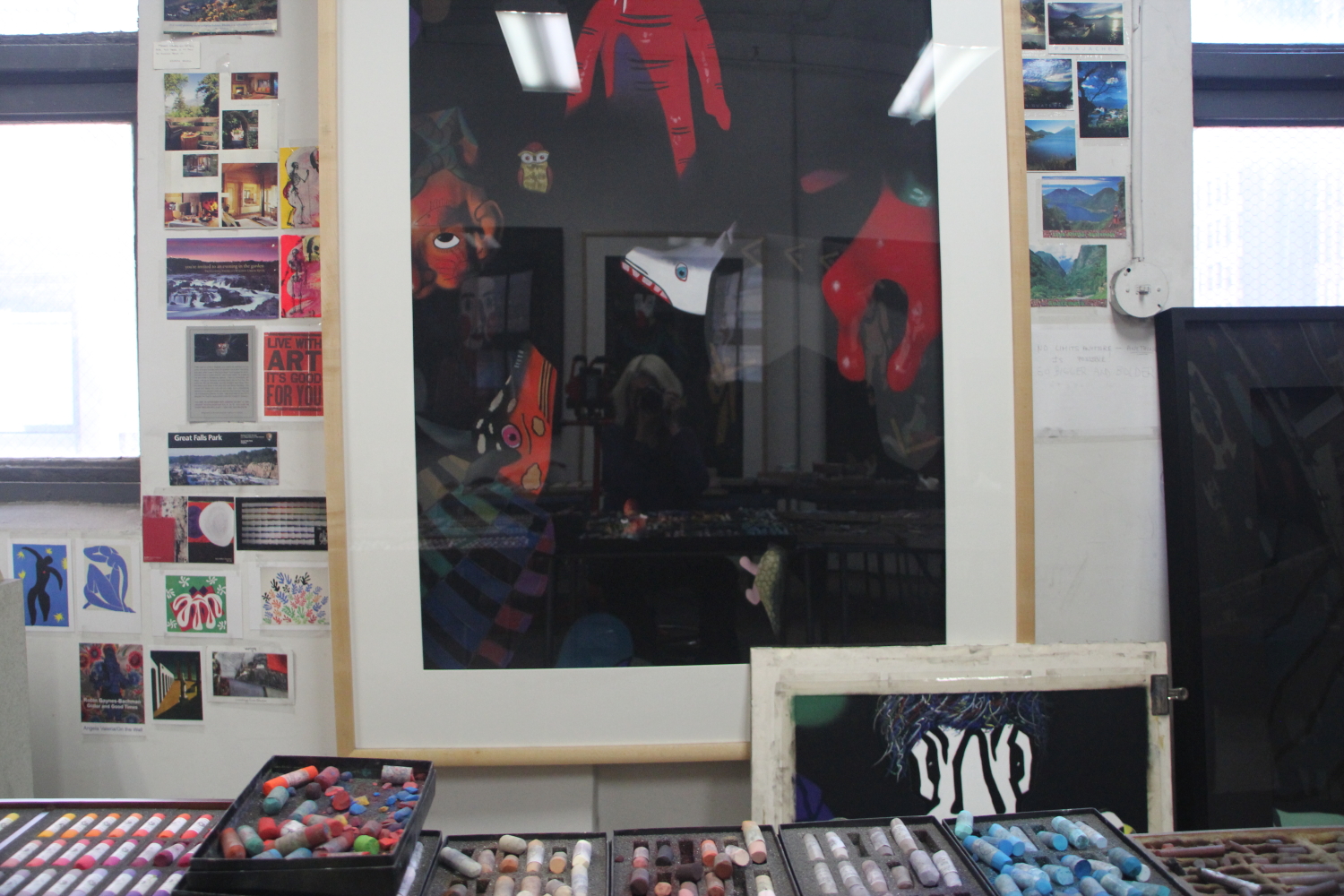
Self-portrait with “Some Things We Regret”
* an ongoing series of quotations – mostly from artists, to artists – that offers wisdom, inspiration, and advice for the sometimes lonely road we are on.
A chastening day yesterday. Color rose up and towered over me and advanced toward me. A tsunami – only that terrifying Japanese word for tidal wave will do – of color, and I was swept off my feet. In a frenzy, I tried to catch it. Sheet after sheet of Arches paper spread around the studio, covering all the surfaces of all my tables and finally the floor. I tried to keep one step ahead all morning. In the afternoon, I managed to get a toehold, and once again recognized my limitation: that vestige of all that a human being could know that is what I do know. I see this delicate nerve of myself as unimpressive. The fact is that is all I have. The richness of years, contained like wine in the goatskin of my body, meets my hand narrowly.
Anne Truitt in Turn: The Journal of an Artist
Comments are welcome!
Q: Do you have any advice for a young painter or someone just starting out as an artist?
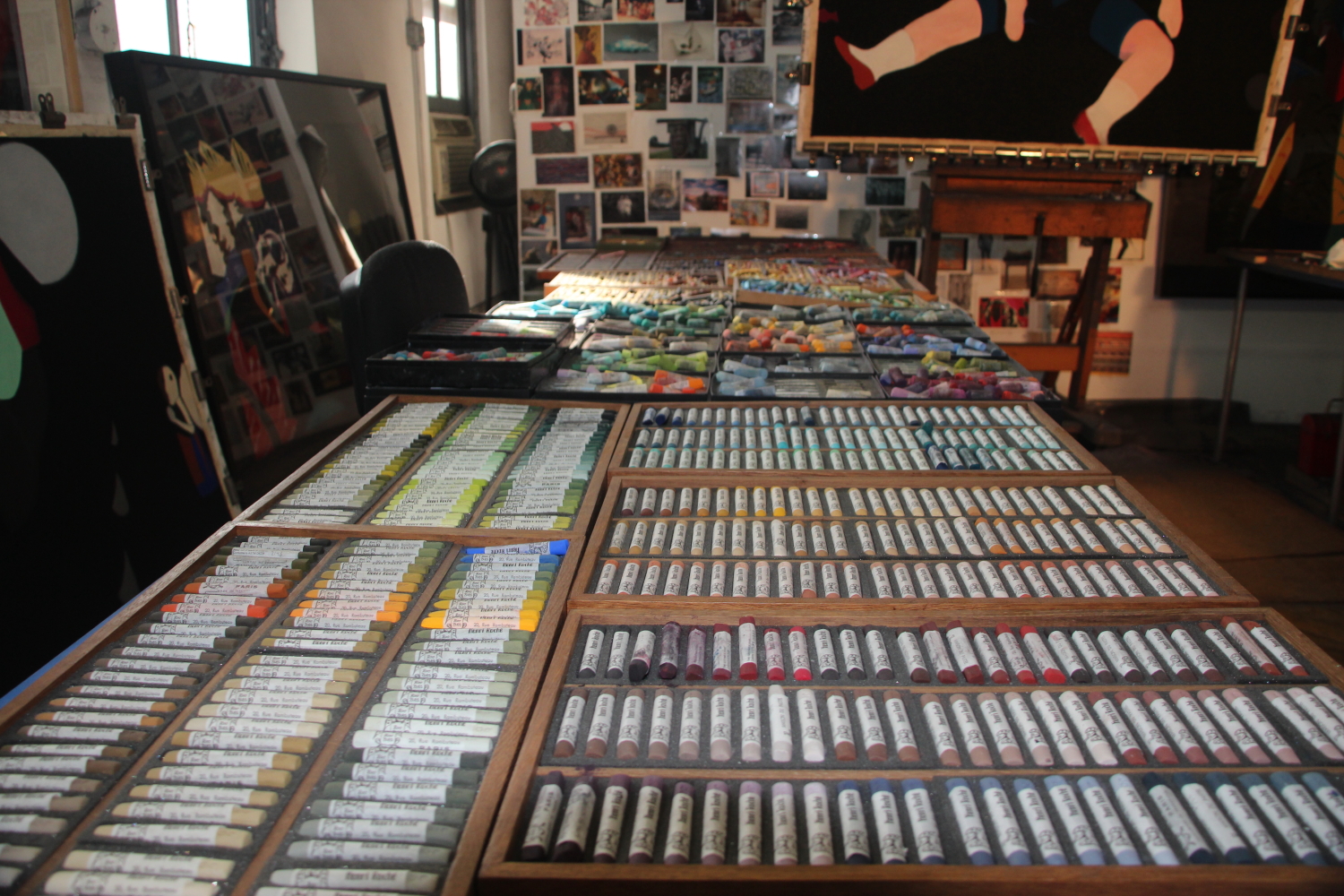
Studio
A: As artists each of us has at least two important responsibilities: to express things we are feeling for which there are no adequate words and to communicate to a select few people, who become our audience. By virtue of his or her own uniqueness, every human being has something to say. But self-expression by itself is not enough. As I often say, at it’s core art is communication. Without this element there is no art. When artists fail to communicate, perhaps they haven’t mastered their medium sufficiently so are unsuccessful in the attempt, or they may be being self-indulgent and not trying. Admittedly there is that rare and most welcome occurrence when an artistic statement – such as a personal epiphany – happens for oneself alone.
Most importantly, always listen to what your heart tells you. It knows and speaks the truth and becomes easier to trust as you mature. If you get caught up in the art world, step back and take some time to regain your bearings, to get reacquainted with the voice within you that knows the truth. Paint from there. Do not ever let a dealer or anyone else dictate what or how you should paint.
With perhaps the singular exception of artist-run cooperative galleries, be very suspicious of anyone who asks for money to put your work in an exhibition. These people are making money from desperate and confused artists, not from appreciative art collectors. With payment already in hand there is no financial incentive whatsoever for these people to sell your paintings and they won’t.
Always work in a beautiful and special place of your own making. It doesn’t need to be very large, unless you require a large space in which to create, but it needs to be yours. I’m thinking of Virginia Woolf’s “a room of one’s own” here. A studio is your haven, a place to experiment, learn, study, and grow. A studio should be a place you can’t wait to enter and once you are there and engaged, are reluctant to leave.
Be prepared to work harder than you ever have, unrelentingly developing your special innate gifts, whether you are in the mood to do so or not. Most of all remember to do it for love, because you love your medium and it’s endless possibilities, because you love working in your studio, and because you feel most joyously alive when you are creating.
Comments are welcome!
Pearls from artists* # 49

Untitled, 24″ x 24″ chromogenic print, edition of 5
* an ongoing series of quotations – mostly from artists, to artists – that offers wisdom, inspiration, and advice for the sometimes lonely road we are on.
The beauty of art is better, “higher,” according to Hegel, than the beauty of nature because it is made by human beings and is the work of the spirit. But the discerning of beauty in nature is also the result of traditions of consciousness, and of culture – in Hegel’s language, of spirit.
The responses to beauty in art and to beauty in nature are interdependent. As Wilde pointed out, art does more than school us on how and what to appreciate in nature. (He was thinking of poetry and painting. Today the standards of beauty in nature are largely set by photography.) What is beautiful reminds us of nature as such – of what lies beyond the human and the made – and thereby stimulates and deepens our sense of the sheer spread and fullness of reality, inanimate as well as pulsing, that surrounds us all.
A happy by-product of this insight, if insight it is: beauty regains its solidity, its inevitability, as a judgment needed to make sense of a large portion of one’s energies, affinities, and admirations; and the usurping notions appear ludicrous.
Imagine saying, “That sunset is interesting.”
Paolo Dilonardo and Anne Jump, editors, Susan Sontag At the Same Time: Essays and Speeches
Comments are welcome!


 barbararachkoscoloreddust.com