Blog Archives
Q: Would you please share your current bio?

A: Here it is.
Barbara Rachko, born in 1953 in Paterson, New Jersey, is a contemporary painter based in New York City, renowned for her large pastel-on-sandpaper paintings inspired by Bolivian Carnival masks. With nearly 40 years dedicated to revolutionizing pastel as a fine art medium, Rachko’s influential blog, Barbara Rachko’s Colored Dust, has garnered over 229,000 subscribers. She is the subject of the acclaimed documentary “Barbara Rachko: True Grit,” available on YouTube, and her ebook “From Pilot to Painter” captures her inspiring journey from a former pilot to an accomplished artist.
Rachko’s work explores the vibrant cultural heritage of Bolivian Carnival masks, and Mexican and Guatemalan folk art. Her meticulous attention to detail is showcased in notable series such as Bolivianos, Black Paintings, and Domestic Threats. In 2023, she was featured in a documentary that premiered at the Newport Beach Film Festival, earning the Audience Award and Best in Category Award, further cementing her impact on contemporary art.
Her solo exhibitions include the Joy Pratt Markham Gallery at Walton Arts Center (AR), Louise Jones Brown Gallery at Duke University (NC), Olin Gallery (VA), and La MaMa La Galleria (NY). She trained in photography at the International Center of Photography in New York and studied drawing and pastel techniques at the Art League School in Alexandria, VA. Her works are held in private collections worldwide and have been showcased at prestigious art fairs, including Art Basel Miami, Moon Art Fair in Hamburg, and Art Busan in Korea, affirming her global influence in pastel painting.
Comments are welcome!
Q: Does your work look different to you on days when you are sad, happy, etc.?

Barbara’s Studio
A: I am much more critical on days when I am sad so that the faults, imperfections, and things I wish I had done better stand out. Fortunately, all of my work is framed behind plexiglas so I can’t easily go back in to touch up perceived faults. I am reminded of the expression, “Always strive to improve, whenever possible. It is ALWAYS possible!” However, I’ve learned that re-working a painting is a bad idea. You are no longer deeply involved in making it and the zeitgeist has changed. The things you were concerned with are gone: some are forgotten, others are less urgent.
For most artists our work is autobiography. Art is personal. When I look at a completed pastel painting, I usually remember exactly what was happening in my life as I created it. Each piece is a snapshot – maybe a time capsule, if anyone could decode it – that reflects and records a particular moment. When I finally pronounce a piece finished and sign it, that’s it, THE END. It’s as good as I can make it at that point in time. I’ve incorporated everything I was thinking about, what I was reading, how I was feeling, what I valued, art exhibitions I visited, programs that I heard on the radio or watched on television, music that I listened to, what was going on in New York, in the country, and in the world.
It is still a mystery how this heady mix finds its way into the work. During the time that I spend on it, each particular painting teaches me everything it has to teach. A painting requires months of looking, reacting, correcting, searching, thinking, re-thinking, revising. Each choice is made for a reason and together these decisions dictate what the final piece looks like. On days when I’m sad I tend to forget that. On happier days I remember that the framed pastel paintings that you see have an inevitability to them. If all art is the result of one’s having gone through an experience to the end, as I believe it is, then the paintings could not, and should not, look any differently.
Comments are welcome.
Q: What kind of reactions do you get from spectators at your exhibitions? (Question from “Cultured Focus Magazine”)

A group exhibition in New Jersey
A: Reactions to my work run the gamut – from dopey comments like, “I’m scared!” to “How in the world is such beauty and profundity possible to achieve using only soft pastel on a piece of sandpaper!”
I’m sure most artists can say the same. We can only hope that our work finds its way to an audience that has the eyes, heart, and mind to understand, to appreciate on a deep level the decades of devotion, sacrifice, and hard work that go into creating works of art.
Comments are welcome!
Q: Would you talk about your early art exhibitions? (Question from “Culture Focus Magazine”)

Review of my first exhibition at Brewster Arts, New York City!
A: Certainly! My very first group exhibition was in a juried show in the late 1980s at the Art League Gallery in Alexandria, VA. This was a gallery that offered monthly juried shows for members. I applied regularly, had work accepted many times, and frequently won first prize for my pastel paintings.
Early exhibitions at the Art League were followed by group and solo exhibitions at nonprofit and university spaces in Virginia, Washington, D.C., Maryland, North Carolina, Pennsylvania, Ohio, Rhode Island, Connecticut, Massachusetts, New Jersey, and New York; more or less up and down the mid-Atlantic states and the northeast, which were all places I could drive my truck to hand-deliver fragile pastel paintings.
My very first solo exhibition at a commercial gallery was at 479 Gallery in SoHo (New York City) in July 1996. In 1995 I had submitted work to a juried group show and was awarded first prize, which was a solo exhibition at 479 the following year.
My exhibition with 479 Gallery was quickly followed by representation at a prestigious New York gallery, Brewster Arts Ltd., which specialized in Latin American masters such as Frida Kahlo, Leonora Carrington, Diego Rivera, Rufino Tamayo, and many others. I was awarded my first two-person exhibition there in October 1996 and got to meet fellow gallery artist Leonora Carrington when she came to the opening. I could hardly believe my good fortune at gaining representation at such a revered and elegant gallery!
Comments are welcome!

Q: I saw your book of photos. Very nice. How do you keep track of inventory? I have struggled with that. (Question from Laura Fischer Saxon via Facebook).
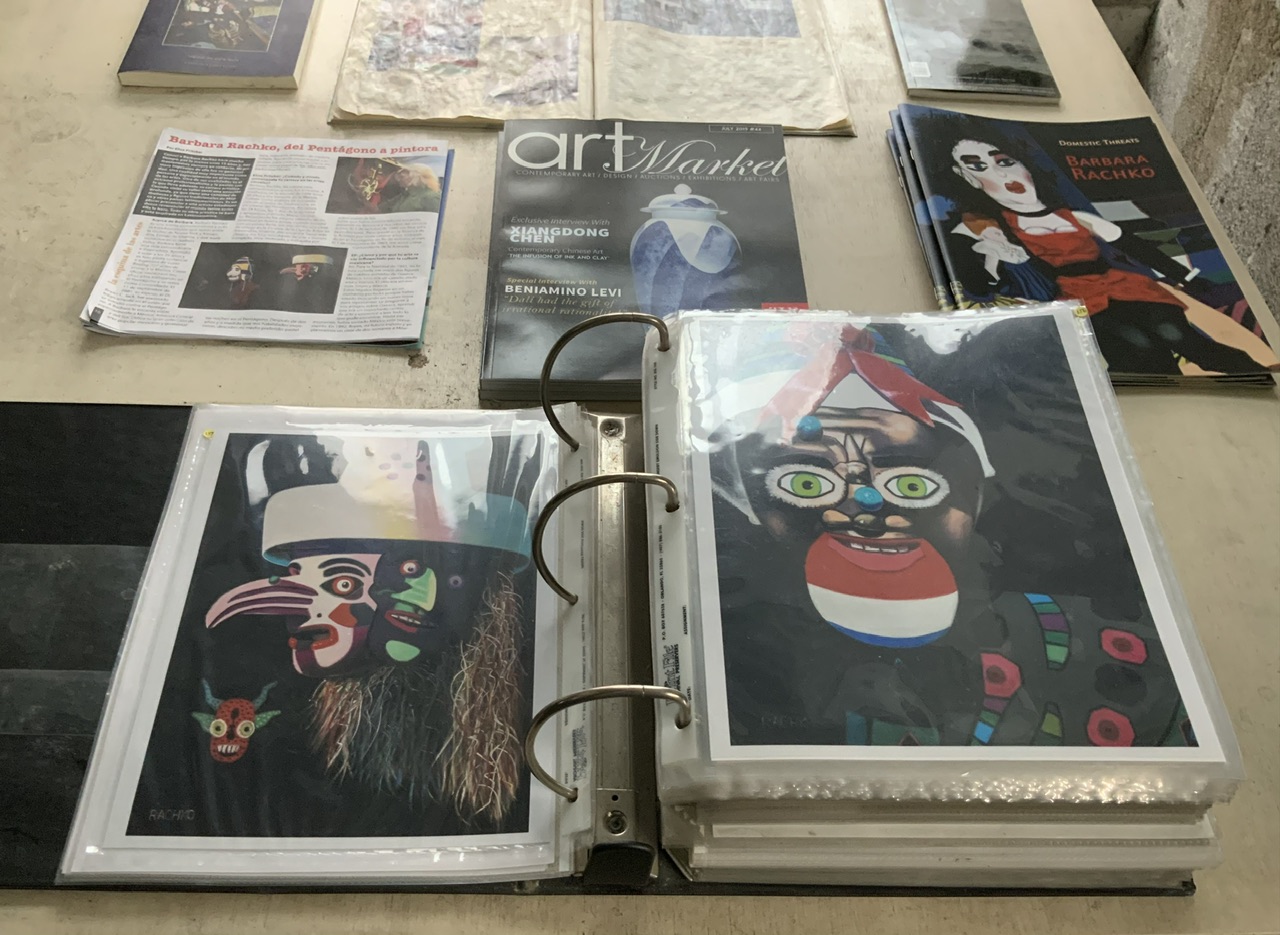
Barbara’s portfolio book
A: Every time I finish a pastel painting I order an 8” x 10” c-print at Duggal Visual Solutions. I started doing this in the 1980s when I was a portrait artist and the company that represented me needed photos of my work to show to potential clients. I’ve just continued making 8” x 10”photos all these years in order to document my work!
Pastel is an extremely slow medium so even though I have been working more than 37 years, the two pastel paintings in progress now are numbers 160 and 161. The portfolio book also has early press clippings, reviews from before the internet (when everything was on paper), and a few photos of early solo exhibitions in the 1990s.
BTW what a great question! No one has ever asked me this before!
Comments are welcome!
Q: How many days a week do you work on your art?

At work
A: My life is devoted to art and to art-making. Working in pastel is slow and labor-intensive – in a good year I make four or five pastel paintings – so maintaining good work habits is imperative. As a fulltime professional artist, I strive to keep regular studio hours. I work five days a week, roughly seven hours a day.
However, running the business side of things is an every day activity: marketing, interviews, applying for exhibitions, making photographs, documenting my professional activities, sending JPEGs, responding to inquiries, etc. There is always something to do!
Comments are welcome!
Q: Do you think artists should post prices on their websites?
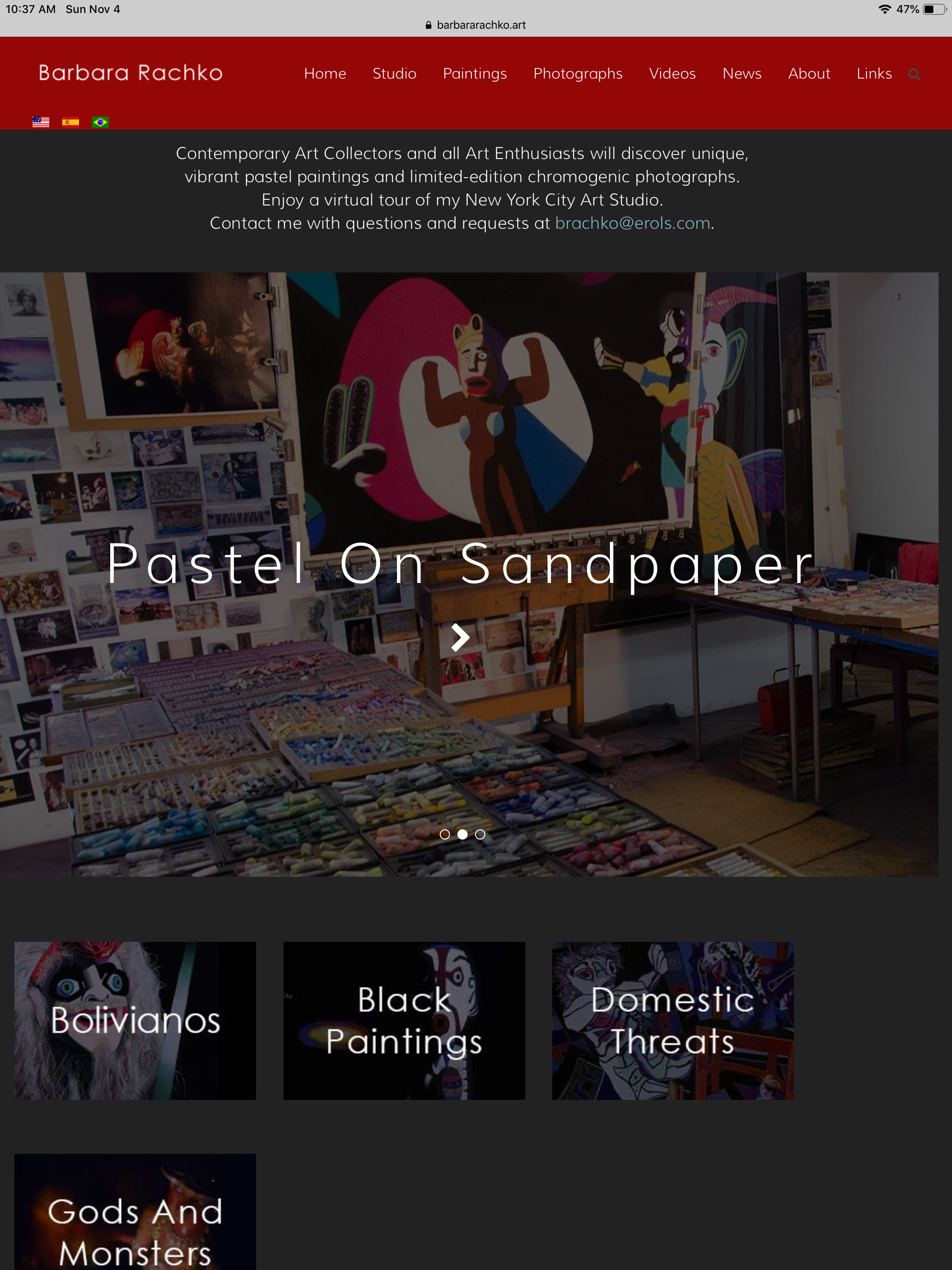
Screenshot of Barbara’s homepage
A: It depends on what the purpose and objectives of a particular artist’s website are. I use my website to document all of the work, the process, exhibitions, and press in one central place. I do not list prices. If someone is interested in more information, including prices, they can easily email or call me.
I have two assistants who help with social media and my online presence continues to grow. Many of my available pastel paintings are included on commercial sites like Artsy. Current prices are listed there.
Comments are welcome!
Q: What was the first painting you ever sold?
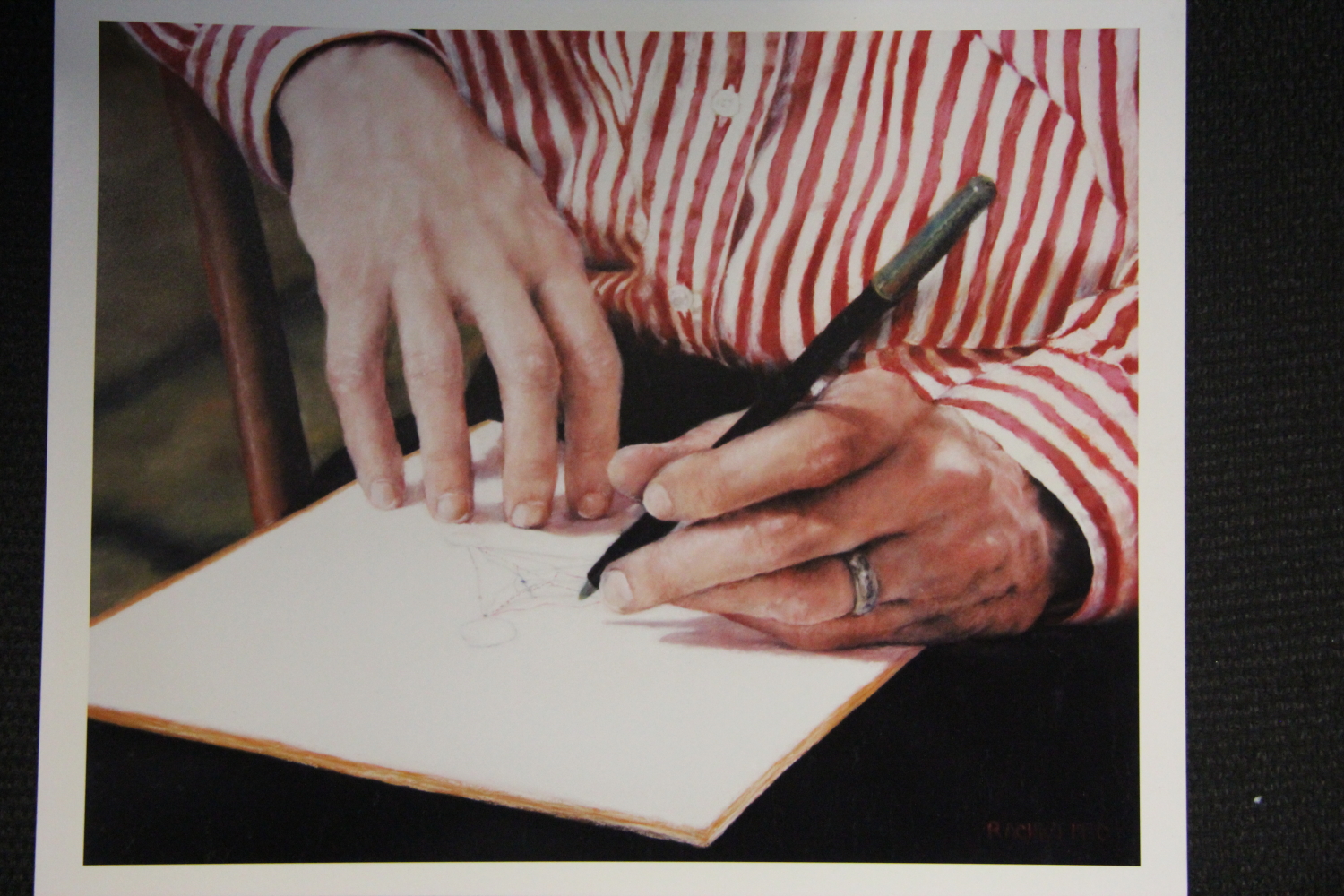
“Bryan’s Ph.D.”, 11″ x 13 1/2″, soft pastel on sandpaper
A: I believe my first sale was “Bryan’s Ph.D.” I made it in 1990 as one of several small paintings created to improve my skills at rendering human hands in pastel. I had recently left the Navy and was building a career as a portrait artist. Bryan, my late husband, was often my model for these studies, not only because it was convenient, but because he had such beautiful hands.
In 1990 Bryan was working on his Ph.D. in economics at the University of Maryland. In this painting he is drawing a diagram that illustrates a theoretical point about “international public goods,” the subject of his research. He was sitting in an old wooden rocking chair in our backyard in Alexandria, VA. I still own the chair and the house. I photographed his hands close-up and then created the painting. I don’t remember which of Bryan’s cameras I used, but it was one that took 35 mm film; perhaps his Nikon F-2. Somewhere I must still have the negative and the original reference photo.
“Bryan’s Ph.D.” is 11″ x 13 1/2″ and it sold for $500 at a monthly juried exhibition at The Art League in Alexandria. I have not seen it since 1990. (Above is a photograph of “Bryan’s Ph.D.” from my portfolio book).
Not long ago the owner contacted me, explaining that she had received the painting as a gift from her now ex-husband. She was selling it because it evoked bitter memories of her divorce. Her phone call was prompted by uncertainty about the painting’s value now. She had a likely buyer and needed to know what price to charge.
I was saddened because I have so many beautiful memories of this particular painting and of an idyllic time in my life with Bryan. He was on a leave of absence from the Pentagon to work on his dissertation, while I was finished with active duty. At last I was a full time artist, busily working in the spare bedroom that we had turned into my first studio.
My conversation with the owner was a reminder that once paintings are let out into the world, they take on associations that have nothing to do with the personal circumstances surrounding their creation. In short, what an artist creates solely out of love, stands a good chance of not being loved or appreciated by others. This is one reason to only sell my work to people I select personally. I ended the telephone conversation hoping that “Bryan’s Ph.D.” fares better in its new home.
Comments are welcome!
Q: What is the reality of the art world today? Do people experience it enough?

West 29th Street studio
A: I cannot comment on the art world today or the experience of other people. I can only speak for myself. I am completely devoted to my work; my entire life revolves around art. When I’m not in my studio creating, I am reading about art, thinking about it, gaining inspiration from other artists and from artistic travel, working out new ideas, going to museum and gallery exhibitions, trying to understand the business side of things, etc. Art is a calling and I personally experience it enough as my work continues to evolve!
Comments are welcome!


 barbararachkoscoloreddust.com
Q: What kind of reactions do you get from spectators at your exhibitions? (Question from “Cultured Focus Magazine”)
Jan 18
Posted by barbararachkoscoloreddust
A: Reactions to my work run the gamut – from dopey comments like, “I’m scared!” to “How in the world is it possible to achieve such beauty and profundity using only soft pastel on a piece of sandpaper!” I’m sure most artists can say the same. We can only hope that our work finds its way to an audience that has the eyes, heart, and mind to understand, to appreciate on a deep level the decades of devotion, sacrifice, and hard work that go into creating works of art.
Comments are welcome!
Share this:
Posted in 2025, Exhibitions, New York, NY
Comments Off on Q: What kind of reactions do you get from spectators at your exhibitions? (Question from “Cultured Focus Magazine”)
Tags: achieve, appreciate, artists, audience, “Cultured Focus Magazine”, “Worlds Unseen & Seen”, beauty, comments, creating, decades, devotion, Exhibitions, hard work, New York, possible, profundity, question, reactions, sacrifice, sandpaper, scared, soft pastel, spectators, understand, using, Westbeth Gallery, works of art