Blog Archives

Pearls from artists* # 479
*an ongoing series of quotations – mostly from artists, to artists – that offers wisdom, inspiration, and advice for the sometimes lonely road we are on.
… a gift is a thing we cannot get by our own efforts. We cannot buy it; we cannot acquire it through an act of will. It is bestowed upon us. Thus we rightly speak of talent as a “gift,” for although a talent can be performed through an effort of the will, no effort in the world can cause its initial appearance. Mozart, composing on the harpsicord at the age of four, had a gift.
We also rightly speak of intuition or inspiration as a gift. As the artist works, some portion of his creation is bestowed upon him. An idea pops into his head, a tune begins to play, a phrase comes to mind, a color falls into place on the canvas. Usually, in fact, the artist does not find himself engaged or exhilarated by the work, nor does it seem authentic, until this gratuitous element has appeared so that along with any true creation comes the uncanny sense that “I,” the artist, did not make the work. “Not I, not I, but the wind that blows through me,” says D.H. Lawrence. Not all artists emphasize the gift phase of their creations to the degree Lawrence does, but all artists feel it.
Lewis Hyde in The Gift: Imagination and the Erotic Life of Property
Comments are welcome!
Pearls from artists* # 476
*an ongoing series of quotations – mostly from artists, to artists – that offers wisdom, inspiration, and advice for the sometimes lonely road we are on.
For a great many artists solitude is the time when they feel most real and alive. It is when they have their most intense experiences, when they can vicariously live out any adventure, any dream. Tennessee Williams said, “I’m only really alive when I’m writing.” The painter Robert Motherwell wrote, “I feel most real to myself in the studio.” The young, exuberant Russian painter Marie Bashkirtseff exclaimed at the end of the last century:
In the studio all distinctions disappear. One has neither name nor family; one is no longer the daughter of one’s mother, one is oneself and individual, and one has before one art, and nothing else. One feels so happy, so free, so proud!
We may think of his aliveness as the accumulation of al the above-listed benefits, as the artist working out her life, manifesting her creativity, suiting her personality, playing, avoiding unwanted social interactions, working authentically and integrity, living intensely – as the artist being her grandest self.
Eric Maisel in A Life in the Arts: Practical Guidance and Inspiration for Creative and Performing Artists
Comments are welcome!
Pearls from artists* # 475

*an ongoing series of quotations – mostly from artists, to artists – that offers wisdom, inspiration, and advice for the sometimes lonely road we are on.
In order to warm the artist’s heart, it’s necessary to assert that he is doing good work. Random or wrong-headed praise won’t do the trick, but will only exacerbate the artist’s feeling that he is unseen and misunderstood.
Even wrong-headed praise is the exception rather than the rule in the artist’s search for recognition. More often than not your recognition will consist of criticism, not praise. You may be criticized for not attempting work you have no desire to attempt, for pandering to mass taste, for working too exotically or too narrowly… You may be attacked in a mixed review that purports to praise you. In short, you may be criticized for everything and anything under the sun.
Can you escape this criticism as you struggle for recognition? No. The journalist Elbert Hubbard said, “To escape criticism, do nothing, say nothing, be nothing.” … you can’t escape criticism, you can’t tame your critics.
Eric Maisel in A Life in the Arts: Practical Guidance and Inspiration for Creative and performing Artists
Comments are welcome!
Q: What makes you drawn to face masks?

A: For me a mask is so much more than a mask. It is almost a living thing with its own soul and with a unique history. I always wonder, who created this mask? For what purpose? Where has it been? What stories would it tell if it could? In my current “Bolivianos” series I feel as though I am creating portraits of living, or perhaps once living, beings.
In a way the masks are a pretext for a return to my early days as an artist. When I resigned my Naval commission to pursue art full time, I started out as a photo-realist portrait painter. The twist is that this time I do not have to satisfy a client’s request to make my subjects look younger or more handsome. I am joyfully free to respond only to the needs of the pastel painting before me on the easel.
Comments are welcome!
Pearls from artists* # 474

*an ongoing series of quotations – mostly from artists, to artists – that offers wisdom, inspiration, and advice for the sometimes lonely road we are on.
If ever an artist needed a degree of protection against his public, surely it is Vincent van Gogh. Reproductions of his most emblematic paintings, especially the gyrating nightscapes and the blazing series of sunflower studies made in his late years, adorn countless bedrooms, living rooms, and bathrooms all across what used to be known as the developed world. The popularity of the works executed in the great flowering of this last period, which began around the time of his revelatory visit in the autumn of 1885 to the newly completed Rijksmuseum, in Amsterdam, and ended when he died less than five years later at the age of thirty-seven, is unparalleled. Of the great ones among his contemporaries, and there were many, only Degas can come near to rivaling him as a mainstay of interior decoration.
John Banville in His Own Worst Enemy, The New York Review of Books, May 13, 2021
Comments are welcome!
Pearls from artists* # 472
*an ongoing series of quotations – mostly from artists, to artists – that offers wisdom, inspiration, and advice for the sometimes lonely road we are on.
A remark by Kurt Anderson suggests how the Internet discourages patient gazing: “Waiting a while to get everything you want… was a definition of maturity. Demanding satisfaction right this instant, on the other hand, is a defining behavior of seven-year-olds. The powerful appeal of the Web is not just the ‘community’ it enables but its instantane-ity… as a result… delayed gratification itself came to seem quaint and unnecessary.” A survey commissioned by the Visitor Studies Association reveals the impact of impatience. On average, the survey found, Americans spend between six and ten seconds looking at individual works in museums. (Is it just a coincidence that six to ten seconds is also the average time browsers perch on any given Web page?) Yet how many hours a day do we spend absorbed by one or another electronic screen? For the Los Angeles artist Ed Ruscha (born 1937) brief encounters won’t suffice. When somebody asked, “How can you tell good art from bad?” Ruscha replied, “With a bad work you immediately say, ‘Wow!’ But afterwards, you think, ‘Hum? Maybe not.’ With a good work, the opposite happens.” Time is lodged at the heart of Ruscha’s formula, as the artwork becomes part of our temporal experience. In order to know what is good, we need to take a breather. Even to know what is bad, we need to pause.
Arden Reed in Slow Art: The Experience of Looking, Sacred Images to James Turrell
Comments are welcome!
Q: How did your ebook “From Pilot to Painter” come to be? (Question from “Arte Realizzata”)
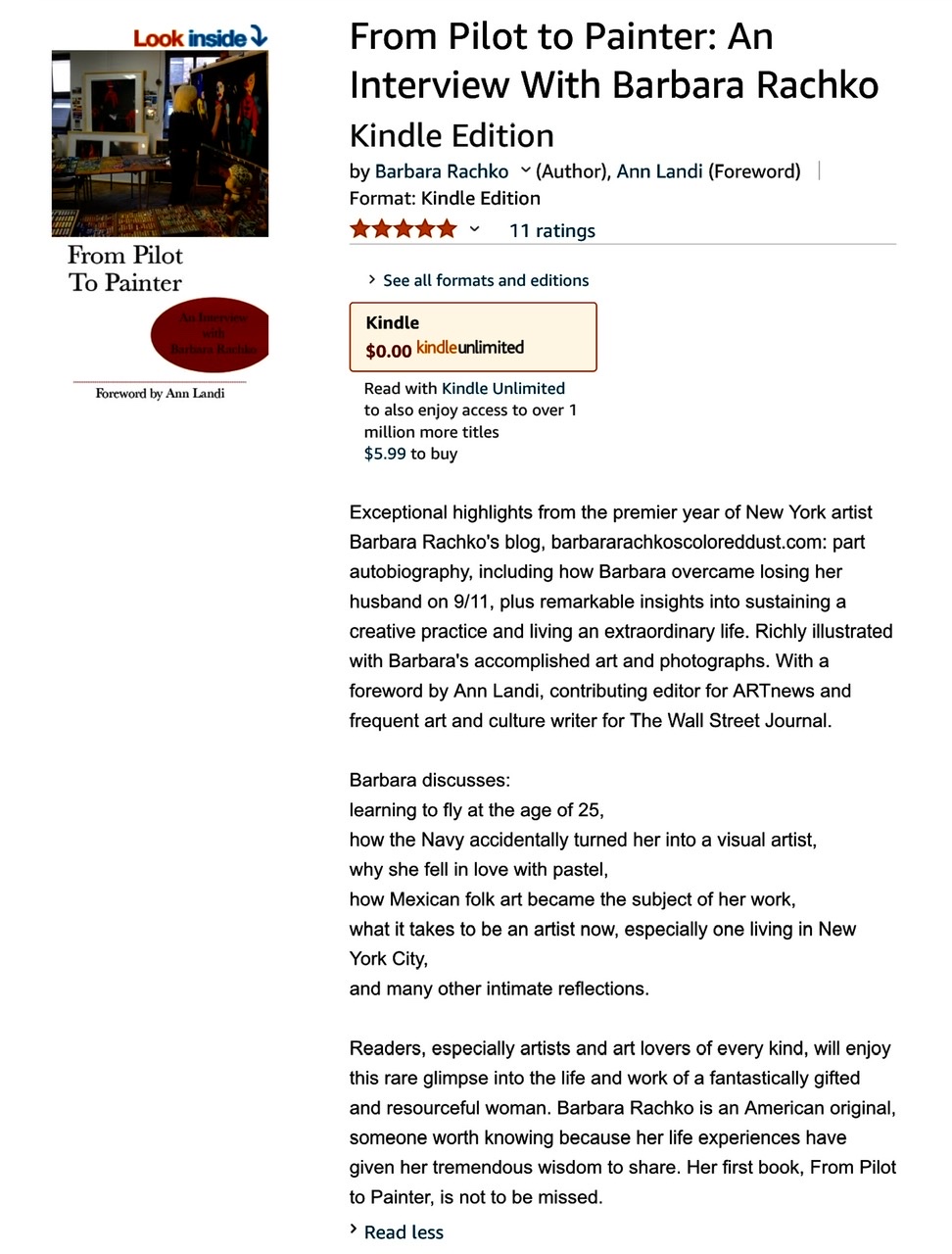
A: It was my longtime assistant, Barbra Drizin’s, idea and more than I’d care to admit, I was resistant. I said, “I am much too busy to write an ebook!” Barbra went on to explain that we could start with material I had already written for my blog, expand on it, add reproductions of my pastel paintings, etc. With her persuasion, I agreed! Barbra made the initial selections and together we added and revised text, organized the material, and worked out countless details. I asked my friend, Ann Landi, to write a foreword and Barbra found an editor to put everything into Amazon’s ebook format.
Now I am extremely pleased that my ebook FROM PILOT TO PAINTER is available not only on Amazon, but also on iTunes. It is based on my blog and is part memoir, including the loss of my husband on 9/11, insights into my creative practice, and intimate reflections on what it’s like to be an artist living in New York City. The ebook includes material not found on the blog, plus 25+ reproductions of my vibrant pastel-on-sandpaper paintings, a Foreword by Ann Landi, the founder of Vasari21.com and longtime critic for ARTnews, and more.
Comments are welcome!
Pearls from artists* # 470
*an ongoing series of quotations – mostly from artists, to artists – that offers wisdom, inspiration, and advice for the sometimes lonely road we are on.
Find something that is really meaningful to you – that’s the most important thing at the end of the day. Even if everything goes well, there are still those moments when you see through it all. Once you see through the fame, money, and social life and ask yourself, “What is this all about? What does it mean to me?,” it’s great if you can see your work clearly and what you see is important to you.
That same thing goes on the other side. When you wonder why you go through all this hell and you’re struggling, at least you see that you really enjoy what you do, you are fulfilled by what you make, and you believe in it.
Charles Long, artist, Mount Baldy, CA, in Art/Work: Everything You Need to Know (And Do) As You Pursue Your Art Career by Heather Darcy Bhandari and Jonathan Melber
Comments are welcome!
Q: When did you start using the sandpaper technique and why (Question from “Arte Realizzata”)

A: In the late 1980s when I was studying at the Art League School in Alexandria, VA, I enrolled in a three-day pastel workshop with Albert Handel, an artist known for his southwest landscapes in pastel and oil paint. I had just begun working with soft pastel and was experimenting with paper. Handel suggested I try Ersta fine sandpaper. I did and nearly three decades later, I’ve never used anything else.
This paper is acid-free and accepts dry media, mainly pastel and charcoal. It allows me to build up layer upon layer of pigment and blend, without having to use a fixative. The tooth of the paper almost never gets filled up so it continues to hold pastel. (On the rare occasion when the tooth DOES fill up, which sometimes happens with problem areas that are difficult to resolve, I take a bristle paintbrush, dust off the unwanted pigment, and start again). My entire technique – slowly applying soft pastel, blending and creating new colors directly on the paper, making countless corrections and adjustments, rendering minute details, looking for the best and/or most vivid colors – evolved in conjunction with this paper.
I used to say that if Ersta ever went out of business and stopped making sandpaper, my artist days would be over. Thankfully, when that DID happen, UArt began making a very similar paper. I buy it in two sizes – 22″ x 28″ sheets and 56″ wide by 10-yard-long rolls. The newer version of the rolled paper is actually better than the old, because when I unroll it, it lays flat immediately. With Ersta I would lay the paper out on the floor for weeks before the curl would give way and it was flat enough to work on.
Comments are welcome!



