Blog Archives
Pearls from artists* # 581

With recent “Bolivianos”
*an ongoing series of quotations – mostly from artists, to artists – that offers wisdom, inspiration, and advice for the sometimes lonely road we are on.
The essence of style is this: We have something in us, about us; it can be called many things, but for now let’s call it our original nature. We are born with our original nature, but on top of that, as we grow up, we accommodate to the patterns and habits of our culture, family, physical environment, and the daily business of the life we have taken on. What we are taught solidifies as “reality.” Our persona, the mask we show the world, develops out of our experience and training, step by step from infancy to adulthood. We construct our world through the actions of perception, learning, and expectation. We construct our “self” through the same actions of perception, learning, and expectation. World and self interlock and match each other, step by step and shape by shape. If the two constructions, self and world, mesh, we grow from child to adult becoming “normally adjusted individuals.” If they do not mesh so well, we may experience feelings of inner division, loneliness, or alienation.
If we should happen to become artists, our work takes on, to a certain extent, the style of the time: the clothing in which we are dressed by our generation, our country and language, our surroundings, the people who have influenced us.
But somehow, even when we are grown up and “adjusted,” everything we do and are – our handwriting, the vibrato of our voice, the way we handle the bow or breathe into the instrument, our way of using language, the look in our eyes, the pattern of whirling fingerprints on our hand – all these things are symptomatic of our original nature. They all show the imprint of our own deeper style or character.
Stephen Nachmanovitch in Free Play: Improvisation in Life and Art
Comments are welcome!
Pearls from artists* # 466

*an ongoing series of quotations – mostly from artists, to artists – that offers wisdom, inspiration, and advice for the sometimes lonely road we are on.
Within the initial artistic response to something is a core idea or feeling and most of our work comes from stripping away everything that is extraneous to it. To translate that vision means “to get across” the idea or feeling. How cleanly can that idea be isolated and honed, how much can be stripped away? Everything superfluous and tangential needs to be eliminated. Otherwise the idea may get buried and our intention deflected. And the viewer’s will also. The problem is seldom that an idea is too simple. Power comes from something deeply felt and simply stated. “Nothing astonishes men so much as common sense and plain dealing. All great actions have been simple, and all great pictures are.” (Quote from Ken Weber, The Eye of the Spirit, Shambala, 1998, p. 136).
Ian Roberts in Creative Authenticity: 16 Principles to Clarify and Deepen Your Artistic Vision
Comments are welcome!
Pearls from artists* # 349
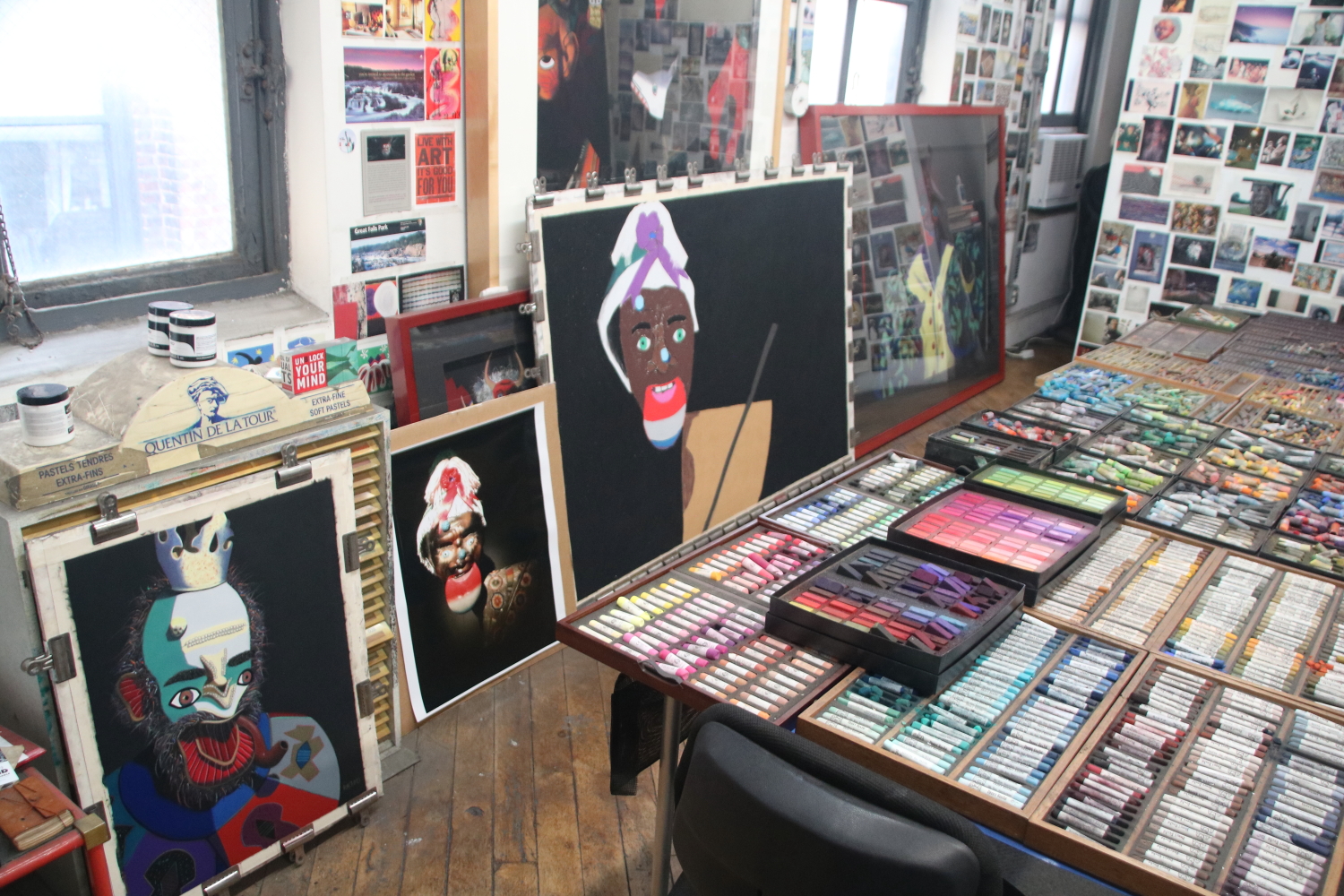
Barbara’s studio
*an ongoing series of quotations – mostly from artists, to artists – that offers wisdom, inspiration, and advice for the sometimes lonely road we are on.
If Dostoyevsky, Flaubert, and so many others were able to create great artistic works, it was because they were able to pull off something few adults can find it in themselves to do: they were able to suspend all final judgments about life and the universe in order to play…
The spirit of work is concerned with self-preservation. It evaluates concepts and ideas in terms of their practical value. Building roads, raising walls, running elections, debating policies, educating the young – all of these are purposive actions ultimately aimed at upholding social structures, changing those structures, or promoting one’s place within society. The spirit of work is the home of the ego, the part of us that has evolved to survive and thrive. One of the conditions of the artistic creation seems to be the ability to move frame this frame of mind into the spirit of play. As many artist have said in varying ways, the trick is to forget everything and create for the sake of creating. No worthwhile play, of course, is without effort. As the painstaking care Flaubert put into every line of his books makes clear, the spirit of play is sometimes the most exciting. Nevertheless, art remains in essence a game, an activity undertaken for its own sake, no matter how difficult. Like all games, it requires the establishment of a perimeter within which things that one might take very seriously in ordinary life are given only relative value. The perimeter suspends all the conventional rules, allowing the artist to turn the world on its head and let the imagination roam freely.
No sooner have we entered the spirit of play than we see things differently.
J.F. Martel in Reclaiming Art in the Age of Artifice: A Treatise, Critique, and Call to Action
Comments are welcome!
Pearls from artists* # 320
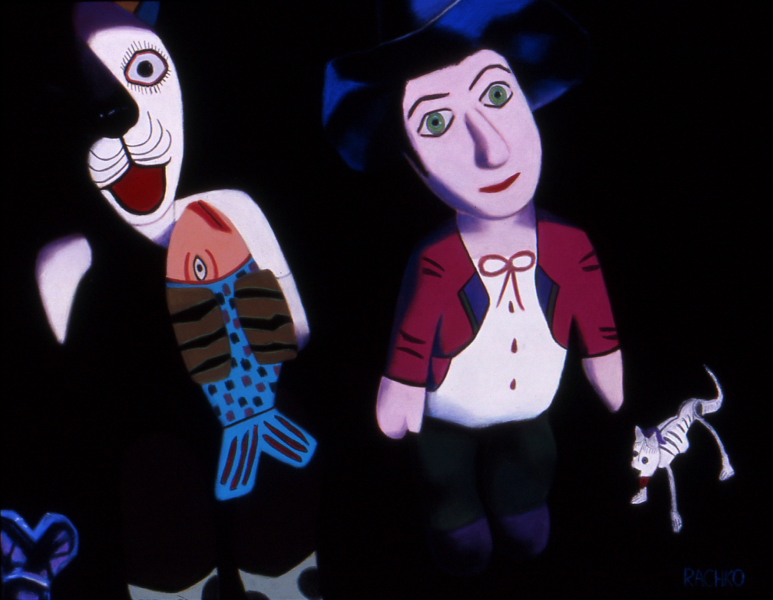
“Offering,” soft pastel on sandpaper, 20″ x 26″
*an ongoing series of quotations – mostly from artists, to artists – that offers wisdom, inspiration, and advice for the sometimes lonely road we are on.
As soon as I use words and actions to convey an emotion, I engage with the world, pitting my feelings against fate in hopes of a desired outcome. If I am angry, my anger is directed at someone or something. If I am in love, my love is for another. Feelings are purposive in ordinary reality, our emotional states tangled in the processes of life. This is what we mean when we refer to ourselves as subjects. But if, instead of acting on a feeling, I make it the basis of a song or a film or a dance, something strange happens. My purposive feeling leaves the closed circle of my personal existence, almost as though I had taken it out of historical time altogether. Transposed into the work of art, it becomes nonpurposive, undirected. It disassociates from its original focus, and from my self as subject, acquires a kind of autonomy. Artistic creation allows for the subjective aspect of our lives normally locked inside our skulls to exist outside us, which is to say that in art, the subjective becomes objective.
J.F. Martel in Reclaiming Art in the Age of Artifice: A Treatise, Critique, and Call to Action
Comments are welcome!
Pearls from artists* # 107

“The Ancestors,” soft pastel on sandpaper, 38″ x 58″
* an ongoing series of quotations – mostly from artists, to artists – that offers wisdom, inspiration, and advice for the sometimes lonely road we are on.
If the proper goal of art is, as I now believe, Beauty, the Beauty that concerns me is that of Form. Beauty is, in my view, a synonym of the coherence and structure underlying life (not for nothing does Aristotle list plot first in his enumeration of the components of tragedy, a genre of literature that, at least in its classical form, affirms order in life). Beauty is the overriding demonstration of pattern that one observes, for example, in the plays of Sophocles and Shakespeare, the fiction of Joyce, the films of Ozu, the paintings of Cezanne and Matisse and Hopper, and the photographs of Timothy O’Sullivan, Alfred Stieglitz, Edward Weston, and Dorothea Lange.
Why is Form beautiful? Because, I think, it helps us meet our worst fear, the suspicion that life may be chaos and that therefore our suffering is without meaning. James Dickey was right when he asked rhetorically, “What is heaven anyway, but the power of dwelling among objects and actions of consequence.” “Objects of consequence” cannot be created by man alone, nor can “actions of consequence’ happen in a void; they can only be found within a framework that is larger than we are, an encompassing totality invulnerable to our worst behavior and most corrosive anxieties.
… How, more specifically, does art reveal Beauty, or Form? Like philosophy it abstracts. Art simplifies. It is never exactly equal to life. In the visual arts, this careful sorting out in favor of order is called composition, and most artists know its primacy.
Beauty in Photography by Robert Adams
Comments are welcome!


 barbararachkoscoloreddust.com