Category Archives: Quotes
Pearls from artists* # 409

Recent works in progress
*an ongoing series of quotations – mostly from artists, to artists – that offers wisdom, inspiration, and advice for the sometimes lonely road we are on.
Poets can look at a painting and understand it without having it spelled out [and] painters can read poetry… People say, I don’t understand what it means, about John Ashbery’s poetry. Painters would never say that… The idea of “I don’t understand what it means,” looking at abstract painting and saying, “Explain it to me, what does it mean?” You don’t say that, and you don’t ask people to explain music. And so, poets, painters, composers don’t need explanations. Explanations are for other people… burdened by logic.
Elaine de Kooning quoted in Mary Gabriel in Ninth Street Women
Comments are welcome!
Pearls from artists* # 408

“No Cure for Insomnia,” pastel on sandpaper, 58″ x 38″ image, 70” x 50” framed
* an ongoing series of quotations – mostly from artists, to artists – that offers wisdom, inspiration, and advice for the sometimes lonely road we are on.
Classics have nothing to do with aesthetic sophistication. They use the aesthetic as a springboard to something else. The creation of a classic will often require the artist to deviate from prevailing standards in order to push the ordinary vision through. If there is one prerequisite for producing a classic, it is the willingness to follow the vision wherever it leads, even if it demands a breach of convention, technique, or popular taste. (It may not even be a question of if or when, for how can one produce a truly singular work without reinventing the medium to some extent?) We often hear that the master artist is “in love” with her material: that the sculptor loves the marble, the dancer loves the body, the musician loves his instrument. For the maker of classics, however, the medium always seems to be an obstacle; love is never without a tinge of spite. William S. Burroughs was so contemptuous of language that he took to describing it as a disease. He conceived his work as an attempt to confront language in hopes to cure the mind of the “word virus.” Indeed, if the goal of art is to take us beyond the ordinary preoccupations to reach the heart of the Real, it would seem essential that there be a fight, a struggle to wrest from the medium something to which Consensus dictates it is not naturally inclined.
J.F. Martel in Reclaiming Art in the Age of Artifice: A Treatise, Critique, and Call to Action
Comments are welcome!
Pearls from artists* # 407

“Survivors,” soft pastel on sandpaper, 20″ x 26″ image, 28 1/2″ x 35″ framed
* an ongoing series of quotations – mostly from artists, to artists – that offers wisdom, inspiration, and advice for the sometimes lonely road we are on.
In the images [the paintings of the Chauvet cave in southern France] this prehistoric people have bequeathed to us, we get a glimpse of something like a shared humanity, but we also gaze into a stranger part of ourselves, something reaching to the depths. Since we do not know the context in which the paintings were made, we cannot in good faith chalk them up to some clear pragmatic end. We are seeing art in its naked state, deprived of any discernible appropriation. This can trouble our secular sensibilities since it confronts us not just with the mysteries of nature, but more strikingly still with the riddle of the presence of such things as us in the otherwise coherent physical world. Given the fact that the molecular chemistry that makes life possible is the same throughout the cosmos, would finding works of art on Mars or a remote planet be any more uncanny than finding them here on Earth?
J.F. Martel in Reclaiming Art in the Age of Artifice: A Treatise, Critique, and Call to Action
Comments are welcome!
Pearls from artists* # 406

With “Avenger,” soft pastel on sandpaper, 58” x 38” image, 70” x 50” framed
* an ongoing series of quotations – mostly from artists, to artists – that offers wisdom, inspiration, and advice for the sometimes lonely road we are on.
If we really are due for a shift in consciousness, it is incumbent upon each of us to “be the change,” in Gandhi’s famous phrase. Nothing is written in the stars.
Art is a testament to this way of thinking, because every great work of art is made, not for an abstract audience, but for the lone percipient with whom it seeks to connect. The symbols that compose artistic works are not static objects but dynamic events. As such, they can only emerge within a field of awareness, that is, within the context of a life being lived. It is therefore by approaching the work of art as though it were intended specifically for you – as though the artist had fashioned it with you in mind every step of the way – that you can turn the aesthetic experience into an engine of change in your own life and in the lives of those around you.
J.F. Martel in Reclaiming Art in the Age of Artifice: A Treatise, Critique, and Call to Action
Comments are welcome!
Pearls from artists* # 405

Barbara’s studio
* an ongoing series of quotations – mostly from artists, to artists – that offers wisdom, inspiration, and advice for the sometimes lonely road we are on.
… art is an objective pursuit with the same claim to truth as science, albeit truth of a different order. At the very least the consistency and universality of aesthetic expression throughout history and around the globe suggest that the undertaking that finds its modern formulation in the concept of art is a distinct sphere of activity with its own ontology. My belief is that what the modern West calls art is the direct outcome of a basic human drive, an inborn expressivity that is inextricably bound with the creative imagination. It is less a product of culture than a natural process manifesting through the cultural sphere. One could go so far as to argue that art must exist in order for culture to emerge in the first place.
J.F. Martel in Reclaiming Art in the Age of Artifice: A Treatise, Critique, and Call to Action
Comments are welcome!
Pearls from artists* # 404

“Broken,” soft pastel on sandpaper, 38″ x 58″ image, 50″ x 70″ framed
* an ongoing series of quotations – mostly from artists, to artists – that offers wisdom, inspiration, and advice for the sometimes lonely road we are on.
Before we can even think of ecological rescue, global disarmament, or economic reform, we must find a way back to what science fiction writers call our homeworld. The term encompasses more than the biosphere; it also includes our homes, our places of work, our communities, families, friends, and lovers. It includes our technologies and tools, the physical body, the sensible soul, and the unconscious psyche. We need a faith to restore our capacity to feel, to affect and be affected with the same passionate intensity as our forebears, whose powers of feeling astound us so in the records and art of the past. The death of affect, to borrow a phrase from JG Ballard, is the true catastrophe of our spectral age, our spiritual Hiroshima. It makes questions such as whether life’s riddles are answered at the Vatican, in Tibet, or by the Large Hadron Collider utterly meaningless, since it removes the ground we need to pose such questions in the first place. Neither religion nor science can give us back the ground. Only the imagination can. Only art can mend the rupture of the soul and the world, the body and the earth.
J.F. Martel in Reclaiming Art in the Age of Artifice: A Treatise, Critique, and Call to Action
Comments are welcome!
Pearls from artists* # 403
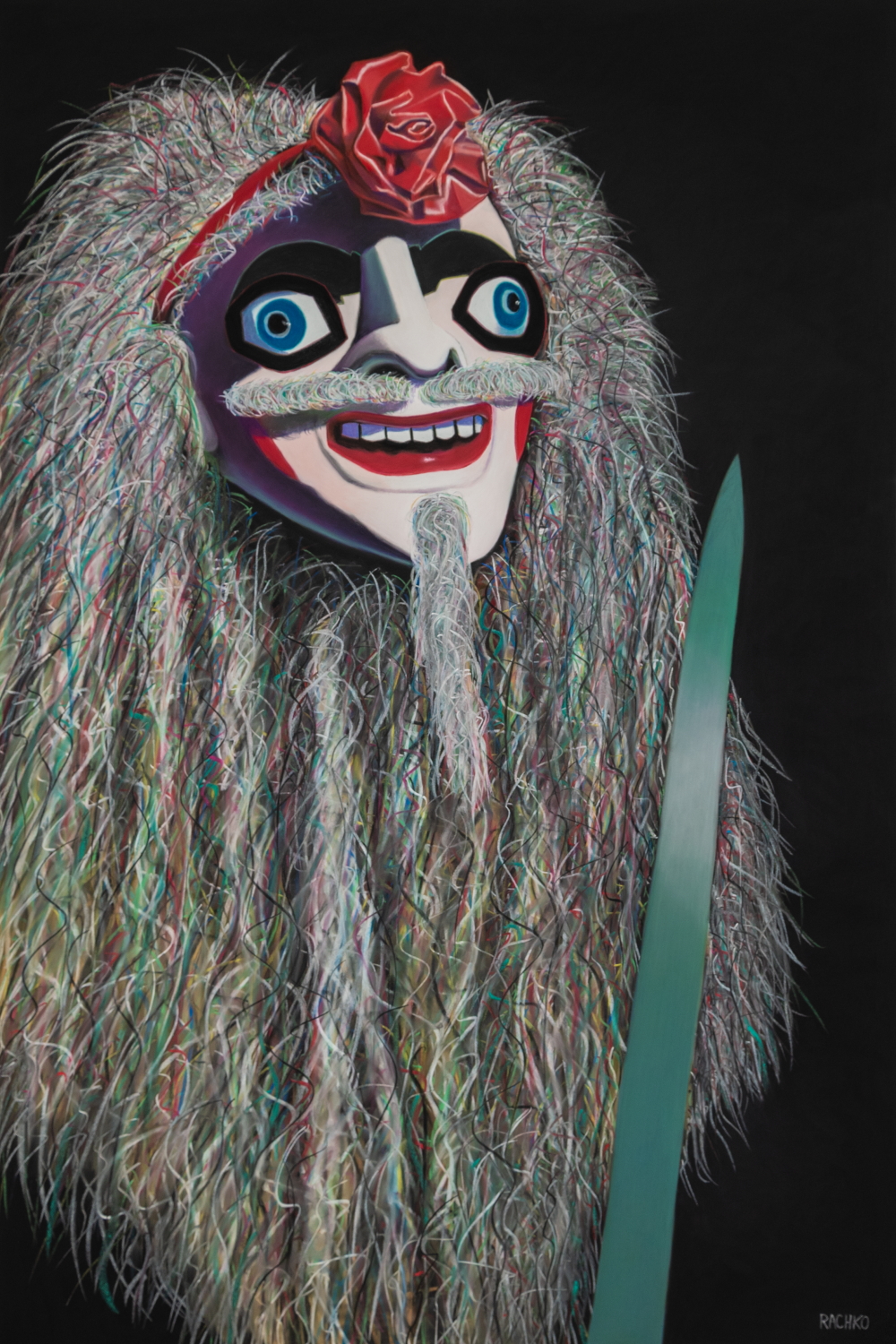
“Avenger,” soft pastel on sandpaper, 58″ x 38″
*an ongoing series of quotations – mostly from artists, to artists – that offers wisdom, inspiration, and advice for the sometimes lonely road we are on.
There is that doctor who opens you up, does exactly the right thing, closes you up – and you die. He failed to take the chance that might have saved you. Art is a crucial, dangerous operation we perform on ourselves. Unless we take a chance, we die in art.
Morty Feldman quoted in Mary Gabriel in Ninth Street Women
Comments are welcome!
Pearls from artists* # 402
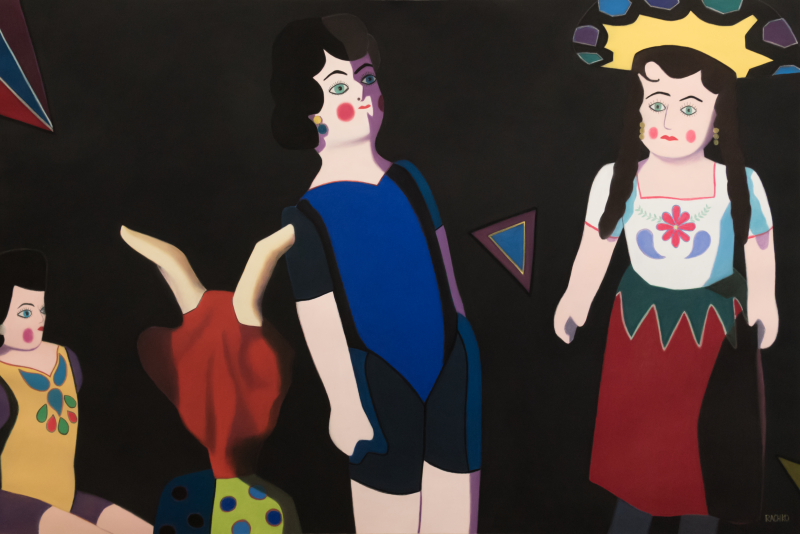
“Conundrum,” soft pastel on sandpaper, 38″ x 58″
*an ongoing series of quotations – mostly from artists, to artists – that offers wisdom, inspiration, and advice for the sometimes lonely road we are on.
Rodin was lonely before his fame, and perhaps after the fame that came to him still lonelier. For fame is actually only the sum of all the misunderstandings that gather around a new name.
Rainer Maria Rilke quoted in Mary Gabriel in Ninth Street Women
Comments are welcome!
Pearls from artists* # 401

“Prophecy,” Soft Pastel on Sandpaper, 58″ x 38″ Image, 70″ x 50″ Framed
*an ongoing series of quotations – mostly from artists, to artists – that offers wisdom, inspiration, and advice for the sometimes lonely road we are on.
Said [Larry] Rivers,
You could be poor and think your life worthwhile – the dance of the mind, the leap of the intellect. If you made art that did not sell immediately, or ever, you could still be involved in a meaningful, inspiring activity that was a reward in itself, and you could show it to the people you dreamed of thrilling with your efforts; your friends were your audience. They were sitting on your shoulder watching you work. That was the opera of the time… Pursuit of a career and commercial success was selling out, losing one’s soul. In painting, writing, music, and dance, nothing could be more shameful.
Mary Gabriel in Ninth Street Women
Comments are welcome!
Pearls from artists* # 400

In the studio with friends
* an ongoing series of quotations – mostly from artists, to artists – that offers wisdom, inspiration, and advice for the sometimes lonely road we are on.
A student in the audience raised her hand and asked me:
“Why should I live?”
… In the very act of asking that question, you are seeking reasons for your convictions, and so you are committed to reason as the means to discover and justify what is important to you. And there are so many reasons to live!
As a sentient being, you have the potential to flourish. You can refine your faculty of reason itself by learning and debating. You can seek explanations of the natural world through science, and insight into the human condition through the arts and humanities. You can make the most of your capacity for pleasure and satisfaction, which allowed your ancestors to thrive and thereby allowed you to exist. You can appreciate the beauty and the richness of the natural and cultural world. As the heir to billions of years of life perpetuating itself, you can perpetuate life in turn. You have been endowed with a sense of sympathy – the ability to like , love, respect, help, and show kindness – and you can enjoy the gift of mutual benevolence with friends, family, and colleagues.
And because reason tells you that none of this is particular to you, you have the responsibility to provide to others what you expect for yourself. You can foster the welfare of other sentient beings by enhancing life, health, knowledge, freedom, abundance, safety, beauty, and peace. History shows that when we sympathize with others and apply our ingenuity to improving the human condition, we can make progress in doing so, and you can help to continue that progress.
Stephen Pinker in Enlightenment Now: The Case for Reason, Science, Humanism, and Progress
Comments are welcome!


 barbararachkoscoloreddust.com