Category Archives: New York, NY
Pearls from artists* # 108
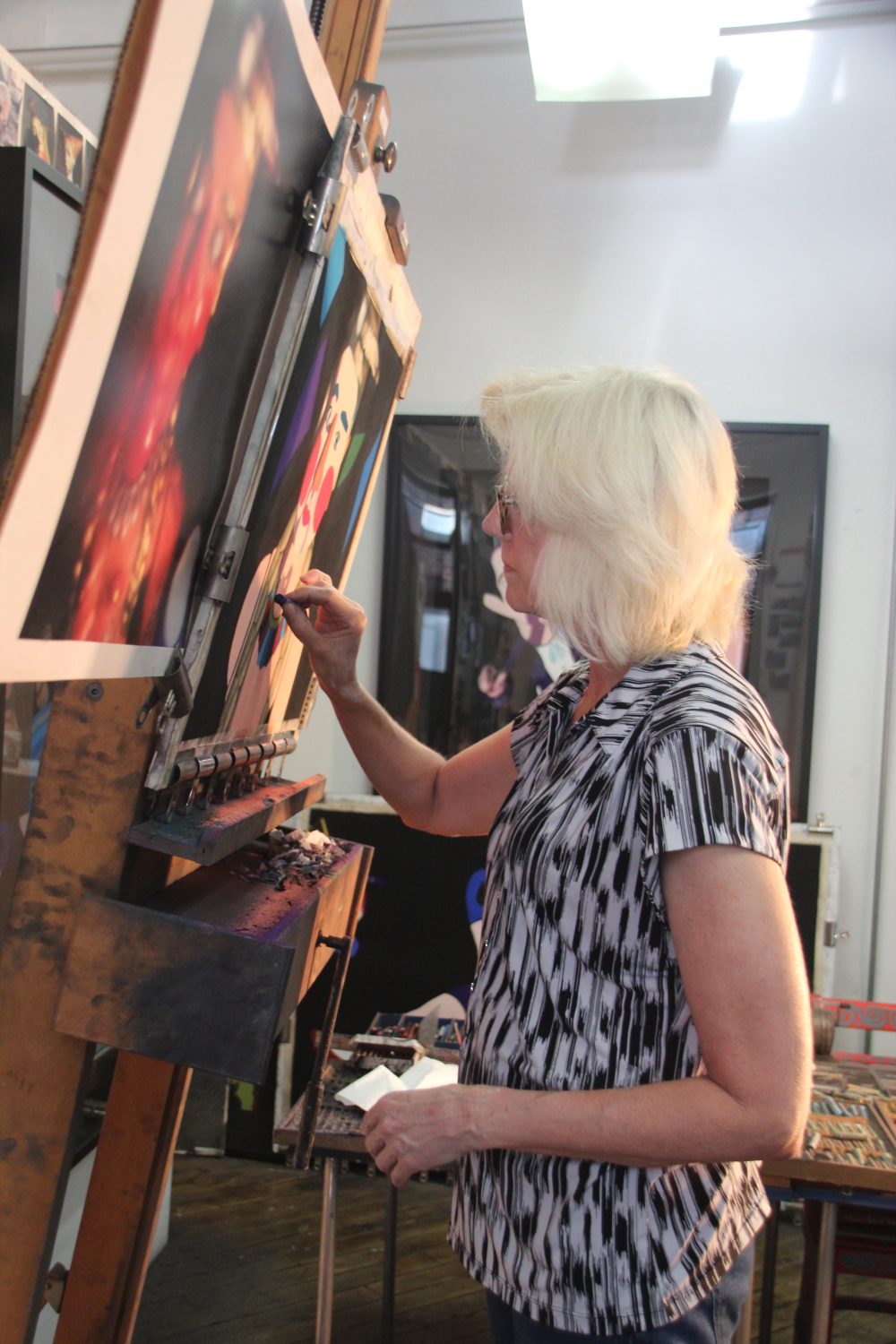
At work on a pastel painting
* an ongoing series of quotations – mostly from artists, to artists – that offers wisdom, inspiration, and advice for the sometimes lonely road we are on.
Artists generally need privacy in order to create, and as I’ve noted, what constitutes adequate privacy varies by person and time. Solitude quickly becomes isolation when it oversteps one’s desires. But most artists need to feel that they and their work won’t be examined prematurely and, certainly, won’t be ambushed unfinished by ridiculing eyes. You might go out and invite various people to critique a piece in progress, even knowing they’re unlikely to view it with sympathy, exactly because you feel there’s necessary information in their opinion. But, if you’ve invited them, however unpleasant the response, your experience is likely preferable to what you would feel if they impulsively offered up the same critiques unsolicited.
Someone making art needs privacy in part because the process of creation makes many people feel vulnerable, sometimes exquisitely so, particularly since the work frequently emerges in a jumble of mixed-up small parts that you can only assemble gradually, or in a wet lumpy mound that requires patient sculpting. When people feel prematurely revealed or exposed, they often experience great discomfort and find themselves babbling apologetically, seeking to reassure by laying out the distance they have yet to travel. It is in part this babble-as-smoke-screen to cover exposure resulting, distracting, unhappy self-consciousness that privacy seeks to shelter.
But even more significantly, privacy grants us permission to turn our attention inward without interruption. As I described earlier, in order to concentrate, think, and fantasize, we need to feel we’re in a safe enough space that we can lower our vigilance, stop monitoring our environment, and allow ourselves to refocus on the happenings within our own minds. There are times interruptions feel merciful, but many more when they disrupt our effort to flesh out an inchoate notion.
Janna Malamud Smith in an absorbing errand: How Artists and Craftsmen Make Their Way to Mastery
Comments are welcome!
Q: Can you describe your entire body of work in six words or less?
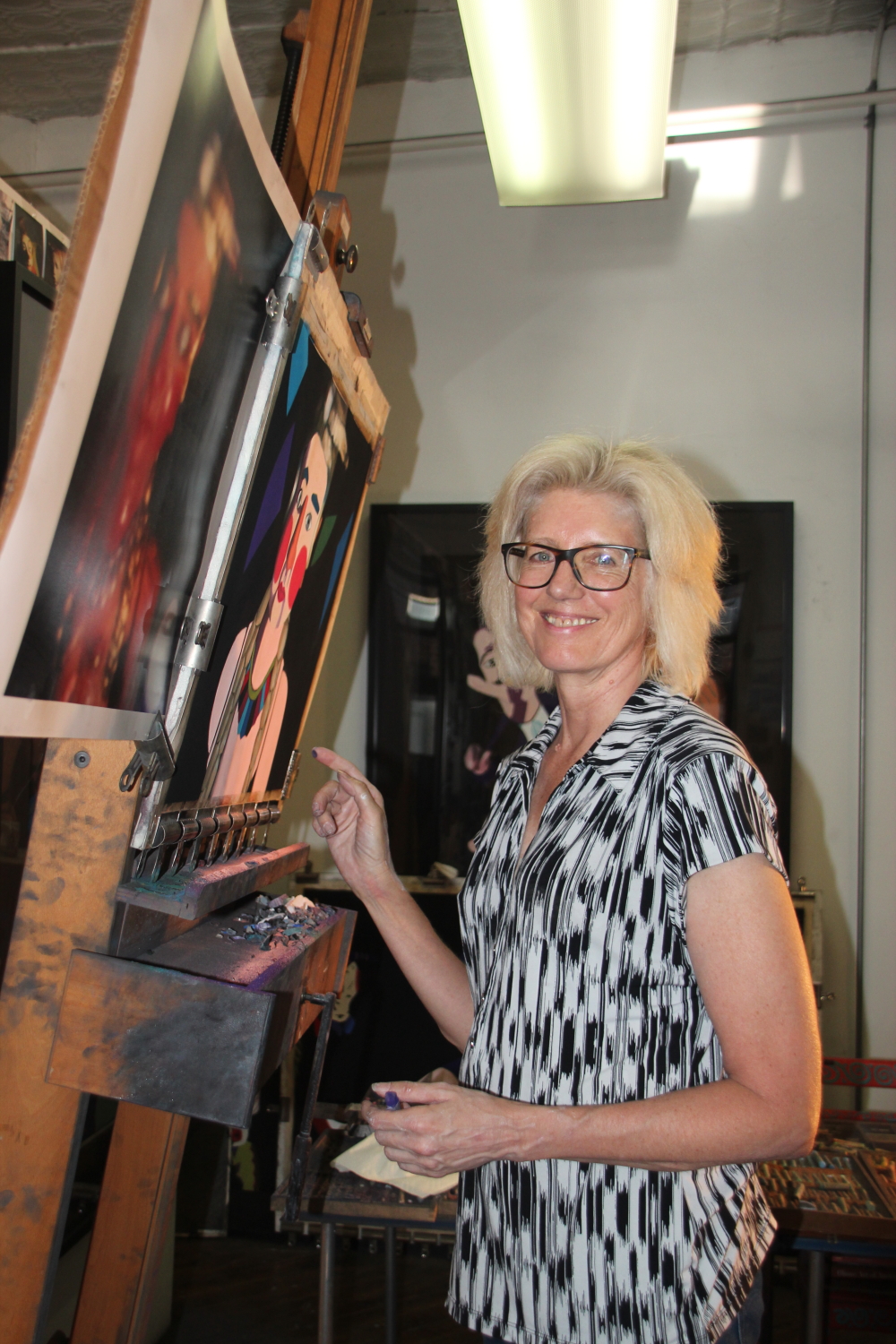
In the studio, Photo: Britta Konau
A: Only if I forget what it took to get me to this point! I remember all too well the long periods of study, hard work, self-doubt, self-nurturing, disappointments, setbacks, risks, focus, drive, discipline, joy, detours, fallow periods, rejections, perseverance, etc. that have gone into sustaining an art career for nearly thirty years. There are no blueprints and few role models for a successful artist’s life. (Even the meaning of “success” as an artist is difficult to define). I invite others, who surely can be more objective, to attempt a summation of my entire body of work in a few words.
Comments are welcome!
Q: You have been a working artist for nearly thirty years. Considering your entire body of work, is there any particular painting that you love or hate?

Barbara’s studio
A: With very few exceptions, I generally love all of my paintings equally. I do not hate any of them. Each was the best I could make at that particular stage in my development as an artist and as a person. I am a perfectionist with high standards – this is my life’s work. I am devoted to becoming the best artist I can be. I have never pronounced a work “finished” until it is the absolute best that I can make.
Comments are welcome!
Pearls from artists* # 102
New York, NY
* an ongoing series of quotations – mostly from artists, to artists – that offers wisdom, inspiration, and advice for the sometimes lonely road we are on.
That a photograph is unlikely to be a laboratory record is evident when we think about how it is made. Most photographers are people of immense enthusiasms whose work involves many choices – to brake the car, grab the yellow instead of the green filter, wait out the cloud, and at the second everything looks inexplicably right, to release the shutter. Behind these decisions stands the photographer’s individual framework of recollections and meditations about the way he perceived that place or places like it before. Without such a background there would be no knowing whether the scene on the ground glass was characteristic of the geography and of his experience of it and intuition of it – in short, whether it was true.
Making photographs has to be, then, a personal matter; when it is not, the results are not persuasive. Only the artist’s presence in the work can convince us that its affirmation resulted from and has been tested by human experience. Without the photographer in the photograph the view is no more compelling than the product of some annoying record camera, a machine perhaps capable of happy accident but not response to form.
Beauty in Photography by Robert Adams
Comments are welcome!
Q: How long does it take you to complete a pastel-on-sandpaper painting?
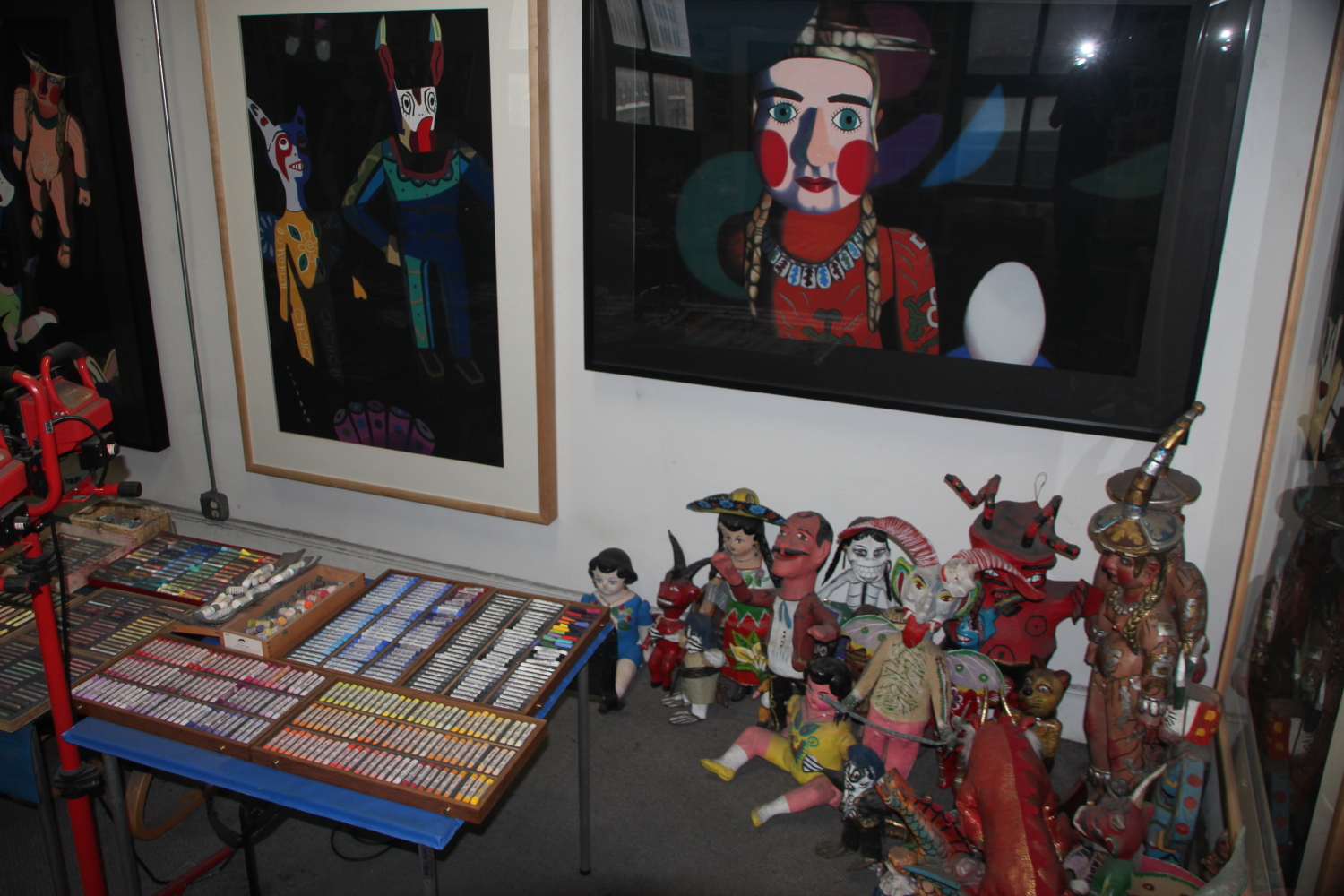
Barbara’s studio
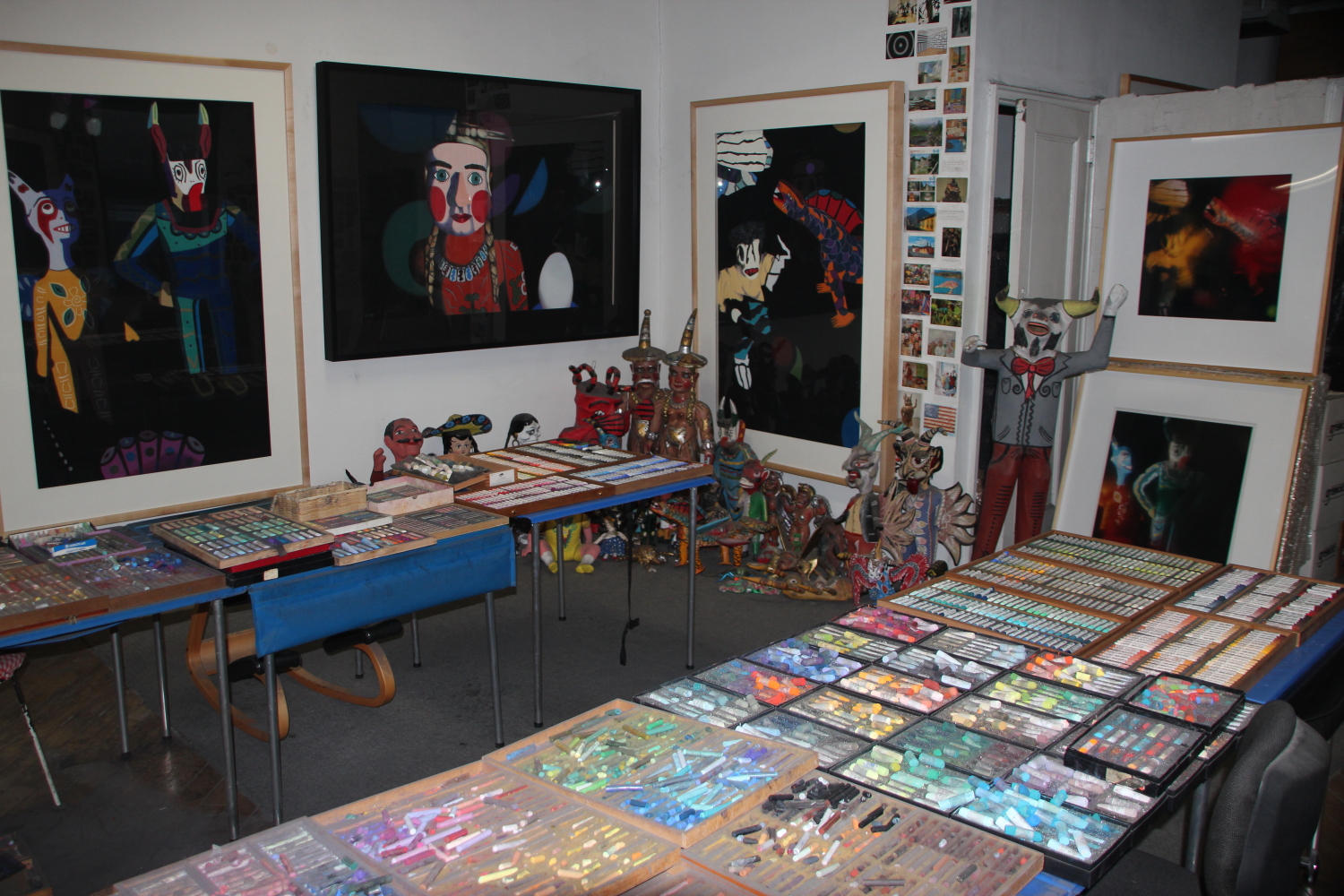
A: Mine is a slow and labor-intensive process. First, there is foreign travel to find the cultural objects – masks, carved wooden animals, paper mâché figures, and toys – that are my subject matter. If they are heavy I ship them home.
Next comes planning exactly how to photograph them, lighting and setting everything up, and shooting a roll of 220 film with my Mamiya 6 camera. I still like to use an analog camera for my fine art work, although I am rethinking this. I have the film developed, decide which image to use, and order a 20” x 24” reference photograph from Manhattan Photo on West 20th Street.
Then I am ready to start. I work on each pastel-on-sandpaper painting for approximately three months. I am in my studio 7 to 8 hours a day, five days a week. During that time I make thousands of creative decisions as I apply and layer soft pastels (I have 8 tables-worth to choose from!), blend them with my fingers, and mix new colors directly on the sandpaper. A finished piece consists of up to 30 layers of soft pastel. My self-invented technique accounts for the vivid, intense color that often leads viewers of my originals to look very closely and ask, “What medium is this?” I believe I am pushing soft pastel to its limits, using it in ways that no other artist has done.
Comments are welcome!
Pearls from artists* # 100
Barbara’s studio
* an ongoing series of quotations – mostly from artists, to artists – that offers wisdom, inspiration, and advice for the sometimes lonely road we are on.
I think it’s terribly important that people have always made structures that are better and more rigorous and more demanding than we as an audience can live up to for every single moment. Serious art should be better than you are. I think my plays are more lucid, more rigorous, than I, Richard, am in my life. I’m a stumble bum like all the rest of us. Create art that is better than you are able to manifest in normal life.
Richard Foreman in Anne Bogart’s Conversations with Anne: Twenty-four Interviews
Comments are welcome!
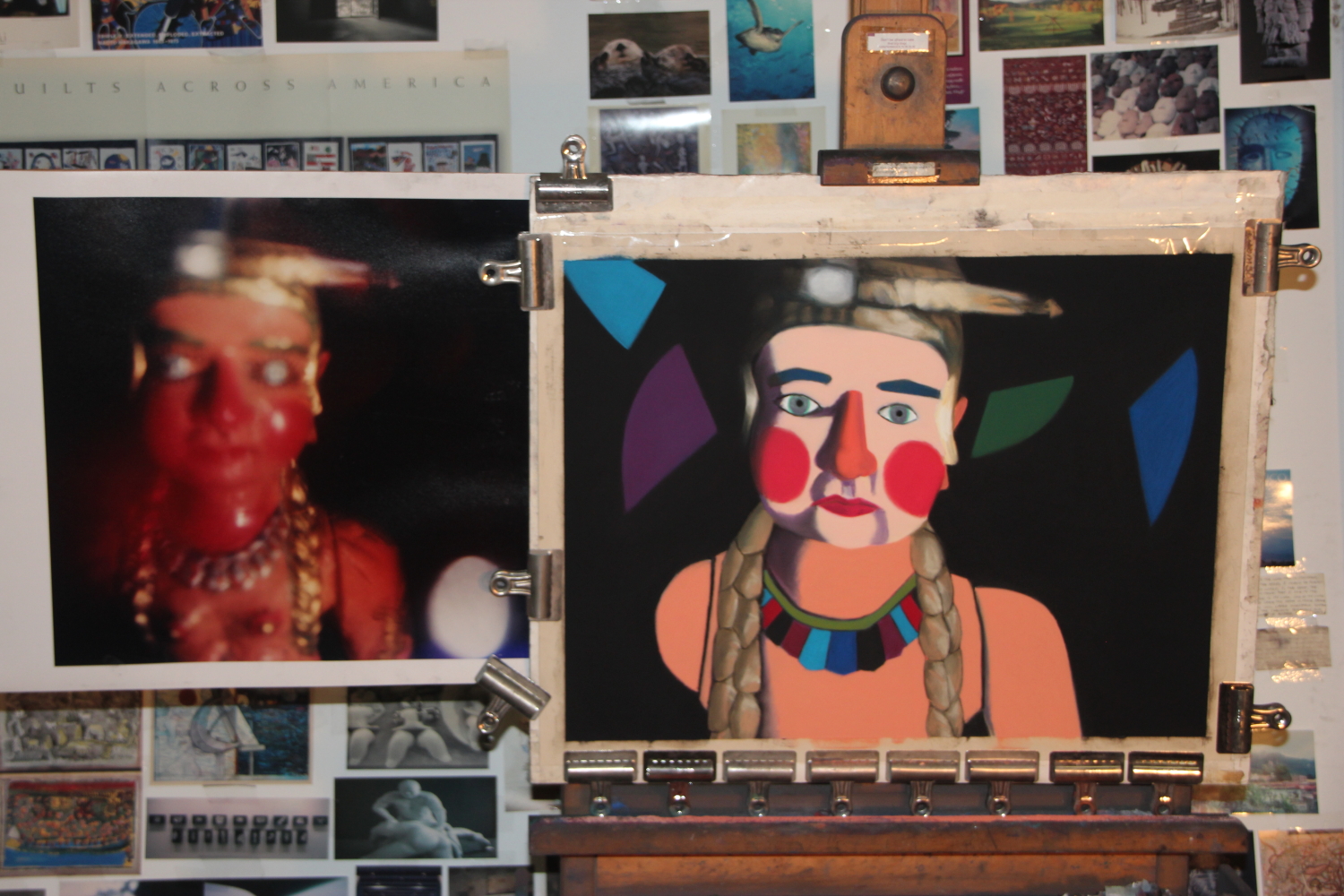
Q: What’s on the easel today?
Pastel painting in progress
A: I am working on an untitled small, 20″ x 26″, pastel-on-sandpaper painting.
Pearls from artists* # 99

Barbara’s studio
* an ongoing series of quotations – mostly from artists, to artists – that offers wisdom, inspiration, and advice for the sometimes lonely road we are on.
I think there are two very interesting stages in creative work. One is confusion and one is boredom. They generally both mean that there’s a big fish swimming under the water. As Rilke said, “Live the questions.” And not judge that there’s something wrong about confusion, because the people who are working, say, on the cure for leprosy – they work for years and years in a state of confusion, and very often they don’t find the cure. They find something completely different. But they keep living the question. Confusion is absolutely essential to the creative process. If there was no confusion, why do it? I always feel that all of us have questions we’re asking all our lives, for our work, and if we ever found the answer, we’d stop working. We wouldn’t need to work anymore.
Boredom – if you’ve ever been in therapy, you’d know that when you start getting bored, that’s really important. The therapist sits up; there’s something going on, because the wall that you come against – that’s where the real gold is. It’s really precious.
Andre Gregory (from My Dinner with Andre) in Anne Bogart, Conversations with Anne: Twenty-four Interviews
Comments are welcome!
Q: Who is your favorite artist and why?

Catalogue of Matisse’s late work
A: I admire the work of many artists, but if I have to choose only one then I’d say Matisse. Whenever there is a Matisse exhibition in New York, I try to see it at least once. Many years ago I read Hillary Spurling’s definitive two-volume biography (The Unknown Matisse, published 1998, and Matisse the Master, 2005) and became fascinated with how his life unfolded, how Matisse struggled and overcame daunting obstacles in order to make art, and how his work continued to grow and evolve throughout his long life.
I believe that Matisse and I are kindred souls in three respects: we both came from unpromising beginnings (he from a textile family in northern France, me from a blue collar family in New Jersey), our fathers did not support our interest in becoming artists, and he famously worked in series (I am well into my third series).
Comments are welcome!


 barbararachkoscoloreddust.com
Q: What is the reality of the art world today? Do people experience it enough?
Aug 2
Posted by barbararachkoscoloreddust
West 29th Street studio
A: I cannot comment on the art world today or the experience of other people. I can only speak for myself. I am completely devoted to my work; my entire life revolves around art. When I’m not in my studio creating, I am reading about art, thinking about it, gaining inspiration from other artists and from artistic travel, working out new ideas, going to museum and gallery exhibitions, trying to understand the business side of things, etc. Art is a calling and I personally experience it enough as my work continues to evolve!
Comments are welcome!
Share this:
Posted in 2014, An Artist's Life, Art in general, Black Paintings, Creative Process, Inspiration, New York, NY, Pastel Painting, Photography, Studio, Working methods
2 Comments
Tags: art, art world, artistic, business, calling, comment, completely, continues, creating, devoted, enough, evolve, Exhibitions, experience, gaining, gallery, going, grow, ideas, inspiration, life, museum, people, personally., reading, reality, revolves, speak, Studio, thinking, today, travel, trying, understand, West 29th Street, work, working