Blog Archives
Travel photo of the month*

*favorite travel photos that have not yet appeared in this blog
Comments are welcome!
Q: Would you speak more about being represented by Brewster Gallery in the late 1990s?

A: In 1996 I landed my first major New York gallery, Brewster Gallery. I was still living in Virginia and Mia Kim, the director, had accepted my work on the basis of unsolicited slides mailed to the gallery in July. The first time she saw my pastel paintings in person was when I delivered them for a solo exhibition in October.
Brewster represented Latin American masters such as Frida Kahlo, Francisco Zuniga, Diego Rivera, Francisco Toledo, and Rufino Tamayo. Mia Kim, the director, said that she sometimes had to defend her decision to represent me. Mia’s fabulous response was, “Barbara has the SOUL of a Latina!” My work at that time was heavily influenced by Mexican culture. Mia immediately understood what I was doing in my work. How thrilled and honored I was to be represented by a gallery where my fellow sole non-Latina was Leonora Carrington! Leonora came to my opening.
Those were wonderful days!
Comments are welcome!
Q: When did you begin drawing and painting? (Question from “Cultured Focus Magazine”)

A: This is a long story because my path to becoming a professional artist has been unusually circuitous.
I grew up in a blue collar family in suburban New Jersey. My parents were both first-generation Americans and no one in my family had gone to college. I was a smart kid, who showed some artistic talent in kindergarten and earlier. At the age of 6, my sister, my cousin, and I enrolled in Saturday morning painting classes at the studio of a local artist. I continued the classes for about 8 years and became a fairly adept oil painter.
At the age of 15 my father decided that art was not a serious pursuit – he called it a hobby, not a profession – and abruptly stopped paying for my Saturday morning lessons. Unfortunately, there were no artists or suitable role models in my family. So with neither financial nor moral support to pursue art, I turned my attention to very different interests.
Cut to ten years later. When I was 25, I earned my private pilot’s license and spent the next two years amassing other flying licenses and ratings, culminating in a Boeing-727 flight engineer’s certificate.
At 29, I joined the Navy. By then I was an accomplished civilian pilot with thousands of flight hours so I expected to fly jets. However, in the early 1980s women were not allowed in combat. There were very few women Navy pilots and those few were restricted to training male pilots. There were no women pilots landing on aircraft carriers.
In the mid-1980s I was in my early 30s, a lieutenant on active duty in the Navy, working a soul-crushing job as a computer analyst on the midnight shift in a Pentagon basement. It was literally and figuratively the lowest point of my life. I was completely bored and miserable.
Remembering the joyful Saturdays of my youth when I had taken art classes with a local New Jersey painter, I enrolled in a drawing class at the Art League School in Alexandria, Virginia. Initially I wasn’t very good, but it was wonderful to be around other women and a world away from the mentality of the Pentagon. I was having fun again! I enrolled in more classes and became a very motivated full-time art student who worked nights at the Pentagon. As I studied and improved my skills, I quickly discovered my preferred medium – soft pastel on sandpaper.
Although I knew I had found my calling, for more than a year I agonized over whether or not to leave the financial security of a Navy paycheck. Finally I did make up my mind and resigned my commission, effective on September 30, 1989. With Bryan’s (my then boyfriend’s) support, I left the Navy to devote my time to making art.
I’m probably one of the few people who can name THE day I became a professional artist! That day was October 1, 1989. Fortunately, I have never needed another job. I remained in the Navy Reserve for the next 14 years, working primarily at the Pentagon for two days each month and two weeks each year. I commuted by train to Washington, DC after I moved to Manhattan in 1997. Finally on November 1, 2003, I officially retired as a Navy Commander.
Life as a self-employed professional artist is endlessly varied, fulfilling, and interesting. I have never regretted my decision to pursue art full-time.
Comments are welcome!
Q: Would you talk about your early art exhibitions? (Question from “Culture Focus Magazine”)
Review of my first exhibition at Brewster Arts, New York City!
A: Certainly! My very first group exhibition was in a juried show in the late 1980s at the Art League Gallery in Alexandria, VA. This was a gallery that offered monthly juried shows for members. I applied regularly, had work accepted many times, and frequently won first prize for my pastel paintings.
Early exhibitions at the Art League were followed by group and solo exhibitions at nonprofit and university spaces in Virginia, Washington, D.C., Maryland, North Carolina, Pennsylvania, Ohio, Rhode Island, Connecticut, Massachusetts, New Jersey, and New York; more or less up and down the mid-Atlantic states and the northeast, which were all places I could drive my truck to hand-deliver fragile pastel paintings.
My very first solo exhibition at a commercial gallery was at 479 Gallery in SoHo (New York City) in July 1996. In 1995 I had submitted work to a juried group show and was awarded first prize, which was a solo exhibition at 479 the following year.
My exhibition with 479 Gallery was quickly followed by representation at a prestigious New York gallery, Brewster Arts Ltd., which specialized in Latin American masters such as Frida Kahlo, Leonora Carrington, Diego Rivera, Rufino Tamayo, and many others. I was awarded my first two-person exhibition there in October 1996 and got to meet fellow gallery artist Leonora Carrington when she came to the opening. I could hardly believe my good fortune at gaining representation at such a revered and elegant gallery!
Comments are welcome!
Q: Can you elaborate on the title of your very first series, “Domestic Threats”?

A: All of the paintings in this series are set in places where I reside or used to live, either a Virginia house or New York apartments, i.e., domestic environments. Each painting typically contains a conflict of some sort, at least one figure who is being menaced or threatened by a group of figures. So I named the series “Domestic Threats.”
Depending on what is going on in the country at a particular moment in time, however, people have seen political associations in my work. When my husband, Bryan, was killed on 9/11, many people thought the title, “Domestic Threats,” was prescient. They have ascribed all kinds of domestic terrorism associations to it, but that is not really what I had in mind. For a time some thought I was hinting at scenes of domestic violence, but that also is not what I had intended. “Domestic Threats” seems to be fraught with associations that I never considered, but it’s an apt title for this body of work.
Comments are welcome!
Q: Would you talk about your first solo exhibition in a commercial gallery?

“Big Deal,” soft pastel on sandpaper, 58″ x 38″
A: Although I had exhibited in a number of non-profit galleries in Virginia, Washington, DC, Maryland, New Jersey, and New York, my first solo in a commercial gallery was at 479 Gallery, 520 Broadway, in July 1996. The previous summer I had entered a juried exhibition there. My work won first prize and I was awarded a solo show the following July.
This exhibition was soon followed by representation at an important New York gallery, Brewster Fine Arts, at 41 West 57th Street. I had my first two-person exhibition at Brewster in October 1996. The gallery specialized in art by Latin American artists. Besides myself, the sole non-Latina represented by Brewster was Leonora Carrington! I quickly began exhibiting alongside a group of illustrious artists: Leonora, Rufino Tamayo, Francisco Toledo, Francisco Zuniga, and other Latin American masters. I could hardly believe my good fortune!
Comments are welcome!
Travel photo of the month*
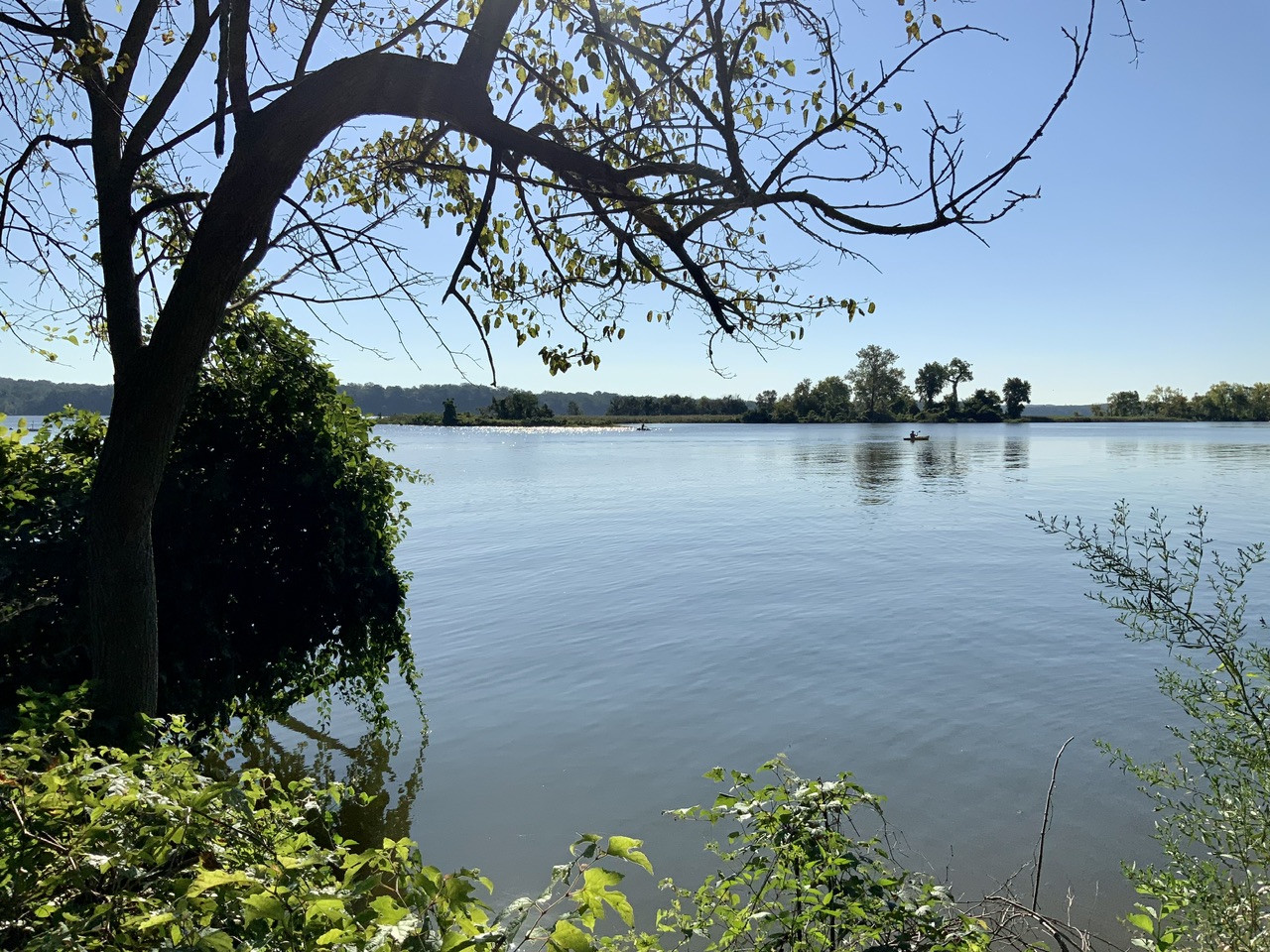
Alexandria, VA
*favorite travel photos that have not yet appeared in this blog
Comments are welcome!
Q: It must be tricky moving pastel paintings from your New York studio to your framer in Virginia. Can you explain what’s involved? (Question from Ni Zhu via Instagram)
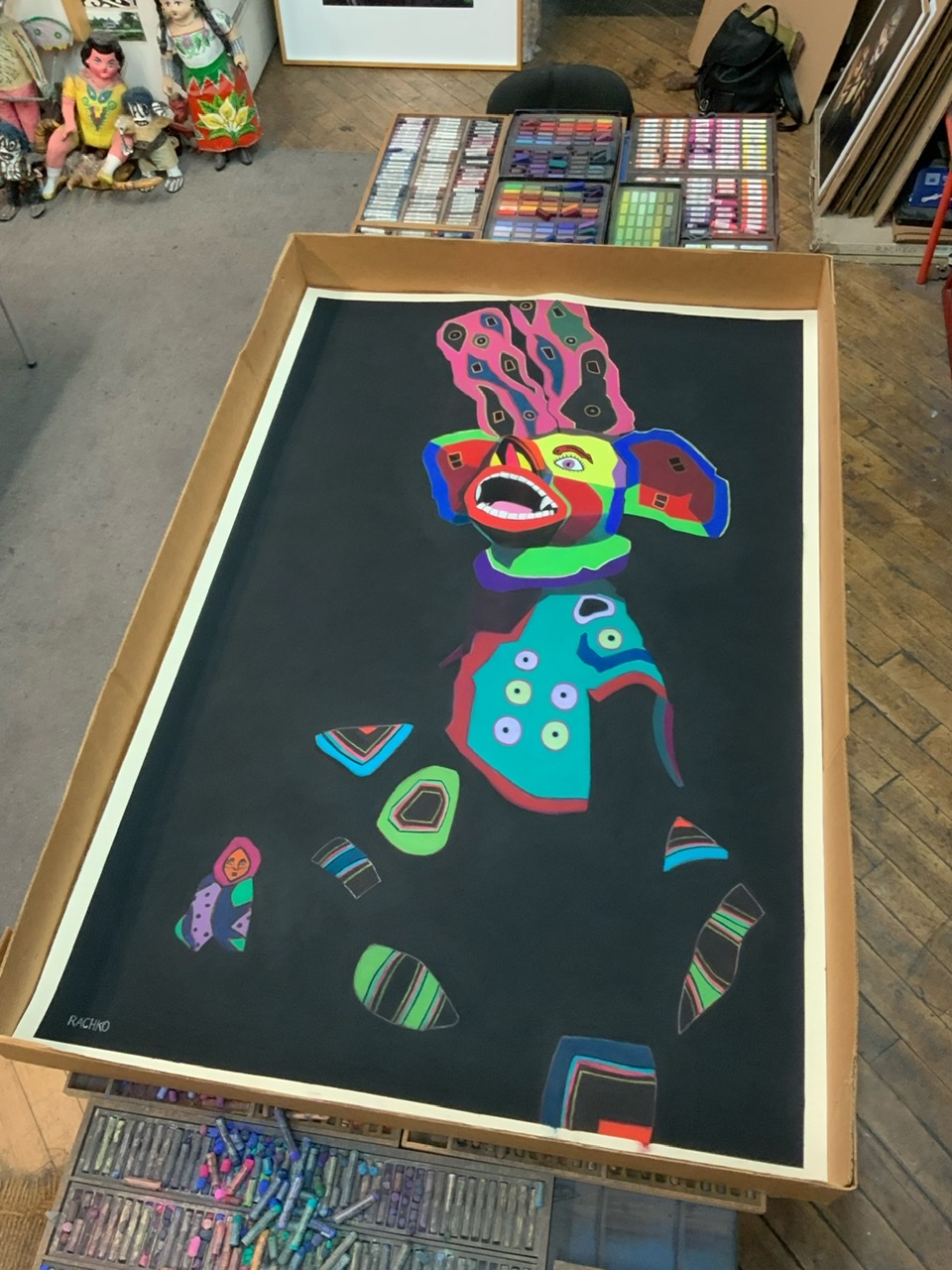
“Impresario” partially boxed for transport to Virginia
A: Well, I have been working with the same framer for three decades so I am used to the process.
Once my photographer photographs a finished, unframed piece, I carefully remove it from the 60” x 40” piece of foam core to which it has been attached (with bulldog clips) during the months I worked on it. I carefully slide the painting into a large covered box for transport. Sometimes I photograph it in the box before I put the cover on (see above).
My studio is in a busy part of Manhattan where only commercial vehicles are allowed to park, except on Sundays. Early on a Sunday morning, I pick up my 1993 Ford F-150 truck from Pier 40 (a parking garage on the Hudson River at the end of Houston Street) and drive to my building’s freight elevator. I try to park relatively close by. On Sundays the gate to the freight elevator is closed and locked so I enter the building around the corner via the main entrance. I unlock my studio, retrieve the boxed painting, bring it to the freight elevator, and buzz for the operator. He answers and I bring the painting down to my truck. Then I load it into the back of my truck for transport to my apartment.
I drive downtown to the West Village, where I live, and double park my truck. (It’s generally impossible to park on my block). I hurry to unload the painting, bring it into my building, and up to my apartment, all the while hoping I do not get a parking ticket. The painting will be stored in my apartment, away from extreme cold or heat, until I’m ready to drive to Virginia. On the day I go to Virginia, I load it back into my truck. Then I make the roughly 5-hour drive south.
Who ever said being an artist is easy was lying!
Comments are welcome!
Q: What does it feel like when you dop off a pastel painting at your Virginia framer’s shop? Are you sorry to see it go? (Question from Caroline Golden)
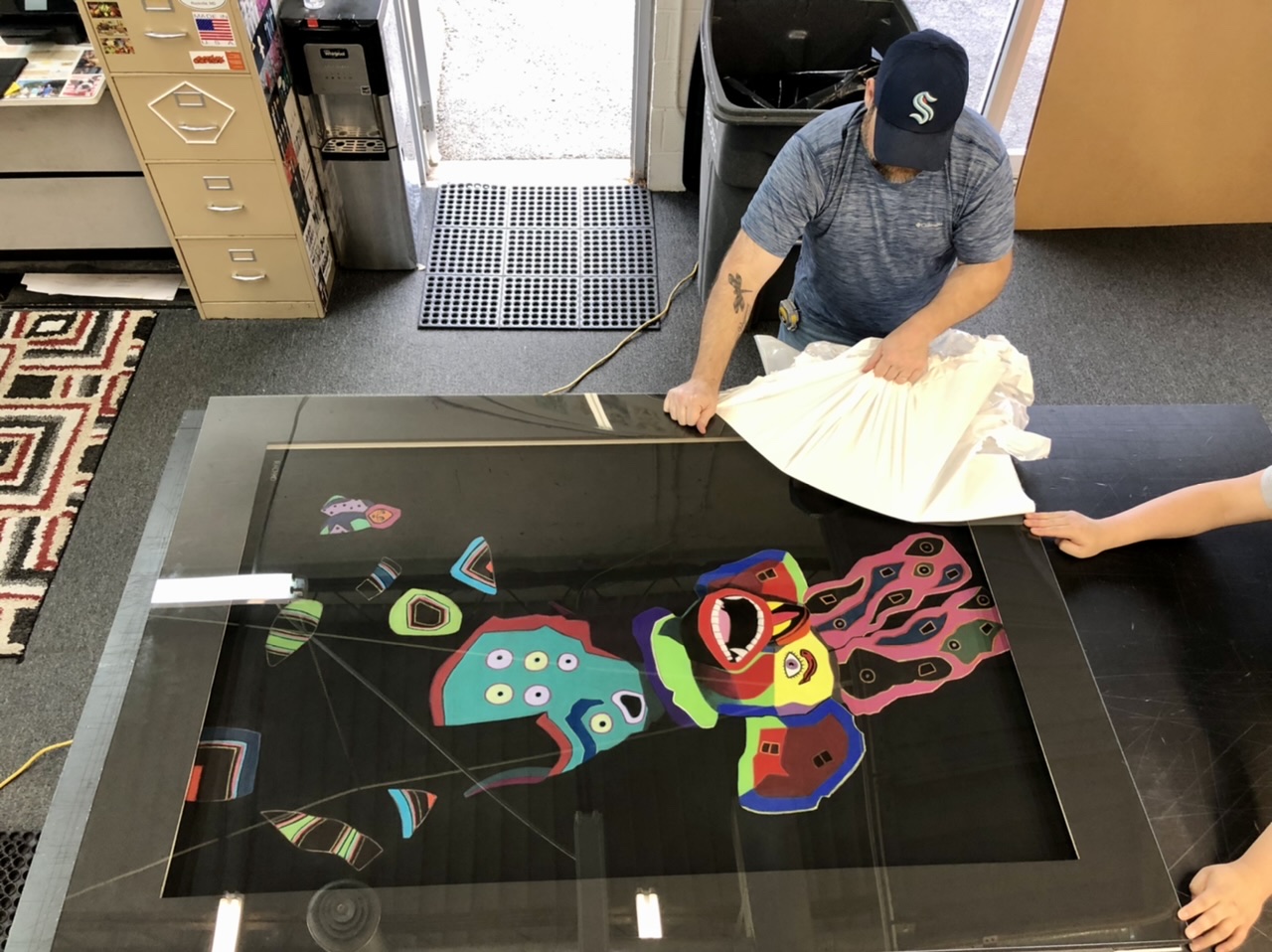
A: Actually, just the opposite since I have been looking at it on my easel for more than three months. Typically, I’m glad to say goodbye – temporarily – because I know when I pick it up in a month, I will have gained some distance and can begin to see and think about it more objectively. I can start reflecting on how this pastel painting relates to my overall body of work.
Comments are welcome!



 barbararachkoscoloreddust.com