Blog Archives
Q: Why do you work in series?
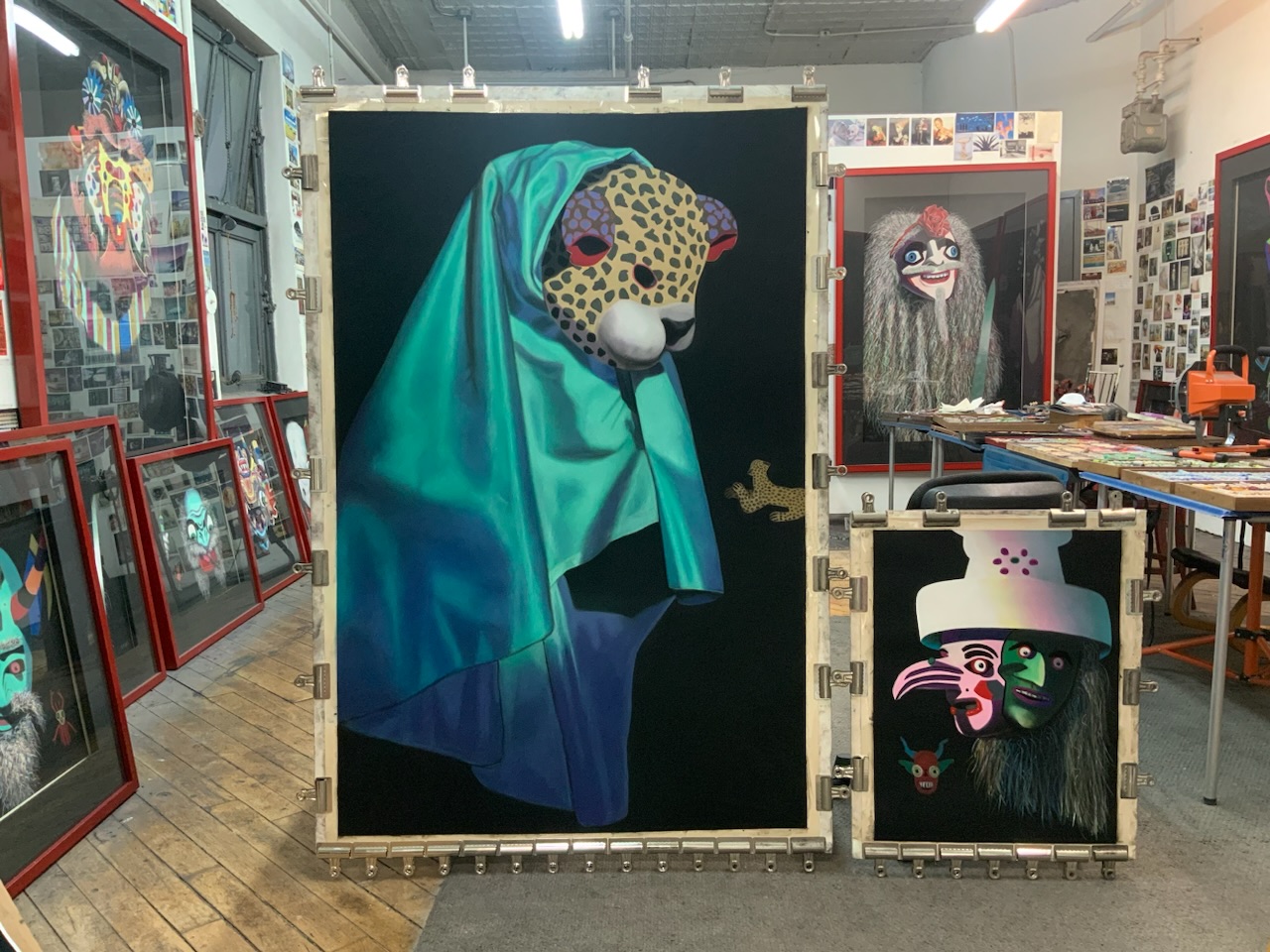
“Bolivianos” paintings in progress and on the walls and floor
A: I don’t really have any choice in the matter. It’s more or less the way I have always worked so it feels natural. Art-making comes from a deep place. In keeping with the aphorism ars longa, vita brevis, it’s a way of making one’s time on earth matter. Working in series mimics the more or less gradual way that our lives unfold, the way we slowly evolve and change over the years. Life-altering events happen, surely, but seldom do we wake up drastically different – in thinking, in behavior, etc. – from what we were the day before. Working in series feels authentic. It helps me eke out every lesson my paintings have to teach. With each completed piece, my ideas progress a step or two further.
I remember going to the Metropolitan Museum to see an exhibition called, “Matisse: In Search of True Painting.” It demonstrated how Matisse worked in series, examining a subject over time and producing multiple paintings of it. Matisse is my favorite artist of any period in history. I never tire of seeing his work and this particular exhibition was very enlightening. As I studied the masterpieces on the wall, I recognized a kindred spirit and thought, “Obviously, working in series was good enough for Matisse!”
Comments are welcome!
Pearls from artists* #561

*an ongoing series of quotations – mostly from artists, to artists – that offers wisdom, inspiration, and advice for the sometimes lonely road we are on.
The most powerful symbols draw profound reactions from us. The symbolic images in great art attract and fascinate us; they stir our souls and move us beyond what can be easily expressed; ‘their pregnant language cries out to us that they mean more than they say.’
The unconscious produces symbols as part of a natural process within us. These images emerge out of the context of our lived experience… Jung saw the meaning-making process as one that not only requires attendance to the real context of our lives and history, but also involves profound inner listening. It asks us to use our rational capacities, but also our feeling and imaginal ones.
Symbolic images redirect our psychic energy, bringing together conscious and unconscious material and producing the lessening of conflict. In this way, they activate a transcendent function within the psyche. We experience this as the discovery of personal meaning and healing. This transformation is not the result of formulaic operations, but rather is a dynamic process that requires our authentic and vulnerable participation. The process challenges the whole of who we are and requires deep moral effort. That the unconscious would produce moving, powerful compensatory symbols inside us at all points to a fact that our culture may not have fully grasped – that there is a force working within us which is always driving us towards healing growth and greater consciousness… Despite our suffering, the psyche is always ultimately seeking both a healthy homeostatic balance and our ever-unfolding growth and unique development.
Gary Bobroff in Carl Jung: Knowledge in a Nutshell
Comments are welcome!
Q: What advice would you give to a young artist with potential?

Barbara’s studio (since April 1997)
A: I last answered this question in my blog more than ten years ago and I would say similar things now to what I said then.
Be sure that you love your process unconditionally because there is no relationship between how hard you will work and how much money you will earn, period. Indeed, with inflation and rapidly evolving ways of doing business, it seems to cost more money every year to be an artist. As I’ve said often, be prepared to work very, very hard. Really it’s all about making the most of your gifts as an artist. If you don’t feel a deep responsibility to developing your talents as far as possible, you won’t have what it takes to keep going. Countless artists quit and no one can blame them. You absolutely must love your materials and your creative process and be willing to do whatever it takes to continue making art.
This is not a life for slackers!
Comments are welcome!
Q: How do you determine what size to make your pastel paintings? (Question from Prince North via Facebook)

A: For three decades I have been making pastel paintings in two sizes: 26” x 20” and 58” x 38.” These sizes are dictated by practical considerations.
The smaller ones are because 28” x 22” sheets of acid-free sandpaper are what’s available. (I mask off an inch all around for mats so the paintings are 20″ x 26″). For large paintings I buy rolls of acid-free sandpaper that measure 54 inches wide by 30 feet. I cut this down to 40″ x 60″ for paintings and mask off an inch all around on these, too.
And why specifically make them 58” x 38”? This is the absolute largest size I can make and I prefer making big paintings!
Again, practical factors come into play: the size of my truck, the cost and size of mat board, and the weight of the frames.
My pastel paintings need to lie flat when they are moved. Framed paintings are 70” x 50,” the largest size that can fit flat in the back of my Ford F-150. 58” x 38” is the largest size that will fit in a 8 feet by 4 feet sheet of mat board. (60 inch wide mat board is available, but the cost goes up considerably). Lastly, I’ve never weighed them but my large framed paintings are already rather heavy. It takes two people to carry them.
Comments are welcome!
Pearls from artists* # 543

*an ongoing series of quotations – mostly from artists, to artists – that offers wisdom, inspiration, and advice for the sometimes lonely road we are on.
Although the struggles that I faced involved me as an individual, I didn’t feel alone. I was forbidden to travel, but this forced immobility didn’t adversely affect my work; instead it gave me sustenance. For me, inspiration comes from resistance – without that, my efforts would be fruitless. Having a real – and powerful – adversary was my good fortune, making freedom all the more tangible – freedom comes from all the sacrifices you make to achieve it. Limitations come only from a fear inside the heart, and art is the antidote to fear. I did not need sympathy, for courage itself is an aesthetic feeling, and it’s only when true feeling is transformed into something broadly understood that art can avoid drying up.
Ai Weiwei in 1000 Years of Joys and Sorrows
Comments are welcome!
Q: What makes you feel most alive?

A: Making art makes me feel alive, using all my gifts, my brain, my heart, and my hands to create something that never existed before and that can never be duplicated; knowing I’m the only person, ever, who could or would make this particular thing, as I strive to push my pastel techniques further each time out. Whether it’s a painting or a photograph, I enjoy making something from nothing… art that is well-crafted and has never been seen before.
Travel is the other activity that excites me. I thrive on adventure and I especially love new vistas. When I am in a country I have never visited before, with every step and around every bend there is something new to see. I am an explorer at heart!
Comments are welcome!
Pearls from artists* # 514
*an ongoing series of quotations – mostly from artists, to artists – that offers wisdom, inspiration, and advice for the sometimes lonely road we are on
Basically I am trying not to stagnate. I go this way and I go that way and I don’t know where I’m going next. But if I should get stagnant, I’d lose my interest.
There are so many things to be considered when making music. The whole question of life itself; my life in which there are many things on which I don’t think I’ve reached a final conclusion; there are matters I don’t think I’ve covered completely, and all these things have to be covered before you make your music sound any way. You have to grow to know.
When I was younger, I didn’t think this would happen, but now I know that I’ve still got a long way to go. Maybe when I’m sixty I’ll be satisfied with what I’m doing, but I don’t know… I’m sure that later on my ideas will carry more conviction.
I know that I want to produce beautiful music, music that does things to people that they need. Music that will uplift and make them happy – those are the qualities I’d like to produce.
Coltrane on Coltrane: The John Coltrane Interviews, edited by Chris DeVito
Comments are welcome!
Pearls from artists* # 512
* an ongoing series of quotations – mostly from artists to artists – that offers wisdom, inspiration, and advice for the sometimes lonely road we are on.
Let inspiration lead you wherever it wants to lead you. Keep in mind that for most of history people just made things, and they didn’t make a big freaking deal about it.
We make things because we like making things.
We pursue the interesting and the novel because we like the interesting and the novel.
Elizabeth Gilbert in Big Magic: Creative Living Beyond Fear
Comments are welcome!
Pearls from artists* # 505
*an ongoing series of quotations – mostly from artists, to artists – that offers wisdom, inspiration, and advice for the sometimes lonely road we are on.
… I myself was once “at the top: – with a book that sat on the bestseller list for more than three years. I can’t tell you how many people said to me during those years, “How are you ever going to top that?” They’d speak of my great good fortune as though it were a curse, not a blessing, and would speculate about how terrified I must feel at the prospect of not being able to reach such phenomenal heights again.
But such thinking assumes there is a “top” – and that reaching that top (and staying there) is the only motive one has to create. Such thinking assumes that the mysteries of inspiration operate on the same scale as we do – on a limited human scale of success and failure, of winning and losing, of comparison and competition, of commerce and reputation, of units sold and influence wielded. Such thinking assumes that you must be constantly victorious – not only against your piers, but also against an earlier version of your own poor self. Most dangerously of all, such thinking assumes if you cannot win, then you must not continue to play.
But what does any of that have to do with vocation? What does any of that have to do with the pursuit of love? What does any of that have to do with the strange communion between the human and the magical? What does any of that have to do with faith? What does any of that have to do with the quiet glory of merely making things, and then sharing those things with an open heart and no expectations?
Elizabeth Gilbert in Big Magic: Creative Living Beyond Borders
Comments are welcome!


 barbararachkoscoloreddust.com