Blog Archives
Q: Would you speak about the meaning of your work and the different materials you use?
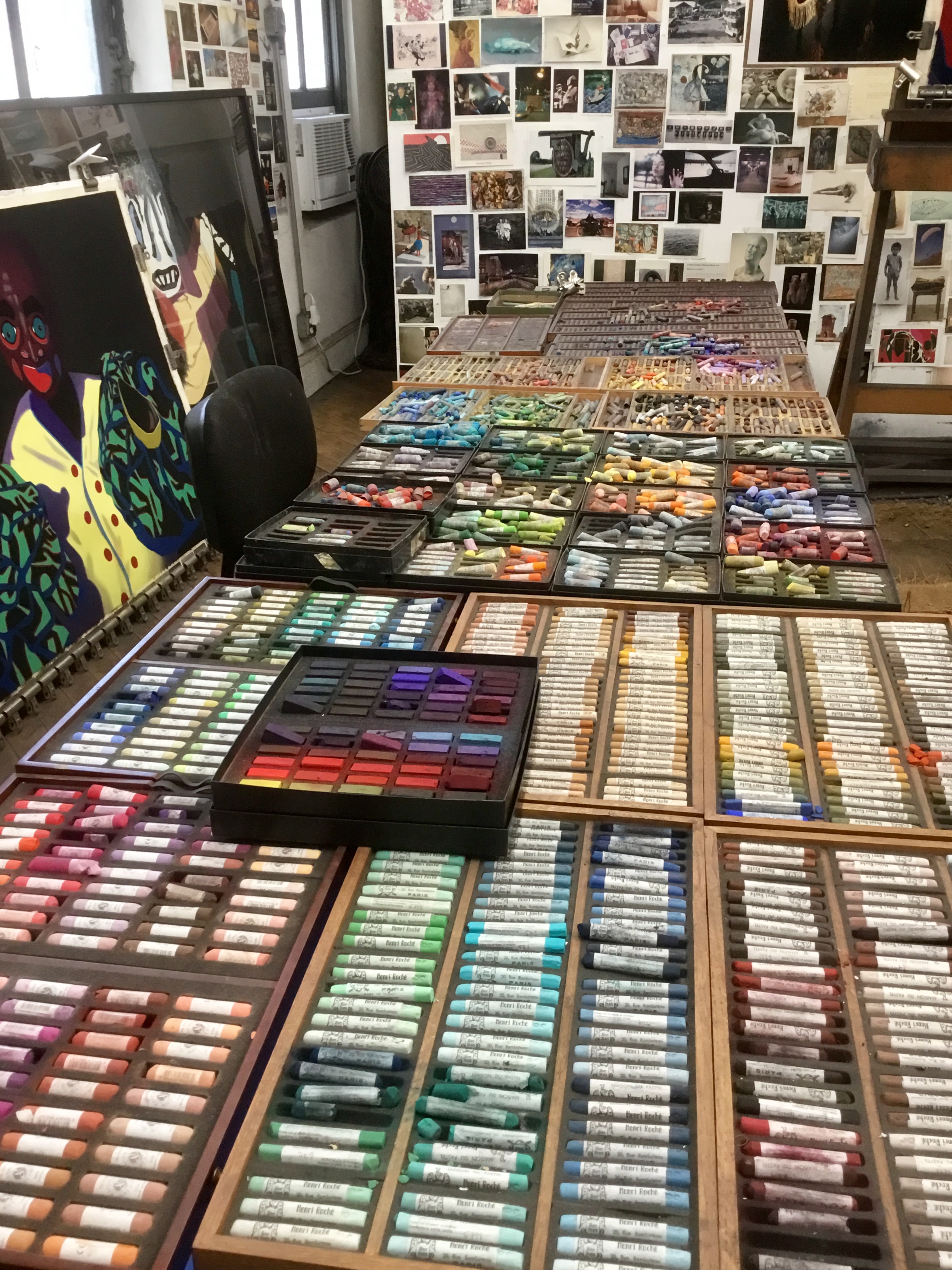
About half of Barbara’s pastels
A: It is as difficult to explain the meaning of my art as it is to interpret the meaning of life! I am invested in and concerned with process: foreign travel, prodigious reading, devotion to craft, months of slow meticulous work in the studio trying to create an exciting work of art that has never been seen before, etc. I love making pastel paintings! Many years ago I challenged myself to push the limits of what soft pastel can achieve. I am still doing so.
I leave it to others – viewers, arts writers, critics, art historians – to study my creative journey and talk about meanings. I believe an artist is inspired to create and viewers ponder the creation. I would not presume to tell anyone how to react to my work.
For many years I have been devoted to promoting soft pastel as a fine art medium. There are excellent reasons it has been around for five hundred years! It is the most permanent of media. There’s no liquid binder to cause oxidizing or cracking over time, as happens with oil paint. Pastel colors are intense because they are close to being pure pigment. Pastel allows direct application (no brushes) with no drying time and no color changes.
I use UArt acid-free sandpaper. This is not sandpaper from a hardware store. It is made for artists who work in pastel and allows me to build up layers of pigment without using a fixative. My process – slowly applying and layering pastels, blending and mixing new colors directly on the paper, making countless adjustments, searching for the best and/or most vivid colors – continually evolves. Each pastel painting takes months to create.
Comments are welcome!
Pearls from artists* # 328

Barbara in her studio, Photo: Izzy Nova
*an ongoing series of quotations – mostly from artists, to artists – that offers wisdom, inspiration, and advice for the sometimes lonely road we are on.
An artist’s words are always to be taken cautiously… The artist who discusses the so-called meaning of his work is usually describing a literary side-issue. The core of his original impulse is to be found, if at all, in the work itself. Just the same, the artist must say what he feels…
I want to explain why I did the piece, I don’t see why artists should say anything because the work is supposed to speak for itself. So whatever the artist says about it is like an apology, it is not necessary.
I never talk literally; you have to use analogy and interpretation and leaps of all kinds…
I am suspicious of words. They do not interest me, they do not satisfy me. I suffer from the ways in which words wear themselves out. I distrust the Lacans and Bossuets because they gargle with their own words. I am a very concrete woman. The forms are everything…
With words you can say anything. You can lie as long as the day, but you cannot lie in the recreation of experience…
Louise Bourgeois: Destruction of the Father, Reconstruction of the Father: Writings and interview 1923-1997, edited and with texts by Marie-Laure Bernadac and Hans-Ulrich Obrist
Comments are welcome!
Q: When and where did you start your career in the visual arts?
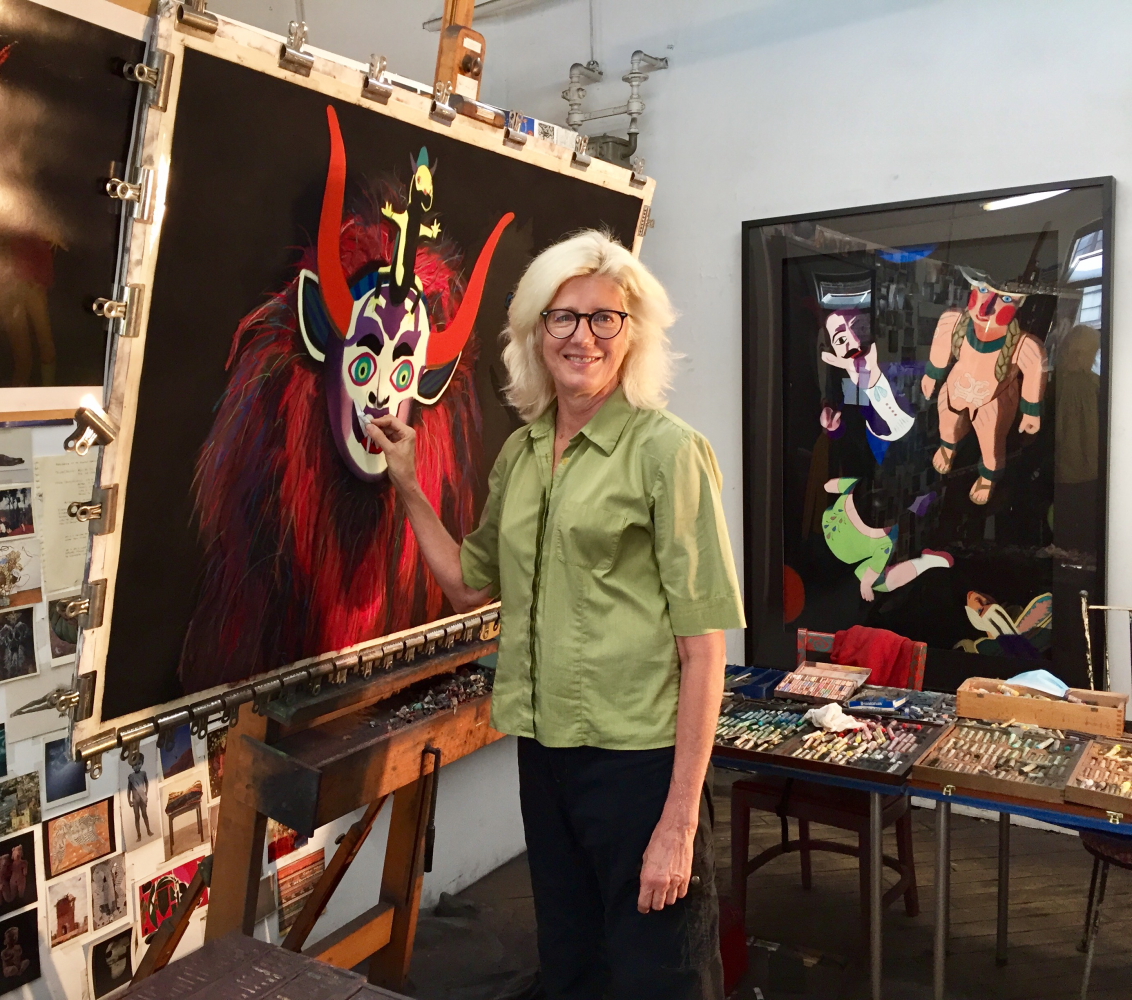
In the studio, Photo: Maria Cox
A: My journey to becoming an artist was circuitous. In the mid-1980s I was a thirty-something Navy lieutenant. I worked a soul-crushing job as a computer analyst on the midnight shift in a Pentagon basement. We were open 24/7 and supported the Joint Chiefs of Staff.
Remembering the joyful Saturdays of my youth in New Jersey, when I had studied with a local painter, I enrolled in a drawing class at the Art League School in Alexandria, Virginia. I loved it! I took more classes and became a highly motivated, full-time art student who worked nights at the Pentagon. After two years and as my skills improved, I discovered my preferred medium – soft pastel on sandpaper.
I knew I had found my calling, submitted my resignation, and left active duty. On October 1, 1989 I became a professional artist. However, I remained in the Navy Reserve for another fourteen years, working at the Pentagon one weekend a month. On November 1, 2003, I retired as a Navy Commander.
Comments are welcome!
Pearls from artists* # 324

Untitled c-print, 24″ x 24,” edition of 5
*an ongoing series of quotations – mostly from artists, to artists – that offers wisdom, inspiration, and advice for the sometimes lonely road we are on.
“The artist is the creator of beautiful things.” From [Immanuel] Kant’s perspective on conventional beauty, [Oscar] Wilde’s definition would seem to demote artists to a cosmetic role, turning them, as William Irwin Thompson said, into “the interior decorators of Plato’s cave.” On the other hand, under the terms of a radical beauty that brings forth the Real instead of pacifying us with delusions of “realism,” Wilde’s line can help restore art to its shamanic source in our minds. Perhaps it would have been better if Wilde had defined the artist as the creator of numinous things – of enchanted objects, omens, or talismans. Because if there is one thing that all beautiful things share, it is that they are all symbols. They are all transmissions from another plane of existence.
It is one thing to acknowledge the Beautiful as an objective property of the phenomenal world. It is another to stop and listen to what it has to say.
J.F. Martel in Reclaiming Art in the Age of Artifice: A Treatise, Critique, and Call to Action
Comments are welcome!
Q: What more would you wish to bring to your work?
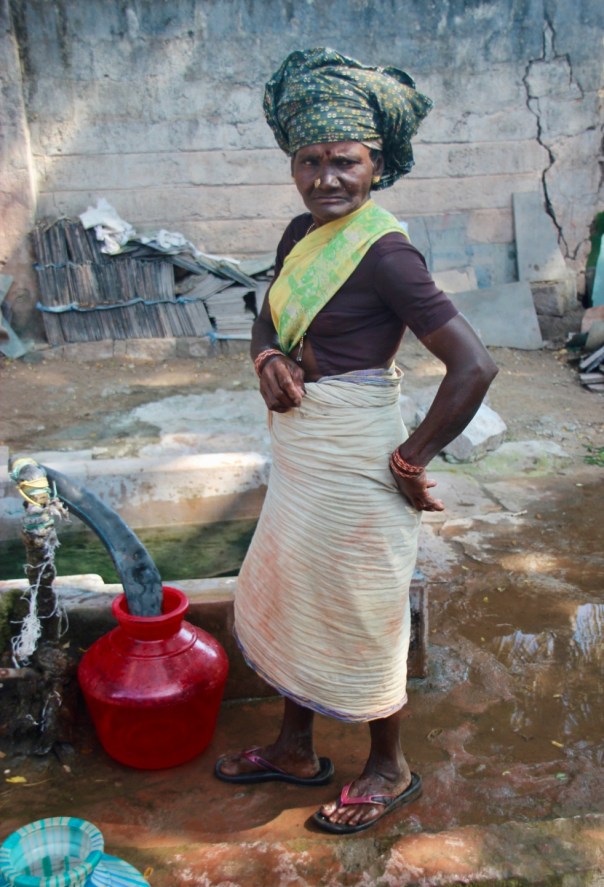
Tile worker in South India
A: I tend to follow wherever the work leads, rather than directing it. I have never been able to predict where it will lead or what more might be added.
Travel is essential for inspiration. Besides many Mexican sojourns, I have been to Bali, Sri Lanka, South India, Guatemala, Honduras, Brazil, Peru, Argentina, Paraguay, and other places. A second trip to India is upcoming, to Gujarat and Rajistan this time.
Last year I had the opportunity to go to Bolivia. In La Paz I visited the Museum of Ethnography and Folklore, where a stunning mask exhibition was taking place. As soon as I saw it, I knew this would be the inspiration for my next series, “Bolivianos.” So far I have completed six “Bolivianos” pastel paintings with two more in progress now. This work is getting a lot of press and several critics have declared it to be my strongest series yet.
Comments are welcome!

Q: Do your materials have properties that allow you to maximize what you depict in your work?
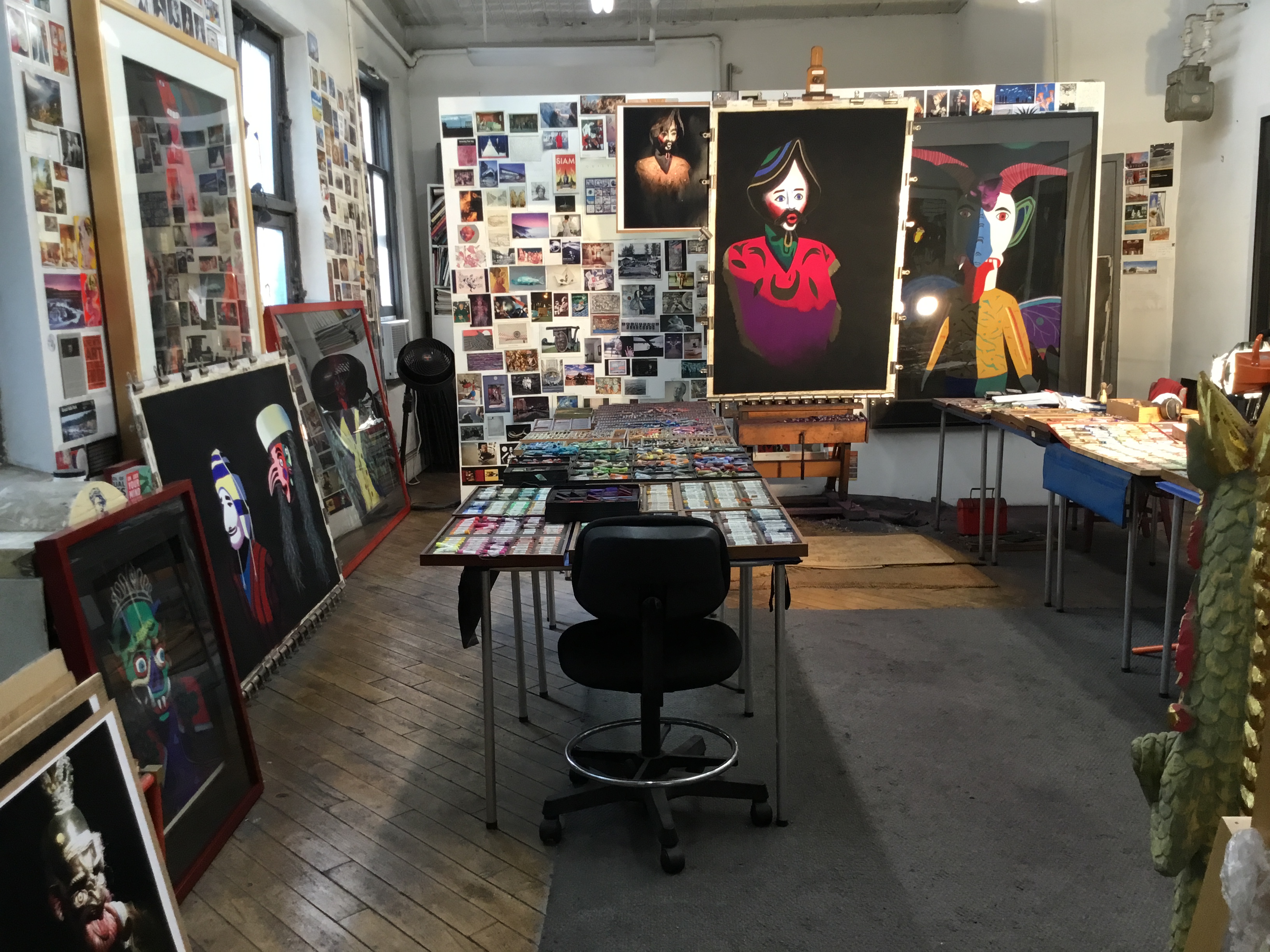
Barbara’s studio
A: I work exclusively in soft pastel on sandpaper. Pastel, which is pigment and a binder to hold it together, is as close to unadulterated pigment as an artist can get. It allows for very saturated color, especially as I utilize the self-invented techniques developed and mastered over more than thirty years as an artist. I believe my “science of color” to be unique, completely unlike how any other artist works. I spend three or four months on each painting, applying pastel and blending the layers together to mix new colors directly on the paper.
The sandpaper support allows the build up of 25 to 30 layers of pastel as I slowly and meticulously work for hundreds of hours to complete a painting. The paper is extremely forgiving. I can change my mind, correct, refine, etc. as much as I want until a painting is the best I can create at that moment in time.
Comments are welcome!
Q: Do you have a favorite painting among all the work you have created?
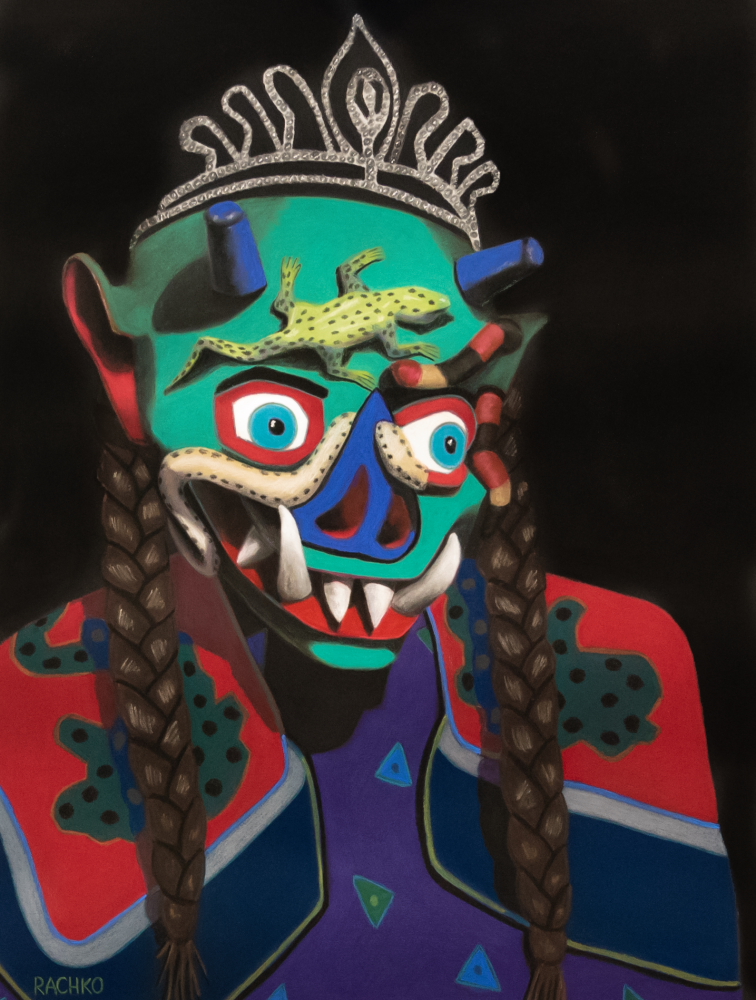
”Shamanic,” soft pastel on sandpaper, 26” x 20”
A: Generally, it’s the last one I completed, perhaps because it encapsulates everything I’m currently thinking about. At the moment my favorite is “Shamanic.”
I believe all of my prior experience in and out of the studio has contributed to making me a better artist and also a better person. So whichever work I finished last, seems the best somehow, and it’s also my favorite.
I wonder, do other artists feel this way, too?
Comments are welcome!
Q: What is more important to you, the subject of the painting or the way it is executed?

“Sam and Bobo,”soft pastel on sandpaper, 36″ x 31”, 1989
A: In a sense my subject matter – folk art, masks, carved wooden animals, papier mâché figures, toys – chose me. With it I have complete freedom to experiment with color, pattern, design, and other formal properties. In other words, although I am a representational artist, I can do whatever I want since the depicted objects need not look like real things. Execution is everything now.
This was not always the case. I started out in the 1980s as a traditional photorealist, except I worked in pastel on sandpaper. (For example, see the detail in Sam’s sweater above). As I slowly learned and mastered my craft, depicting three-dimensional people and objects hyper-realistically in two dimensions on a piece of sandpaper was thrilling… until one day it wasn’t.
My personal brand of photorealism became too easy, too limiting, too repetitive, and SO boring to execute! In 1989 I had at last extricated myself from a dull career as a Naval officer working in Virginia at the Pentagon. Then after much planning, in 1997 I was a full-time professional artist working in New York.
Certainly I was not going to throw away this opportunity by making boring photorealist art. I wanted to do so much more as an artist: to experiment with techniques, with composition, to see what I could make pastel do, to let my imagination play a larger role in the paintings I made. I was ready to devote the time and do whatever it took to push my art further.
After spending the early creative years perfecting my technical skills, I built on what I had learned. I began breaking rules – slowly at first – in order to push myself onward. And I continue to do so, never knowing what’s next. Hopefully, in 2018 my art is richer for it.
Comments are welcome!
Pearls from artists* # 302

“Epiphany,” soft pastel on sandpaper, 38″ x 58″
*an ongoing series of quotations – mostly from artists, to artists – that offers wisdom, inspiration, and advice for the sometimes lonely road we are on.
Regardless of personal convictions or professional concerns, an artist’s power comes down to two things: her sensitivity to the radical mystery of existence, and the artistry and craft with which she can channel that mystery into an object or performance. Neither existential awe nor a given metaphysical outlook need to serve as an explicit motivation. Simply, the emergence of artistic vision – and the need to express the vision without distorting or conceptualizing it – is contingent upon the underlying wonderment at being itself, a wonderment without which there would be no art.
J.F. Martel in Reclaiming Art in the Age of Artifice: A Treatise, Critique, and Call to Action
Comments are welcome!
Q: Having worked as an artist for more than three decades, you and your work finally are becoming well known. Do you ever receive fan letters?
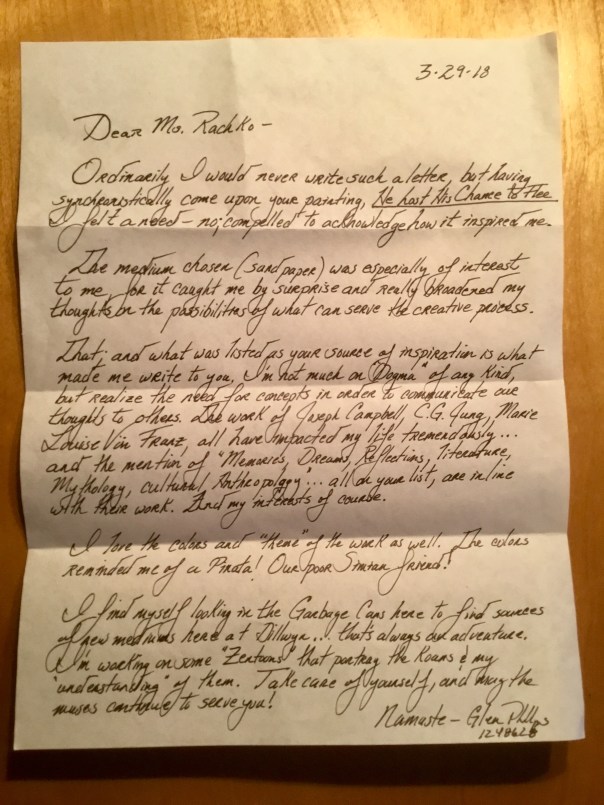
Letter from a fan
A: Yes, I do hear from fans. Recently I received the hand-written letter pictured above. It’s from a well-read inmate in a Virginia prison. I chuckled when I read it because Glen was taken with an old pastel painting of mine called, “He Lost His Chance to Flee”!
It’s a lovely letter. I’m touched to know that my work is inspiring people to think about and make art!
Comments are welcome!



