Blog Archives
Q: Over your 40-year career as an artist, you have managed to keep presentation, technical, subject matter, conceptual consistencies in your art practice and work. How do you manage to filter out inspirations that might be luring at that moment but do not support your art practice? For example, you master pastel works. There must have been moments when you might have been inspired to make oil works. How do you keep such inspirations aside. (Question from Vedica Art Studios and Gallery)

A: About thirty-five years ago, when my pastel paintings were becoming larger—around 60” x 40”—I had to choose between transitioning to oil on canvas or continuing with pastel. Framing was the main concern. I wasn’t certain large pastels could be framed, and even if they could, the cost might be prohibitive. However, I had already fallen in love with pastel and knew no other medium could offer such vibrant colors or velvety textures. Determined, I resolved the framing issue (art-making is fundamentally problem-solving), committed myself fully to soft pastel, and have continued inventing and refining techniques ever since.
My goal from the beginning has always been improvement as an artist. If an activity doesn’t contribute to my growth—as a person or as an artist—I typically don’t pursue it. Time and energy are finite resources, so I try to use them wisely.
Comments are welcome!
Q: Do you have any rituals that you do in the mornings before you begin working?

Art From Your Core by Kate Kretz
A: When I arrive at the studio in the morning it’s rare for me to immediately start working. Usually I read something art-related. At the moment I’m rereading Art From Your Core: A Holistic Guide to Visual Voice by Kate Kretz. This is a fabulous book for visual artists. It is a must-read and has become my current art bible! As usual I am struggling to understand aspects of the art business and figure out what’s next to get my work appreciated and collected by a new audience. Art From Your Core reminds why I decided to make art in the first place and what I need to do to continue to improve. It helps reconnect with forgotten parts of myself and is a much-needed reminder of what I love most about being an artist.
Balancing the creative and business aspects of my art practice is an ongoing struggle. I imagine this is true for most artists. Both jobs are so important. An artist needs an appreciative audience – very few artists devote their lives to art-making so that the work will remain in a closet – but I also believe this (from a note hand-written years ago that I tacked to the studio wall): “Just make the work. None of the rest matters.”
Comments are welcome.
Pearls from artists* # 534

*an ongoing series of quotations – mostly from artists, to artists – that offers wisdom, inspiration, and advice for the sometimes lonely road we are on.
Today I am quoting myself:
I strive to always do what is best for my art practice. It’s difficult sometimes, but it’s important to ignore most of what other people say. They mean well, but advice to artists is often misguided, especially when it is unsolicited. Fortunately, our hearts are never wrong.
B. Rachko on a Facebook post
Comments are welcome!
Q: Would you describe your current work in a few sentences?
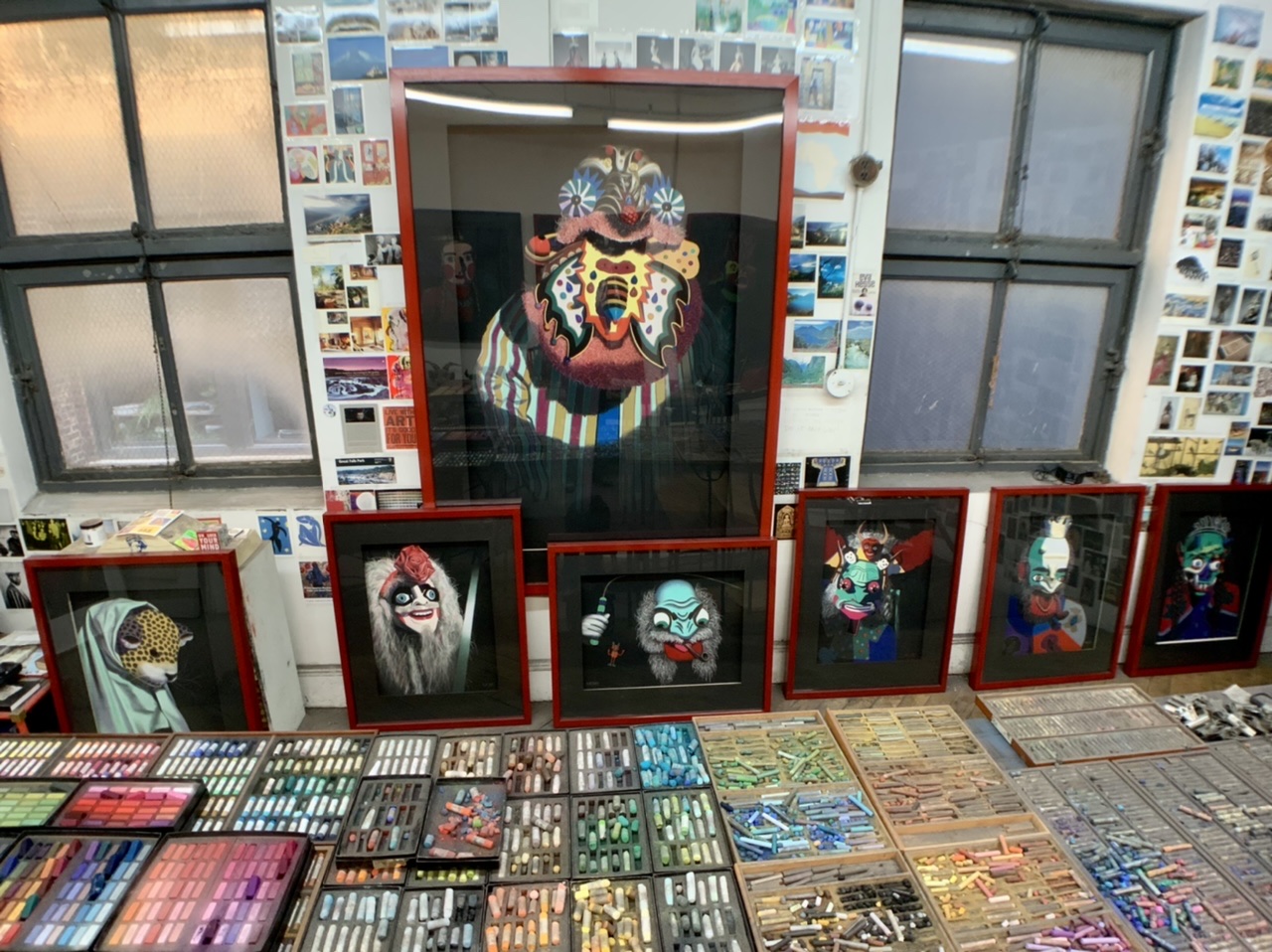
A: Of course, my art practice continually evolves and so does my thinking about its meaning. Using my own iPad photographs of Bolivian Carnival masks from Oruro as source material, for the past five years I have been slowly building a rogue’s gallery of beautiful, if somewhat misunderstood, characters probably best described as oddballs and misfits. For me, the paintings have a deeper meaning as archetypes of the collective unconscious. Creating this series is an act of genuine love. It is my hope that the ”Bolivianos” pastel paintings convey my deep respect and compassion for people around the world.
Comments are welcome!
Q: How do you work and approach your subject? (Question from “Arts Illustrated”)
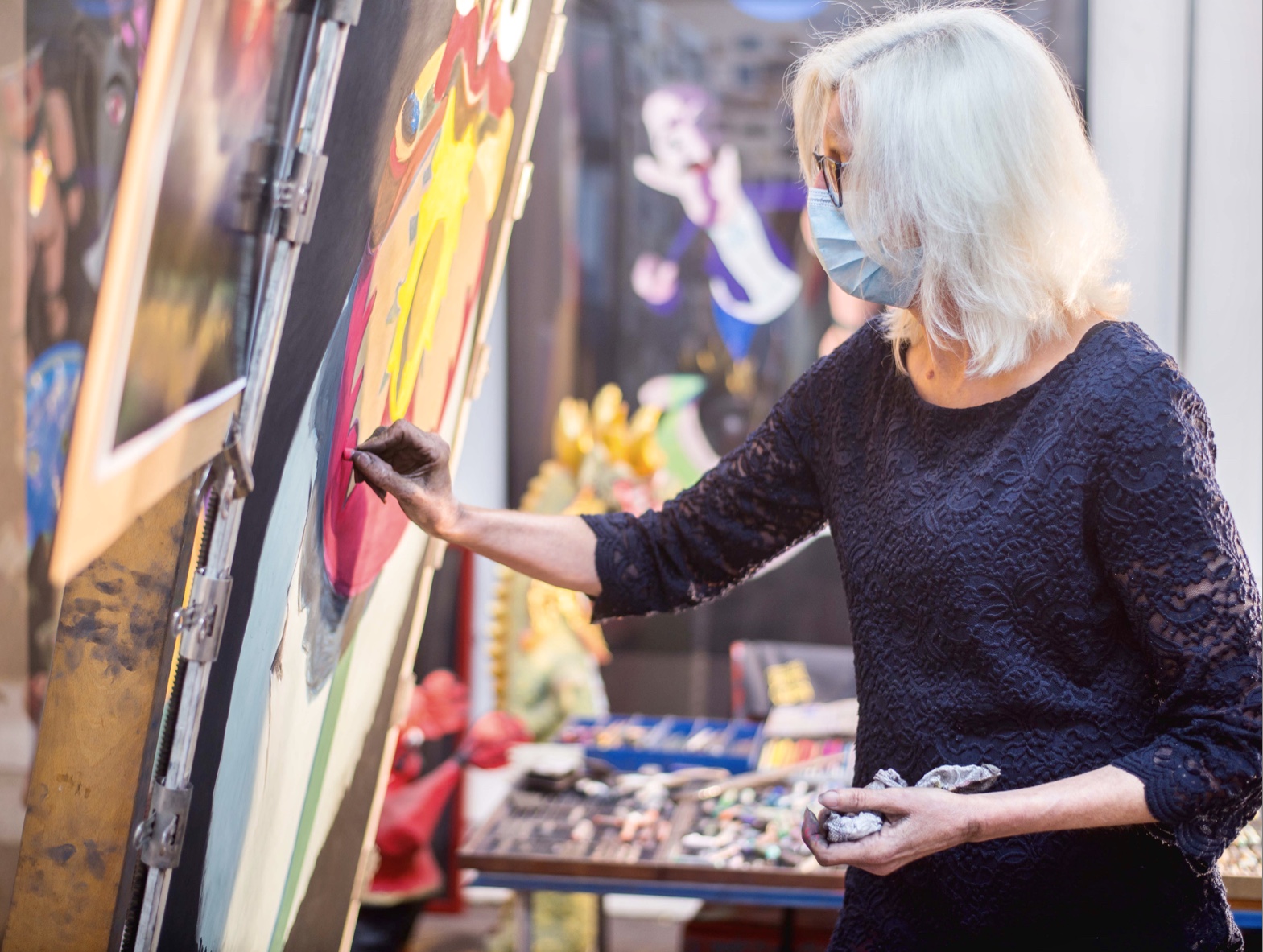
A: Undoubtedly, I could not make my work without UART sandpaper since my entire pastel technique evolved around it. I use 400 0r 500 grit. My favorite thing about it is its ‘tooth’ (i.e. texture or roughness).
Over the many months I spend creating a pastel painting, I build layer upon layer of soft pastel. Because the paper I use is relatively “toothy,” it accepts all of the pastel the painting needs. And as many people know, I own and use thousands of soft pastels!
Many layers of soft pastel and several months of studio time go into creating each painting. My self-invented technique is analogous to the glazing techniques used by the Old Masters, who slowly built up layers of thin oil paint to achieve a high degree of finish. Colors were not only mixed physically, but optically.
Similarly, I gradually build up layers of soft pastel, as many as thirty, to create a pastel painting. After applying a color, I blend it with my fingers and push it into the sandpaper’s tooth. It mixes with the color beneath to create a new color, continually adding richness, saturation, and intensity to the piece. By the time a pastel painting is finished, the colors are bold, vibrant, and exciting.
From the beginning in the 1980s I used photographs as reference material and my late husband, Bryan, would shoot 4” x 5” negatives of my elaborate setups with his Toyo-Omega view camera. In those days I rarely picked up a camera except when we were traveling. After Bryan was killed on 9/11, I inherited his extensive camera collection – old Nikons, Leicas, Graphlex cameras, etc. – and I wanted to learn how to use them. In 2002 I enrolled in a series of photography courses (about 10 over 4 years) at the International Center of Photography in New York. I learned how to use all of Bryan’s cameras and how to make my own big color prints in the darkroom.
Along the way I discovered that the sense of composition, form, and color I developed over many years as a painter translated well into photography. The camera was just another medium with which to express my ideas. Astonishingly, in 2009 I had my first solo photography exhibition in New York.
It’s wonderful to be both a painter and a photographer. Pastel painting will always be my first love, but photography lets me explore ideas much faster than I ever could as a painter. Paintings take months of work. To me, photographs – from the initial impulse to hanging a framed print on the wall – are instant gratification.
For several years I have been using my iPad Pro to capture thousands of travel photographs. Most recently, I visited Gujarat and Rajasthan in India. I have never been inclined to use a sketchbook so composing photos on my iPad keeps my eye sharp while I’m halfway around the world, far from my studio practice.
My blog, “Barbara Rachko’s Colored Dust,” continues to be a crucial part of my overall art practice. Blogging twice a week forces me to think deeply about my work and to explain it clearly to others. The process has helped me develop a better understanding about why I make art and, I like to think, has helped me to become a better writer.
Comments are welcome!
Q: You are a multi-talented woman! Tell us about your book, “From Pilot to Painter,” and how writing, for you, compares to painting and photography. Which do you prefer?
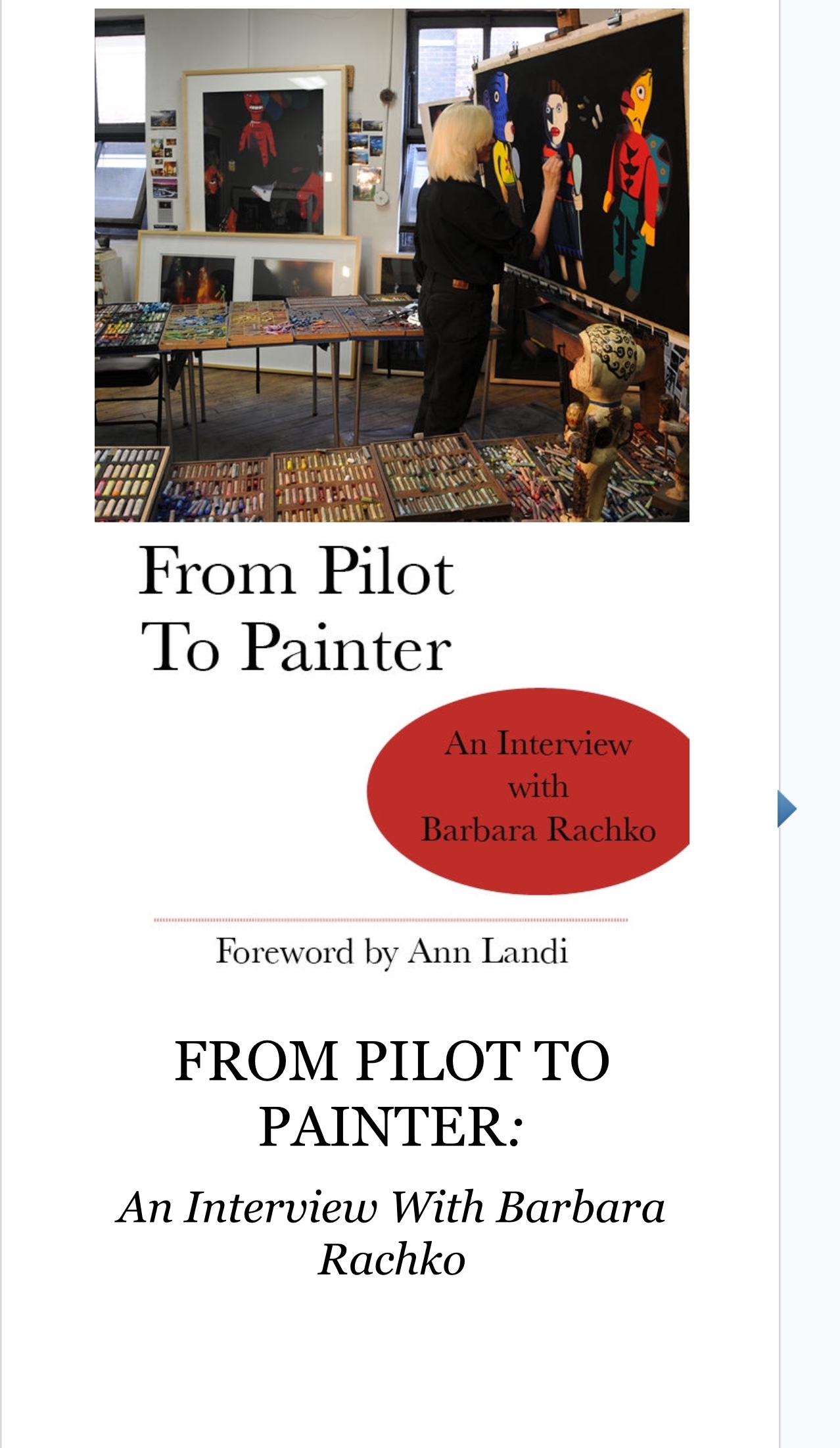
“From Pilot to Painter”
A: I am pleased that my eBook FROM PILOT TO PAINTER is available on Amazon and iTunes. It is based on my blog and is part memoir, including my personal loss on 9/11, insights into my creative practice, and intimate reflections on what it’s like to be an artist living in New York City now. The eBook includes new material not found on the blog, plus 25+ reproductions of my vibrant pastel-on-sandpaper paintings, a Foreword by Ann Landi (who writes for ARTnews and The Wall Street Journal), and more.
“Barbara Rachko’s Colored Dust” (the title of my blog) continues to be a crucial part of my overall art practice. Blogging twice a week forces me to think deeply about my work and to explain it clearly to others. The process has helped me develop a better understanding about why I make art and has encouraged me to become a better writer.
From the beginning in the 1980s I used photographs as reference material and Bryan would shoot 4” x 5” negatives of my elaborate setups with his Toyo-Omega view camera. In those days I rarely picked up a camera except when we were traveling. After Bryan was killed on 9/11, I inherited his extensive camera collection – old Nikons, Leicas, Graphlex cameras, etc. – and I wanted to learn how to use them. In 2002 I enrolled in a series of photography courses (about 10 over 4 years) at the International Center of Photography in New York. I learned how to use all of Bryan’s cameras and how to make my own big color prints in the darkroom. Along the way I discovered that the sense of composition, form, and color I developed over many years as a painter translated well into photography. The camera was just another medium with which to express my ideas. Astonishingly, in 2009 I had my first solo photography exhibition in New York.
It’s wonderful to be both a painter and a photographer. Pastel painting will always be my first love, but photography lets me explore ideas much faster than I ever could as a painter. Paintings take months of work. To me, photographs – from the initial impulse to hanging a framed print on the wall – are instant gratification.
For two years I have been using my iPad Pro to capture thousands of travel photographs. Most recently, I visited Gujarat and Rajasthan in India. I have never been inclined to use a sketchbook so composing photos on my iPad keeps my eye sharp while I’m halfway around the world, far from my studio practice.
Comments are welcome!
Q: What non-art book are you reading now?
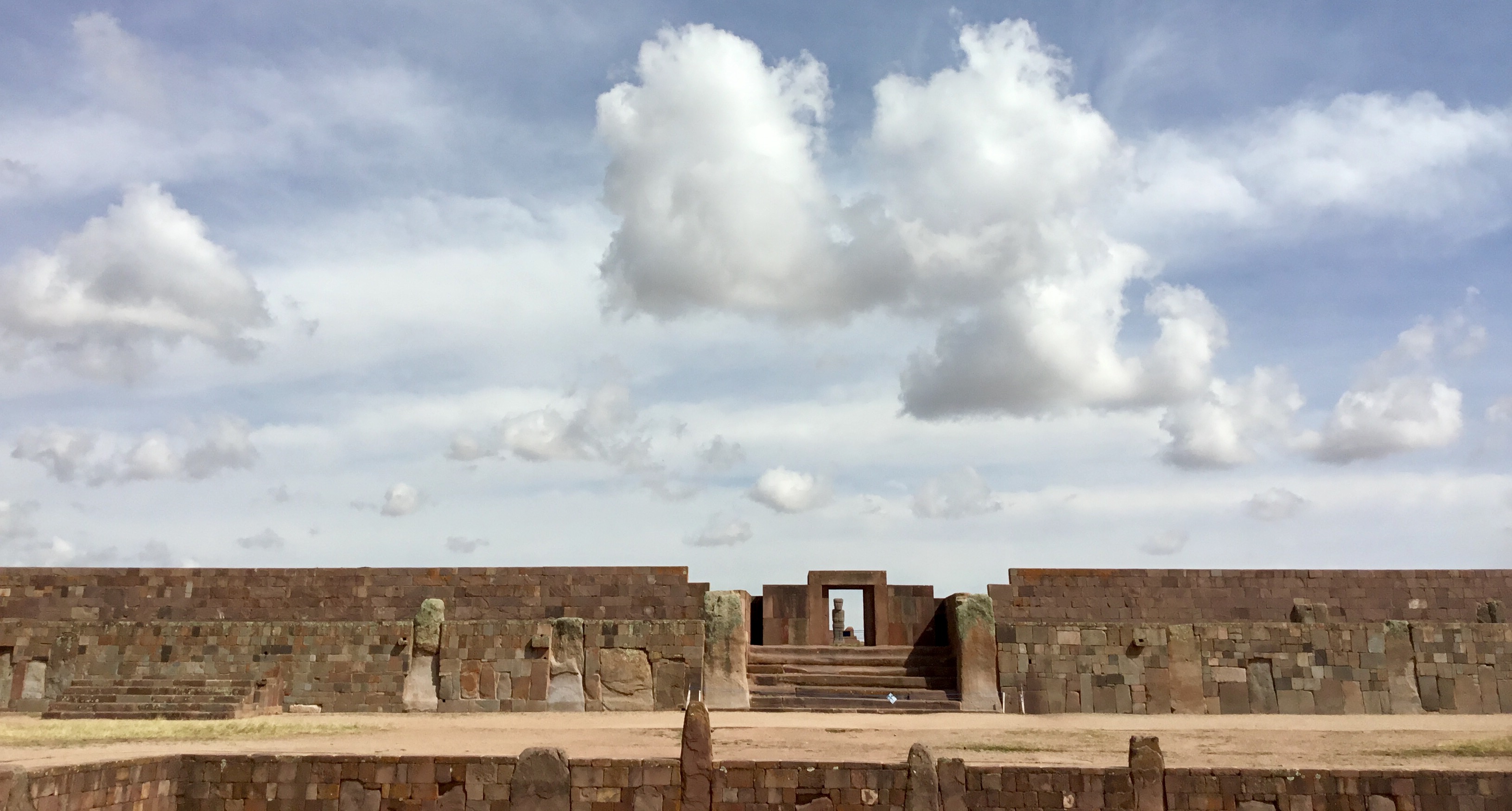
Tiwanaku
A: I am reading Kim Mac Quarrie’s, “The Last Days of the Incas.” It’s fascinating to discover the intricacies of the epic conquest of the short-lived Inca empire. The book is actually thrilling to read. Mac Quarrie makes this story come alive.
Last summer I traveled to Peru to investigate the history of the Incas and the civilizations that preceded them. In May of this year I continued my studies with a trip to Bolivia. Both trips are proving to be highly inspirational for my art practice.
Comments are welcome!


 barbararachkoscoloreddust.com