Category Archives: Working methods
Q: What’s on the easel today?
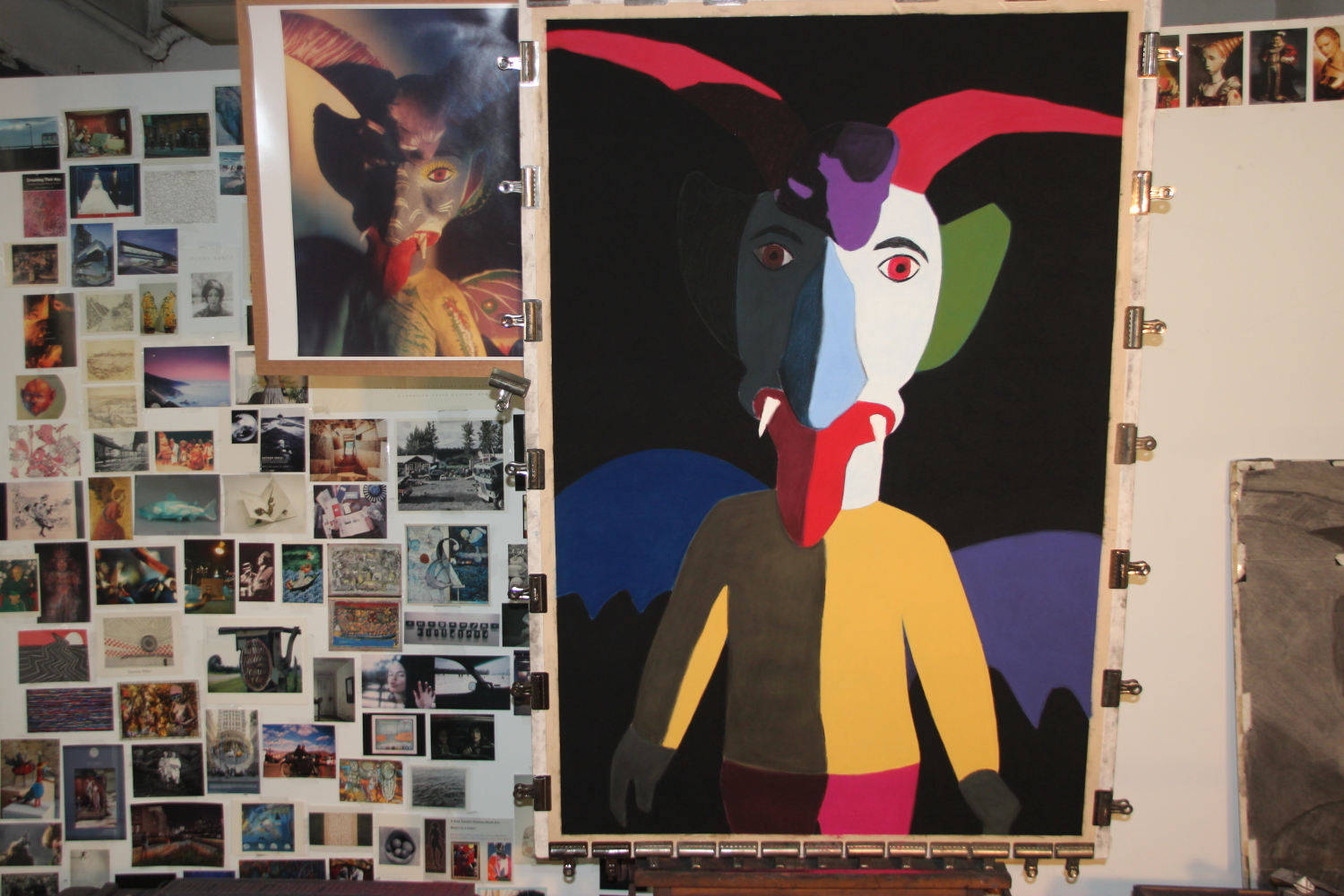
Work in progress, 58″ x 38″
A: Today is a day off to let my fingers heal. When I start a new painting, I need to rub my fingers against raw sandpaper in order to blend the pastel. With each layer the tooth of the paper gets filled up and becomes smooth, but until then my fingers suffer. Here is what I’ve been working on.
This pastel-on-sandpaper painting is an experiment, an attempt to push myself to work with bigger and bolder imagery. The photograph clipped to the easel is one of my favorites. It depicts a Judas that Bryan and I found in a dusty shop in Oaxaca. Among the Mexican and Guatemalan folk art pieces that I’ve collected are five papier mâché Judases. This particular one is unusual because it has a cat’s head attached at the forehead (the purple shape in the painting). They are not made to last. In some Mexican towns large Judases are hung from church steeples, loaded with fireworks, and burned in effigy. This takes place at 10:00 a.m. on the Saturday morning before Easter. Mexico is primarily a Catholic nation, of course, so effigy burning is done as symbolic revenge against Judas for his betrayal of Christ. The Judas in the photo is small and meant for private burning by a family (rather than in public at a church) so by bringing it back to New York I rescued it from a fire-y death! In sympathy with Mexican tradition, I began this painting last Saturday (the day before Easter) at 10 a.m.
Comments are welcome!
Q: Your new work explores relationships to figures through the medium of soft pastel. What prompted this departure from photography?
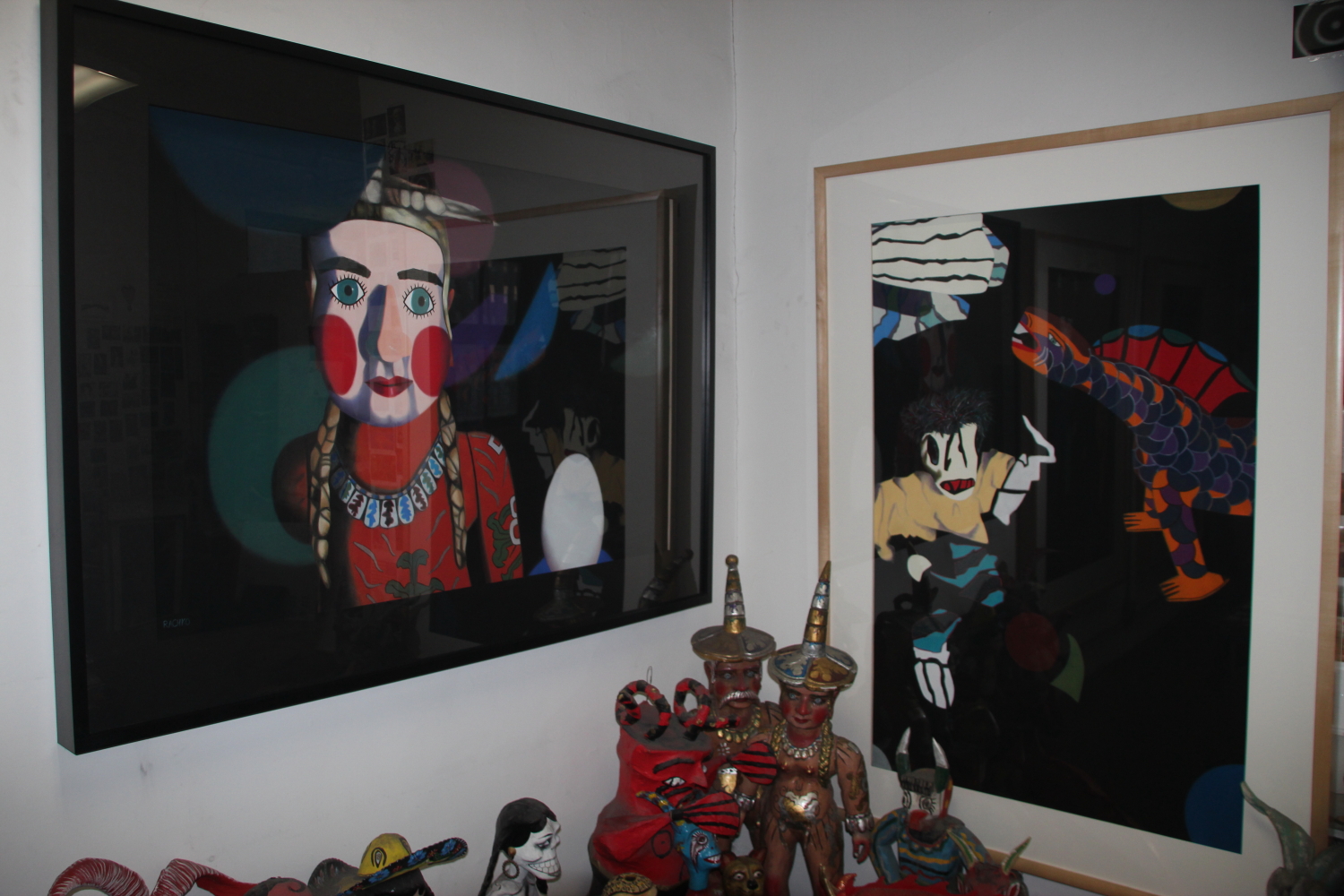
A corner of the studio
A: Actually it was the other way around. As I’ve mentioned, I was a maker of pastel-on-sandpaper paintings long before I became a photographer (1986 vs. 2002). However, the photos in the “Gods and Monsters” series were meant to be photographs in their own right, i.e., they were not made to be reference material for paintings. in an interesting turn of events, in 2007 I started a new series, “Black Paintings,” which uses the “Gods and Monsters” photographs as source material. Collectors who have been following my work for years tell me the new series is the strongest yet. For now I’m enjoying where this work is leading. The last three paintings are the most minimal yet and I’ve begun thinking of them as the “Big Heads.” There is usually a single figure (“Stalemate” has two) that is much larger than life size. “Epiphany” (above, left) is an example. All of them are quite dramatic when seen in person, especially with their black wooden frames and mats.
Comments are welcome!
Pearls from artists* # 33

Botanical, Bali
* an ongoing series of quotations – mostly from artists, to artists – that offers wisdom, inspiration, and advice for the sometimes lonely road we are on.
I am vitally interested in the man who today has the misfortune of being an artist and a human being. By the same token I am as much interested in the maneuvers of the gangster as I am in those of the financier or the military man. They are all part and parcel of society; some are lauded for their efforts, some reviled, some persecuted and hunted like beasts. In our society the artist is not encouraged, not lauded, not rewarded, unless he makes use of a weapon more powerful than those employed by his adversaries. Such a weapon is not to be found in shops or arsenals: it has to be forged by the artist himself out of his own tissue. When he releases it he also destroys himself. It is the only method he has found to preserve his own kind. From the outset his life is mortgaged. He is a martyr whether he chooses to be or not. He no longer seeks to generate warmth, he seeks for a virus with which society must allow itself to be injected or perish. It does not matter whether he preaches love or hate, freedom or slavery; he must create room to be heard, ears that will hear. He must create, by the sacrifice of his own being, the awareness of a value and a dignity which the word human once connoted. This is not the time to analyze and criticize works of art. This is not the time to see the flowers of genius, differentiate between them, label and categorize. This is the time to accept what is offered and be thankful that something other than mass intolerance, mass suicide, can preoccupy the human intellect.
Henry Miller in Stand Still Like the Hummingbird
Comments are welcome!
Q: Your “Gods and Monsters” series consists of tableaux of Mexican and Guatemalan figures that are photographed in a way that blurs certain elements to abstraction while others are in clear focus. Can you please speak more about this work?

Untitled chromogenic print, 24″ x 24″, edition of 5
A: When I depict the Mexican and, more recently, Guatemalan figures in my pastel-on-sandpaper paintings, they are hard-edged, vibrant, and in-your-face. That’s a result of the way I work in pastel. I slowly and meticulously build up layers of pigment, blend them with my fingers, continually refine and try to find the best, most eye-popping colors. It’s a very slow process that takes months of hard work. An aside… One frustration I have as an artist – I am hardly unique in this – is that my audience only sees the finished piece and they look at it for perhaps ten seconds. They rarely think about how their ten-second experience took me months to create!
In 2002 when I began photographing these figures, I wanted to take the same subject matter and give it an entirely different treatment. So these images are deliberately soft focus, dreamy, and mysterious. I use a medium format camera and shoot film. I choose a narrow depth of field. I hold gels in front of the scene to blur it and to provide unexpected areas of color. Even as a photographer I am a colorist.
I want this work to surprise me and it does, since I don’t usually know what images I will get. Often I don’t even look through the viewfinder as I position the camera and the gels and click the shutter. I only know what I’ve shot after I’ve seen a contact sheet, usually the next day.
The “Gods and Monsters” series began entirely as a reaction to my pastel paintings. The latter are extremely meticulous and labor intensive. At a certain point in the process I know more or less what the finished painting will look like, but there are still weeks of slow, laborious detail work ahead. So my photographic work is spontaneous, serendipitous, and provides me with much-needed instant gratification. I find it endlessly intriguing to have two diametrically opposed ways of working with the same subject.
Comments are welcome!
Q: What’s on the easel today?
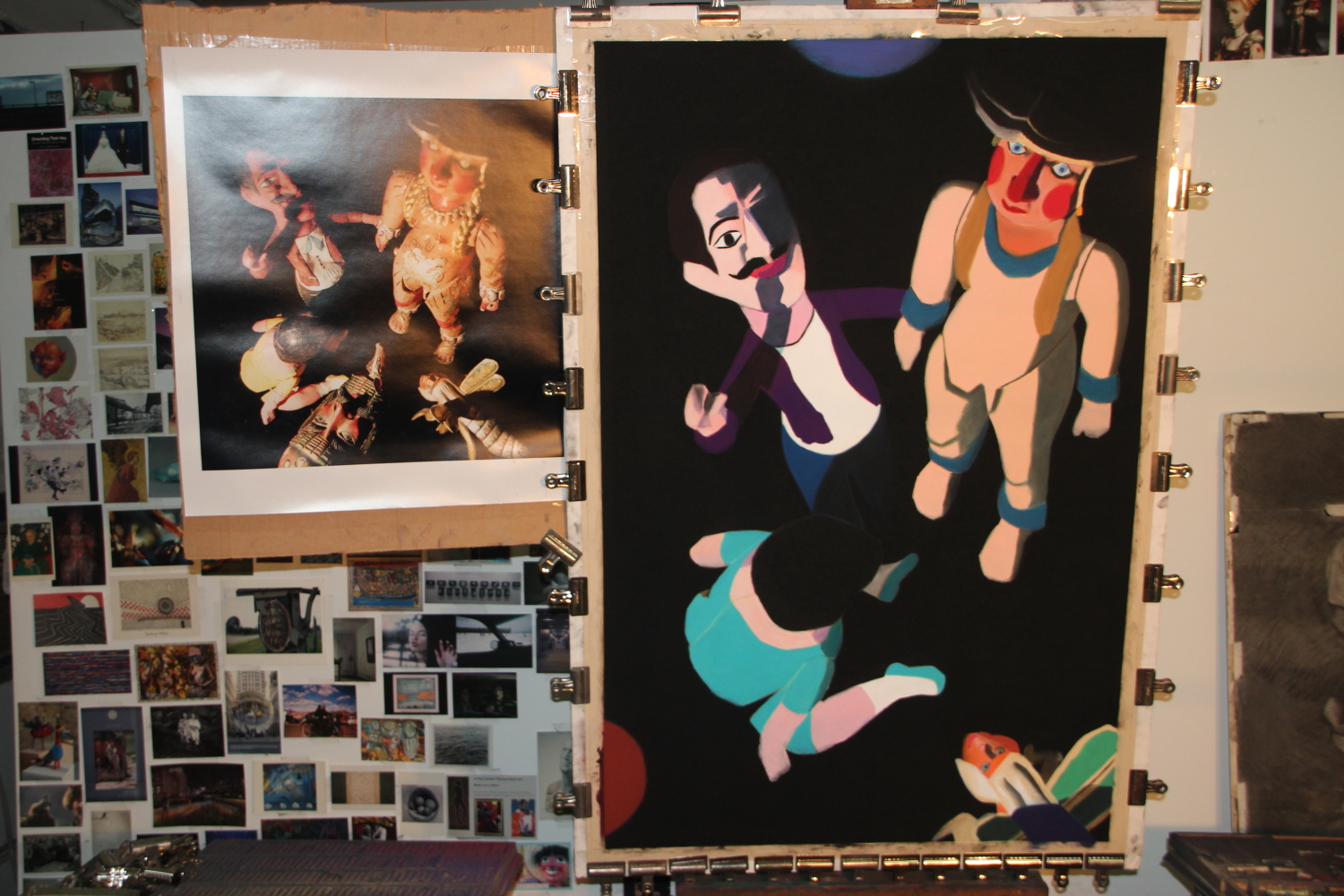
Untitled painting
A: I’ve been working on this pastel-on-sandpaper painting for a few weeks.
Comments are welcome!
Pearls from artists* # 28
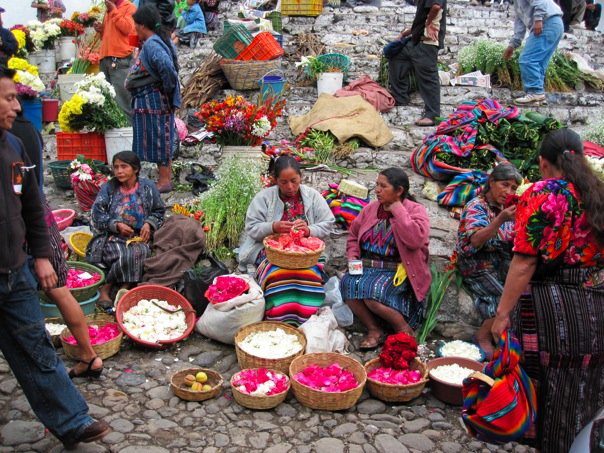
Flower sellers in Chichicastenango, Guatemala
* an ongoing series of quotations – mostly from artists, to artists – that offers wisdom, inspiration, and advice for the sometimes lonely road we are on.
We have talked a good deal about our duty, and how we could attain the right goal, and we came to the conclusion that in the first place our aim must be to find a steady position and a profession to which we can entirely devote ourselves. It is wise to do so, for life is but short and time passes quickly; if one is master of one thing and understands one thing well, one has at the same time insight into and understanding of many things.
One must especially have the end in mind, and the victory one would gain after a whole life of work and effort is better than one that is gained earlier. Whoever lives sincerely and encounters much trouble and disappointment, but is not bowed down by them, is worth more than one who has always sailed before the wind and has only relative prosperity. One must never trust the occasion when one is without difficulties.
Irving Stone with Jean Stone, editors, Dear Theo: The Autobiography of Vincent Van Gogh
Comments are welcome!
Q: Your relationship with photography has changed considerably over the years. How did you make use of photography in your first series of pastel-on-sandpaper paintings, “Domestic Threats”?
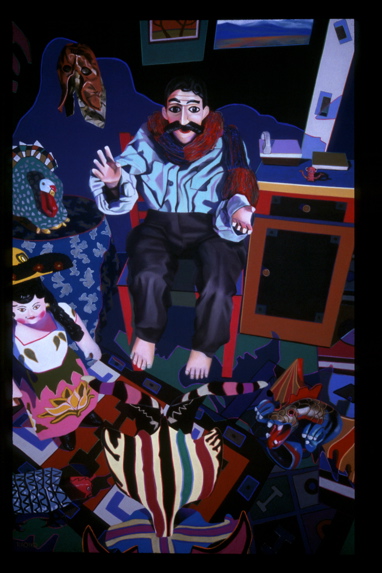
“Truth Betrayed by Innocence,” 2001, 58″ x 38″, the last pastel painting for which Bryan photographed the setup
A: When my husband, Bryan, was alive I barely picked up a camera, except to photograph sights encountered during our travels. Throughout the 1990s and beyond (ending in 2007), I worked on my series of pastel-on-sandpaper paintings called, “Domestic Threats.” These were realistic depictions of elaborate scenes that I staged in our 1932 Sears house in Alexandria, Virginia, and later, in a New York sixth floor walk-up apartment, using the Mexican masks, carved wooden animals, and other folk art figures that I found on our trips to Mexico. I staged and lit these setups, while Bryan photographed them using his Toyo-Omega 4 x 5 view camera. We had been collaborating this way almost from the beginning (we met on February 21, 1986). Having been introduced to photography by his father at the age of 6, Bryan was a terrific amateur photographer. He would shoot two pieces of 4 x 5 film at different exposures and I would select one, generally the one that showed the most detail in the shadows, to make into a 20 x 24 photograph. The photograph would be my starting point for making the pastel painting. Although I work from life, too, I could not make a painting without mostly looking at a reference photo. After Bryan was killed on 9/11, I had no choice but to study photography. Over time, I turned myself into a skilled photographer.
Comments are welcome!
Q: Please speak about your background as a Naval officer and aviator and how that has informed your sensibility as an artist.
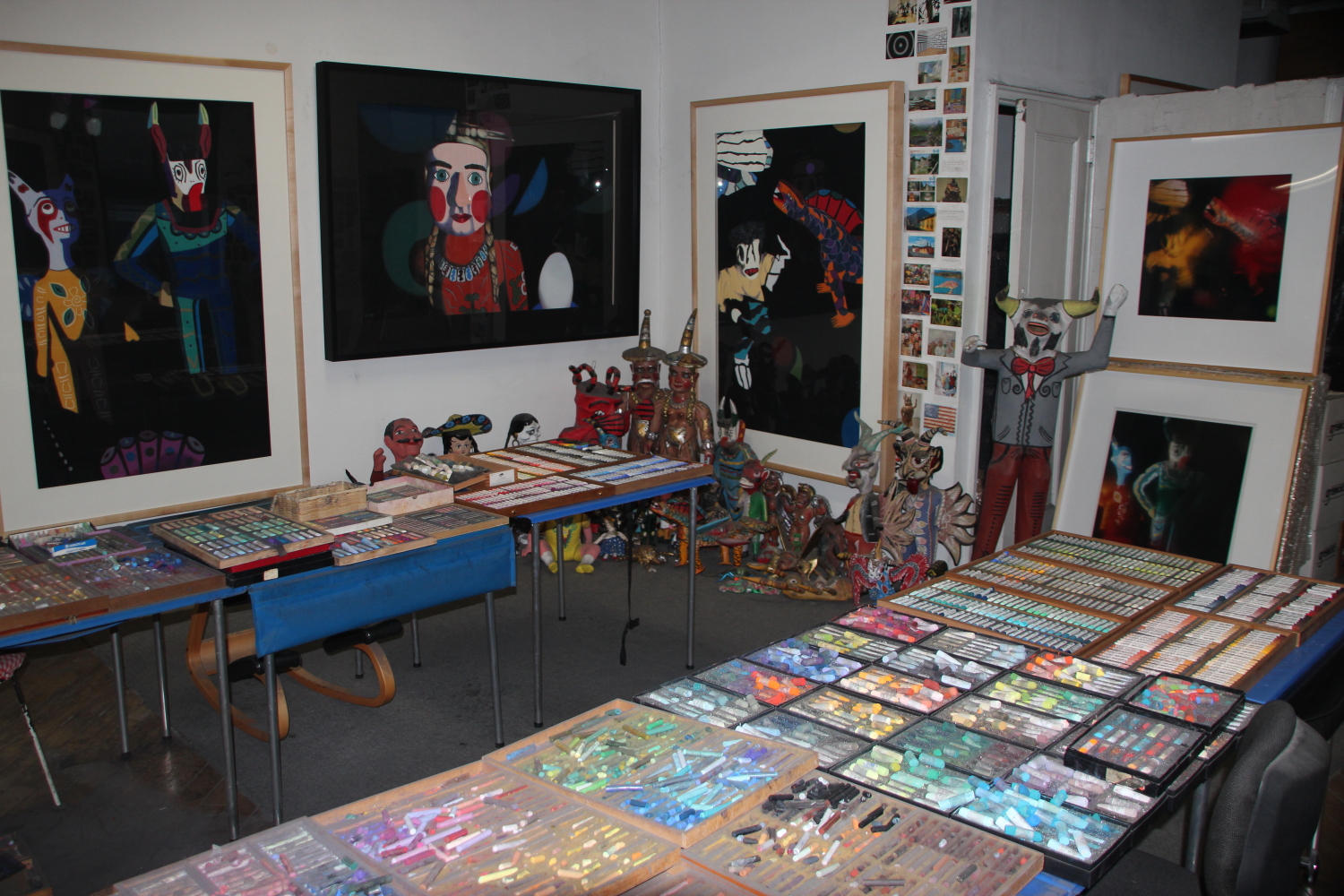
The studio yesterday
A: At the age of 25 I got my private pilot’s license before spending the next two years amassing thousands of hours of flight time as I earned every flying license and rating I could, ending with a Boeing-727 flight engineer certificate. I joined the Navy when I was 29. I used to think that the 7 years I spent on active duty were wasted – during those 7 years I should have been working on my art – but I see things differently now. The Navy taught me to be disciplined, to be goal-oriented and focused, to love challenges, and in everything I do, to pay attention to the details. Trying to make it as an artist in New York is nothing BUT challenges so these qualities serve me well, whether I’m creating paintings, shooting and printing photographs, or trying to understand the art business and keep up with social media. I enjoy spending long solitary hours working to become a better artist. I am meticulous about craft and will not let a work out of my studio or out of the darkroom until it is as good as I can make it.
Comments are welcome!
Pearls from artists* # 25
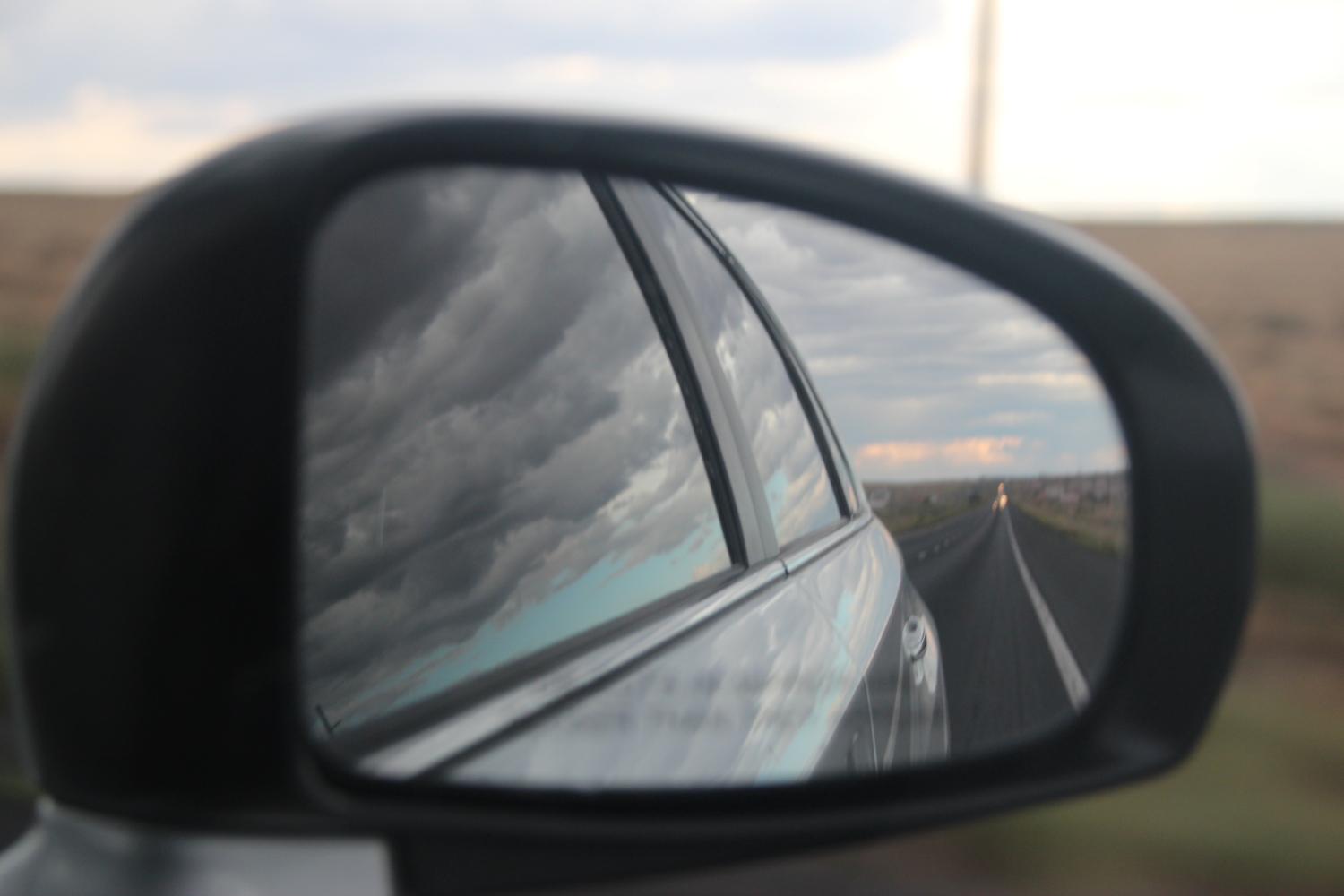
Arizona highway (Donna at the wheel)
* an ongoing series of quotations – mostly from artists, to artists – that offers wisdom, inspiration, and advice for the sometimes lonely road we are on.
February 21, 1924. A hell of a day yesterday. Bitter disappointment awaits the worker in photography.
After risking my neck to get the 8 x 10 camera on la azotea – flat roof – over Tina’s room, the highest vantage point of Lucerna 12, and after straining my back and stripping my nerves to capture a sweep of scurrying cloud forms, development revealed fog – ruinous fog – unmistakably from extraneous light – and a beautiful negative it was, or might have been!
The demon fog can play such uncanny tricks – always I am confounded, disconcerted, mystified until the trouble has been located. All morning I squinted and poked and probed, finally patching with felt the supposed leak due to a warped back, but I lost my negative, as fine a one as any of clouds I have done.
In a blue funk, I was ready to quit, and when Galvan called, accepted his suggestion that we ride into the country and then walk for a while.
North, and out of el distrito federal, he took us to a barranca – gorge – close by – in fact, hardly twenty minutes drive away, yet, from the desolation of this cactus covered gulch we seemed a hundred miles away from any city street. Cactus and rock and the tortuous curves of el arroyo seco – the dry gulch – a bleakness to the spot intensified by a lowering sky, black wrathful clouds, angrily unable to spill their burden of rain. We climbed, we shot, we lay on the dead grass and watched the sunset edge the clouds with rose, and all around stiff cacti in spreading silhouette. Tea with Galvan, his three old aunts and Don pepe – cajeta de Celaya, te, pasas – jelly from Celaya, tea, raisins, and sweet bread.
I feel better, to hell with photography, art, women and all.
Yet – I wished for my camera today. Those serrated stalks of the maguey, their bold uncompromising leaves cutting the horizon, they would make a fine jagged base to a typical Mexican sky.
Nancy Newhall, editor, The Daybooks of Edward Weston: Two Volumes in One: I. Mexico II. California
Comments are welcome!
Q: What’s on the easel today?
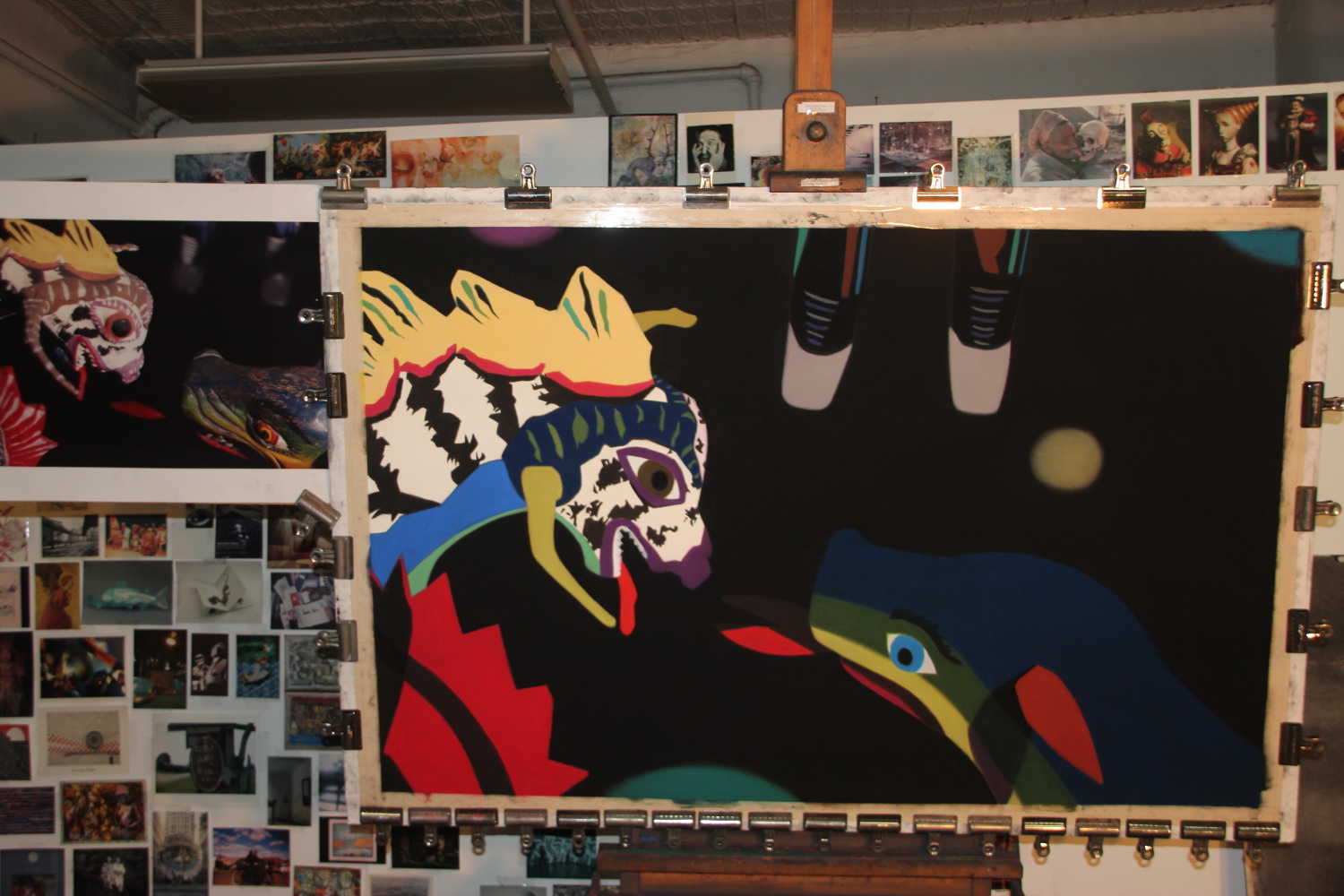
“Stalemate” in progress, soft pastel on sandpaper
A: A large pastel painting with the working title, “Stalemate.” For this one I went back and looked at some of my older 35 mm negatives. I selected one from 2002 and made the photographic print you see above, clipped to the left side of my easel. This piece is unusual because I’m painting the figures much larger than life size. I like what’s happening, but it’s slow going.
The title, “Stalemate,” is one I thought of some twenty-odd years ago, when I worked on a very different pastel painting – a table top still life – by that name. Somehow I couldn’t resolve some problems in the composition so I never finished it. I haven’t seen it in years, but it’s probably sitting in my Alexandria basement someplace.
Comments are welcome!



