Category Archives: Working methods
Pearls from artists* # 21

Apartment building, New York City
* an ongoing series of quotations – mostly from artists, to artists – that offers wisdom, inspiration, and advice for the sometimes lonely road we are on.
It is the beginning of a work that the writer throws away.
A painting covers its tracks. Painters work from the ground up. The latest version of a painting overlays earlier versions, and obliterates them. Writers, on the other hand, work from left to right. The discardable chapters are on the left. The latest version of a literary work begins somewhere in the work’s middle, and hardens toward the end. The earlier version remains lumpishly on the left; the work’s beginning greets the reader with the wrong hand. In those early pages and chapters anyone may find bold leaps to nowhere, read the brave beginnings of dropped themes, hear a tone since abandoned, discover blind alleys, track red herrings, and laboriously learn a setting now false.
Several delusions weaken the writer’s resolve to throw away work. If he has read his pages too often, those pages will have a necessary quality, the ring of the inevitable, like poetry known by heart; they will perfectly answer their own familiar rhythms. He will retain them. He may retain those pages if they possess some virtues, such as power in themselves, though they lack the cardinal virtue, which is pertinence to, and unity with, the book’s thrust. Sometimes the writer leaves his early chapters in place from gratitude; he cannot contemplate them or read them without feeling again the blessed relief that exalted him when the words first appeared – relief that he was writing anything at all. That beginning served to get him where he was going, after all; surely the reader needs it, too, as groundwork. But no.
Every year the aspiring photographer brought a stack of his best prints to an old, honored photographer, seeking his judgment. Every year the old man studied the prints and painstakingly ordered them into two piles, bad and good. Every year the old man moved a certain landscape print into the bad stack. At length he turned to the young man: “You submit this same landscape every year, and every year I put it in the bad stack. Why do you like it so much?” The young photographer said, “Because I had to climb a mountain to get it.”
Annie Dillard, The Writing Life
Comments are welcome!
Q: Do you listen to music while you work?

A corner of the studio
A: I always have the stereo on when I work in my studio, either tuned in to WBGO (the Newark-based jazz station), WNYC (for news and talk radio; Leonard Lopate, Fresh Air, etc.), WFMU (Fordham University’s radio station, to learn what college kids are listening to) and other local radio stations. I still listen to cd’s, I read the lyrics and the liner notes, and I prefer to listen to music the way artists intended it, meaning that I listen to entire albums from start to finish instead of jumping around between single tracks by different artists. When it comes to music, I’m interested in everything: jazz (especially classic jazz artists like Thelonious Monk, Miles Davis, John Coltrane, Art Blakely, etc.), blues, classical, pop, rock, world music (especially artists from Brazil, Cuba, and any country in Africa), electronic, indy, experimental, ancient music, etc. You name it, I probably listen to it, and if I don’t, I’m eager to learn all about it. When I’m working, certain artists are better to listen to at particular points in a painting. For example, one of my favorite artists to start a new painting with is Lady Gaga. The beat, her energy, and sheer exuberance are perfect when I’m standing in front of my easel with a blank piece of sandpaper in front of me. Gaga’s music gets me moving and working fast, putting down colors instinctively without thinking about them, just feeling everything.
It’s a different story when I am at my apartment and am shooting a photo setup. Then I might or might not listen to music. Lately it’s more about working fast (I shoot 24 images in about 15 minutes), choosing a variety of interesting vantage points, getting surprising effects, etc.
Comments are welcome!
Q: When you set up your figures to photograph, do you create a story?
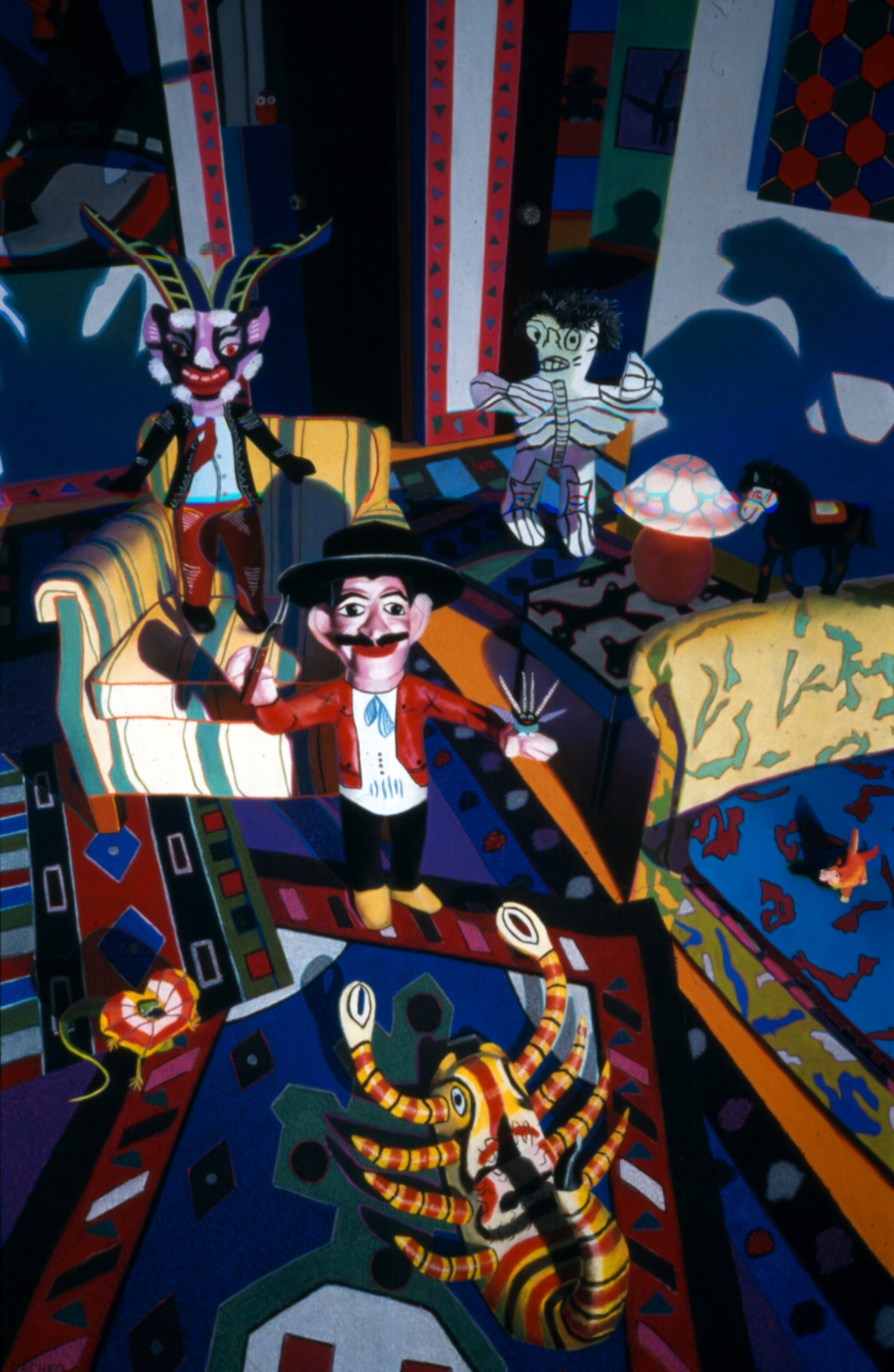
“He Just Stood There Grinning,” soft pastel on sandpaper, ” 58″ x 38″
A: I always did so with my “Domestic Threats” paintings, but not with my current work. As I set up a group of figures to photograph, I would make up a story about what was happening between them: what the Day of the Dead skeleton I bought in Mexico City was saying to the frog/fish/human mask from Guerrero, for example. I was a big kid playing with my favorite toys! The stories were the spark to get me started on a new project, but I usually forgot about them afterwards. They were necessary, yet incidental to my creative process, which is probably why I have never written them down.
Years ago I had the experience of being at one of my solo shows when a group of elementary school children came along with their teacher. The teacher asked them to act out one of the stories in a particular painting. Ever curious about how people relate to my work, I didn’t introduce myself as the creator of the pieces hanging on the walls. I no longer remember the details, but their interpretations soon had me laughing. It is a constant surprise to hear from people encountering my work for the first time what they see in it, especially when those people are young kids with wild imaginations!
Comments are welcome!
Q: Why do you work in series?
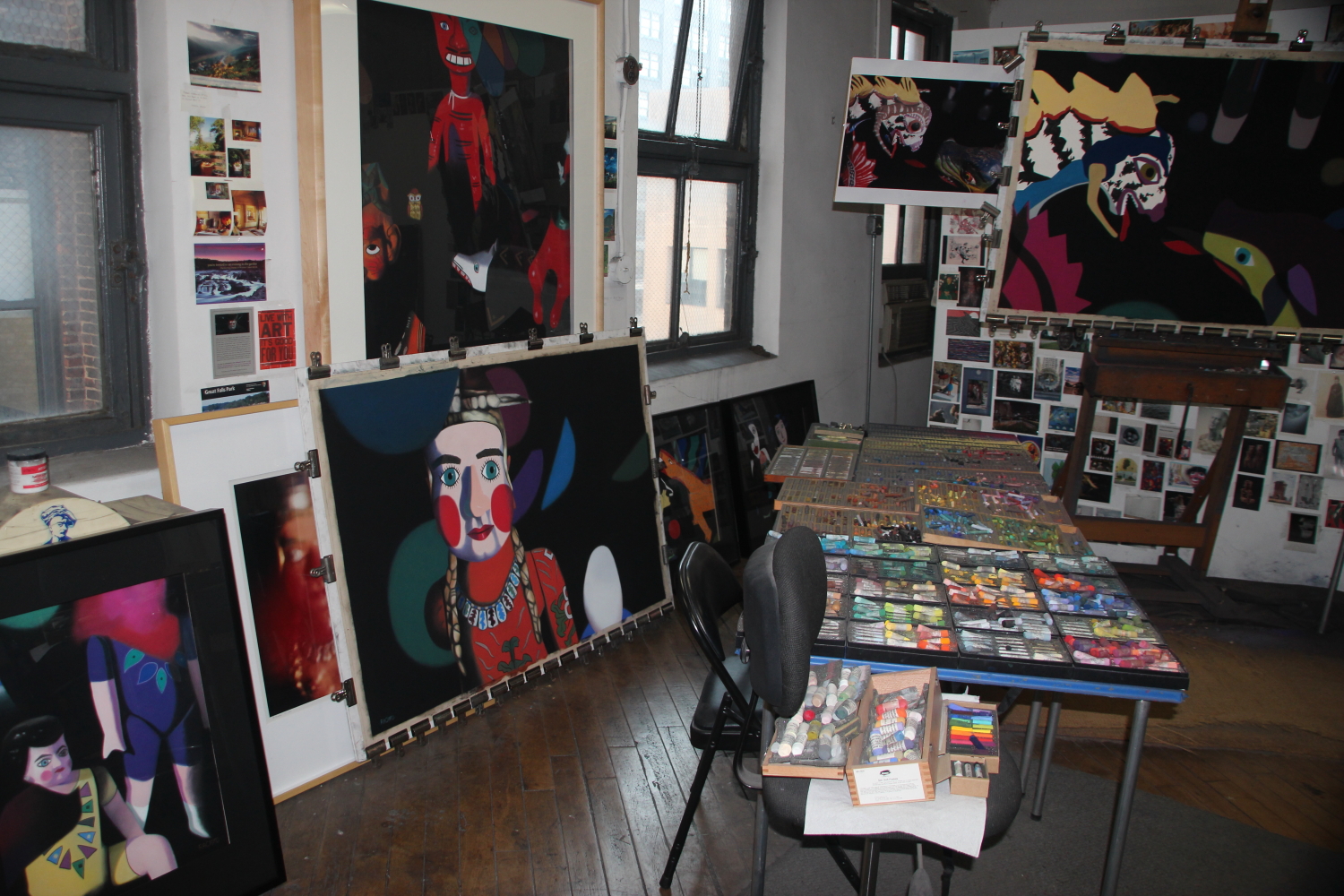
The studio recently
A: I don’t really have any choice in the matter. It’s more or less the way I have always worked so it feels natural. Art-making comes from a deep place. In keeping with the aphorism ars longa, vita brevis, it’s a way of making one’s time on earth matter. Working in series mimics the more or less gradual way that our lives unfold, the way we slowly evolve and change over the years. Life-altering events happen, surely, but seldom do we wake up drastically different – in thinking, in behavior, etc. – from what we were the day before. Working in series feels authentic. It helps me eke out every lesson my paintings have to teach. With each completed piece, my ideas progress a step or two further.
Last week I went to the Metropolitan Museum to see an exhibition called, “Matisse: In Search of True Painting.” It demonstrates how Matisse worked in series, examining a subject over time and producing multiple paintings of it. Matisse is my favorite artist of any period in history. I never tire of seeing his work and this particular exhibition is very enlightening. In fact, it’s a must-see and I plan to return, something I rarely do because there is always so much to see and do in New York. As I studied the masterpieces on the wall, I recognized a kindred spirit and thought, “Obviously, working in series was good enough for Matisse!”
Comments are welcome!
Pearls from artists* # 17

Boat hull
* an ongoing series of quotations – mostly from artists, to artists – that offers wisdom, inspiration, and advice for the sometimes lonely road we are on.
The better you know yourself, the more you will know when you are playing to your strengths and when you are sticking your neck out. Venturing out of your comfort zone may be dangerous, yet you do it anyway because our ability to grow is directly proportional to an ability to entertain the uncomfortable.
… Another thing about knowing who you are is that you know what you should not be doing, which can save you a lot of heartaches and false starts if you catch it early on.
I was giving a lecture to students at Vassar not long ago. Working with the students’ autobiographies, I invited a dance student, a music student who brought his saxophone, and an art student to join me on stage. I asked the dancer to improvise some movement from a tuck position on the floor. I asked the saxophone player to accompany the dancer. And I asked the art student to assign colors to what they were doing. I admit I was constructing a three-ring circus in the lecture hall. But my goal was to bring the three students together by forcing them to work off the same page, and also to free them to discover how far they could go improvising on this simple assignment.
When I asked the art student to read out loud his color impressions, everyone in the hall was taken aback. He droned on and on about himself, feelings he’d had, stories about friends. Not a word about color. Finally I heard “limpid blue” come out of his mouth. I waved my arms, signaling him to stop reading.
“Do you realize,” I said, “that you’ve just recited about five hundred words in an assignment about color? You’ve covered everything under the sun, and ‘limpid blue’ is the first time you’ve mentioned a color. I’m not convinced you want to be a painter.”
As far as I was concerned, this young man was in “DNA denial.” I gave him a painterly exercise and he gave me a text heavy response. A young man with painting in his genes would be rattling off colors immediately. Instead, his vivid use of language – limpid blue does not come in tubes – suggested that he really ought to be a writer.
It would be presumptious of me to think I had him pegged for a writer, not a painter, after that brief encounter. But if I got him to reexamine what he’s built for, then he was a step or two ahead of most people.
Twyla Tharp, The Creative Habit: Learn it and Use it for Life
Comments are welcome.
Pearls from artists* # 16

“Big Deal,” soft pastel on sandpaper
* an ongoing series of quotations – mostly from artists, to artists – that offers wisdom, inspiration, and advice for the sometimes lonely road we are on.
For the artist drawing is discovery. And that is not just a slick phrase, it is quite literally true. It is the actual act of drawing that forces the artist to look at the object in front of him, to dissect it in his mind’s eye and put it together again; or, if he is drawing from memory, that forces him to dredge his own mind, to discover the content of his own store of past observations. It is a platitude in the teaching of drawing that the heart of the matter lies in the specific process of looking. A line, an area of tone, is not really important because it records what you have seen, but because of what it will lead you to see. Following up its logic in order to check its accuracy, you find confirmation or denial in the object itself or in your memory of it. Each confirmation or denial brings you closer to the object, until finally you are, as it were, inside it: the contours you have drawn no longer marking the edge of what you have seen, but the edge of what you have become. Perhaps that sounds needlessly metaphysical. Another way of putting it would be to say that each mark you make on the paper is a stepping-stone from which you proceed to the next, until you have crossed your subject as though it were a river, have put it behind you.
Geoff Dyer, editor, Selected Essays: John Berger
Comments are welcome.
Q: Why do you have so many pastels?

Barbara’s pastels
A: Our eyes can see infinitely more colors than the relative few that are made into pastels. When I layer pigments onto the sandpaper, I mix new colors directly on the painting. The short answer is, I need lots of pastels so that I can make new colors.
I’ve been working exclusively with soft pastel for nearly 27 years. Whenever I feel myself getting into a rut in how I select and use my colors, I look around for new materials to try. I’m in one of those periods now and plan to buy soft pastels made by Henri Roché in Paris. (Not long ago I received a phone call from their artist’s liaison and was offered samples based on my preferences. Wow, what great colors!). Fortunately, new brands of soft pastels are continually coming onto the market. There are pastels that are handmade by artists – I love discovering these – and new ones manufactured by well-known art supply companies. Some sticks of soft pastel are oily, some are buttery, some more powdery, some crumble easily, some are more durable. Each one feels distinct in my hand.
Furthermore, they each have unique mixing properties. It’s an under-appreciated science that I stumbled upon (or maybe I invented it, I’m not sure since I can’t know on a deep level how other pastel painters work). In this respect soft pastel is very different from other paint media. Oil painters, for example, need only a few tubes of paint to make any color in the world. I don’t go in much for studying color theory as a formal discipline. If you want to really understand and learn how to use color, try soft pastel and spend 10,000+ hours (the amount of time Malcolm Gladwell says, in his book, “Outliers,” that it takes to master a skill) figuring it all out for yourself!
Comments are welcome.
Q: Does your work look different to you on days when you are sad, happy, etc.?
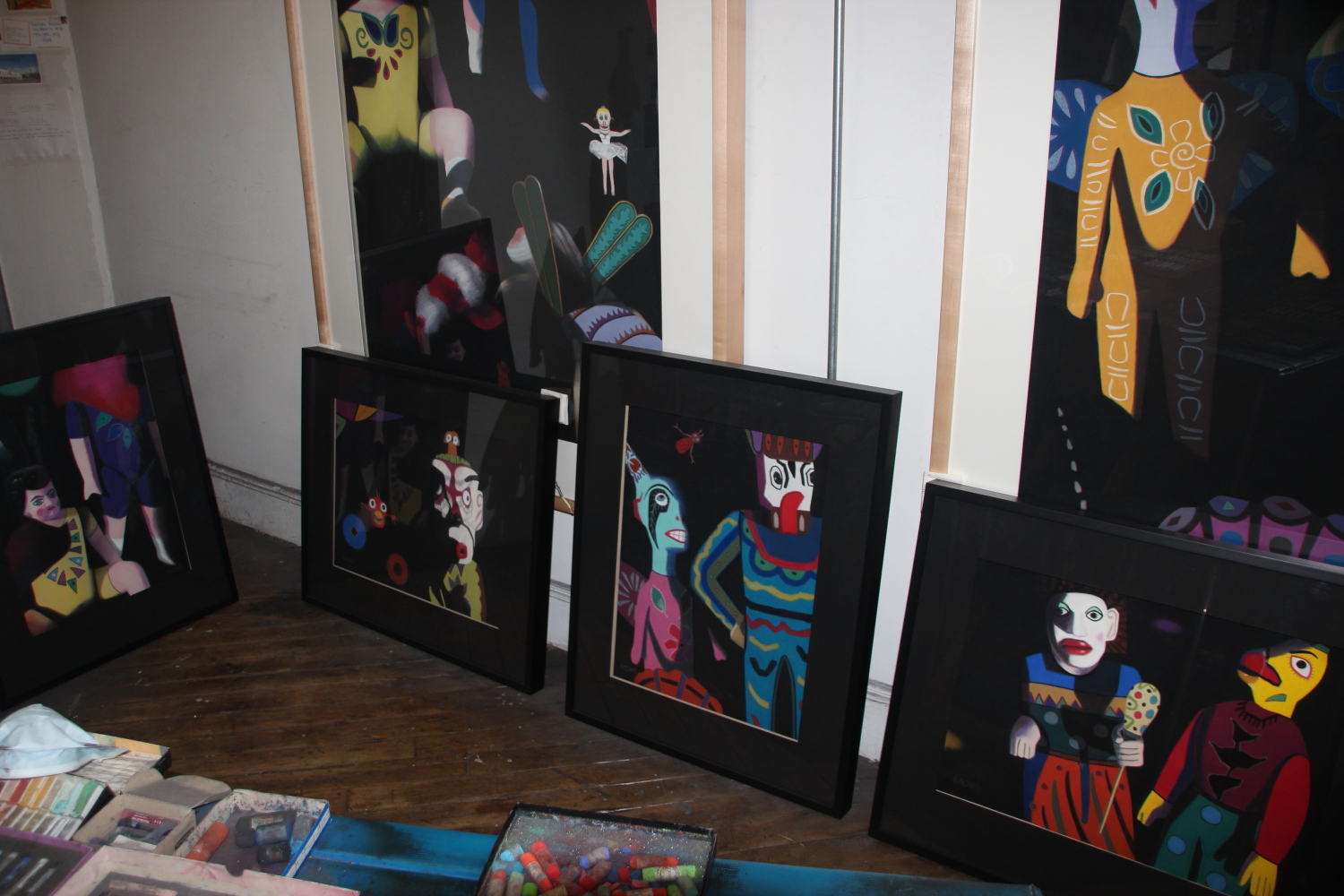
Recent work
A: I’m more critical on days when I am sad so that the faults, imperfections, and things I wish I had done better stand out. Fortunately, all of my work is framed behind plexiglas so I can’t easily go back in to touch up newly-perceived faults. It reminds me of the expression, “Always strive to improve, whenever possible. It is ALWAYS possible!” However, I’ve learned that re-working a painting is a bad idea. You are no longer deeply involved in making it and the zeitgeist has changed. The things you were concerned with are gone: some are forgotten, others are less urgent. For most artists the work is autobiography. Everything is personal. When I look at a completed pastel painting, I usually remember exactly what was happening in my life as I worked on it. Each piece is a snapshot – maybe even a time capsule, if anyone could decode it – that reflects and records a particular moment. When I finally pronounce a piece finished and sign it, that’s it, THE END. It’s as good as I can make it at that point in time. I’ve incorporated everything I was thinking about, what I was reading, how I was feeling, what I valued, art exhibitions I visited, programs that I heard on the radio or watched on television, music that I listened to, what was going on in New york, in the country, in the world, and so on. It is still a mystery how this heady mix finds its way into the work. During the time that I spend on it, each particular painting teaches me everything it has to teach. A painting requires months of looking, reacting, correcting, searching, thinking, re-thinking, revising. Each choice is made for a reason and as an aggregate these decisions dictate what the final piece looks like. On days when I’m sad I tend to forget that. On happier days I remember that the framed pastel paintings that you see have an inevitability to them. If all art is the result of one’s having gone through an experience to the end, as I believe it is, then the paintings could not, and should not, look any differently.
Comments are welcome.
Q: How do you know when a pastel painting is finished?
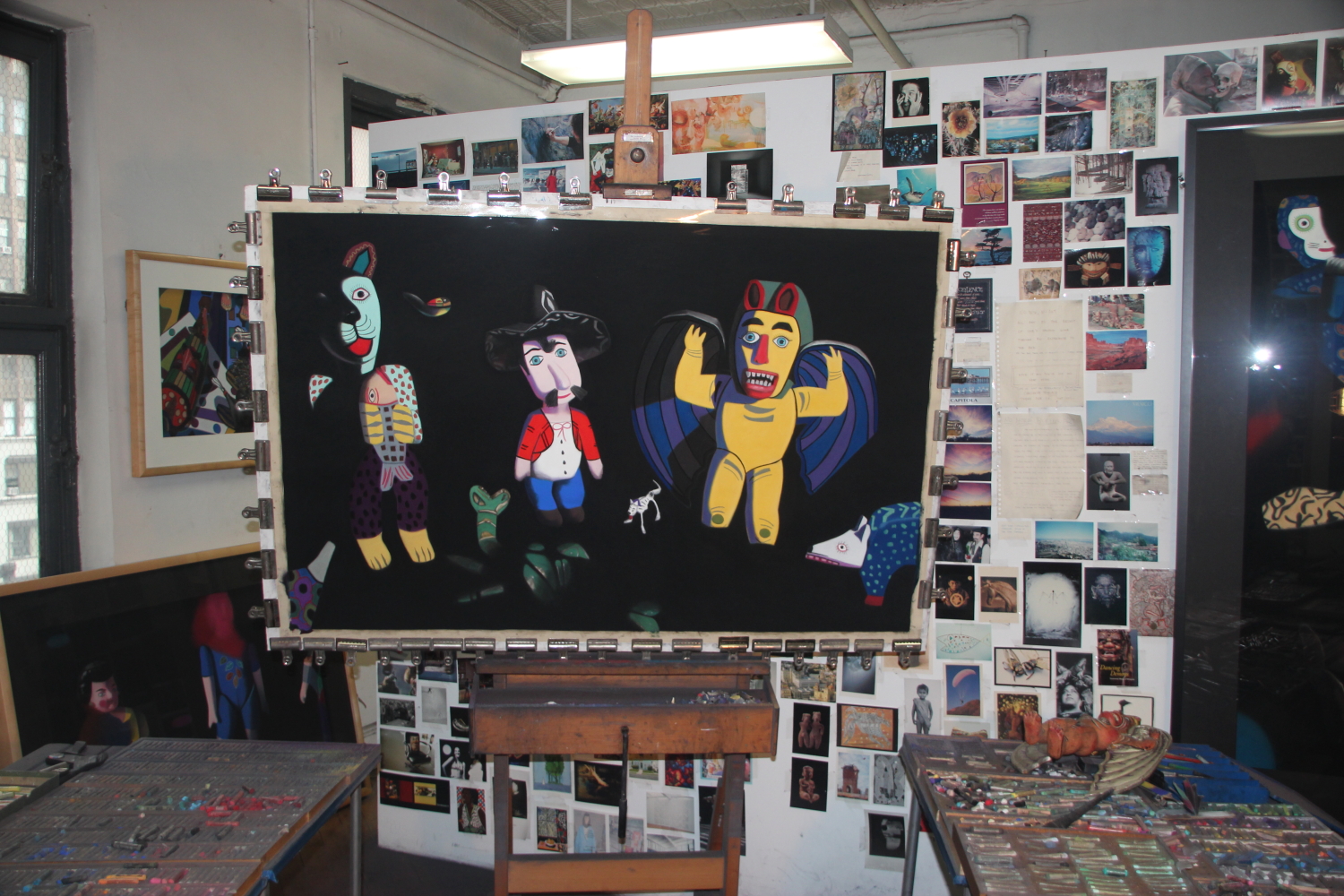
“Big Wow,” soft pastel on sandpaper
A: During the several months that I work on a pastel painting, I search for the best, most eye-popping colors, as I build up and blend together as many as 25 to 30 layers of pigment. I am able to complete some areas, like the background, fairly easily – maybe with six or seven layers – but the more realistic parts take more applications because I am adding details. Details always take time to perfect. No matter how many pastel layers I apply, however, I never use fixatives. It is difficult to see this in reproductions of my work, but the finished surfaces achieve a texture akin to velvet. My technique involves blending each layer with my fingers, pushing pastel deep into the tooth of the sandpaper. The paper holds plenty of pigment and because the pastel doesn’t flake off, there is no need for fixatives.
I consider a given painting complete when it is as good as I can make it, when adding or subtracting anything would diminish what is there. I know my abilities and I know what each individual stick of pastel can do. I continually try to push myself and my materials to their limits.
Comments are welcome.
Pearls from artists* # 11

Great Salt Lake
* an ongoing series of quotations – mostly from artists, to artists – that offers wisdom, inspiration, and advice for the sometimes lonely road we are on.
Virtually all artists spend some of their time (and some artists spend all of their time) producing work that no one else much cares about. It just seems to come with the territory. But for some reason – self defense, perhaps – artists find it tempting to romanticize this lack of response, often by (heroically) picturing themselves peering deeply into the underlying nature of things long before anyone else has eyes to follow.
Romantic, but wrong. The sobering truth is that the disinterest of others hardly ever reflects a gulf in vision.In fact there’s generally no good reason why others should care about most of any one artist’s work. The function of the overwhelming majority of your artwork is simply to teach you how to make the small fraction of your artwork that soars. One of the basic and difficult lessons every artist must learn is that even the failed pieces are essential. X-rays of famous paintings reveal that even master artists sometimes made basic mid-course corrections (or deleted really dumb mistakes) by over-painting the still wet canvas. The point is that you learn how to make your work by making your work, and a great many pieces you make along the way will never stand out as finished art. The best you can do is make art you care about – and lots of it!
The rest is largely a matter of perseverance. Of course once you’re famous, collectors and academics will circle back in droves to claim credit for spotting evidence of genius in every early piece. But until your ship comes in, the only people who will really care about your work are those who care about you personally. Those close to you know that making the work is essential to your well being. They will always care about your work, if not because it is great, then because it is yours – and this is something to be genuinely thankful for. Yet however much they love you, it still remains as true for them as for the rest of the world: learning to make your work is not their problem.
David Bayles and Ted Orland, Art & Fear
Comments are welcome.



