Blog Archives
Pearls from artists* # 374
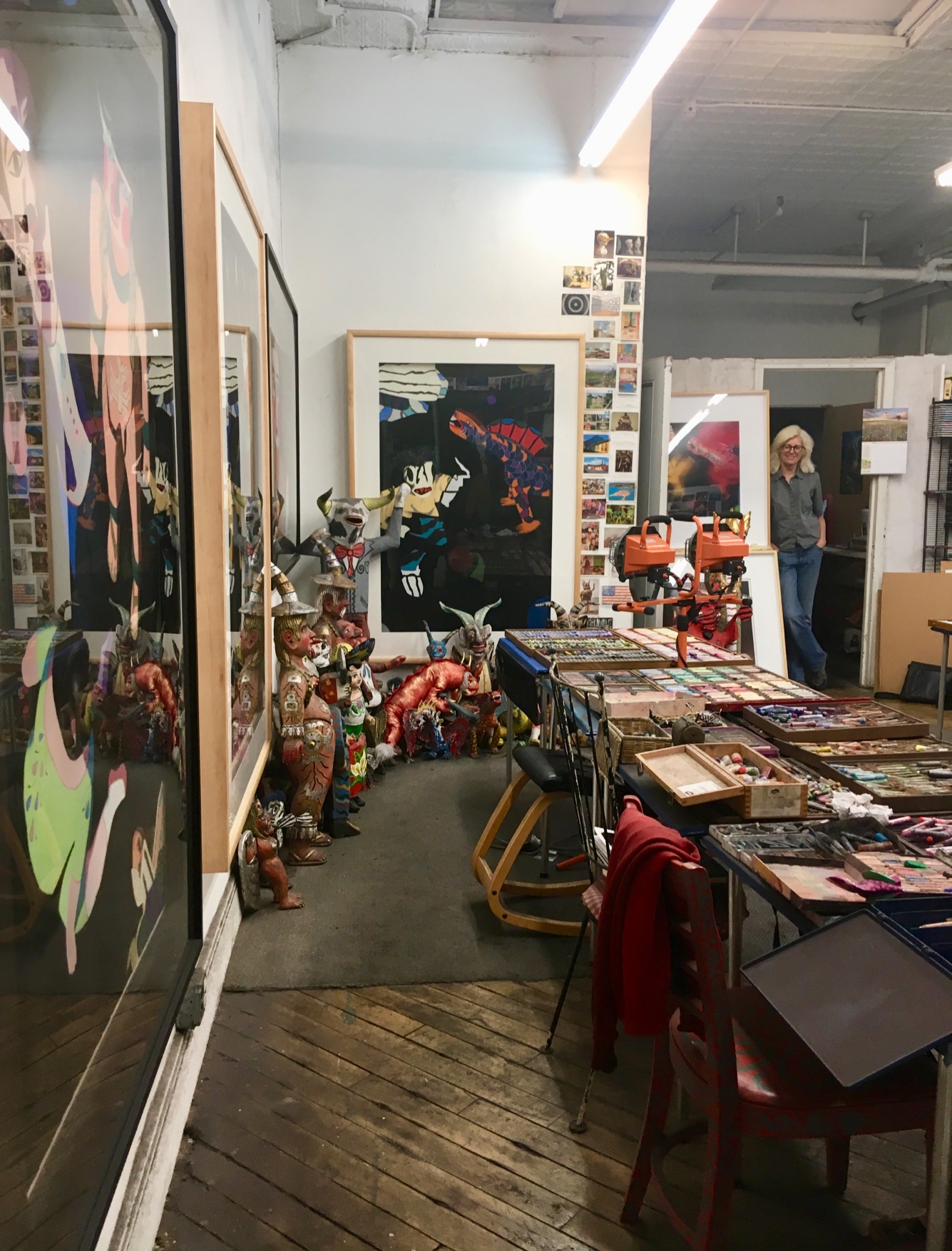
Barbara’a studio
* an ongoing series of quotations – mostly from artists, to artists – that offers wisdom, inspiration, and advice for the sometimes lonely road we are on.
Finally, [John] Graham said, of all the arts, painting was the most difficult because one false move on a canvas could mean the difference between a great painting and a failure. A writer could always resurrect a word, but a line or a shape was so ephemeral that, once changed, it was almost always lost for good. “To create life one has to love. To create a great work of art one has to love truth with the passion of a maniac. If society does not perceive this love, perhaps humanity will.” …The artists… came away… feeling as though they were not aberrations but part of a long tradition of individuals who had ignored fashion to create culture.
Mary Gabriel in Ninth Street Women
Comments are welcome!
Pearls from artists* # 351

Barbara at work on “The Orator”
*an ongoing series of quotations – mostly from artists, to artists – that offers wisdom, inspiration, and advice for the sometimes lonely road we are on.
That art is apolitical does not mean that artists themselves can be excused from the political responsibilities that fall on others. It means rather that as a manifestation of eternal psychic force, each work of art goes farther and deeper than the limited perspective of any individual mind, including that of its author.
No artist can predict how his work will affect the world… The artist invests his entire personality into the work, but he does so as a means of expressing a vision that is transpersonal. Everything that makes him what he is informs the work, but the final result transcends all personal contingencies.
J.F. Martel in Reclaiming Art in the Age of Artifice: A Treatise, Critique, and Call to Action
Comments are welcome!
Pearls from artists* # 348
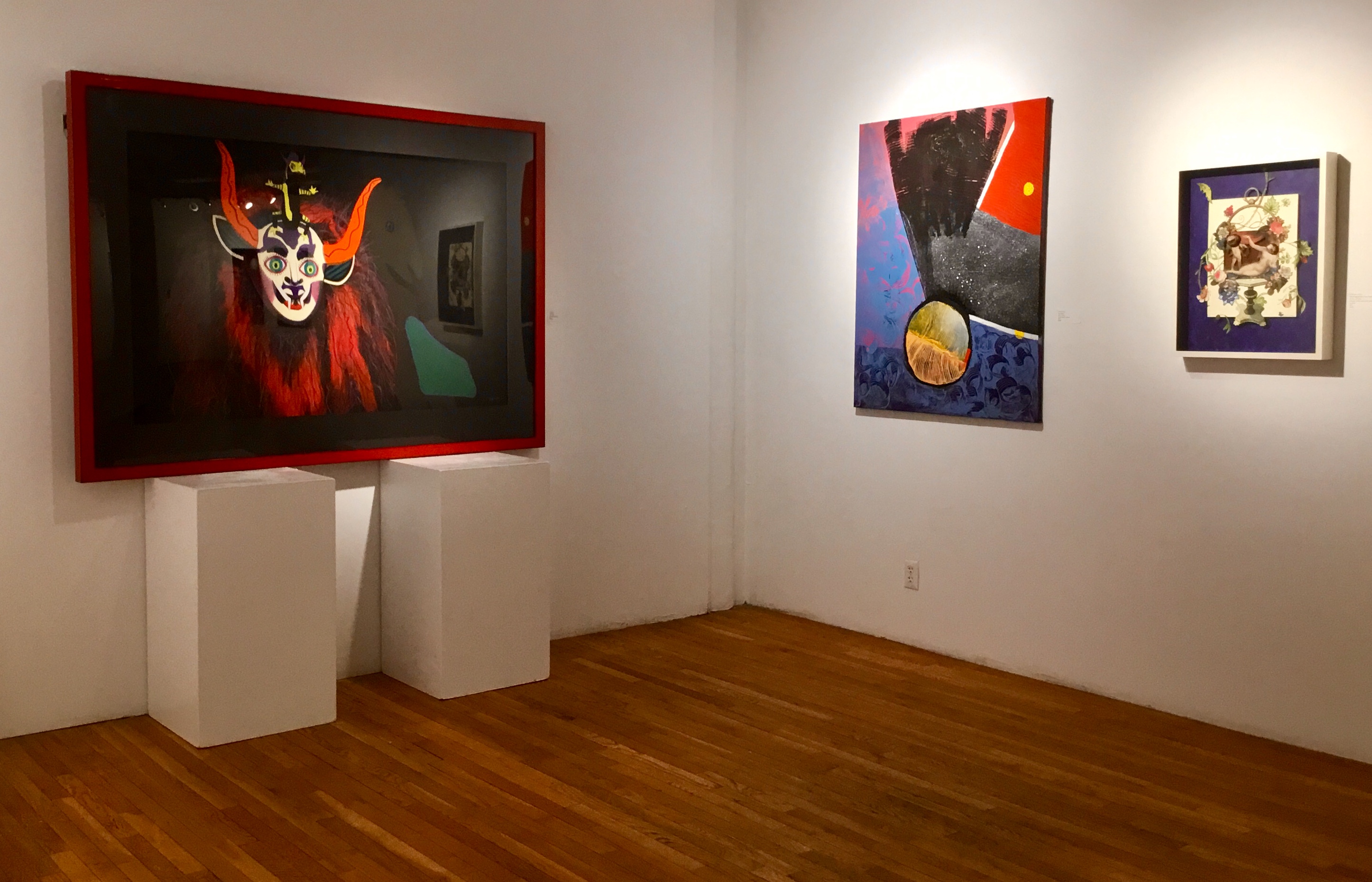
“The Orator” in “Worlds Seen & Unseen” at Westbeth Gallery, NYC
*an ongoing series of quotations – mostly from artists, to artists – that offers wisdom, inspiration, and advice for the sometimes lonely road we are on.
The percipient apprehends the primal quality of art as beauty and symbol, in an experience that invariably involves a sense of radical mystery. Art dissolves the fog of Consensus in which we normally operate to reveal the unseen in the situation. It places us in exactly the same position as the first people who stared up at the stars in wonder. The work of art is perpetually new; it demands reinterpretation with each era, each generation, each percipient. Great works of art are like inexhaustible springs originating from a place beyond our “little world of man.” They reconnect us with a reality too vast for the rational mind to comprehend. Therefore, art can be described as the human activity through which our all-too-human mentality is overcome and in light of which all finite judgments are shown to be inefficient. It is at once a sinking to the source and a leap toward the infinite.
J.F. Martel in Reclaiming Art in the Age of Artifice: A Treatise, Critique, and Call to Action
Comments are welcome!
Pearls from artists* # 341
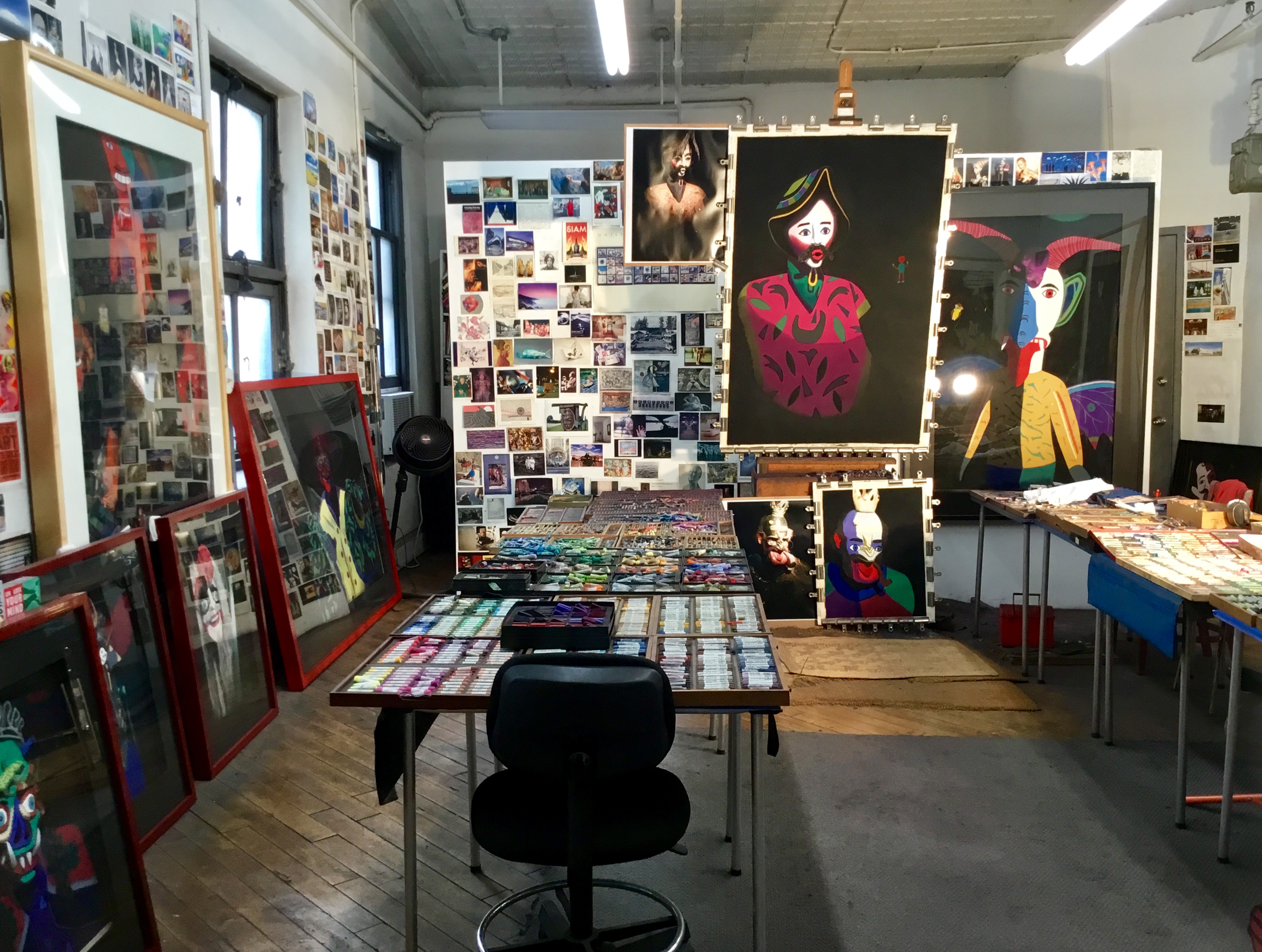
Barbara’s studio
*an ongoing series of quotations – mostly from artists, to artists – that offers wisdom, inspiration, and advice for the sometimes lonely road we are on.
The classic work of art is a form of life with its own bizarre consciousness. In the performing arts – theater, dance, music – this consciousness is not reducible to the minds of the performers onstage. The participants are parts of a spiritual organism that includes and transcends them. In our modern materialist mindset we naturally attribute the impression that a work speaks in its own voice to the intention of the author, who used it as a vehicle for her own ideas. But… works of art express much that their authors never intended to say: they exceed the limited views of those who bring them into being.
J.F. Martel in Reclaiming Art in the Age of Artifice: A Treatise, Critique, and Call to Action
Comments are welcome!
Pearls from artists* # 320
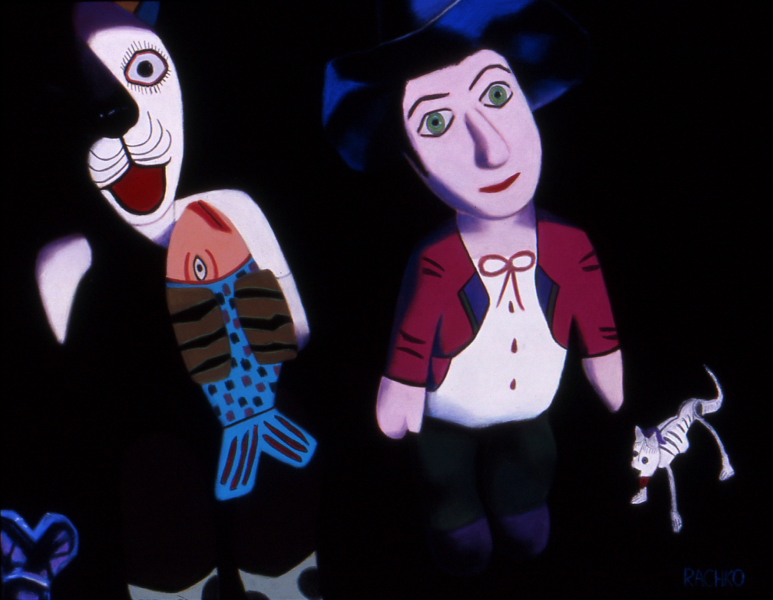
“Offering,” soft pastel on sandpaper, 20″ x 26″
*an ongoing series of quotations – mostly from artists, to artists – that offers wisdom, inspiration, and advice for the sometimes lonely road we are on.
As soon as I use words and actions to convey an emotion, I engage with the world, pitting my feelings against fate in hopes of a desired outcome. If I am angry, my anger is directed at someone or something. If I am in love, my love is for another. Feelings are purposive in ordinary reality, our emotional states tangled in the processes of life. This is what we mean when we refer to ourselves as subjects. But if, instead of acting on a feeling, I make it the basis of a song or a film or a dance, something strange happens. My purposive feeling leaves the closed circle of my personal existence, almost as though I had taken it out of historical time altogether. Transposed into the work of art, it becomes nonpurposive, undirected. It disassociates from its original focus, and from my self as subject, acquires a kind of autonomy. Artistic creation allows for the subjective aspect of our lives normally locked inside our skulls to exist outside us, which is to say that in art, the subjective becomes objective.
J.F. Martel in Reclaiming Art in the Age of Artifice: A Treatise, Critique, and Call to Action
Comments are welcome!
Pearls from artists* # 315

“The Champ,” soft pastel on sandpaper, 26″ x 20″
*an ongoing series of quotations – mostly from artists, to artists – that offers wisdom, inspiration, and advice for the sometimes lonely road we are on.
A work of art is good if it has sprung from necessity. In this nature of its origin lies the judgment of it: there is no other. Therefore, my dear sir, I know of no advice for you save this: to go into yourself and test the deeps in which your life takes rise; at its source you will find the answer to the question whether you must create. Accept it, just as it sounds, without inquiring into it. Perhaps it will turn out that you are called to be an artist. Then take that destiny upon yourself and bear it, its burden and its greatness, without ever asking what recompense might come from outside. For the creator must be a world unto himself and find everything in himself and in Nature to whom he has attached himself.
Rainer Maria Rilke, Letters to a Young Poet, Translated by M.D. Herter Norton
Comments are welcome!
Pearls from Artists* # 313

Barbara and Tomas in Panajachel, Guatemala
*an ongoing series of quotations – mostly from artists, to artists – that offers wisdom, inspiration, and advice for the sometimes lonely road we are on.
Proclaiming that the object in Surrealism was fundamental, [Andre] Breton suggests a radical transition in surrealist creation, one that liberated the poet-artist from all constraints in the making of the artistic object. Breton’s text calls for a “revolution of the object,” suggesting that in the placing of an object into a new context, and thus attributing it with a new meaning – also called a “detournement” – which takes precedence. Drawing in his interpretation of Hegelian subject-object relations, Breton describes the “object” as a work of art that relies on a philosophical procedure, affirming the surrealist process as one that is realized in the experience of apprehending the object through a dialectical method. Citing the work of Marcel Duchamp and Max Ernst, Breton explains that an object may become a product of surrealist creation through the simple “manipulation” of it. Here ”manipulation“ is defined as a procedure which reveals the object in its original and new state at the same time. If taking an object out of its original context and placing it in a new space creates the potential for a creative act, then this text seems to validate the surrealist practice of collecting. As the collector acquired objects and unites them in a gallery or a home, they assume new significance contingent upon their physical juxtaposition to other objects.
Moon Dancers: Yup’ik Masks and the Surrealists, edited by Jennifer Field, Introduction by Christina Rudofsky
Comments are welcome!
Pearls from artists* # 303
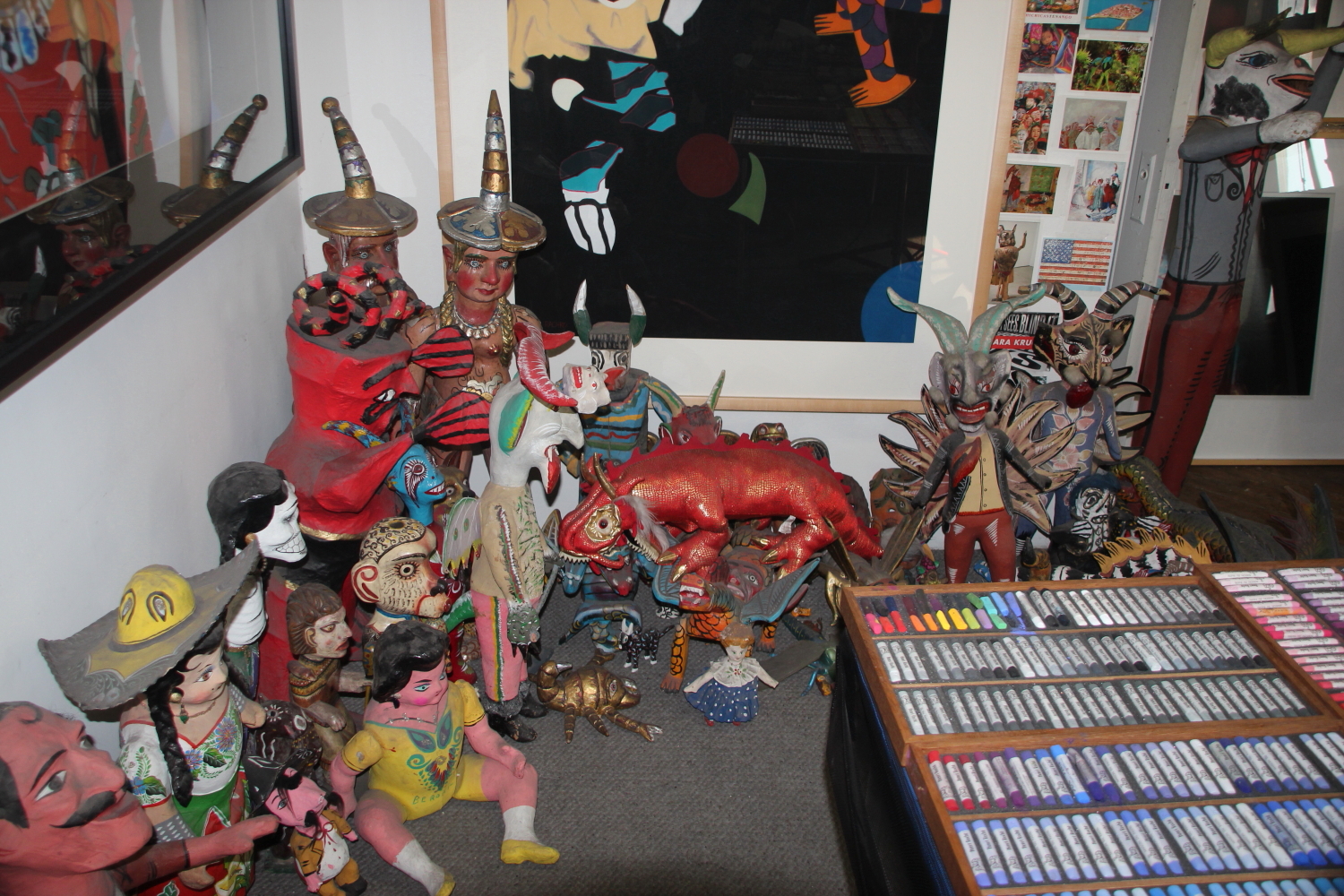
Barbara’s Studio
*an ongoing series of quotations – mostly from artists, to artists – that offers wisdom, inspiration, and advice for the sometimes lonely road we are on.
If the majority of aesthetic works fail to astonish us, then. it may have something to do with the ingrained insensitivity that is part and parcel of contemporary life. It may also have something to do with the fact that art, as Solzhenitsyn said so eloquently, is constantly being put to uses that are at odds with its essence. Indeed, the moment a work of art appears, all kinds of other factors come into play. Cultural institutions, social pressures, laws, customs, fashions, and trends pull it in every direction. Fame, money, conformism, attention-seeking, and knee-jerk rebellion can lure artists to abandon their own vision in order to emulate those of others, to adhere to formulas and paint by numbers, or to value external convention over vision. The inevitable result is a lot of bad art that couldn’t astonish anyone. It should come as no surprise, when looking over the glut of aesthetic objects that proliferate around us, if we feel the need to distinguish between authentic and inauthentic art – which is to say, art that astonishes us by attuning us to the radical mystery of being, and art that attempts to reinforce our shared illusions, comforting or intimidating us with the notion that there is nothing to wonder at since everything has been figured out.
J.F. Martel in Reclaiming Art in the Age of Artifice: A Treatise, Critique, and Call to Action
Comments are welcome!
Pearls from artists* # 292
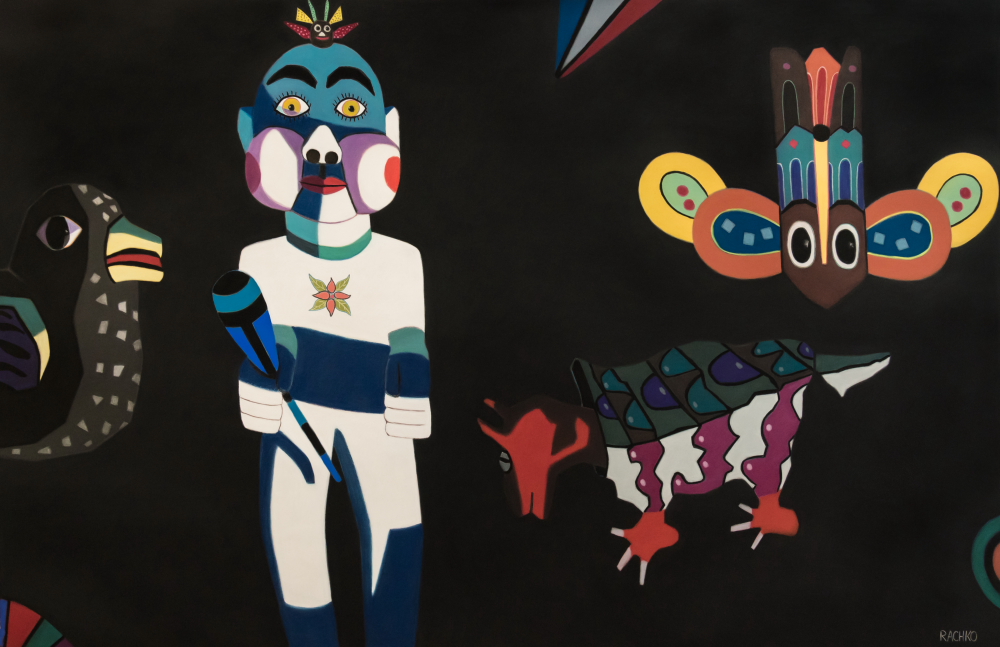
“White Star,” soft pastel on sandpaper, 38″ x 58″
*an ongoing series of quotations – mostly from artists, to artists – that offers wisdom, inspiration, and advice for the sometimes lonely road we are on.
… many tools may share qualities of fine design with works of art. We are in the presence of a work of art only when it has no preponderant instrumental use, and when its technical and rational foundations are not pre-eminent. When the technical organization or the rational order of a thing overwhelms our attention, it is an object of use. On this point Lodoli anticipated the doctrine of functionalists of our century when he declared in the eighteenth century that only the necessary is beautiful. Kant, however, more correctly said on the same point that the necessary cannot be judged beautiful, but only right or consistent. In short, a work of art is as useless as a tool is useful. Works of art are as unique and irreplaceable as tools are common and expendable.
George Kubler in The Shape of Time: Remarks on the History of Things
Comments are welcome!
Pearls from artists* # 244
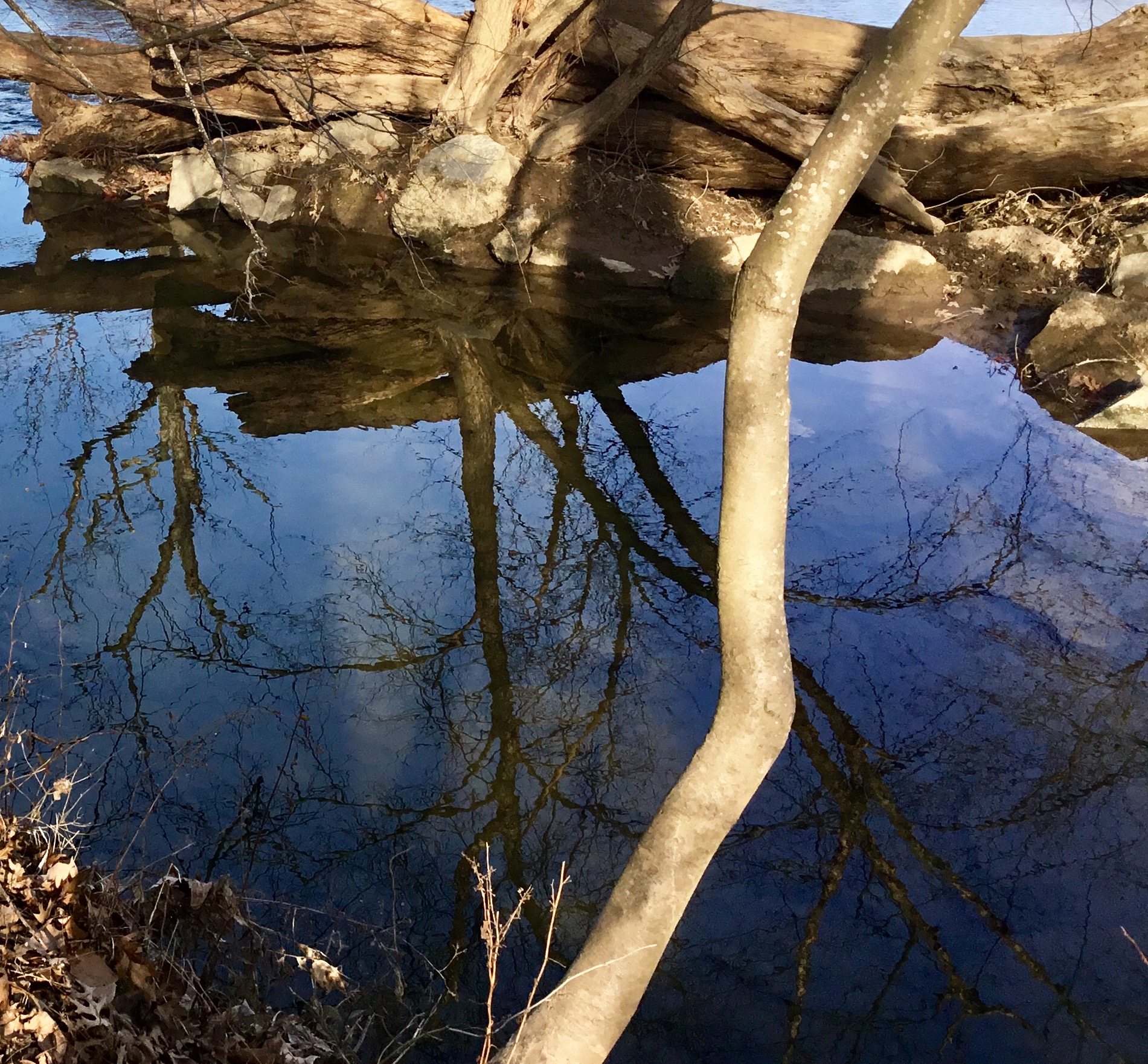
Great Falls, VA
* an ongoing series of quotations – mostly from artists, to artists – that offers wisdom, inspiration, and advice for the sometimes lonely road we are on.
Poet or painter, musician or architect, all solitary individuals at bottom turn to nature because they prefer the eternal to the transient, the profound rhythms of eternal laws to that which finds justification in passing. Since they cannot persuade nature to share in their experience they consider their task to grasp nature in order to place themselves somewhere in its vast contexts. And with these single solitary individuals all of humanity approaches nature. It is not the ultimate and possibly most peculiar value of art that it constitutes the medium in which man and landscape, figure and world encounter and find each other. But in the painting, the building, the symphony – in a word, in art itself, they seem to join together as if in a higher, prophetic truth, to rely on one another, and it is as if they completed each other to become that perfect unity that characterizes the work of art.
The Poet’s Guide to Life: The Wisdom of Rilke, edited and translated by Ulrich Baer
Comments are welcome!


 barbararachkoscoloreddust.com