Blog Archives
Pearls from artists* #694
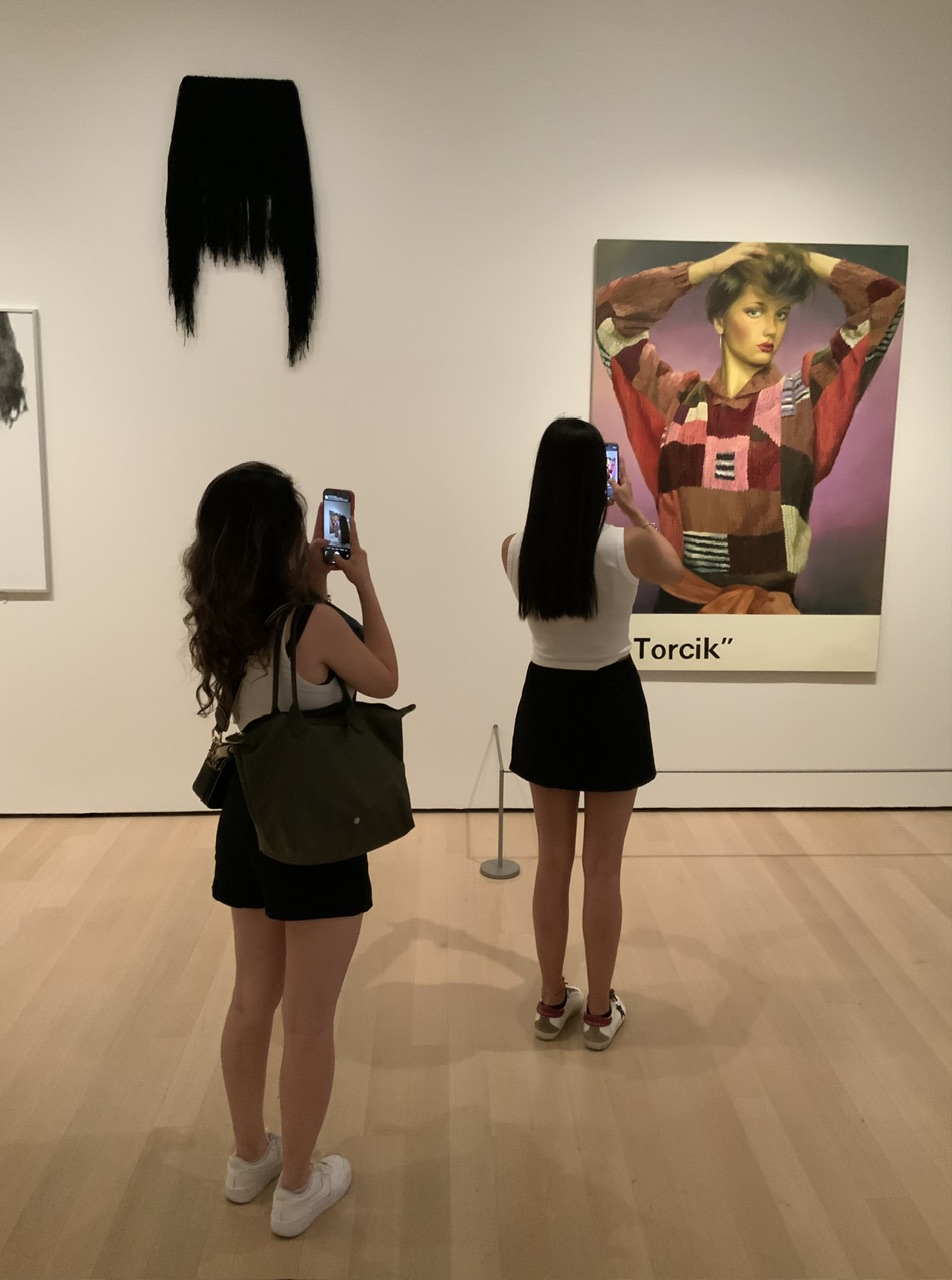
*an ongoing series of quotations – mostly from artists, to artists – that offers wisdom, inspiration, and advice for the sometimes lonely road we are on.
Long ago, when I was in my insecure twenties, I met a clever, independent, creative, and powerful woman in her mid-seventies, who offered me a superb piece of life wisdom.
She said: “We all spend our twenties and thirties trying so hard to be perfect, because we’re so worried about what other people will think of us. Then we get into our forties and fifties, and we finally start to be free, because we’re so worried decide that we don’t give a damn about what anyone thinks of us. But you won’t be completely free until you reach your sixties and seventies, when you realize this liberating truth—nobody was ever thinking about you, anyhow.”
They aren’t. They weren’t. They never were.
People are mostly thinking about themselves. People don’t have time to worry about what you’re doing, or how well you’re doing it, because they’re all caught up in their own dramas. People’s attention may be drawn to you for a moment (if you succeed or fail spectacularly and publicly, for instance), but that attention will soon enough revert back to where it’s always been—on themselves. While it may seem lonely and horrible at first to imagine that you aren’t anyone’s first order of business, there is also a great release to be found in this idea. You are free, because everyone is too busy fussing over themselves to worry that much about you.
Go be whomever you want to be, then.
Do whatever you want to do.
Pursue whatever fascinates you and brings you to life.
Create whatever you want to create—and let it be stupendously imperfect, because it’s exceedingly likely that no one will even notice.
And that’s awesome.
Elizabeth Gilbert in Big Magic: Creative Living Beyond Fear
Comments are welcome!
Q: What would you be if you were not an artist?

The studio with pastel paintings in progress!
A: I honestly have no idea, but whatever it might be, there is a good chance that I’d be bored! In my younger days boredom was a strong motivator. I left the active duty Navy out of boredom. I couldn’t bear not being intellectually challenged (most of my jobs consisted of paper-pushing), not using my flying skills (at 27 I was a licensed commercial pilot and Boeing 727 flight engineer), and not developing my artistic talent. In what surely must be a first, by spending a lot of time and money training me for jobs I hated, the Navy turned me into a hard-working artist! And once I left the Navy there was no plan B. There was no time to waste. It was “full speed ahead.”
Art is a calling. You do not need to be told this if you are among those who are called. It’s all about “the work,” that all-consuming focus of an artist’s life. If a particular activity doesn’t make you a better artist, you avoid it. You work hard to nourish and protect your gifts. As artists we invent our own tasks, learn whatever we need in order to progress, and complete projects in our own time. It is life lived at its freest.
My art-making has led me to fascinating places: Mexico, Guatemala, Brazil, Chile, Easter island, Argentina, Uruguay, France, England, Italy, Bali, Java, India, Bhutan, and more; and to in-depth studies of intriguing subjects: drawing, color, composition, art and art history, the art business, film and film history, photography, mythology, literature, music, jazz history, and archaeology, particularly that of ancient Mesoamerica (the Olmec, Zapotec, Mixtec, Aztec, Maya, etc.). And this rich mixture continually grows! For anyone wanting to spend their time on earth learning and meeting new challenges, there is no better life than that of an artist.
I SO agree with this exchange that I read years ago between between Trisha Brown and Mikhail Baryshnikov in the New York Times. I wrote it on a piece of paper and taped it to my studio wall:
Trisha: How do you think we keep going? Are we obsessed?
Mikhail: We do it because there’s nothing better. I’m serious. Because there is nothing more exciting than that. Life is so boring, that’s why we are driven to the mystery of creation.
Comments are welcome.
Pearls from artists* # 674
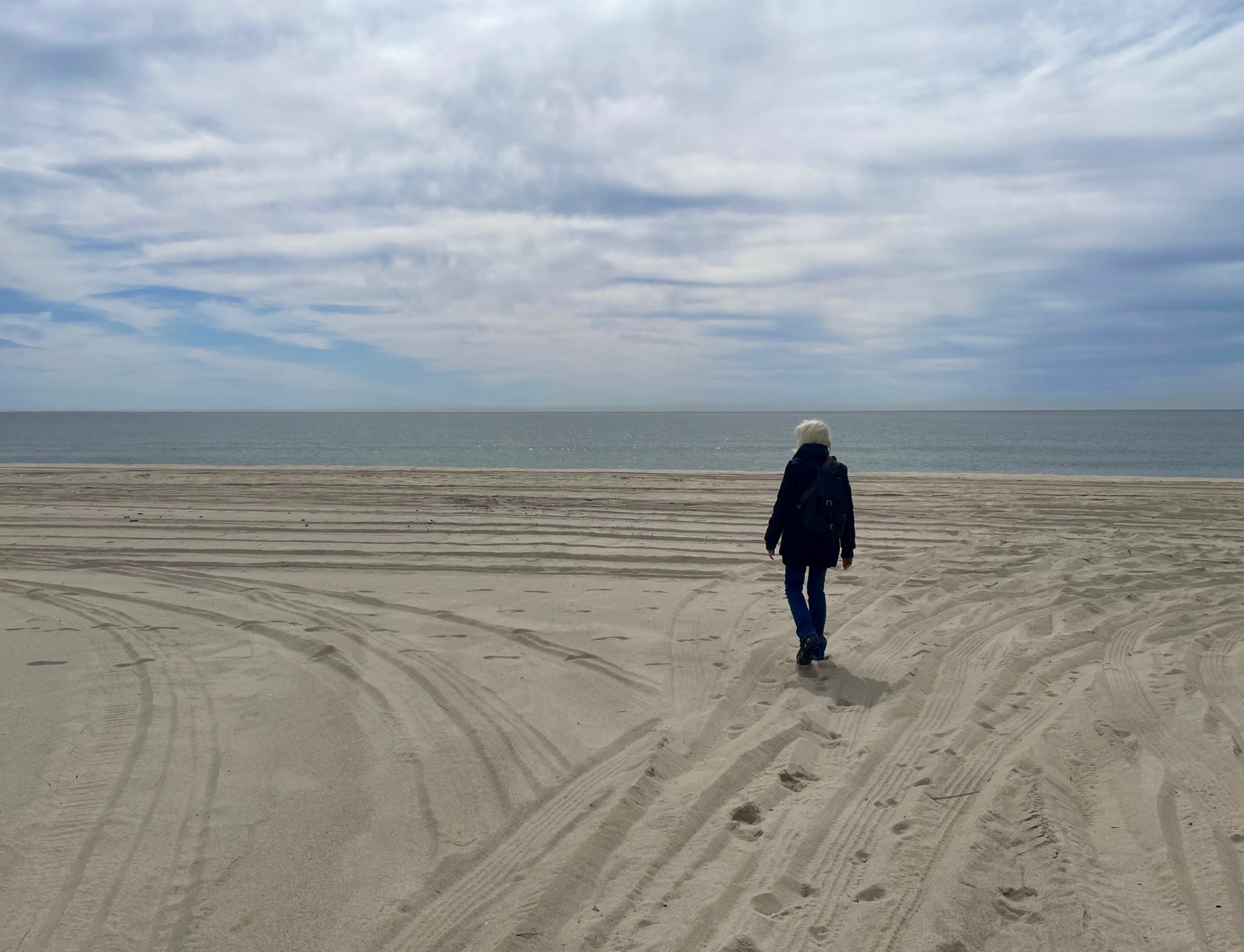
Southampton, New York Photo: Susan Erlichman
*an ongoing series of quotations – mostly from artists, to artists – that offers wisdom, inspiration, and advice for the sometimes lonely road we are on.
Everything about art requires dedication and presence. It is an intimate act, demanding the kind of sustained devotion we rarely lavish on other human beings. The artist’s generosity is highly impractical because there is no guarantee that it will ever be appreciated. Consider the level of optimism needed to repeatedly spend, even deplete, whatever reserves might be required to create the most superlative gift you could offer, one that is essentially given away to the world for free. The work we make is a love letter in a bottle, thrown into the ocean. It may or may not be read. We do not negotiate. like businesspeople, ‘You give me this, and I will give you that…’ We bequeath our pursuit of excellence and creative spirit to our audience, without reservation or qualification. We know what we have invested in it and sleep better because of it.
– Kate Kretz in Art From Your Core: A Holistic Guide to Visual Voice
Comments are welcome!
Q: What makes you just want to run back to the studio and start something new?

Beginnings
A: For nearly four decades, I have always worked in series, which means that one pastel painting leads quite naturally into the next. Considerable thought and planning go into each one before I ever begin, so it would be uncharacteristic for me to just start something new out of nowhere.
That said, my favorite part of the months-long creative process is when I am starting a brand new pastel painting. I get excited each time I begin a new piece because beginnings are full of so much possibility! Soon I will be looking at something I have never created before. I’ll watch it gradually take shape over months and will be challenged to solve unforeseeable problems, to continually refine and improve it along the way. The goal is always, of course, to resolve it into some sort of successful existence. Whatever happens, I know I am about to go on a very intriguing journey that will undoubtedly expand my technical knowledge and make me a much better artist.
Comments are welcome!
Q: You seem very disciplined. Do you ever have a day when you just can’t get excited about going to the studio to work?

Signing “Narcissist”
A: That happens occasionally, but I usually still go to the studio to work. You know the expression, “99% of life is just showing up”? Well, of course I have to show up at my studio to accomplish anything so I still try to keep fairly regular studio hours – 6 to 7 hours a day, 4 or 5 days a week. And that’s not to mention all the other work – answering email, checking social media, writing blog posts, etc. – which I tend to do at lunchtime, in the evenings, and on my days off from the studio.
When you are an artist there is always work to do and for some of it, no one else can do it because no one else knows the work from the inside the way the maker does. I like what Twyla Tharp says in her book, “The Creative Habit.” In order to progress an artist needs good work habits that become a daily routine. And Chuck Close used to say, “Inspiration is for amateurs,” meaning a professional works whether she’s in the mood or not. I completely agree so I keep working and slowly moving ahead.
As Tchaikovsky wrote in a letter to a friend:
We must always work, and a self-respecting artist must not fold his hands on the pretext that he is not in the mood. If we wait for the mood, without endeavoring to meet it halfway, we easily become indolent and apathetic. We must be patient, and believe that inspiration will come to those who can master their disinclination. A few days ago I told you I was working every day without any real inspiration. Had I given way to my disinclination, undoubtedly I should have drifted into a long period of idleness. But my patience and faith did not fail me, and today I felt that inexplicable glow of inspiration of which I told you; thanks to which I know beforehand that whatever I write today will have power to make an impression, and to touch the hearts of those who hear it.
Quoted in Eric Maisel’s A Life in the Arts: Practical Guidance and Inspiration for Creative and Performing Artists.
Comments are welcome!
Pearls from artists* # 612
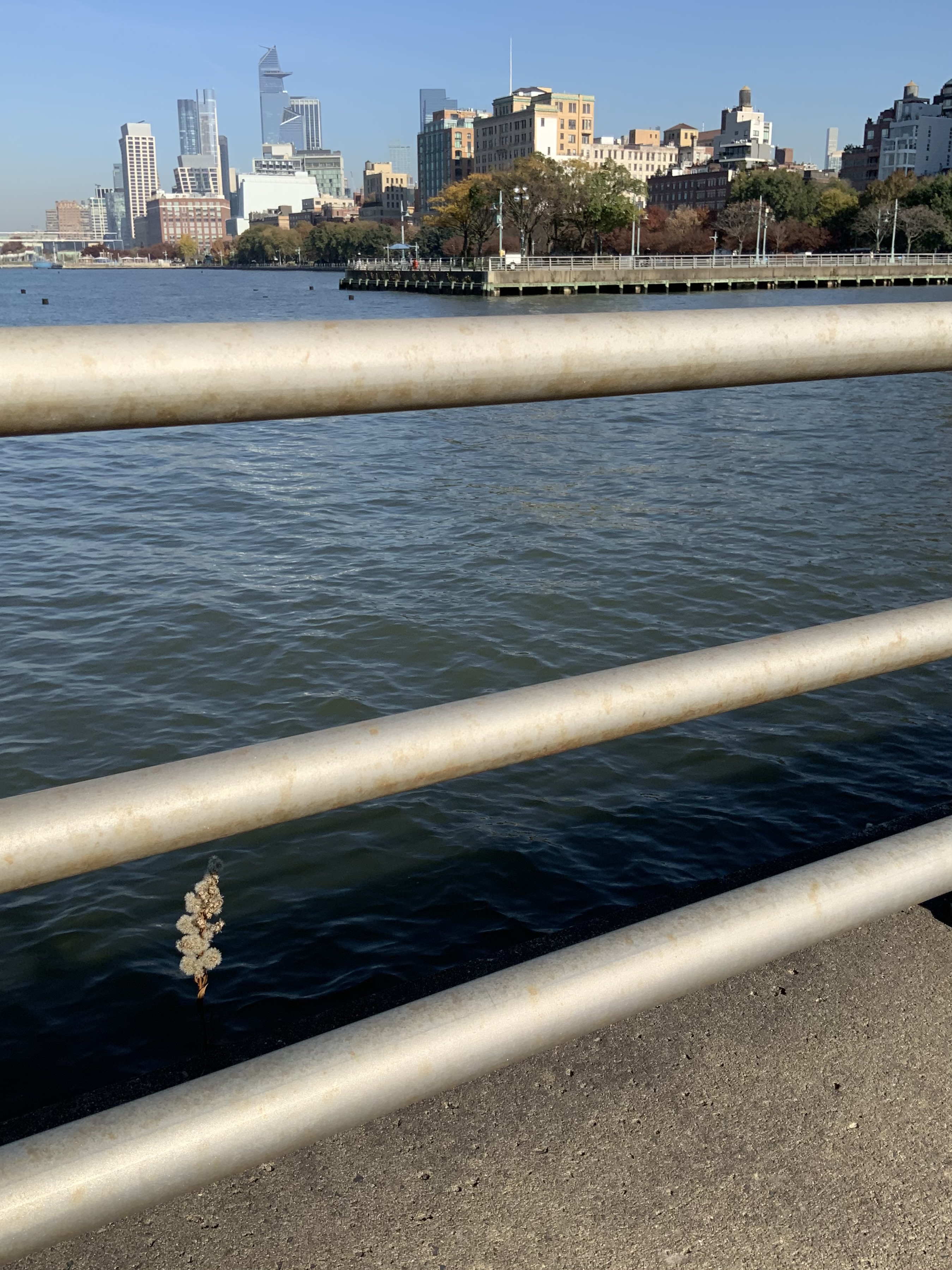
New York, NY
*an ongoing series of quotations – mostly from artists, to artists – that offers wisdom, inspiration, and advice for the sometimes lonely road we are on.
It is the poet and philosopher who provide the community of objectives in which the artist participates. Their chief preoccupation, like the artist, is the expression in concrete form of their notions of reality. Like him, they deal with verities of time and space, life and death, and the heights of exaltation as well as the depths of despair. The preoccupation with these external problems creates a common ground which transcends the disparity of the means used to achieve them. And it is in the language of the philosopher and poet or, for that matter, of other arts which share the same objective that we must speak if we are to establish some verbal equivalent of the significance of art.
Let us not for a moment conceive that the language of one is interchangeable with that of the other: that one can duplicate the sense of a picture by the sense of words or sounds, or that one can translate the truth of words by means of pictorial delineations. Not all odes of Pindar, framed and embroidered, could duplicate the portrayal by Apelles’ brush of the Hero of the Palaestra. The Pandemonium of Milton or Dante’s Inferno can never replace the vision of the Last Judgment by either Michelangelo or Signorelli. No more so than the Pastoral Symphony of Beethoven can be apprehended through the reading of idyllic poems, augmented by descriptions of woodland and fields, of torrents and streams, the study of ornithological sounds, and the laws of harmonics. Neither books on jurisprudence, nor costume plates, can possibly reconstruct Raphael’s School of Athens. And the man who knows a book or a picture through its critics, whatever his experience, has no experience of the art itself. The truth, the reality of each, is confined within its own boundaries and must be perceived in terms of the means generic to itself.
In speaking of art here, there is no thought of recreating the experience of the picture. If we compare one art to another, it is not with the intention of contrasting their actuality, but to speak rather of the motivations and properties such as are admissible to the world of verbal ideas. And if… we are partial to the philosopher – at the expense of those others who share with the artist his common objectives, it is not because we divine in his effort a greater sympathy to the artist, but because philosophy shares with art it’s preoccupation with ideas in the terms of logic.
Mark Rothko in The Artist’s Reality: Philosophies of Art
Comments are welcome!
Pearls from artists* # 580
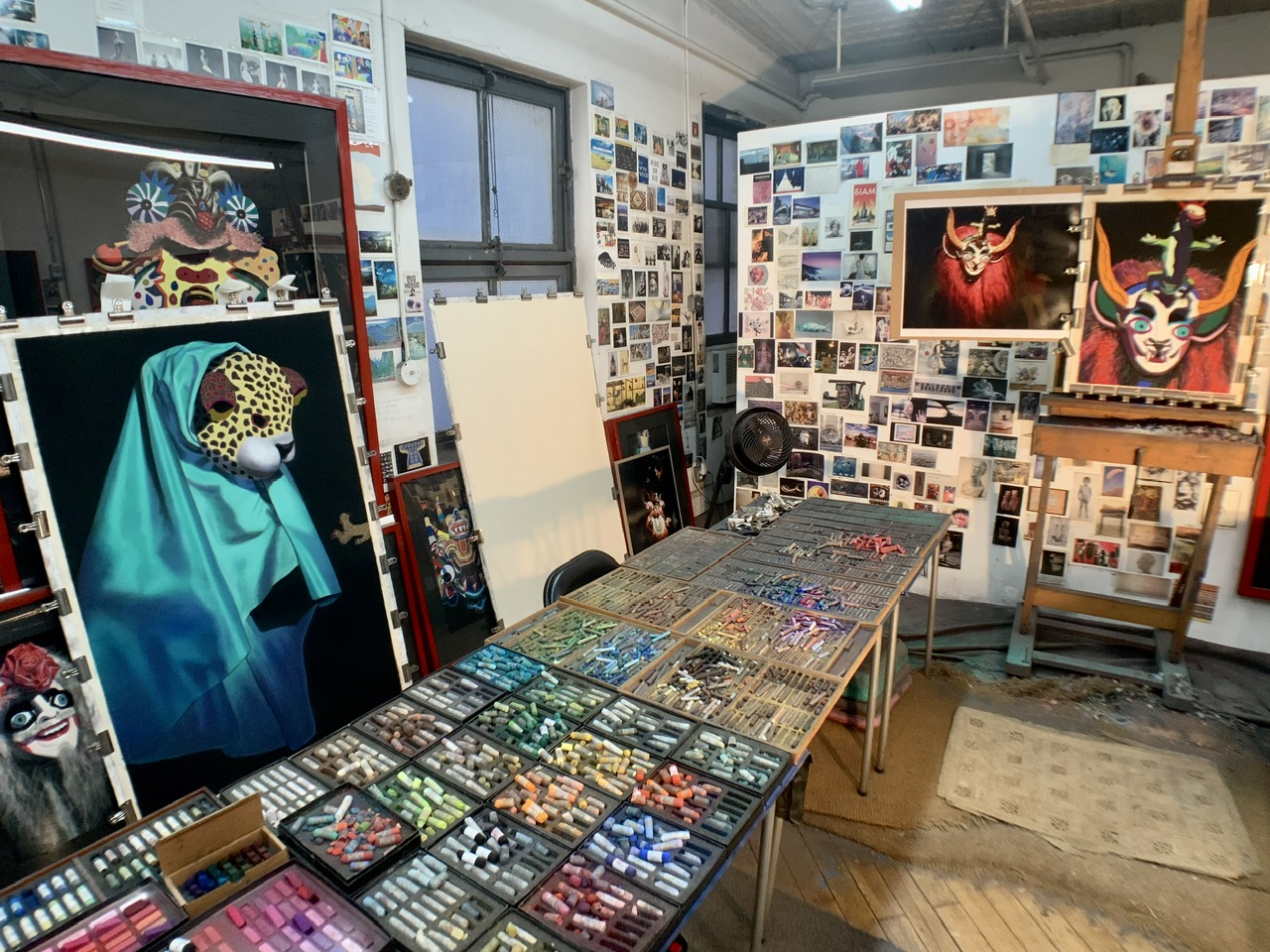
Barbara’s Studio
*an ongoing series of quotations – mostly from artists, to artists – that offers wisdom, inspiration, and advice for the sometimes lonely road we are on.
Love is the spirit that motivates the artist’s journey. The love may be sublime, raw, obsessive, passionate, awful, or thrilling, but whatever its quality, it’s a powerful motive in the artist’s life. The actor Derek Jacobi distinguished this special deeply rooted drive from mere desire in the following way:
You have to have an absolute obsession and compulsion to act, not just desire; it’s just not enough to have talent and want to express it, it’s not enough. It’s got to be more deeply rooted, more abrasive. The fire in the belly has got to be there. If there’s no fire, you can’t do it.
What is it that the artist loves? It is first and foremost the sheer power of whatever medium has attracted him. This is why he’s an artist and not a botanist or an archeologist: an art form has gotten under his skin. It may be the power of the book that gripped him, the power of dance, the power of music, the power of the image, or the power of the play.
Eric Maisel in A Life in the Arts: Practical Guidance and Inspiration for Creative and Performing Artists
Comments are welcome!
Q: What do you like most about being an artist?
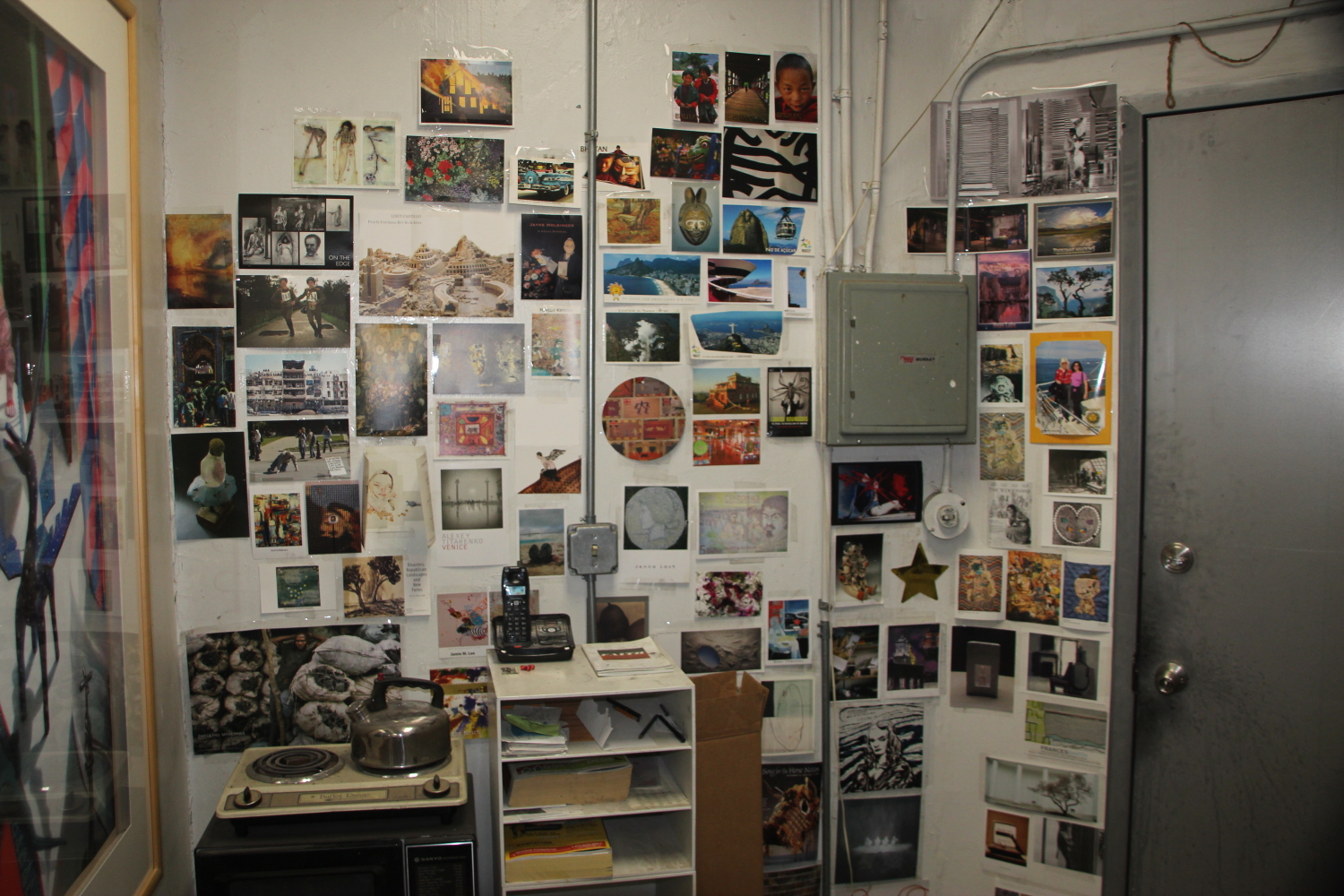
Entrance to Barbara’s studio
A: I love walking into my studio in the morning, knowing that I will spend the day doing what I love, using all my talents, skills, and experience to solve whatever problems lie ahead in the work. As artists we create our own tasks and then go about solving them. Yes, the day to day challenges are significant, but having the freedom to do meaningful work that we love is priceless.
When I was a Lieutenant in the Navy working at the Pentagon, I was very unhappy (and one doesn’t just give two weeks notice and leave the Navy behind)! I still remember what it was like having a soul-crushing job. I am grateful for this turn in my life journey. How much better life is as a professional artist!
Comments are welcome!
Q: Love your selection of pastels! Do you have favorites that you need to force yourself not to continually return to? (Question from Donina Asera via Facebook)

A: No, I don’t think so. Certainly, I do have general preferences. I prefer dark, vivid, intense colors so many of my pale pastels go mostly unused. The single pastel that I use most is Rembrandt black – I buy them buy the dozens – because it takes many layers of pigment to achieve my dark black backgrounds. Otherwise, I strive to be open to whatever the painting needs. My goal – always! – is to make a pastel painting that is exciting to look at and different from anything I have created before.
Thank you very much for the great question!
Comments are welcome!
Q: What advice would you give to a young artist with potential?

Barbara’s studio (since April 1997)
A: I last answered this question in my blog more than ten years ago and I would say similar things now to what I said then.
Be sure that you love your process unconditionally because there is no relationship between how hard you will work and how much money you will earn, period. Indeed, with inflation and rapidly evolving ways of doing business, it seems to cost more money every year to be an artist. As I’ve said often, be prepared to work very, very hard. Really it’s all about making the most of your gifts as an artist. If you don’t feel a deep responsibility to developing your talents as far as possible, you won’t have what it takes to keep going. Countless artists quit and no one can blame them. You absolutely must love your materials and your creative process and be willing to do whatever it takes to continue making art.
This is not a life for slackers!
Comments are welcome!


 barbararachkoscoloreddust.com