Blog Archives
Pearls from artists* # 325
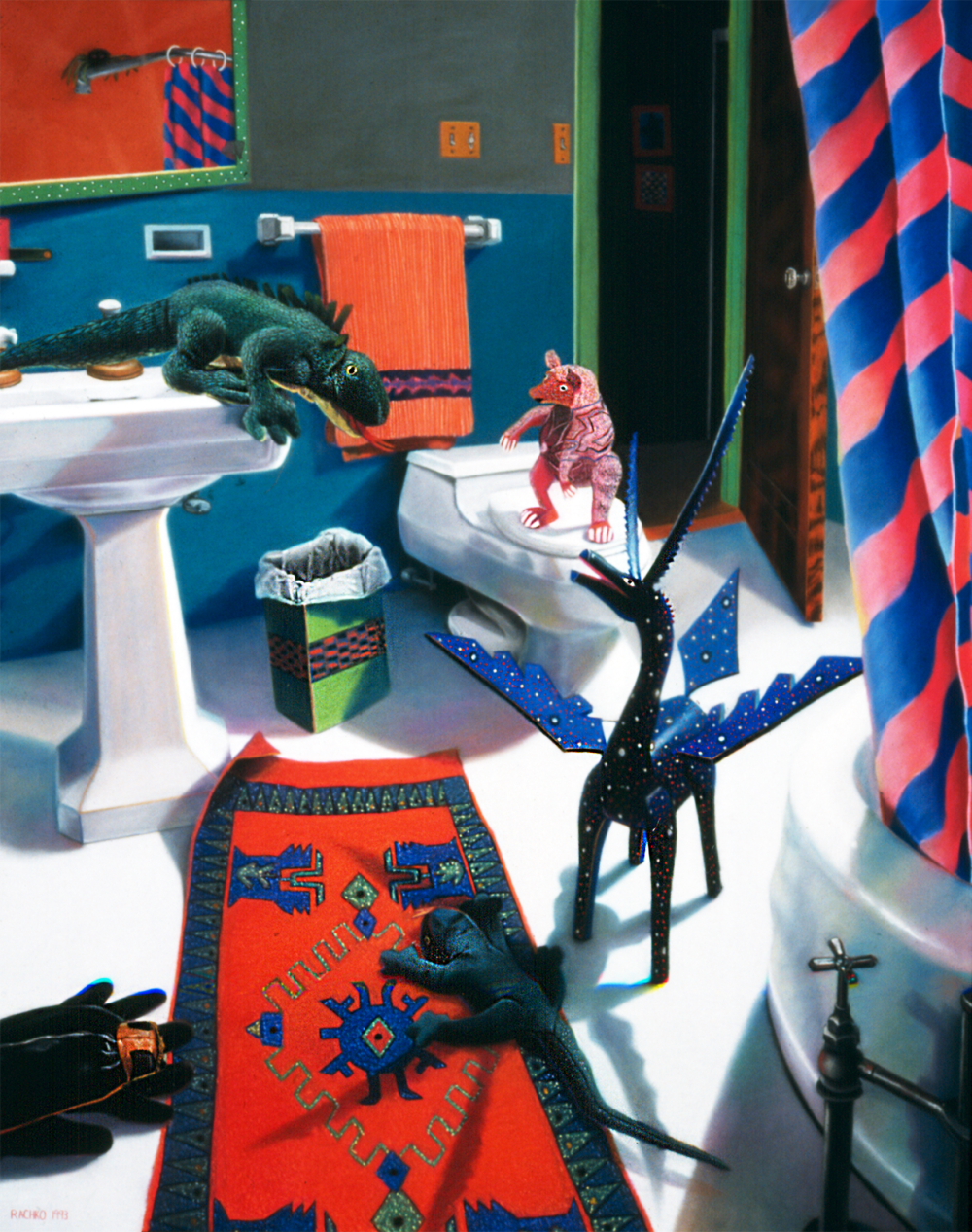
“Myth Meets Dream,” soft pastel on sandpaper, 47″ x 38″
*an ongoing series of quotations – mostly from artists, to artists – that offers wisdom, inspiration, and advice for the sometimes lonely road we are on.
Homo sapiens is the animal that means something, or that desperately wants to mean something. Undoubtedly our thirst for meaning has a lot to do with our petrifying awareness of death, itself a side effect of the imagination, and one that makes our unique position as much of a curse as it is a gift.
As the prime fruit of the imagination, art is the incontrovertible sign of humanity’s presence on earth. But what constitutes the human itself? The prehistoric paintings at Chauvet confront us with a dimension of ourselves that, though familiar in ways, remains in many respects unknown and may ultimately be unknowable. Human consciousness has access to a powerful otherworld, the place of dreams and myth, poetry and lunacy. [This is]… the “imaginal,” the name Henry Corbin gave to the intermediate realm, central to the inscrutable mind of God. As a concrete manifestation of this imaginal realm in the public sphere, art calls us back to the source as a matter of course.
J.F. Martel in Reclaiming Art in the Age of Artifice: A Treatise, Critique, and Call to Action
Comments are welcome!
Pearls from artists* # 308
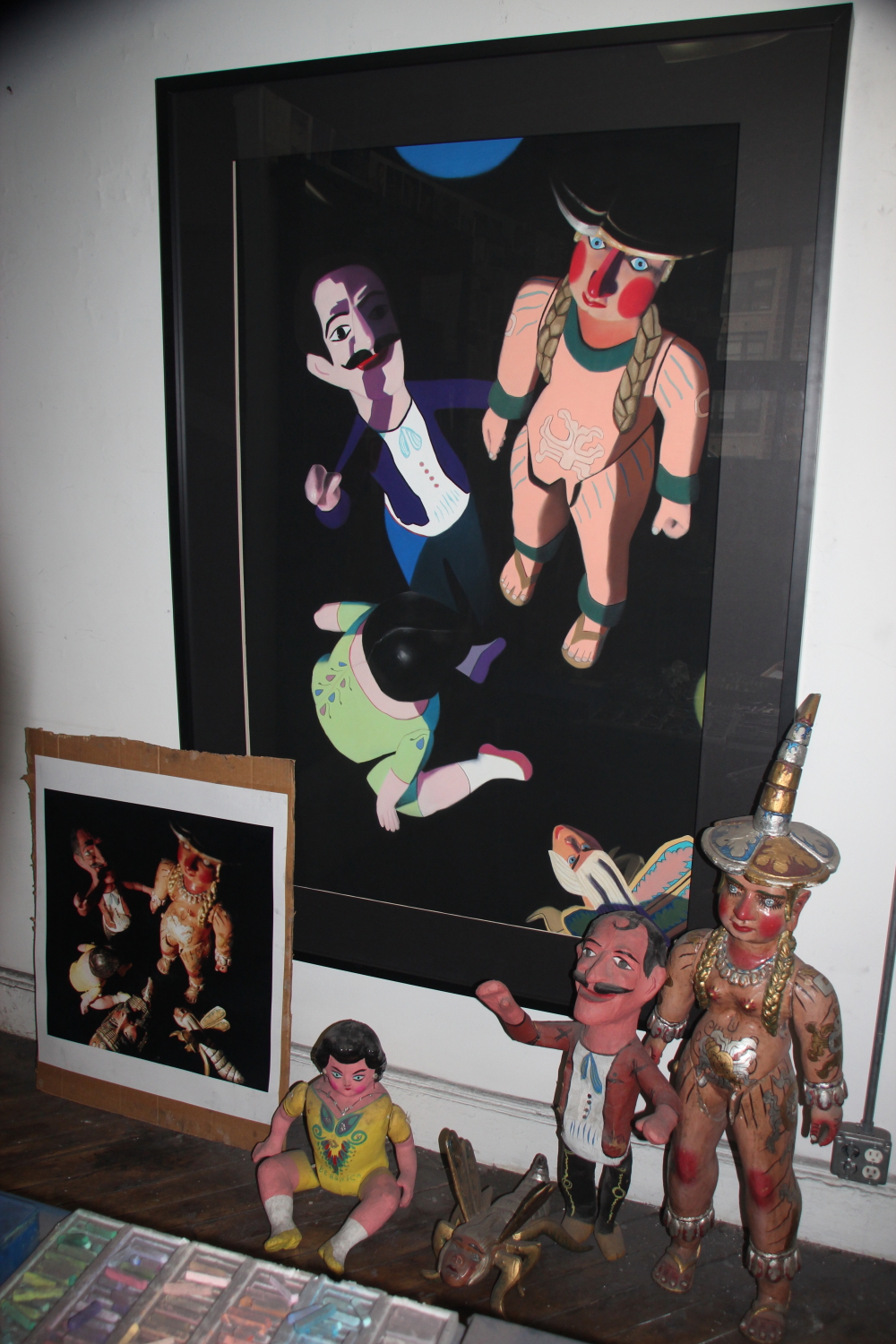
“The Ancestors,” 70” x 50” framed, in Barbara’s studio
*an ongoing series of quotations – mostly from artists, to artists – that offers wisdom, inspiration, and advice for the sometimes lonely road we are on.
Art is mysterious because its purpose is unknown and its effect always exceeds the ends we put it to. If it is true, for instance, that nearly all human societies see the possession of artistic objects as a sign of prestige and power, it may simply be because art’s primary quality makes it a suitable sign for those who want to legitimize their authority. And while it may be the case that art ennobles us by bringing beauty into our lives, or that it conveys complex cultural ideas simply and effectively, or that it preserves the beliefs of one age for the next – again, these functions could very well follow from art’s original, mysterious, irreducible shining. Just as it is the gleam of gold that makes it precious in our eye and not its preciousness that makes it gleam, so the primary quality of art could precede all of its uses and appropriations. In other words art may be something before it becomes all the things we claim it to be.
J.F. Martel in Reclaiming Art in the Age of Artifice: A Treatise, Critique, and Call to Action
Comments are welcome!
Pearls from artists* # 300
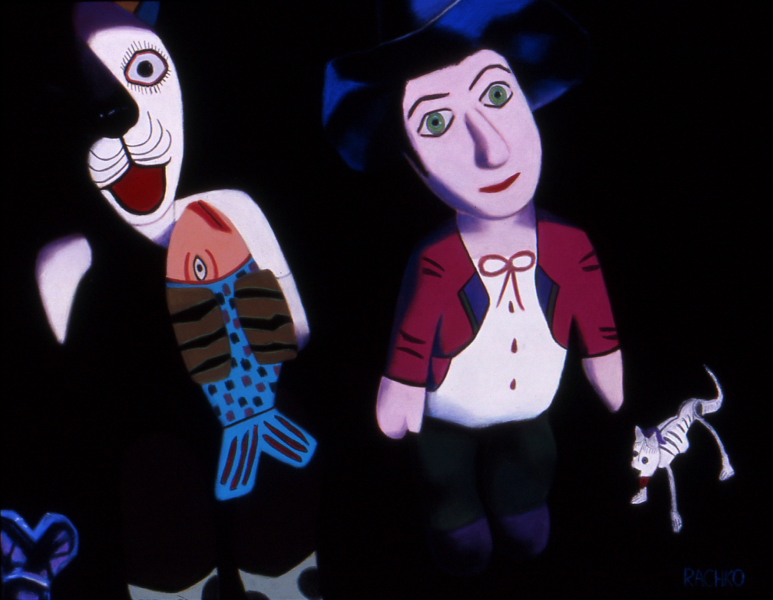
“Offering,” soft pastel on sandpaper, 20″ x 26″
*an ongoing series of quotations – mostly from artists, to artists – that offers wisdom, inspiration, and advice for the sometimes lonely road we are on.
Art breaks down the barriers that normally stand between the physical and the psychic, between your soul and the souls of others. “Through art alone are we able to emerge from ourselves, to know what another person sees of a universe which is not the same as our own and of which, without art, the landscapes would remain as unknown to us as those that may exist on the moon.” For the French novelist Marcel Proust, who wrote those words, art is a meeting place in which human beings commune at a level that ordinary language and sign systems do not allow. Without art, connection at this deeper level is impossible.
J.F. Martel in Reclaiming Art in the Age of Artifice: A Treatise, Critique, and Call to Action
Comments are welcome!
Pearls from artists* # 277

Lake Titicaca above Cocacabana, Bolivia
* an ongoing series of quotations – mostly from artists, to artists – that offers wisdom, inspiration, and advice for the sometimes lonely road we are on.
Einstein wrote, “The most beautiful experience we can have is the mysterious. It is the fundamental emotion which stands at the cradle of true art and true science.” What did Einstein mean by “the mysterious?” I don’t think he meant that science is full of unpredictable or unknowable supernatural forces. I believe that he meant a sense of awe, a sense that there are things larger than us, that we do not have all the answers at this moment. A sense that we can stand right at the edge between known and unknown and gaze into that cavern and be exhilarated rather than frightened. Just as Einstein suggested, I have experienced that beautiful mystery both as a physicist and as a novelist. As a physicist, in the infinite mystery of physical nature. As a novelist, in the infinite mystery of human nature and the power of words to portray some of that mystery.
Alan Lightman in A Sense of the Mysterious: Science and the Human Spirit
Comments are welcome!
Pearls from artists* # 176
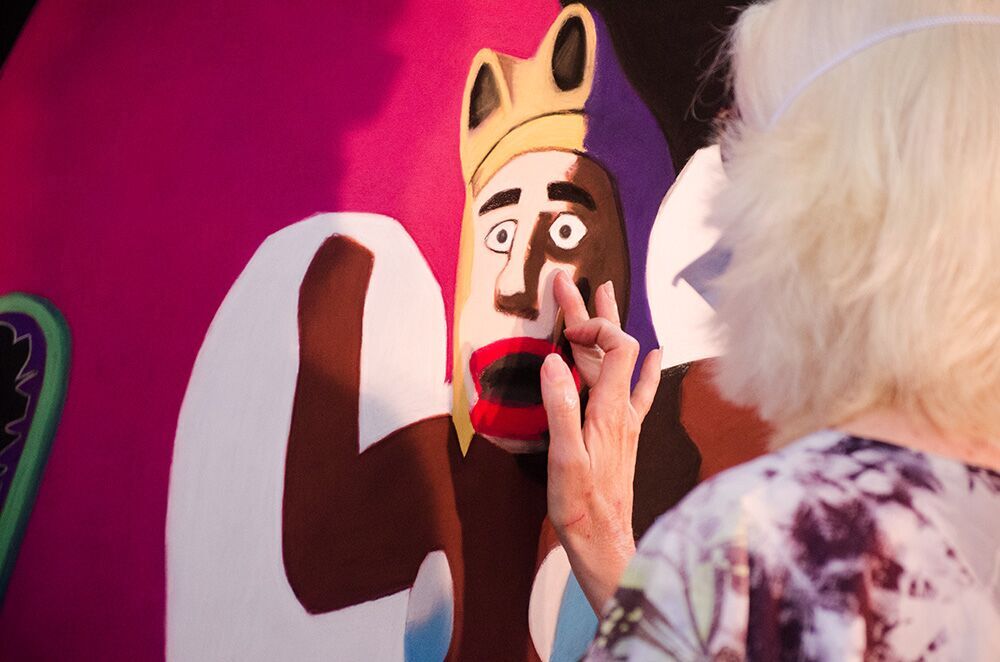
Working on “Charade,” Photo: Marianne Barcellona
* an ongoing series of quotations – mostly from artists, to artists – that offers wisdom, inspiration, and advice for the sometimes lonely road we are on.
I don’t demand a translation of the unknown. I don’t need to understand what it all means, or where ideas are originally conceived, or why creativity plays out as unpredictably as it does. I don’t need to know why we are sometimes able to converse freely with inspiration, when at other times we labor hard in solitude and come up with nothing. I don’t need to know why an idea visited you today and not me. Or why it visited us both. Or why it abandoned us both.
None of us can know such things, for these are among the great enigmas.
All I know for certain is that this is how I want to spend my life – collaborating to the best of my ability with forces of inspiration that I can neither see, nor prove, nor command, nor understand.
It’s a strange line of work, admittedly.
I cannot think of a better way to pass my days.
Elizabeth Gilbert in Big Magic: Creative Living Beyond Fear
Comments are welcome!
Pearls from artists* # 154
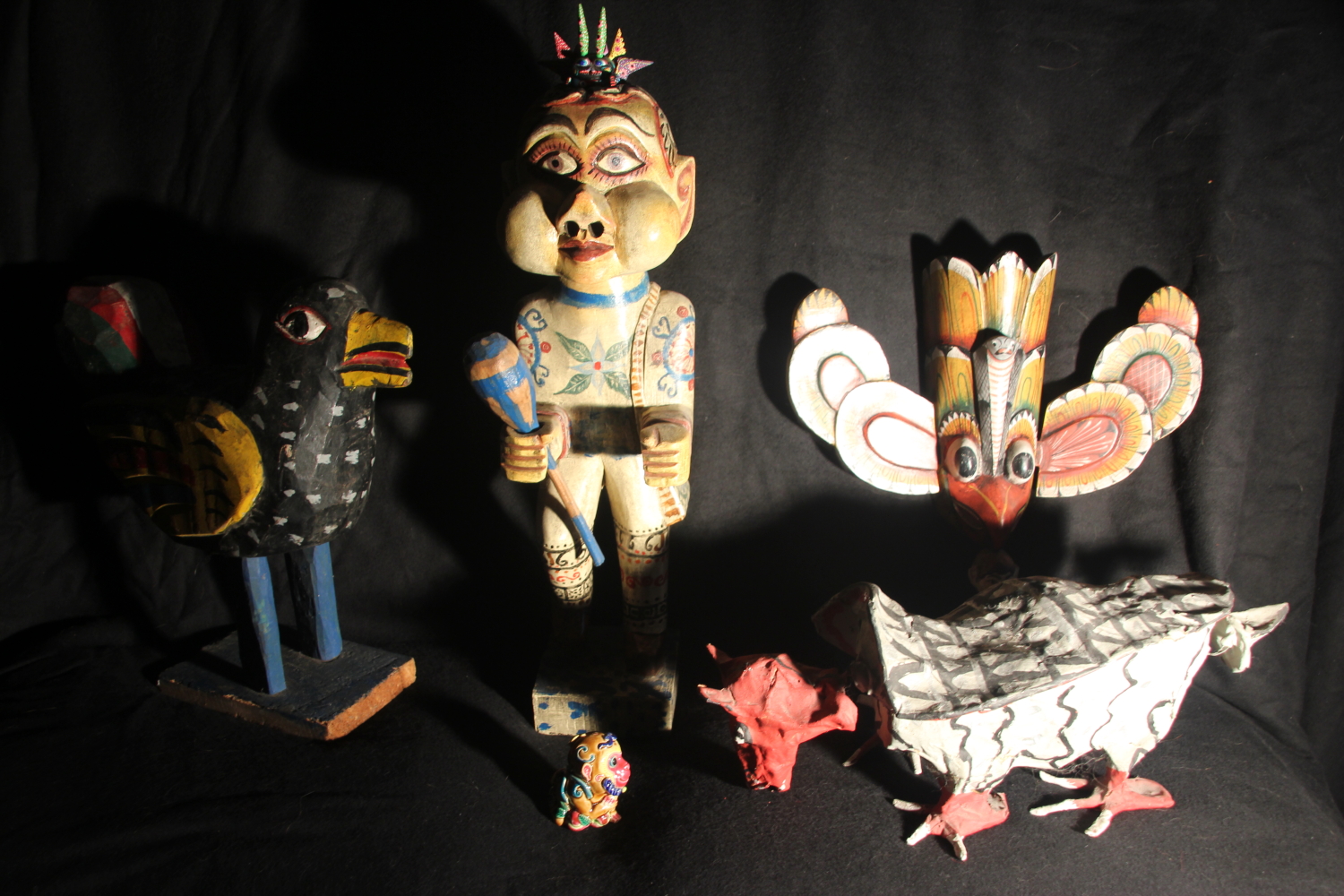
Idea for a painting
* an ongoing series of quotations – mostly from artists, to artists – that offers wisdom, inspiration, and advice for the sometimes lonely road we are on.
Often the public forms an idea of inspiration that is quite false, almost a religious notion. Alas! I do not believe that inspiration falls from heaven. I think it rather the result of a profound indolence and of our incapacity to put to work certain forces in ourselves. These unknown forces work deep within us, with the aid of the elements of daily life, its scenes and passions, and, they burden us and oblige us to conquer the kind of somnolence in which we indulge ourselves like invalids who try to prolong dream and dread resuming contact with reality, in short when the work that makes itself in us and in spite of us demands to be born, we can believe that this work comes to us from beyond and is offered by the gods. The artist is more slumberous in order that he shall not work. By a thousand ruses, he prevents his nocturnal work from seeing the light of day.
For it is at the moment that consciousness must take a precedence and that it becomes necessary to find the means which permit the unformed work to take form, to render it visible to all. To write, to conquer ink and paper, accumulate letters and paragraphs, divide them with periods and commas, is a different matter than carrying the dream of a play or of a book.
Jean Cocteau: The Process of Inspiration in The Creative Process, edited by Brewster Ghiselin
Comments are welcome!
Pearls from artists* # 135

Chalcatzingo (Mexico)
* an ongoing series of quotations – mostly from artists, to artists – that offers wisdom, inspiration, and advice for the sometimes lonely road we are on.
[Meredith Monk on beginning a new piece and whether it gets easier over time].
I always say that the fear is overwhelming at the beginning. It’s like jumping off a cliff. You have absolutely no idea what is going on. It is like being a detective. You try to follow every clue that comes up. Some of them are McGuffins, but I think that is what the process is. It starts out with fear, and I think that’s a good thing. If you know what you are doing already, what is the point in doing it? It is always like hanging out and tolerating pain and the fear of the unknown. Then usually what happens is that a little something will come up. If I am sitting at the piano – and I remember sitting at the piano and almost shaking at the beginning of this piece – one little phrase will come up. And then you get a little interested in that one little phrase. Or I say to myself, “Step by step.” Another thing I say to myself, “Remember playfulness, Meredith?”
What happens at a certain point is that the thing itself starts coming in and you realize that you are more interested than you are afraid. You are in this thing, whatever it is, and fear is useless at a certain point. But at the beginning, it is not bad. It is saying that you are risking. I think that taking the chance on risking is something that keeps you young. I’ll tell you, what you are saying about my skills – I don’t find it easier. It is just as hard as it ever was. I don’t think, “Now I have these skills.” I don’t think in those terms at all.
… When you are making something new, you aren’t going to be able to use the same technique that you used on something else. Maybe other people think it is easier as they go along. I think part of the challenge is not to rely on things that you know, and to keep on listening. It is really a process of listening to what something needs. What’s right for it.
Conversations with Meredith Monk by Bonnie Marranca
Comments are welcome!
Pearls from artists* # 125
Barbara’s studio
* an ongoing series of quotations – mostly from artists, to artists – that offers wisdom, inspiration, and advice for the sometimes lonely road we are on.
My own natural proclivity is to categorize the world around me, to remove unfamiliar objects from their dangerous perches by defining, compartmentalizing and labeling them. I want to know what things are and I want to know where they are and I want to control them. I want to remove the danger and replace it with the known. I want to feel safe. I want to feel out of danger.
And yet, as an artist, I know that I must welcome the strange and the unintelligible into my awareness and into my working process. Despite my propensity to own and control everything around me, my job is to “make the familiar strange and the strange familiar,” as Bertolt Brecht recommended: to un-define and un-tame what has been delineated by belief systems and conventions, and to welcome the discomfort of doubt and the unknown, aiming to make visible what has become invisible by habit.
Because life is filled with habit, because our natural desire is to make countless assumptions and treat our surroundings as familiar and unthreatening, we need art to wake us up. Art un-tames, reifies and wakes up the part of our lives that have been put to sleep and calcified by habit. The artist, or indeed anyone who wants to turn daily life into an adventure, must allow people, objects and places to be dangerous and freed from the definitions that they have accumulated over time.
Anne Bogart in What’s the Story: Essays about art, theater, and storytelling
Comments are welcome!


 barbararachkoscoloreddust.com