Blog Archives
Q: Can you speak about what draws you to the Mexican and Guatemalan figures that you collect?
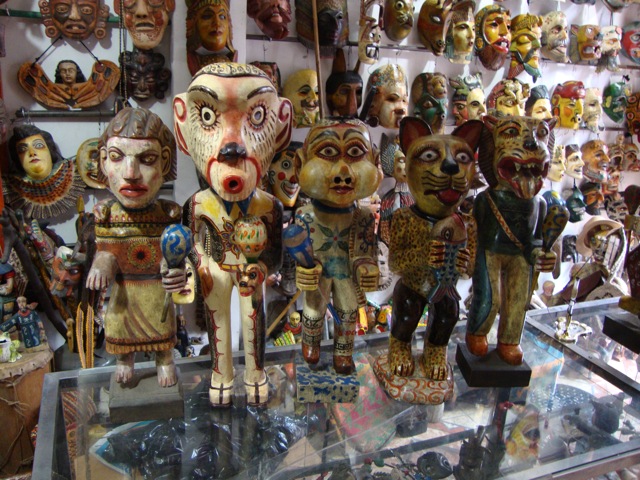
Shop in Panajachel, Guatemala, Photo: Donna Tang
A: I search the markets and bazaars of Mexico, Guatemala, and elsewhere for folk art objects – masks, carved wooden animals, papier mache figures, children’s toys – to bring back to New York to paint and photograph. Color is very important – the brighter and the more eye-catching the patterns are on these objects the better – plus they must be unique and have lots of personality. I try not to buy anything mass-produced or obviously made for the tourist trade. The objects must have been used or otherwise look like they’ve had a life (i.e., been part of religious festivities) to draw my attention. How and where each one comes into my possession is an important part of my creative process.
Finding, buying, and getting them back to the U.S. is always circuitous, but that, too, is part of the process, an adventure, and often a good story. Here’s an example. In 2009 I was in a small town on the shores of Lake Atitlan in Guatemala, called Panajachel. After returning from a boat ride across the lake, my friends and I were walking back to our hotel when we discovered a wonderful mask store. I spent some time looking around, made my selections, and was ready to buy five exquisitely-made standing wooden figures, when I learned that Tomas, the store owner, did not accept credit cards. I was heart-broken and thought, “Oh, no, I’ll have to leave them behind.” However, thanks to my good friend, Donna, whose Spanish is much more fluent than mine, the three of us brain-stormed until finally, Tomas had an idea. I could pay for the figures at the hotel up the block and in a few days when the hotel was paid by the credit card company, the hotel would pay Tomas. Fabulous! Tomas, Donna, and I walked to the hotel, where the transaction was made and the first hurdle was overcome. Working out the packing and shipping arrangements took another hour or two, but during that time Tomas and I became friends and exchanged telephone numbers (the store didn’t even have a telephone so he gave me the phone number of the post office next door, saying that when I called, he could easily run next door!). Most surprisingly, the package was waiting for me in New York when I returned home from Guatemala.
Comments are welcome!
Q: What have you learned about the people of Mexico through your travels, reading, and research?
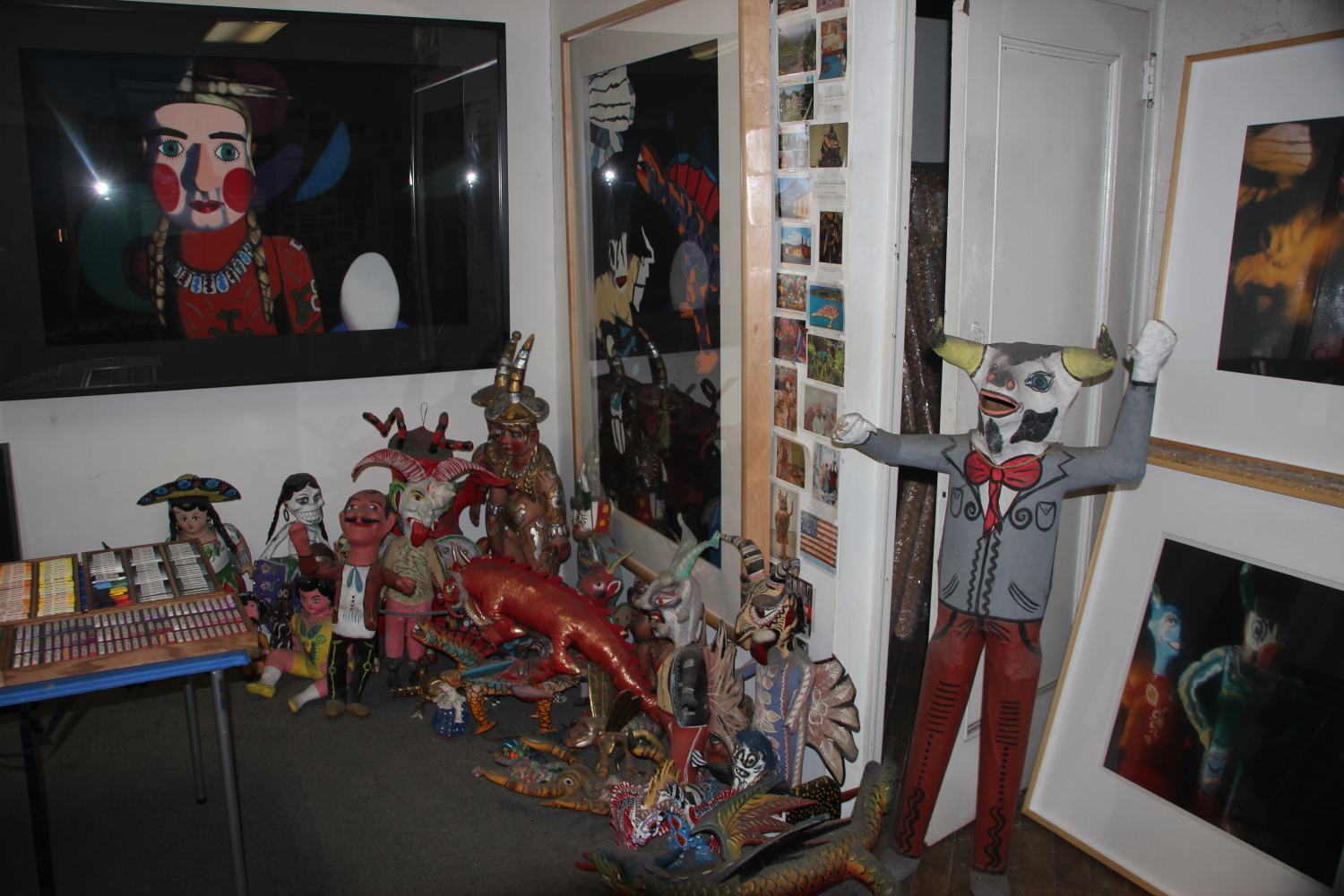
A corner of the studio
A: It didn’t take long to become smitten with these beautiful people. It happened on my first trip there in 1992 when Bryan and I, along with busloads of other tourists, were visiting the Oaxacan cemeteries on The Day of the Dead. The Oaxaquenos tending their ancestor’s graves were so dignified and so gracious, even with so many mostly-American tourists tromping around on a sacred night, that I couldn’t help being taken with them and with their beliefs. My studies since that time have given me a deeper appreciation for the art, architecture, history, mythology, etc. that comprise the extremely rich and complex story of Mexico as a cradle of civilization in the West. It is a wonderfully heady mix and hopefully some of it comes through in my work as a painter and a photographer.
By the way I often wonder why the narrative of Mexico’s fascinating history was not taught in American public schools, at least not where I went to public school in suburban New Jersey. Mexico is our neighbor, for goodness sake, but when I speak to many Americans about Mexico they have never learned anything about the place! It’s shocking, but many people think only “Spring Break” and/or “Drug Wars,” when they hear the word “Mexico.” As a kid I remember learning about Egypt, Mesopotamia, Greece, and other early civilizations in the Middle East, Europe, and Asia, but very little about Mexico. We learned about the Maya, when it was still believed that they were a peaceful people who devoted their lives to scientific and religious pursuits, but that story was debunked years ago. And I am fairly sure that not many Americans even know that Maya still exist in the world … in Mexico and in Guatemala. There are a few remote places that were not completely destroyed by Spanish Conquistadores in the 16th century and later. I’ve been to Mayan villages in Guatemala and seen shamans performing ancient rituals. For an artist from a place as rooted in the present moment as New York, it’s an astounding thing to witness!
Comments are welcome!
Q: Is there an overarching narrative in your photographs with Mexican and Guatemalan figures?
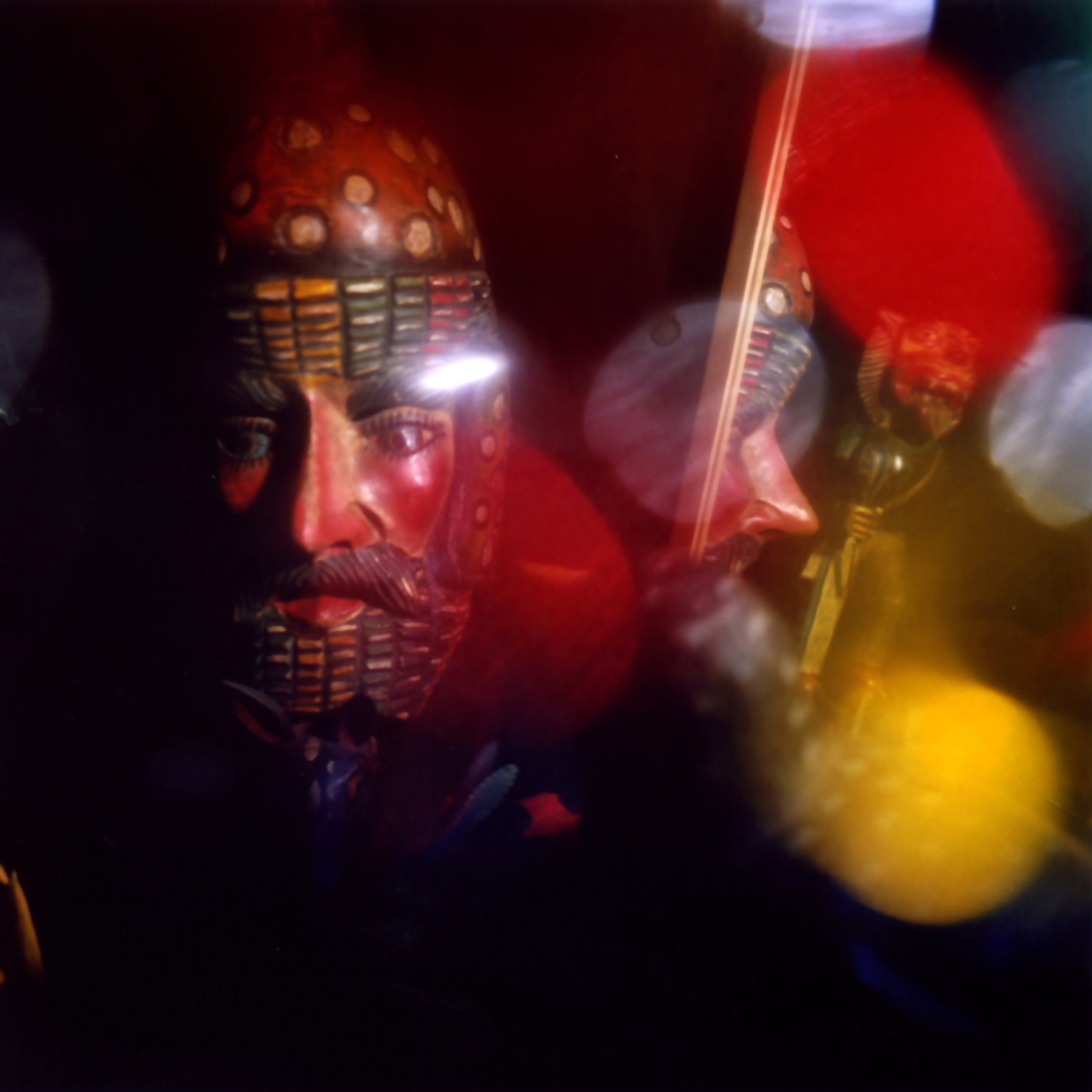
Untitled chromogenic print, 24″ x 24,” edition of 5
A: Maybe, but that’s something for the viewer to judge. I never specify exactly what my work is about for a couple of reasons: my thinking about the meaning of my work constantly evolves, plus I wouldn’t want to cut off other people’s interpretations. Everything is equally valid. I heard Annie Leibovitz interviewed some time ago on the radio. She said that after 40 years as a photographer, everything just gets richer. It doesn’t get easier, it just gets richer. I’ve been a painter for 27 years, a photographer for 11, and I agree completely. Creating this work is an endlessly fascinating intellectual journey. I realize that I am only one voice in a vast art world, but I hope that through the ongoing series of questions and answers on my blog, I am conveying some sense of how artists work and think.
Comments are welcome!
Pearls from artists* # 28
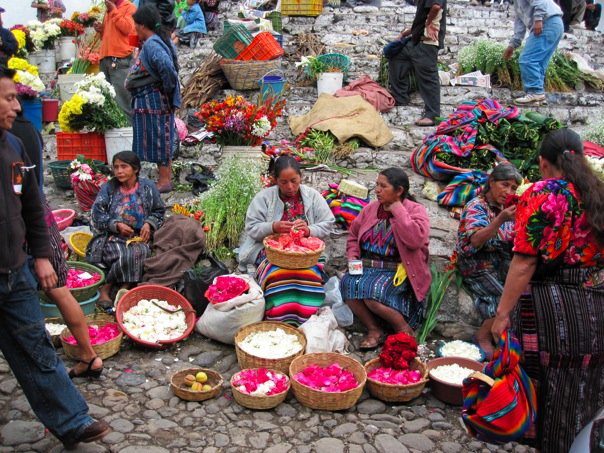
Flower sellers in Chichicastenango, Guatemala
* an ongoing series of quotations – mostly from artists, to artists – that offers wisdom, inspiration, and advice for the sometimes lonely road we are on.
We have talked a good deal about our duty, and how we could attain the right goal, and we came to the conclusion that in the first place our aim must be to find a steady position and a profession to which we can entirely devote ourselves. It is wise to do so, for life is but short and time passes quickly; if one is master of one thing and understands one thing well, one has at the same time insight into and understanding of many things.
One must especially have the end in mind, and the victory one would gain after a whole life of work and effort is better than one that is gained earlier. Whoever lives sincerely and encounters much trouble and disappointment, but is not bowed down by them, is worth more than one who has always sailed before the wind and has only relative prosperity. One must never trust the occasion when one is without difficulties.
Irving Stone with Jean Stone, editors, Dear Theo: The Autobiography of Vincent Van Gogh
Comments are welcome!
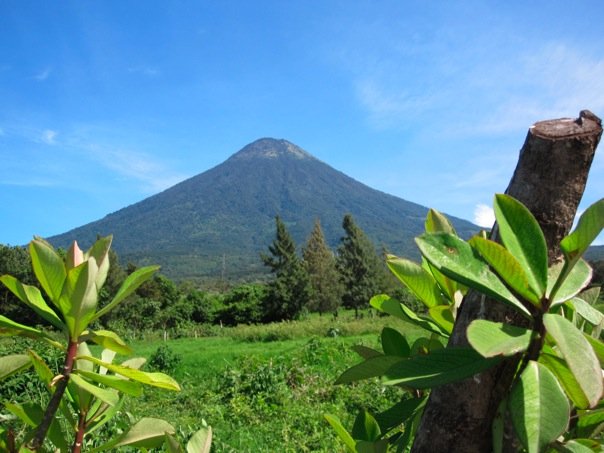
Q: What would you be if you were not an artist?
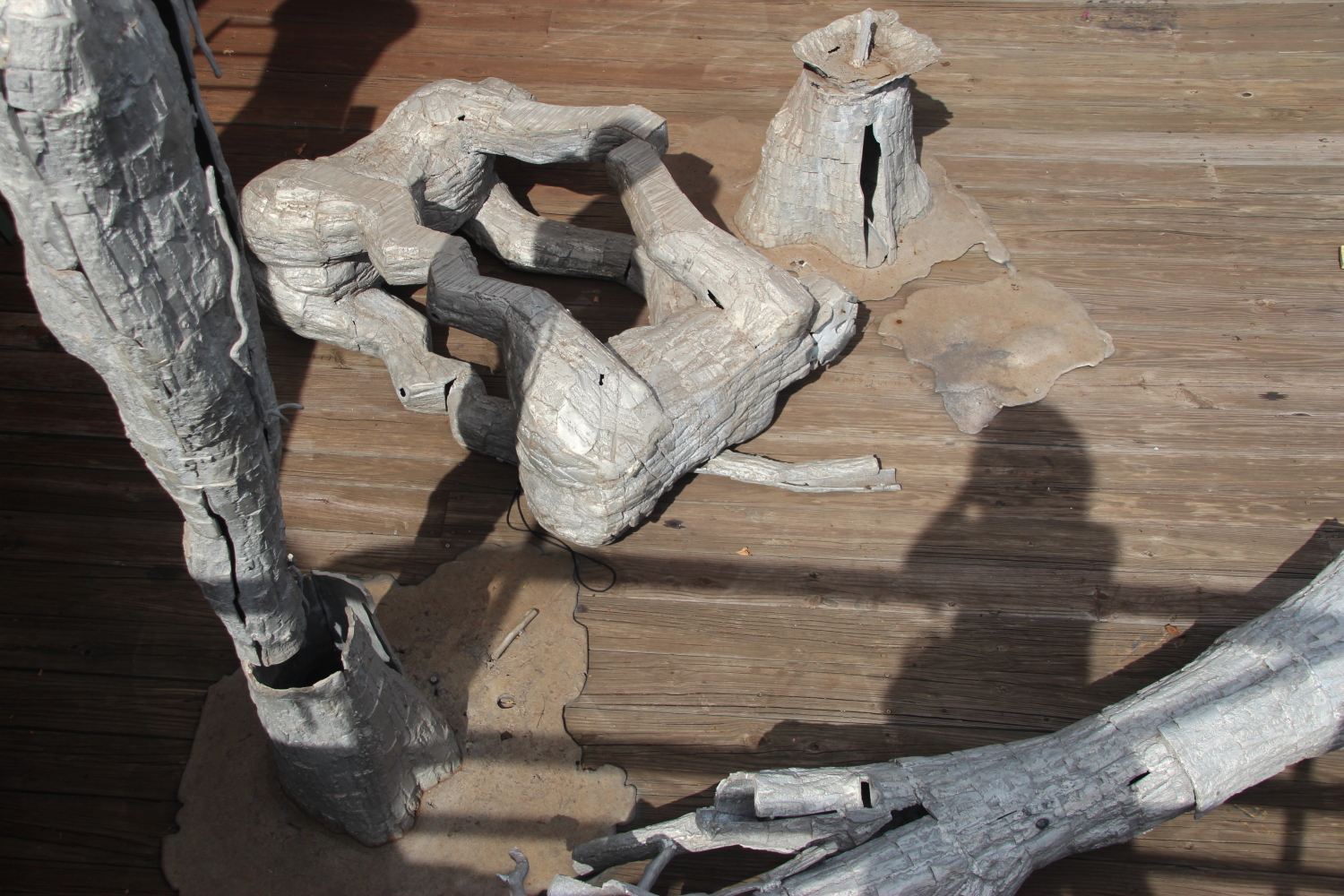
Self-portrait on a Hudson River barge
A: I honestly have no idea, but whatever it might be, there is a good chance that I’d be bored! In my younger days boredom was a strong motivator. I left the active duty Navy out of boredom. I couldn’t bear not being intellectually challenged (most of my jobs consisted of paper-pushing), not using my flying skills (at 27 I was a licensed commercial pilot and Boeing 727 flight engineer), and not developing my artistic talent. In what surely must be a first, by spending a lot of time and money training me for jobs I hated, the Navy turned me into a hard-working artist! And once I left the Navy there was no plan B. There was no time to waste. It was “full speed ahead.”
Art is a calling. You do not need to be told this if you are among those who are called. It’s all about “the work,” that all-consuming focus of an artist’s life. If a particular activity doesn’t make you a better artist, you avoid it. You work hard to nourish and protect your gifts. As artists we invent our own tasks, learn whatever we need in order to progress, and complete projects in our own time. It is life lived at its freest.
My art-making has led me to fascinating places: Mexico, Guatemala, Brazil, Argentina, Uruguay, France, England, Italy, Bali, Java and more; and to in-depth studies of intriguing subjects: drawing, color, composition, art and art history, the art business, film and film history, photography, mythology, literature, music, jazz history, and archaeology, particularly that of ancient Mesoamerica (the Olmec, Zapotec, Mixtec, Aztec, Maya, etc.). And this rich mixture continually grows! For anyone wanting to spend their time on earth learning and meeting new challenges, there is no better life than that of an artist.
I SO agree with this exchange that I read years ago between between Trisha Brown and Mikhail Baryshnikov in the New York Times. I wrote it on a piece of paper and taped it to my studio wall:
Trisha: How do you think we keep going? Are we obsessed?
Mikhail: We do it because there’s nothing better. I’m serious. Because there is nothing more exciting than that. Life is so boring, that’s why we are driven to the mystery of creation.
Comments are welcome.
Q: When did you begin seriously studying photography?
Exhibition catalogue, 2009 solo exhibition at HP Garcia Gallery, NYC; click
“Exhibition catalogue” under Blogroll to view inside pages
A: After I lost my husband, Bryan, on 9/11 – as I’ve discussed elsewhere, Bryan photographed most of the setups for my “Domestic Threats” series – I needed to find a way to continue making art. In June 2002 I began studying photography at the International Center of Photography (ICP) in New York. I took a one week 4 x 5 view camera workshop because Bryan had photographed the setups with a Toyo-Omega view camera. I was surprised to discover that I had absorbed quite a bit of technical information just by watching him. Once I completed the workshop, I decided to start over and to learn as much as I could about photography. So I enrolled in Photography I. Over the next several years I completed about a dozen courses at ICP, eventually learning to make my own large-scale chromogenic prints. Around 2007 I began working seriously as a photographer, creating my photographic series, “Gods and Monsters,” with Bryan’s Mamiya 6 camera. In October 2009 HP Garcia Gallery in New York gave me my first solo photography exhibition (see “Exhibition catalogue” under Blogroll).
I’m busy getting ready for my next solo show there in October. This exhibition will be fairly comprehensive and will include recent photographs (diptychs and single images), new work from the “Black Paintings” series, and a selection of Mexican and Guatemalan figures. There will be an exhibition catalogue and later in the fall, the gallery will publish the first book about my work. I am particularly thrilled about the book, a new, but long overdue, career milestone!
Q: In your earlier “Domestic Threats” series, you liken your paintings to scenes in a movie. Is there an audition process? What qualities must a figure possess to be cast in one of your paintings?

Negotiating with Tomas in Panajachel, Guatemala; photo by Donna Tang
A: There’s not an audition process, but I do feel like the masks and figures call out to me when I’m searching the markets of Mexico and Guatemala. Color is very important – the brighter and the more eye-catching the better – plus they must have lots of “personality.” I try not to buy anything mass-produced or obviously made for tourists. How and where these objects come into my life is an important part of the process. Getting them back to the U.S. is always an adventure. For example, in 2010 I was in Panajachel on the shores of Lake Atitlan in Guatemala. After returning from a boat ride across the lake, my friends and I were walking back to our hotel when we noticed a mask store. This store contained many beautiful things so I spent a long time looking around. Finally, I made my selections and was ready to buy five standing wooden figures, when I learned that Tomas, the store owner, did not accept credit cards. Not having enough cash, I was heart-broken and thought, “Oh, no. I can’t bring these home.” However, thanks to my friend, Donna, whose Spanish was much more fluent than mine, Tomas and she came up with a plan. I would pay for the figures at a nearby hotel and once the owner was paid by the credit card company, he would pay Tomas. Fabulous! Tomas, Donna, and I walked to the hotel, where the transaction was completed. Packing materials are not so easy to find in remote parts of Guatemala so the packing and shipping arrangements took another hour. During the negotiations Tomas and I became friends. We exchanged telephone numbers (he didn’t have a telephone so he gave me the phone number of the post office next door, saying that when I called, he could easily run next door). When I returned to New York ten days later, the package was waiting for me.
While setting up a scene for a painting, I work very intuitively so how the objects are actually “cast” is difficult to say. Looks count a lot – I select an object and put it in a particular place, move it around, and develop a storyline. I spend time arranging lights and looking for interesting cast shadows. I shoot two exposures with a 4 x 5 view camera and order a 20″ x 24″ photograph to use for reference. I also work from the “live” objects. My series, “Domestic Threats,” was initially set in my Virginia house, but in 1997, I moved to a six floor walk-up in New York. For the next few years the paintings were set there, until 2001 when I moved to my current apartment. In a sense the series is a visual autobiography that hints at what my domestic surroundings were like.
Q: How large is your collection of Mexican folk art objects?
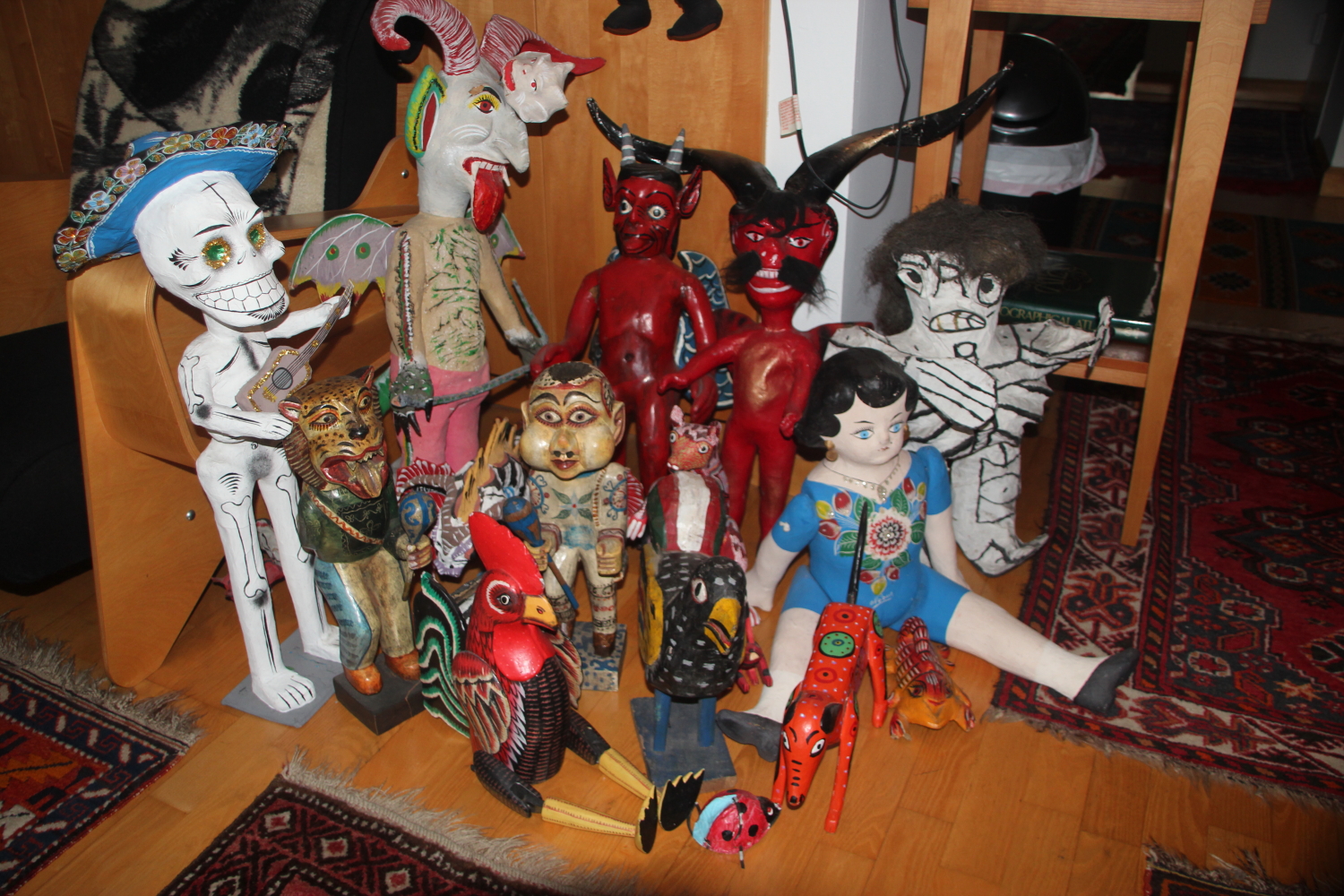
Part of the collection
A: I haven’t counted them, but my guess is 200 pieces of various sizes. This includes the Guatemalan figures. I went to Guatemala in 2009 and 2010. Since I divide my time between a house in Alexandria, VA, an apartment in Manhattan, and a studio in Chelsea, part of my folk art collection is in each of these places.


 barbararachkoscoloreddust.com