Blog Archives
Pearls from artists* # 678
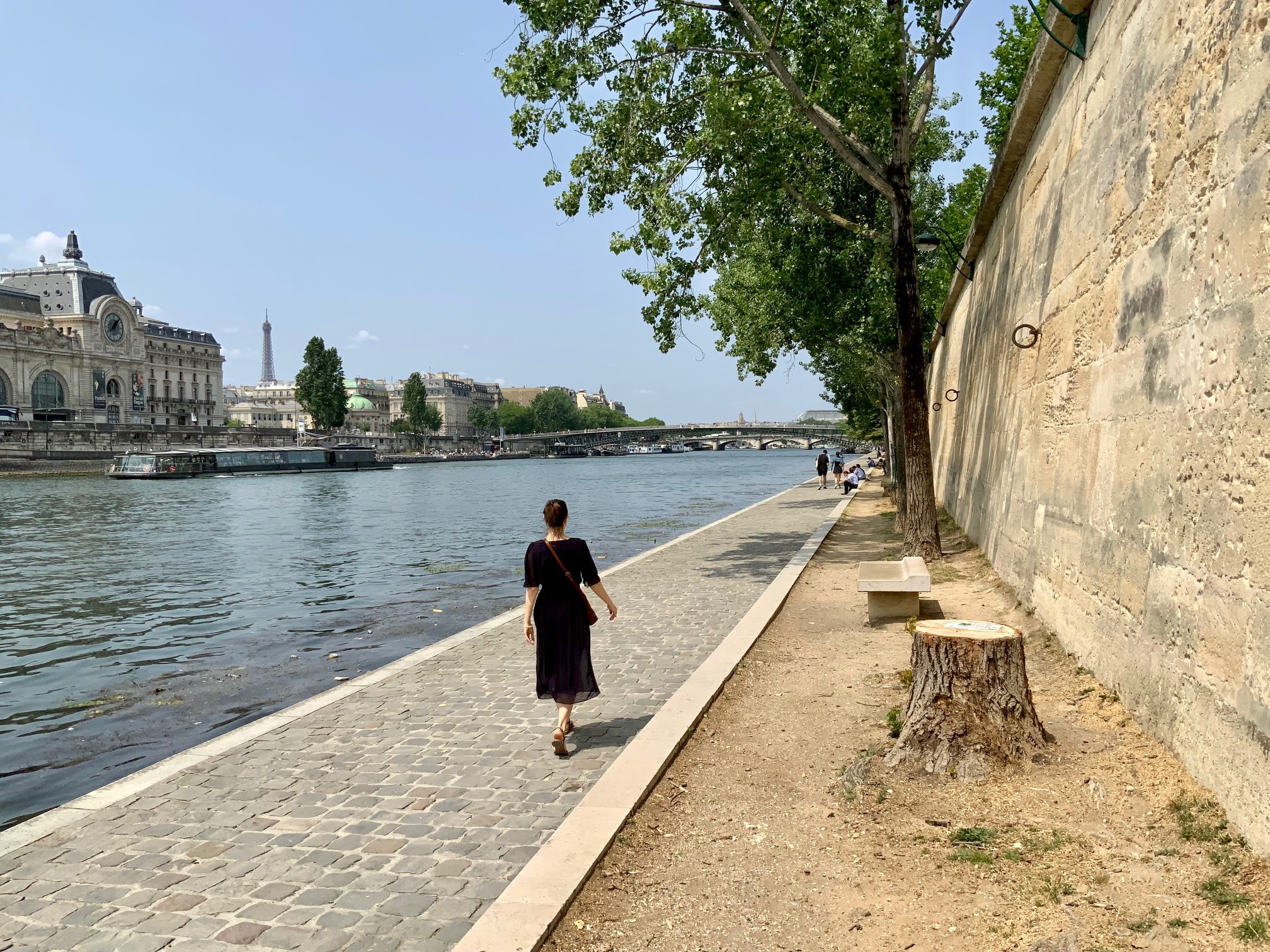
Along the Seine, Paris, France
*an ongoing series of quotations – mostly from artists, to artists – that offers wisdom, inspiration, and advice for the sometimes lonely road we are on.
When I was a bit weary, losing hope, I would go out and walk across Paris. Sometimes I would meet an art lover who would say a word to me, nothing binding for him, but all the same it would buck me up a bit. For example, he might say: “What are you up to? I’d love to see what you’ve done. I’ll come and see you on Thursday at eleven. I’d go home feeling like a new man; I’d tell my wife how enthusiastic I felt; but on Thursday at ten I’d get an express letter saying, “Dear friend, please excuse me, something has come up.” But that wouldn’t matter so much because I’d made a new start. The deal had fallen through, but it’d still helped because it had given me new momentum.
Chatting With Henri Matisse: The Lost 1941 Interview, Henri Matisse with Pierre Courthion, edited by Serge Guilbaut
Comments are welcome!
Q: You seem very disciplined. Do you ever have a day when you just can’t get excited about going to the studio to work?

Signing “Narcissist”
A: That happens occasionally, but I usually still go to the studio to work. You know the expression, “99% of life is just showing up”? Well, of course I have to show up at my studio to accomplish anything so I still try to keep fairly regular studio hours – 6 to 7 hours a day, 4 or 5 days a week. And that’s not to mention all the other work – answering email, checking social media, writing blog posts, etc. – which I tend to do at lunchtime, in the evenings, and on my days off from the studio.
When you are an artist there is always work to do and for some of it, no one else can do it because no one else knows the work from the inside the way the maker does. I like what Twyla Tharp says in her book, “The Creative Habit.” In order to progress an artist needs good work habits that become a daily routine. And Chuck Close used to say, “Inspiration is for amateurs,” meaning a professional works whether she’s in the mood or not. I completely agree so I keep working and slowly moving ahead.
As Tchaikovsky wrote in a letter to a friend:
We must always work, and a self-respecting artist must not fold his hands on the pretext that he is not in the mood. If we wait for the mood, without endeavoring to meet it halfway, we easily become indolent and apathetic. We must be patient, and believe that inspiration will come to those who can master their disinclination. A few days ago I told you I was working every day without any real inspiration. Had I given way to my disinclination, undoubtedly I should have drifted into a long period of idleness. But my patience and faith did not fail me, and today I felt that inexplicable glow of inspiration of which I told you; thanks to which I know beforehand that whatever I write today will have power to make an impression, and to touch the hearts of those who hear it.
Quoted in Eric Maisel’s A Life in the Arts: Practical Guidance and Inspiration for Creative and Performing Artists.
Comments are welcome!
Q: This portrait has an interesting story. Can you explain? (Question from Anna Rybat via Facebook)
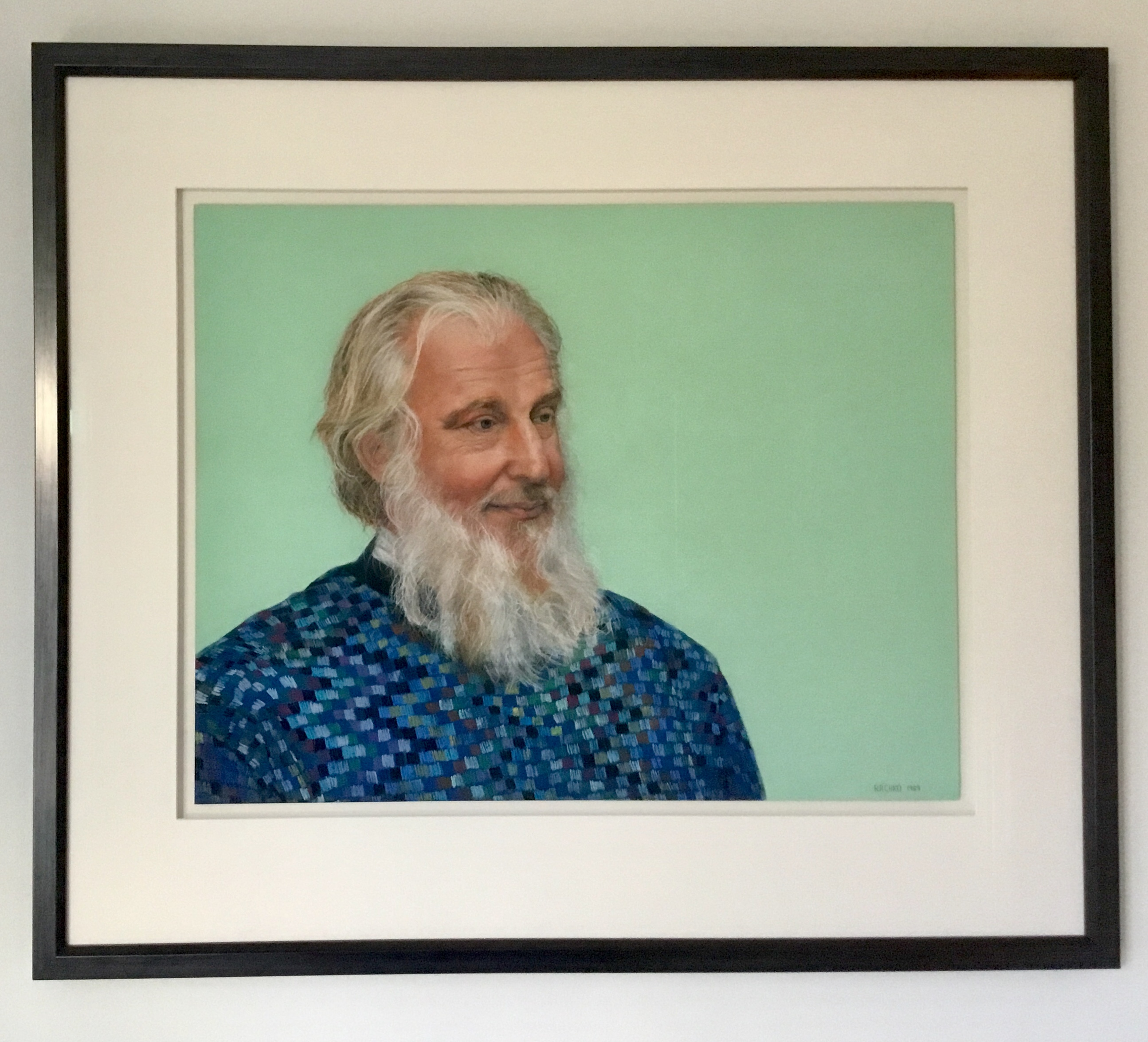
A: “John” was one of several portraits I made of friends in 1988-90 to build up my portfolio for the portrait company I worked for when I left the active duty Navy. I had gifted it to John Breeskin, the psychologist/friend pictured.
When he died, someone sent it back to me. (I hadn’t known he died). I must have not been working that day so for some reason, it was delivered to a print studio on another floor in my building. When the printer moved out, he found it and got in touch with me. By that time he had had “John” for more than a year and never bothered to tell me! The packaging had been removed so I have no idea who sent it or where exactly it came from.
Comments are welcome!
Pearls from artists* # 502

* an ongoing series of quotations – mostly from artists, to artists – that offers wisdom, inspiration, and advice for the sometimes lonely road we are on.
It seems to me that the less I fight my fear, the less it fights back. If I can relax, then fear relaxes, too. I cordially invite fear to come along with me everywhere I go. I even have a welcoming speech prepared for fear, which I deliver right before embarking upon any new project or adventure.
It goes something like this.
“Dearest fear: Creativity and I are about to go on a road trip together. I understand you will be joining us, because you always do. I acknowledge that you believe you have an important job to do in my life, and that you take your job seriously. Apparently, your job is to induce complete panic whenever I’m about to do something interesting – and may I say, you are superb at your job. So, by all means, keep doing your job, if you feel you must. But I will also be doing my job on this road trip, which is to work hard and stay focused. And Creativity will be doing its job, which is to remain stimulating and inspiring. There’s plenty of room in this vehicle for all of us, so make yourself at home, but understand this: Creativity and I are the only ones who will be making any decisions along the way. I recognize and respect that you are part of this family, and so I will never exclude you from our activities, but still – your suggestions will never be followed. You’re allowed to have a seat, and you’re allowed to have a voice, but you are not allowed to have a vote. You’re not allowed to touch the road maps; you’re not allowed to suggest detours; you’re not allowed to fiddle with the temperature. Dude, you’re not even allowed to touch the radio. But above all else, my dear old familiar friend, you are absolutely forbidden to drive.”
Then we head off together – me and creativity and fear – side by side by side forever, advancing once more into the terrifying but marvelous terrain of unknown outcome.
Elizabeth Gilbert in Big Magic: Creative Living Beyond Fear
Comments are welcome!
Pearls from artists* # 493
*an ongoing series of quotations – mostly from artists, to artists – that offers wisdom, inspiration, and advice for the sometimes lonely road we are on.
Professional opportunities in the art world almost always come out of personal connections, and community – almost by definition – is the way to make them. That’s not a prescription for superficial networking or obnoxious self-promotion, neither of which will get you anywhere. It means realizing that the chance to get a piece into a group show or meet a gallerist will probably come through someone you know and rspect, who knows and respects you.
Depending on your temperament, building community can feel daunting, artificial, or fun. There’s no need to subject yourself to awkward conversation at stuffy cocktail parties. Just keep in touch with your friends and professors from art school, attend local openings, and be open to meeting new people at events. If you’re shy, bring a friend along. It’s easier to break your way into conversation when you have a sidekick, and then you can talk about each other’s work instead of your own.
In Art/Work: Everything You Need to Know (and Do) As You Pursue Your Art Career by Heather Darcy Bhandari and Jonathan Melber
Comments are welcome!
Q: How did your ebook “From Pilot to Painter” come to be? (Question from “Arte Realizzata”)
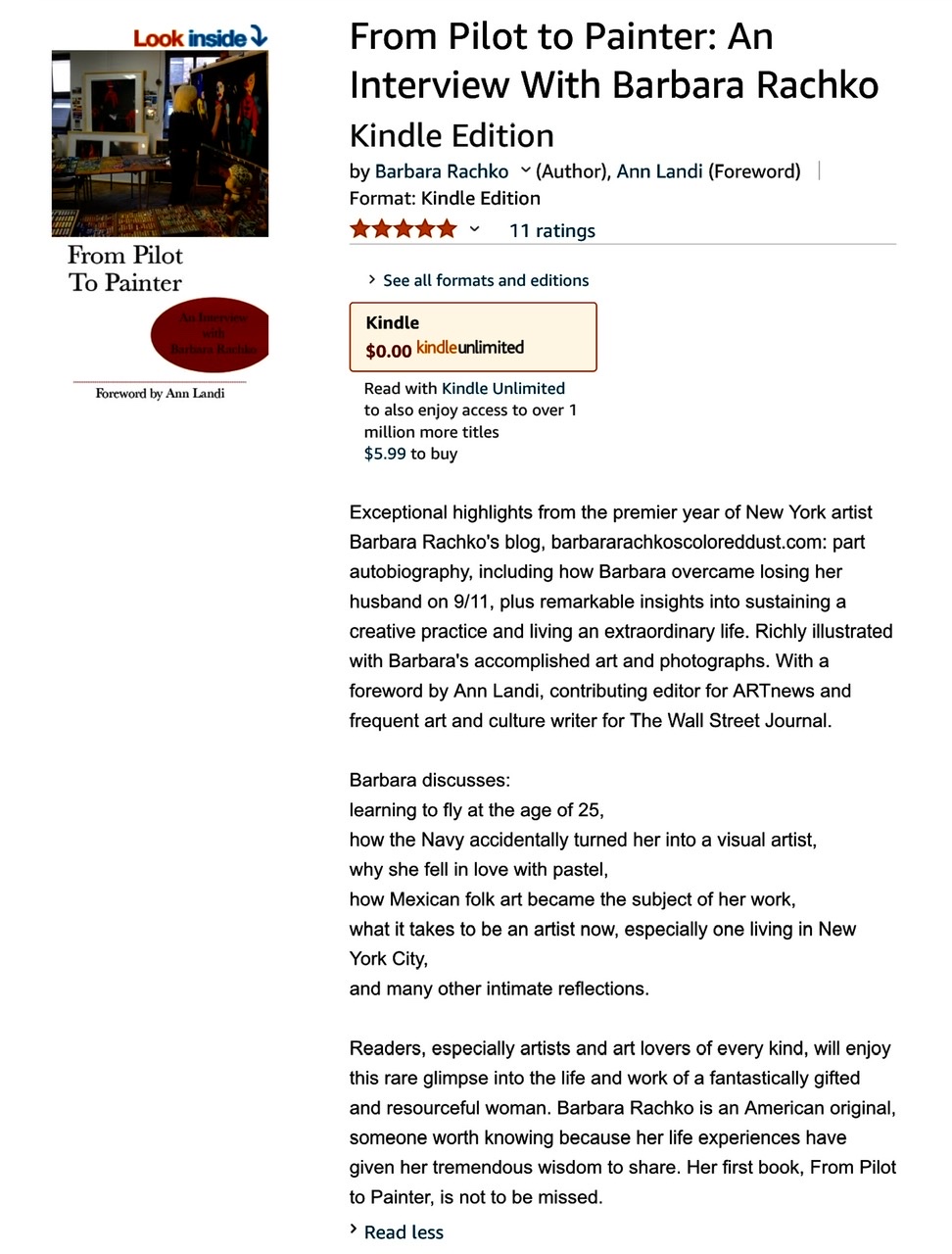
A: It was my longtime assistant, Barbra Drizin’s, idea and more than I’d care to admit, I was resistant. I said, “I am much too busy to write an ebook!” Barbra went on to explain that we could start with material I had already written for my blog, expand on it, add reproductions of my pastel paintings, etc. With her persuasion, I agreed! Barbra made the initial selections and together we added and revised text, organized the material, and worked out countless details. I asked my friend, Ann Landi, to write a foreword and Barbra found an editor to put everything into Amazon’s ebook format.
Now I am extremely pleased that my ebook FROM PILOT TO PAINTER is available not only on Amazon, but also on iTunes. It is based on my blog and is part memoir, including the loss of my husband on 9/11, insights into my creative practice, and intimate reflections on what it’s like to be an artist living in New York City. The ebook includes material not found on the blog, plus 25+ reproductions of my vibrant pastel-on-sandpaper paintings, a Foreword by Ann Landi, the founder of Vasari21.com and longtime critic for ARTnews, and more.
Comments are welcome!
Pearls from artists* # 461

*an ongoing series of quotations – mostly from artists, to artists – that offers wisdom, inspiration, and advice for the sometimes lonely road we are on.
I must not eat much in the evening, and I must work alone. I think that going into society from time to time, or just going out and seeing people, does not do much harm to one’s work and spiritual progress, in spite of what many so-called artists say to the contrary. Associating with people of that kind is far more dangerous; their conversation is always commonplace. I must go back to being alone. Moreover, I must try to live austerely, as Plato did. How can one keep one’s enthusiasm concentrated on a subject when one is always at the mercy of other people and in constant need of their society? Dufresne was perfectly right; the things we experience for ourselves when we are alone are much stronger and much fresher. However pleasant it may be to communicate one’s emotion to a friend there are too many fine shades of feeling to be explained, and although each probably perceives them, he does so in his own way and thus the impression is weakened for both. Since Dufresne has advised me to go to Italy alone, and to live alone once I am settled there, and since I, myself, see the need for it, why not begin now to become accustomed to the life; all the reforms I desire will spring from that? My memory will return, and so will my presence of mind, and my sense of order.
The Journal of Eugene Delacroix edited by Hubert Wellington
Comments are welcome!
Pearls from artists* # 445
*an ongoing series of quotations – mostly from artists, to artists – that offers wisdom, inspiration, and advice for the sometimes lonely road we are on.
My good friend the writer Charles L. Mee, Jr helped me to recognize the relationship between art and the way societies are structured. He suggested that, as societies develop, it is the artists who articulate the necessary myths that embody our experience of life and provide parameters for ethics and values. Every so often the inherited myths lose their value because they become too small and confined to contain the complexities of the ever-transforming and expanding societies. In that moment new myths are needed to encompass who we are becoming. These new constructs do not eliminate anything already in the mix; rather, they include fresh influences and engender new formations. The new mythologies always include ideas, cultures and people formerly excluded from the previous mythologies. So, deduces Mee, the history of art is the history of inclusion.
I believe that the new mythologies will be created and articulated in art, in literature, painting and poetry. It is the artists who will create a livable future through their ability to articulate in the face of flux and change.
Anne Bogart in A Director Prepares: Seven Essays on Art and Theater
Comments are welcome!
Pearls from artists* # 369
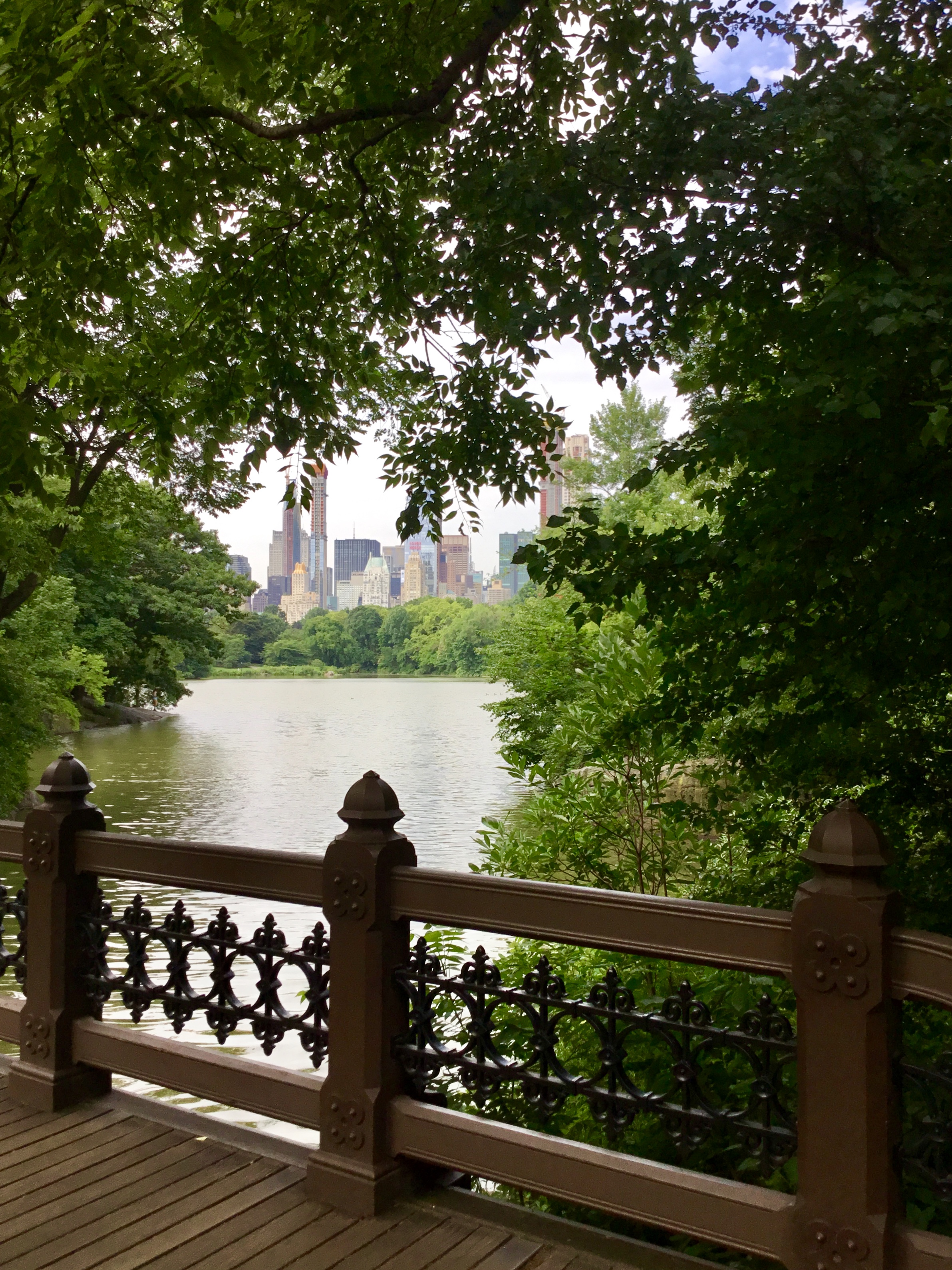
Central Park, NYC
* an ongoing series of quotations – mostly from artists, to artists – that offers wisdom, inspiration, and advice for the sometimes lonely road we are on.
Salieri wrote a memoir of his own, which his friend Ignacio von Mosel used as the basis for a biography, published in 1827. Salieri’s original document disappeared, but Mosel quoted parts of it. One anecdote is particularly winning. Salieri is recounting the premier, in 1770, of his second opera, “Le Donne Letterate” (“The Learned Woman”). The applause is vigorous, prompting the young composer to follow the audience out into the street, in the hope of soaking up more praise. He overheard a group of operagoers:
“The opera is not bad,” said one. “It pleased me right well,” said a second (that man I could have kissed). “For a pair of beginners, it is no small thing,” said the third. “For my part,” said the fourth, “I found it very tedious.” At these words I struck off into another street for fear of hearing something still worse.
Any creative person who has made the mistake of surreptiously canvassing public opinion will identify with Salieri’s fatal curiosity.
Alex Ross in Salieri’s Revenge in The New Yorker, June 3, 2019
Comments are welcome!
Pearls from artists* # 194

“Epiphany,” soft pastel on sandpaper, 38″ x 58″
* an ongoing series of quotations – mostly from artists, to artists – that offers wisdom, inspiration, and advice for the sometimes lonely road we are on.
I did sculpture because what interested me in painting was to bring some order to my brain. It was a change of means. I took to clay as a break from painting; at the time I’d done absolutely everything I could in painting. Which means it was still about organizing. It was to put my sensations in order and look for a method that really suited me. When I’d found it in sculpture, I used it for painting. To come into possession of my own brain: that was always the goal, a sort of hierarchy of all my sensations, so that I could reach a conclusion.
One day, visiting Carriere at his house, I told him that. He replied: “But, my friend, that’s why you work. If you ever managed it, you’d probably stop working. It’s your reason for working.”
In painting – in any oeuvre – the goal is to reconcile the irreconcilable. There are all kinds of qualities in us, contradictory qualities. You have to construct something viable with that, something stable. That’s why you work your whole life long and want to keep on working until the last moment… as long as you haven’t admitted defeat or lost your curiosity, as long as you haven’t settled into a routine.
Chatting with Henri Matisse: The Lost 1941 Interview, Henri Matisse with Pierre Courthion, edited by Serge Guilbaut, translated by Chris Miller
Comments are welcome!


 barbararachkoscoloreddust.com