Blog Archives
Q: You’re also known for being remarkably consistent with your blog and writing. How do you keep that rhythm? (Question from “Pastel, Passion, and Perseverance: An Interview with Barbara Rachko” in .ART Odyssey: Healing)
A page from the interview
A: It’s become habit. I started in 2012 and now I post twice a week.
On Wednesdays, I quote from a book I’m reading, paired with a photo. On Saturdays, I rotate: one week “What’s on the Easel,” another a travel photo, and twice a month a short reflection. Only two posts a month require real writing, so it’s sustainable. Consistency has been everything.
Comments are welcome!
Pearls from artists* # 666

*an ongoing series of quotations – mostly from artists, to artists – that offers wisdom, inspiration, and advice for the sometimes lonely road we are on.
Most of my writing life consists of nothing more than unglamorous, disciplined labor. I sit at my desk and I work like a farmer, and that’s how it gets done. Most of it is not fairy dust in the least.
But sometimes it is fairy dust. Sometimes when I’m in the midst of writing, I feel like I am suddenly walking on one of those moving sidewalks that you find in a big airport terminal; I still have a long slog to my gate. And my luggage is still heavy, but I can feel myself being gently propelled by some exterior force. Something is carrying me along – something powerful and generous – and that something is decidedly not me.
You may know this feeling. It’s the feeling you get when you’ve made something wonderful, or done something wonderful, and when you look back at it later, all you can say is: “I don’t even know where that came from.”
Elizabeth Gilbert in Big Magic: Creative Living Beyond Fear
Comments are welcome!
Pearls from artists* # 636

*an ongoing series of quotations – mostly from artists, to artists – that offers wisdom, inspiration, and advice for the sometimes lonely road we are on.
Some artists will rework a piece for half a lifetime before they know it is finished. An improviser may have to practice for years before being able to play a totally spontaneous minute of music in which every detail is right for its own fleeting moment. The great scientists and scholars are not those who publish or perish at any cost, but rather those who are willing to wait until the pieces of the puzzle come together in nature’s own design. The fruits of improvising, composing, writing, inventing, and discovering may flower spontaneously, but they arise from soil that we have prepared, fertilized, and tended in the faith that they will ripen in nature’s own time.
Stephen Nachmanovitch in Free Play: Improvisation in Life and Art
Comments are welcome!
Pearls from artists* # 635

Dinard, Brittany, France
*an ongoing series of quotations – mostly from artists, to artists – that offers wisdom, inspiration, and advice for the sometimes lonely road we are on.
The body of writing takes a thousand different forms,
and there is no right way to measure.
Changing, changing at the flick of a hand, its various
forms are difficult to capture.
Words and phrases compete with one another, but the
mind is still master.
Caught between the unborn and the living, the writer
struggles to maintain both depth and surface.
He may depart from the square, he may overstep the
circle, searching for the one true form of his reality.
He would fill the eyes of his readers with splendor, he
would sharpen the mind’s values.
The one whose language is muddled cannot do it;
only when mind is clear can language be noble.
Lu Chi quoted in Free Play: Improvisation in Art and Life by Stephen Nachmanovitch
Comments are welcome!
Pearls from artists* # 626

*an ongoing series of quotations – mostly from artists, to artists – that offers wisdom, inspiration, and advice for the sometimes lonely road we are on.
This is why, when writers who are just starting out ask me when it gets easier, my answer is never. It never gets easier. I don’t want to scare them, so I rarely say more than at, but the truth is that, if anything, it gets harder. The writing life is filled with predictable uncertainties, but with the awareness that we are always starting over. That everything we will ever write will be flawed. We may have written one book, or many, but all we know – if we know anything at all – is how to write the book we’re writing. All novels are failures. Perfection itself would be a failure. All we can hope is that we will fail better. That we will not fall prey to the easy enchantments of repeating what may have worked in the past. I try to remember that the job – as well as the plight, and the unexpected joy – of the artist is to embrace uncertainty, to be sharpened and honed by it. Each time we come to the end of a piece of work, we have failed as we have leapt – spectacularly, brazenly – into the unknown.
Dani Shapiro in Still Writing: The Perils and Pleasures of a Creative Life
Comments are welcome!
Pearls from artists* # 628

Beginning
*an ongoing series of quotations – mostly from artists, to artists – that offers wisdom, inspiration, and advice for the sometimes lonely road we are on.
We have nothing to go by, but still, we must begin. It requires chutzpah – the Yiddish word for that ineffable combination of courage and hubris – to put down one word, then another, perhaps even accumulate a couple of flimsy pages, so few that they don’t even firm the smallest of piles, and call it the beginning of a novel. Or memoir. Or story. Or anything, really rather than a couple of flimsy pages.
When I’m between books, I feel as if I will never have another story to tell. The last book has wiped me out, has taken everything from me, everything I understand and feel and know and remember, and … that’s it. There’s nothing left. A low-level depression sets in. The world hides its gifts from me. It has taken me years to realize that this feeling, the one of the well being empty, is as it should be. It means I’ve spent everything. And so I must begin again.
I wait.
I try to be patient. I remember Colette, who wrote that her most essential art was “not that of writing, but the domestic task of knowing how to wait, to conceal, to save up crumbs, to reglue, regild, change the worst into the not-so-bad, how to lose and recover in the same moment that frivolous thing, a taste for life.” Colette’s words, along with those of a few others, have migrated from one of my notebooks to another for over twenty years now. It’s wisdom I need to remember – wisdom that is easy to forget.
Dani Shapiro in Still Writing: The Perils and Pleasures of a Creative Life
Comments are welcome!
Pearls from artists* # 622

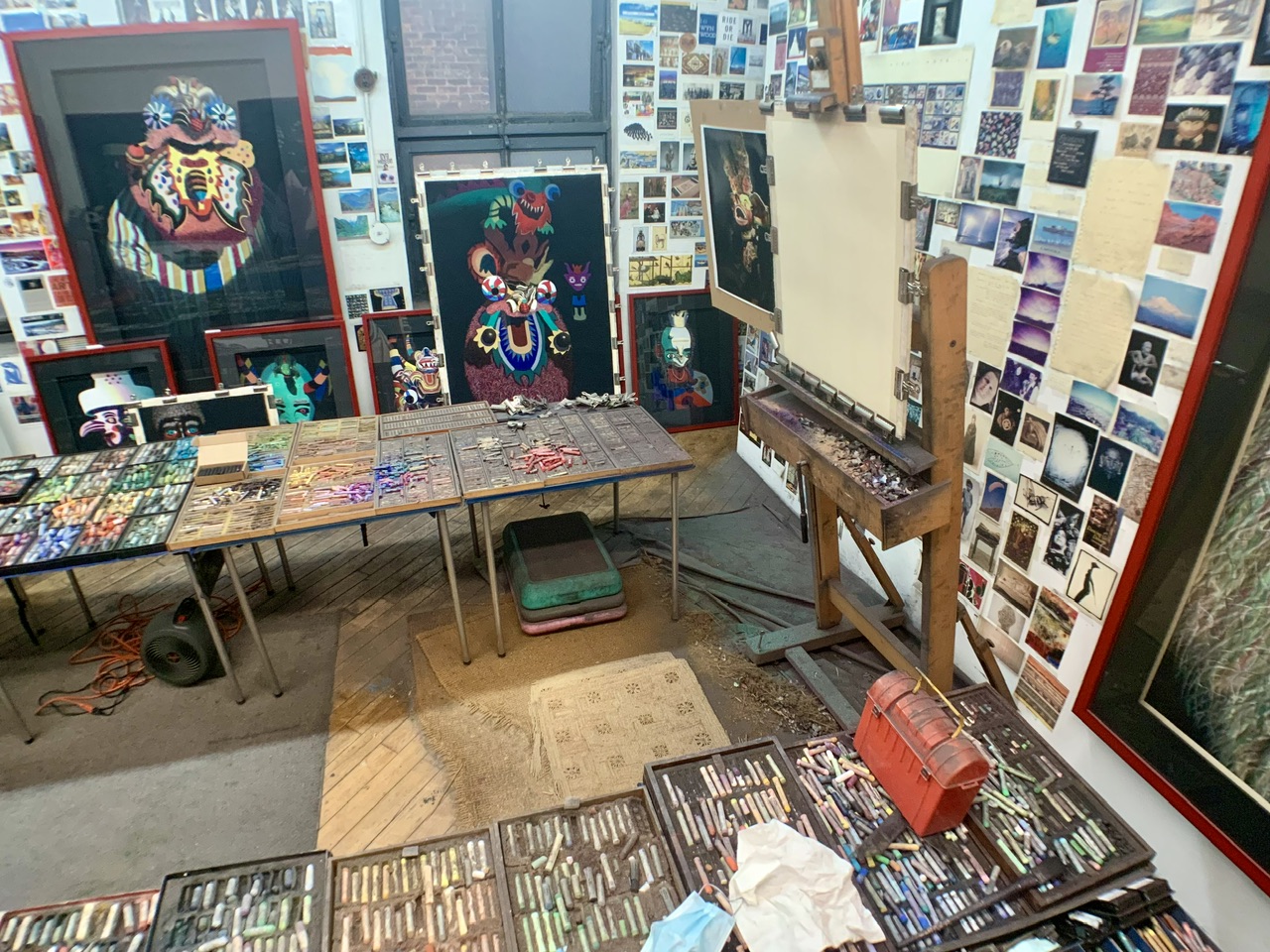
In the studio
*an ongoing series of quotations – mostly from artists, to artists – that offers wisdom, inspiration, and advice for the sometimes lonely road we are on.
Divining meaning from a painting is not so simple that it can be codified in a book, and [Mark] Rothko certainly would not have wanted such a guide to his work. So much of understanding his work is personal, and so much of it is made up of the process of getting inside the work. It is like the “plastic journey” he describes in his “Plasticity” chapter – you must undertake a sensuous adventure within the world of the painting in order to know it at all. He cannot tell you what his paintings, or anyone else’s, is about. You have to experience them. Ultimately, if he could have expressed the truth – the essence of these works – he probably would not have bothered to paint them. As his works exemplify, writing and painting involve different kinds of knowing.
Christopher Rothko in The Artist’s Reality: Philosophies of Art by Mark Rothko
Comments are welcome!
Q: You seem very disciplined. Do you ever have a day when you just can’t get excited about going to the studio to work?

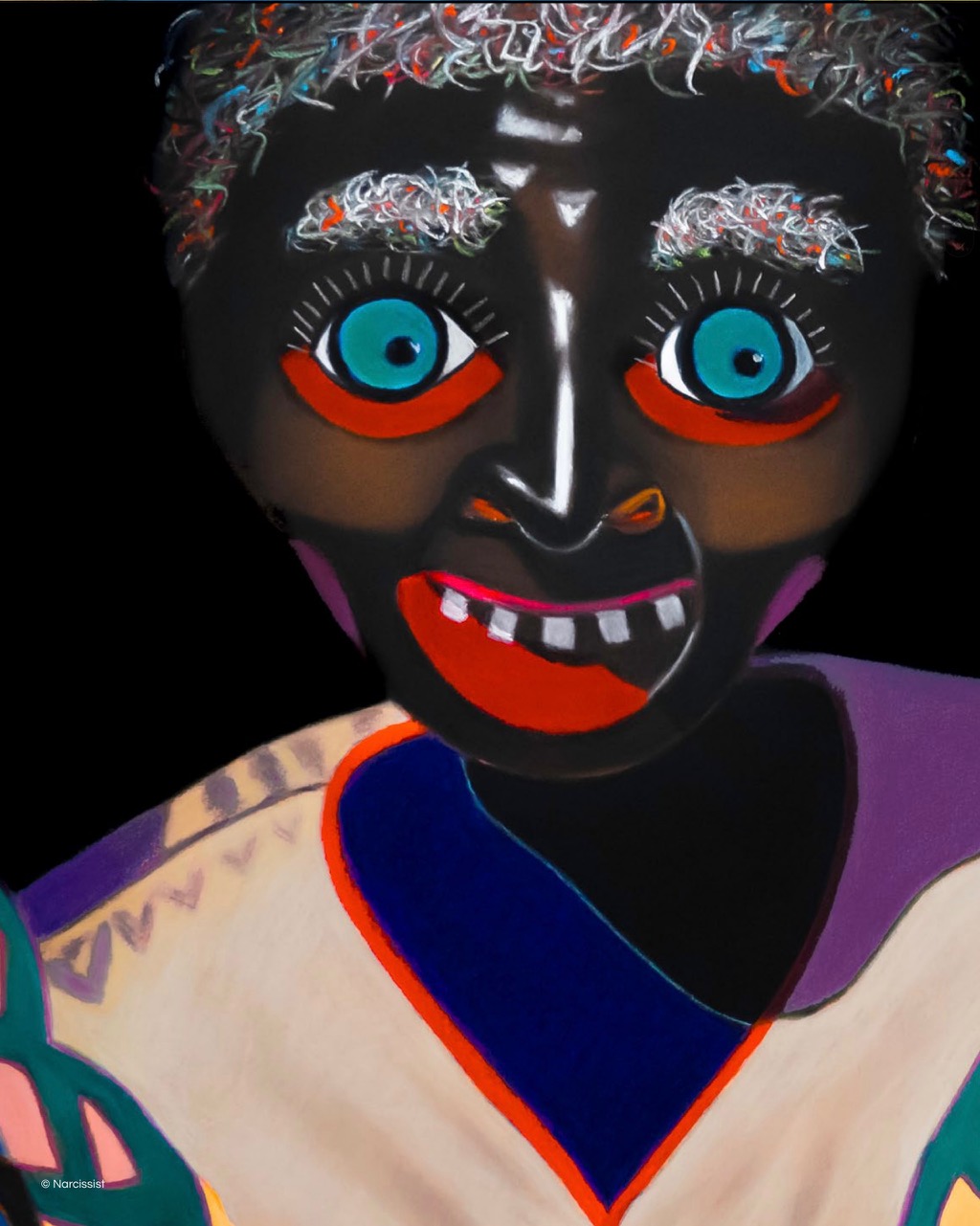
Signing “Narcissist”
A: That happens occasionally, but I usually still go to the studio to work. You know the expression, “99% of life is just showing up”? Well, of course I have to show up at my studio to accomplish anything so I still try to keep fairly regular studio hours – 6 to 7 hours a day, 4 or 5 days a week. And that’s not to mention all the other work – answering email, checking social media, writing blog posts, etc. – which I tend to do at lunchtime, in the evenings, and on my days off from the studio.
When you are an artist there is always work to do and for some of it, no one else can do it because no one else knows the work from the inside the way the maker does. I like what Twyla Tharp says in her book, “The Creative Habit.” In order to progress an artist needs good work habits that become a daily routine. And Chuck Close used to say, “Inspiration is for amateurs,” meaning a professional works whether she’s in the mood or not. I completely agree so I keep working and slowly moving ahead.
As Tchaikovsky wrote in a letter to a friend:
We must always work, and a self-respecting artist must not fold his hands on the pretext that he is not in the mood. If we wait for the mood, without endeavoring to meet it halfway, we easily become indolent and apathetic. We must be patient, and believe that inspiration will come to those who can master their disinclination. A few days ago I told you I was working every day without any real inspiration. Had I given way to my disinclination, undoubtedly I should have drifted into a long period of idleness. But my patience and faith did not fail me, and today I felt that inexplicable glow of inspiration of which I told you; thanks to which I know beforehand that whatever I write today will have power to make an impression, and to touch the hearts of those who hear it.
Quoted in Eric Maisel’s A Life in the Arts: Practical Guidance and Inspiration for Creative and Performing Artists.
Comments are welcome!
Pearls from artists* # 616
*an ongoing series of quotations – mostly from artists, to artists – that offers wisdom, inspiration, and advice for the sometimes lonely road we are on.
This may be the most important piece of advice I can give you: The Internet is nothing like a cigarette break. If anything, it’s the opposite. One of the most difficult practical challenges facing writers in this age of connectivity is the fact that the very instrument on which most of us write is also a portal to the outside world. I once heard Ron Carlson say that composing on a computer is like writing in an amusement park. Stuck for a nanosecond? Why feel it? With the single click of a key we can remove ourselves and take a ride on a log flume instead.
By the time we return to work – if, indeed, we return to our work at all – we will be further away from our deepest impulses rather than closer to them. Where were we? Oh, yes. We were stuck. We were feeling uncomfortable and lost. We have gained nothing in the way of waking-dream time. Our thoughts have not drifted, but rather, have ricocheted from one bright and shiny thing to another.
Dani Shapiro in Still Writing: The Perils and Pleasures of a Creative Life
Comments are welcome!
Pearls from artists* # 595

Film still from “Barbara Rachko: True Grit,” directed by Jennifer Cox, Moto Films LLC
*an ongoing series of quotations – mostly from artists, to artists – that offers wisdom, inspiration, and advice for the sometimes lonely road we are on.
One of the great paradoxes of the writing life is that our words – chosen carefully, so thoughtfully, with deep focus and concentration – those words once on the page go dead on us. Language is ours only when we are forming sentences, moving elements around, grappling with punctuation, speaking words aloud, feeling them on our lips. While we are shaping a scene into something we can hear and touch and see, that scene lives and breathes. We are inside language like painters, we are working in our medium: the tempera, the thin line, the wet oil on canvas, still in process, still alive.
But once we commit – once those words dry like paint, are affixed to the page – it becomes nearly impossible to see them. This? We think to ourselves. Our most loathsome critic emerges with a swirl of her cape. Really? What the hell is this? The sentences appear to have been written in another language – a dark dream language, tucked into some musty, inaccessible corner of our psyche. Attempting to discern its meaning is a bit like looking at our own face in the mirror. It is at once so familiar as to be invisible, and so intimate that we turn away, baffled, ashamed.
Can we ever see ourselves, really? Can we read ourselves?
It is a powerful conundrum because without the ability to see our writing afresh we cannot do the necessary work. How do we know whether a problem lies with the work, or with our inability to enter it? We need clarity, but not coldness. Openness, but not attachment. We want optimism, but that optimism must not go hand in hand with discernment. We’re not looking for a cheerleader, nor a fault-finding judge. We want to read ourselves with equanimity.
Dani Shapiro in Still Writing: The Pleasures and Perils of a Creative Life
Comments are welcome!


 barbararachkoscoloreddust.com