Blog Archives
Q: How has photography changed your approach to painting?
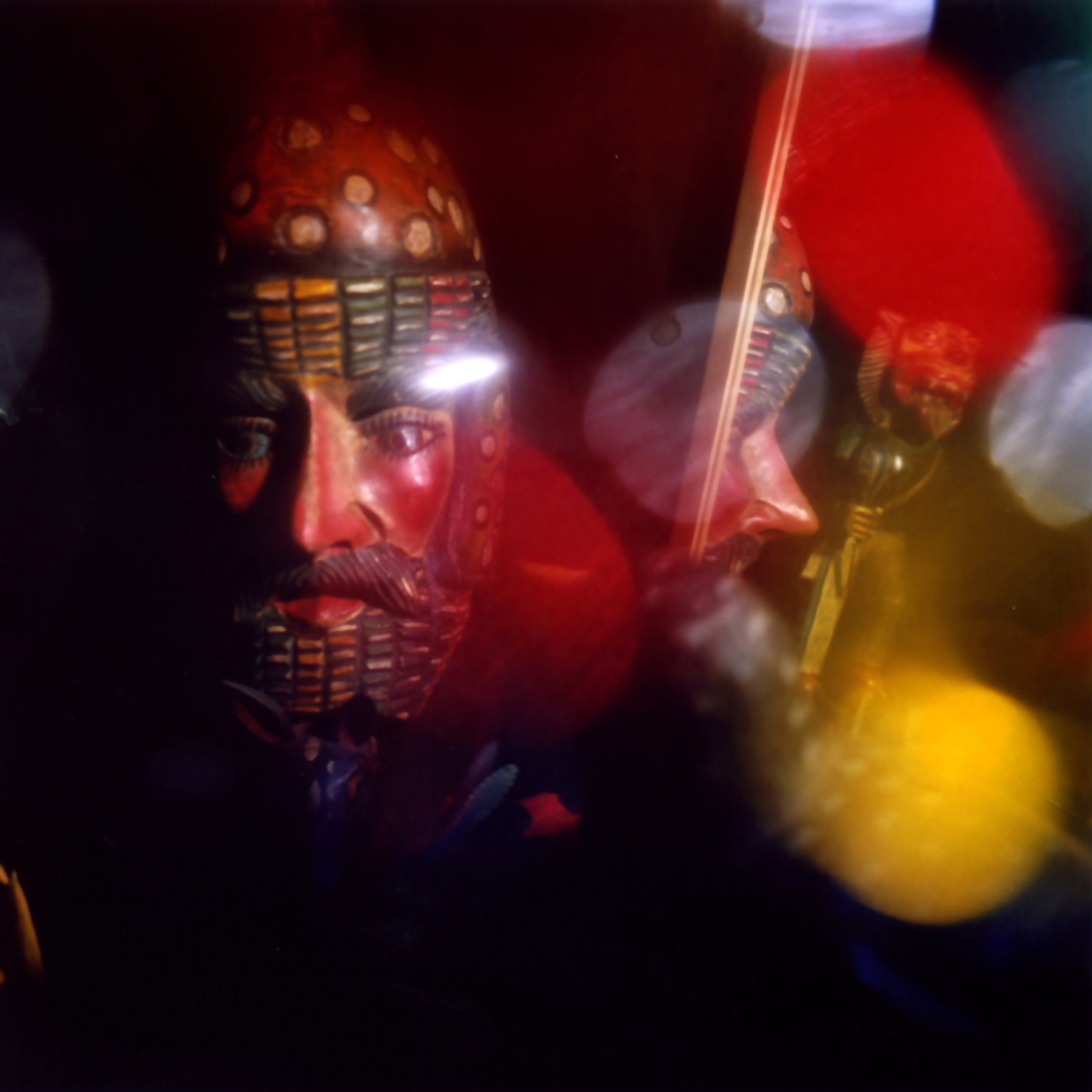
Untitled chromogenic print, 24″ x 24″ on 30″ x 40″ Fujicolor crystal archives paper, edition of 5
A: From the beginning in the 1980s I used photographs as reference material and my late husband, Bryan, would shoot 4” x 5” negatives of my elaborate setups using his Toyo-Omega view camera. In those days I rarely picked up a camera except when we were traveling.
After Bryan was killed on 9/11, I inherited his extensive camera collection – old Nikons, Leicas, Graphlex cameras, etc. – and I wanted to learn how to use them. Starting in 2002 I enrolled in a series of photography courses (about 10 over 4 years) at the International Center of Photography in New York. I learned how to use all of Bryan’s cameras and how to make my own big color prints in the darkroom.
Along the way I discovered that the sense of composition and color I had developed over many years as a painter translated well into photography. The camera was just another medium with which to express my ideas. Astonishingly, in 2009 I had my first solo photography exhibition in New York.
It’s wonderful to be both a painter and a photographer. Pastel painting will always be my first love, but photography lets me explore ideas much faster than I ever could as a painter. Paintings take months of work. Photographs – from the initial impulse to create a setup to hanging a framed chromogenic print on the wall – can be made in minutes.
Comments are welcome!
Q: Can you tell us about the different series of work you have created and what they embody?
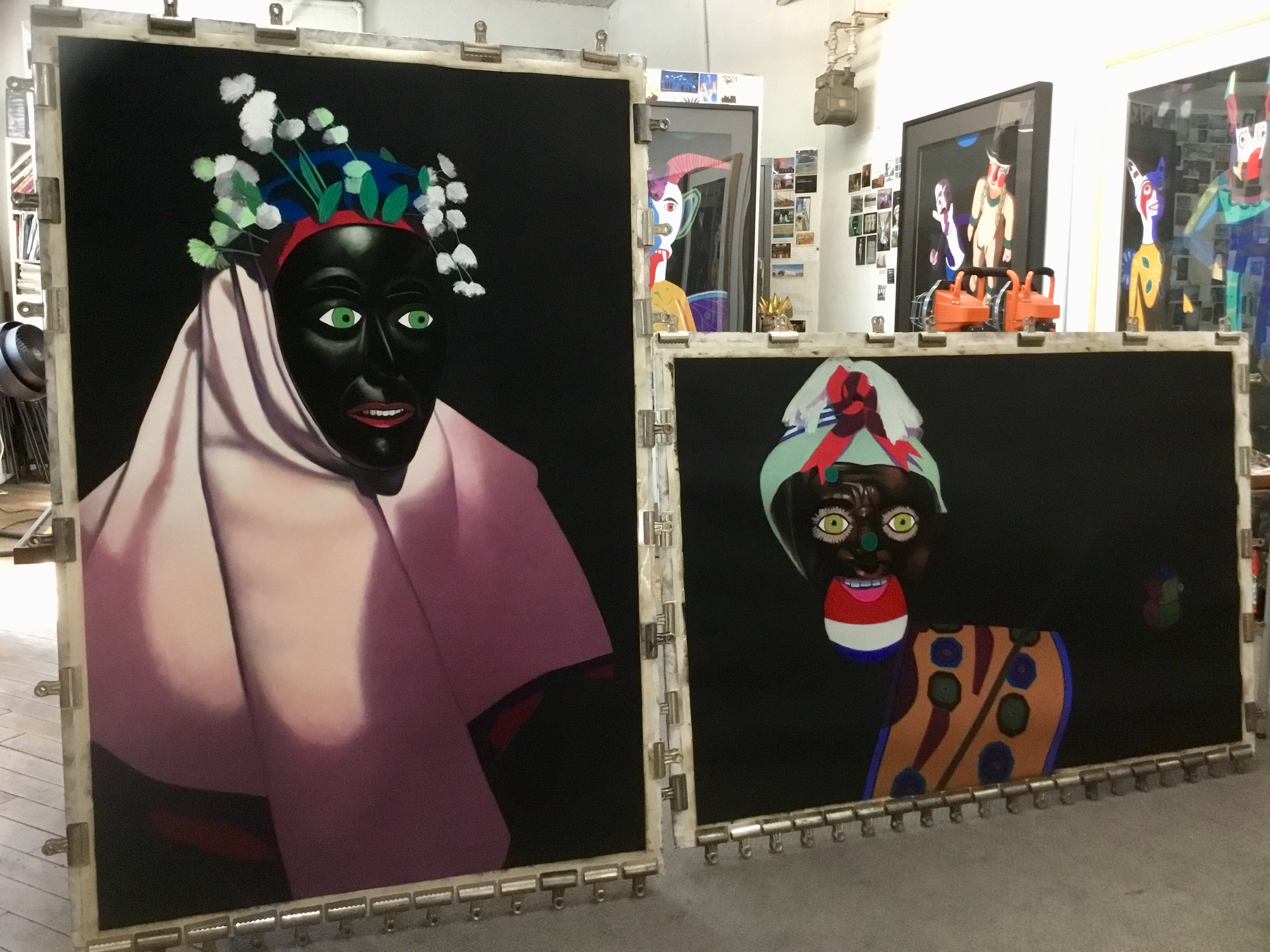
Barbara’s studio with work in progress
A: The Black Paintings series of pastel-on-sandpaper paintings grew directly from an earlier series, Domestic Threats. While both use cultural objects as surrogates for human beings acting in mysterious, highly-charged narratives, in the Black Paintings I replaced all background details of my actual setup (furniture, rugs, etc.) with lush black pastel. In this work the ‘actors’ are front and center.
While traveling in Bolivia two years ago, I visited a mask exhibition at the National Museum of Ethnography and Folklore in La Paz. The masks were presented against black walls, spot-lit, and looked eerily like 3D versions of my Black Paintings. I immediately knew I had stumbled upon a gift. So far I have completed nine pastel paintings in the Bolivianos series. One is awaiting finishing touches, one is in progress now, and I am planning the next one.
All of my pastel paintings are an example of a style called “contemporary conceptual realism” in which things are not quite as innocent as they seem. In this sense each painting is a kind of Trojan horse. There is plenty of backstory to my images, although I usually prefer not to over-explain them. Some mystery must always remain in art.
The world I depict is that of the imagination and this realm owes little debt to the natural world. I recently gave an art talk where I was reminded how fascinating it is to learn how others respond to my work. As New York art critic Gerrit Henry once remarked, “What we bring to a Rachko… we get back, bountifully.”
Comments are welcome!
Q: What’s on the easel today?
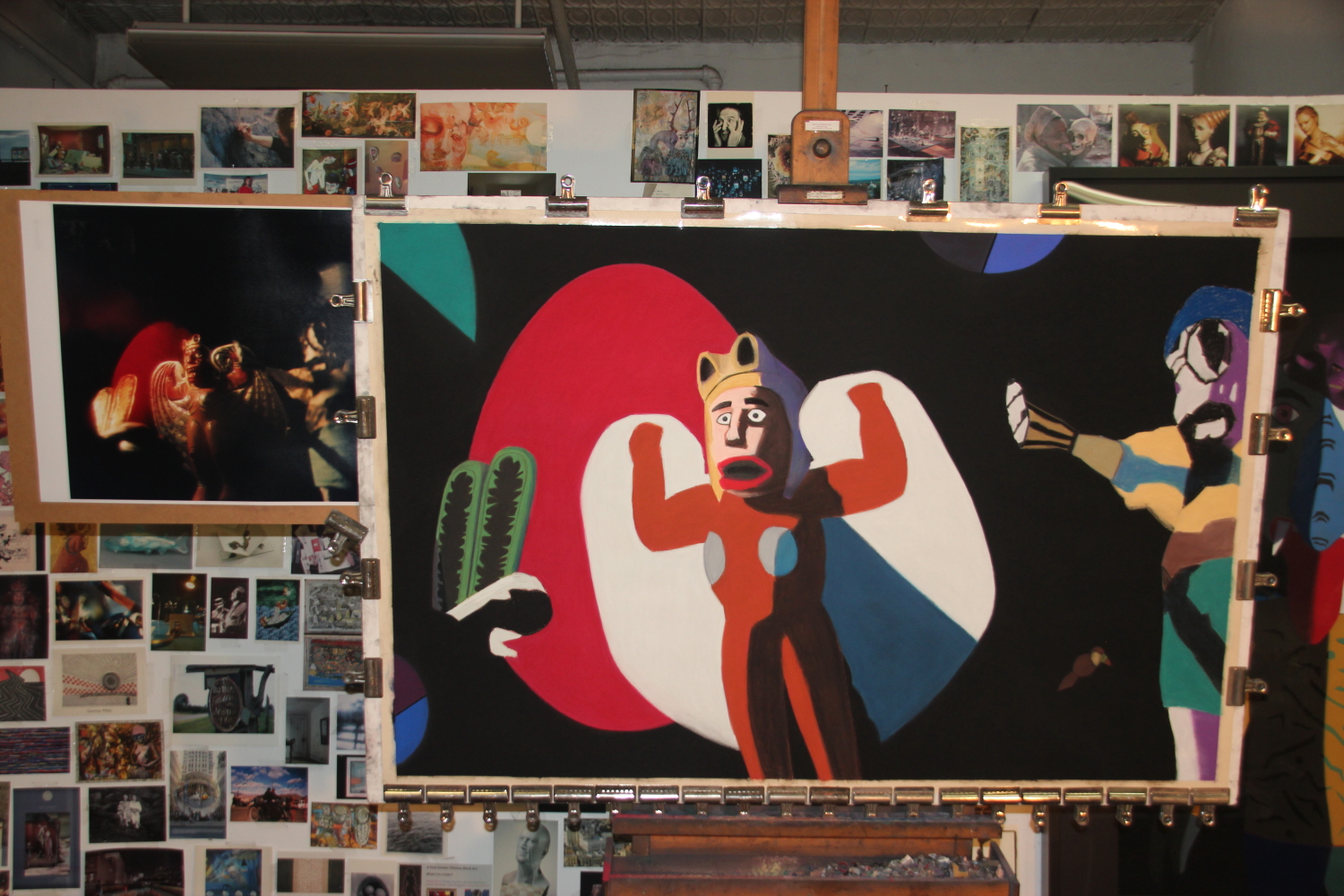
Work in pogress
A: I am working on a 38″ x 58″ pastel painting. Rather than create and photograph a new setup each time, I sometimes search through older photographs to find ones that might spark a compelling painting. Photos that I haven’t seen in a while often have new lessons to teach. The one clipped to my easel above is from 2009.
Comments are welcome!
Q: Have you ever worked outside?

Reproductions of “Cardinal Rule” (top) and “Blue Ego,” originals are soft pastel on sandpaper, 30″ x 38″
A: As a pastel artist I’ve never worked outside – with so many pastels, it’s just not practical – but early on in the “Domestic Threats” series, I created two outdoor setups. Works in the series derived from elaborate scenes that I arranged and then photographed.
I used to take long walks along the Potomac River in Alexandria, VA, and there was a tree stump that was fascinating. It was mostly twisted roots, knotty branches, dark hidden spaces, etc. (top painting in photo). One morning I took several hand puppets and stuffed animals (my subject matter at the time) and carefully arranged them on the tree. Around me people were busy exercising their dogs. Soon I attracted quite a bit of attention – a tall blonde woman playing with puppets on a tree stump! Dogs came over to sniff. Their owners came over, too, and I was pressed into explaining, again and again, that I was an artist, that I was photographing this scene so I could paint it, etc. The interruptions were very annoying.
The second time I tried an outdoor setup was again along the Potomac River, but this time I selected a secluded strip of beach where I was undisturbed. I had forgotten to consider the light and inadvertently chose a cloudy day. I remember being disappointed that the light was flat and lacking shadows. The painting (bottom in photo) turned out to be one of my least favorites.
I resolved from then on to focus on interiors. Alfred Hitchcock famously used rear projection so that he could work in a studio rather than on location. One reason, he said, was that in a studio he had total control. I know what he meant. When I set up an interior scene and position the lights to make interesting shadows, indeed, I have control over the whole look. No aspect is left to chance. The accidents – improvements! – happen later when I work on the painting.
Comments are welcome!
Q: Your relationship with photography has changed considerably over the years. How did you make use of photography in your first series of pastel-on-sandpaper paintings, “Domestic Threats”?
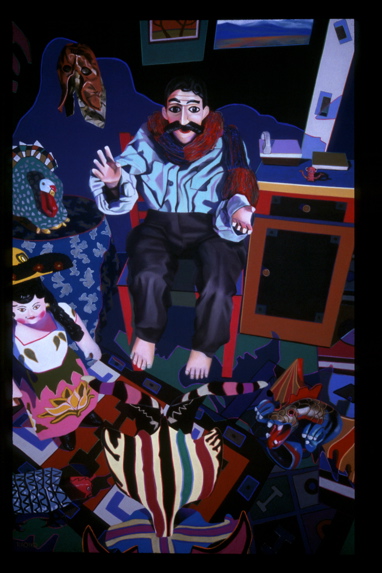
“Truth Betrayed by Innocence,” 2001, 58″ x 38″, the last pastel painting for which Bryan photographed the setup
A: When my husband, Bryan, was alive I barely picked up a camera, except to photograph sights encountered during our travels. Throughout the 1990s and beyond (ending in 2007), I worked on my series of pastel-on-sandpaper paintings called, “Domestic Threats.” These were realistic depictions of elaborate scenes that I staged in our 1932 Sears house in Alexandria, Virginia, and later, in a New York sixth floor walk-up apartment, using the Mexican masks, carved wooden animals, and other folk art figures that I found on our trips to Mexico. I staged and lit these setups, while Bryan photographed them using his Toyo-Omega 4 x 5 view camera. We had been collaborating this way almost from the beginning (we met on February 21, 1986). Having been introduced to photography by his father at the age of 6, Bryan was a terrific amateur photographer. He would shoot two pieces of 4 x 5 film at different exposures and I would select one, generally the one that showed the most detail in the shadows, to make into a 20 x 24 photograph. The photograph would be my starting point for making the pastel painting. Although I work from life, too, I could not make a painting without mostly looking at a reference photo. After Bryan was killed on 9/11, I had no choice but to study photography. Over time, I turned myself into a skilled photographer.
Comments are welcome!
Q: Do you listen to music while you work?

A corner of the studio
A: I always have the stereo on when I work in my studio, either tuned in to WBGO (the Newark-based jazz station), WNYC (for news and talk radio; Leonard Lopate, Fresh Air, etc.), WFMU (Fordham University’s radio station, to learn what college kids are listening to) and other local radio stations. I still listen to cd’s, I read the lyrics and the liner notes, and I prefer to listen to music the way artists intended it, meaning that I listen to entire albums from start to finish instead of jumping around between single tracks by different artists. When it comes to music, I’m interested in everything: jazz (especially classic jazz artists like Thelonious Monk, Miles Davis, John Coltrane, Art Blakely, etc.), blues, classical, pop, rock, world music (especially artists from Brazil, Cuba, and any country in Africa), electronic, indy, experimental, ancient music, etc. You name it, I probably listen to it, and if I don’t, I’m eager to learn all about it. When I’m working, certain artists are better to listen to at particular points in a painting. For example, one of my favorite artists to start a new painting with is Lady Gaga. The beat, her energy, and sheer exuberance are perfect when I’m standing in front of my easel with a blank piece of sandpaper in front of me. Gaga’s music gets me moving and working fast, putting down colors instinctively without thinking about them, just feeling everything.
It’s a different story when I am at my apartment and am shooting a photo setup. Then I might or might not listen to music. Lately it’s more about working fast (I shoot 24 images in about 15 minutes), choosing a variety of interesting vantage points, getting surprising effects, etc.
Comments are welcome!


 barbararachkoscoloreddust.com