Blog Archives
Pearls from artists* # 67

Negombo, Sri Lanka
* an ongoing series of quotations – mostly from artists, to artists – that offers wisdom, inspiration, and advice for the sometimes lonely road we are on.
John Robin Baitz: I was just thinking that you still manage to write with some kind of miraculous hope.
Athol Fugard: You’ve got to. Implicit in the act of creation on the part of the artist is: I make it because I want to share it with you. At the end of my process you are waiting for me… Pascal says “Imagine a cell in darkness and the inmates are shackled together. Every morning at dawn, the door opens and the person at the end of the line is taken out and executed and the door is closed. Those left behind read their fate in the opening and closing of the door every day. it is a metaphor of the human condition.” That is Pascal.
Camus comes to that paragraph and says, “There is no question about it – that is an image of the human condition. What do we do during those 24 hours between the opening and closing of the door? Do we cry? Or do we tap the next person in the chain and say ‘What’s your name? I’m Athol Fugard. Who are you?'” And that’s how we create meaning. At the end of the process you are waiting. And that is the act of faith. That is the hope that every artist has.
Quoted by Anne Bogart in “and then you act: making art in an unpredictable world”
Comments are welcome!
Q: Have you ever worked outside?

Reproductions of “Cardinal Rule” (top) and “Blue Ego,” originals are soft pastel on sandpaper, 30″ x 38″
A: As a pastel artist I’ve never worked outside – with so many pastels, it’s just not practical – but early on in the “Domestic Threats” series, I created two outdoor setups. Works in the series derived from elaborate scenes that I arranged and then photographed.
I used to take long walks along the Potomac River in Alexandria, VA, and there was a tree stump that was fascinating. It was mostly twisted roots, knotty branches, dark hidden spaces, etc. (top painting in photo). One morning I took several hand puppets and stuffed animals (my subject matter at the time) and carefully arranged them on the tree. Around me people were busy exercising their dogs. Soon I attracted quite a bit of attention – a tall blonde woman playing with puppets on a tree stump! Dogs came over to sniff. Their owners came over, too, and I was pressed into explaining, again and again, that I was an artist, that I was photographing this scene so I could paint it, etc. The interruptions were very annoying.
The second time I tried an outdoor setup was again along the Potomac River, but this time I selected a secluded strip of beach where I was undisturbed. I had forgotten to consider the light and inadvertently chose a cloudy day. I remember being disappointed that the light was flat and lacking shadows. The painting (bottom in photo) turned out to be one of my least favorites.
I resolved from then on to focus on interiors. Alfred Hitchcock famously used rear projection so that he could work in a studio rather than on location. One reason, he said, was that in a studio he had total control. I know what he meant. When I set up an interior scene and position the lights to make interesting shadows, indeed, I have control over the whole look. No aspect is left to chance. The accidents – improvements! – happen later when I work on the painting.
Comments are welcome!
Q: What is your best time of day to paint?

The High Line – Barbara’s morning commute to the studio
A: I have always been an early riser and a morning person, from my student pilot days when I’d be at an airport in New Jersey ready to takeoff in a Cessna by 6 a.m., through my days as a Naval officer starting work at the Pentagon at 7, until now when I typically get up before 6 (thanks to my cat, who likes to eat breakfast early). Always I am most energetic in the mornings so that’s when I am most productive and have my best ideas. Generally, I try to arrive at the studio before 10 a.m. and work until 5 p.m. or later.
Comments are welcome!
Pearls from artists* # 38
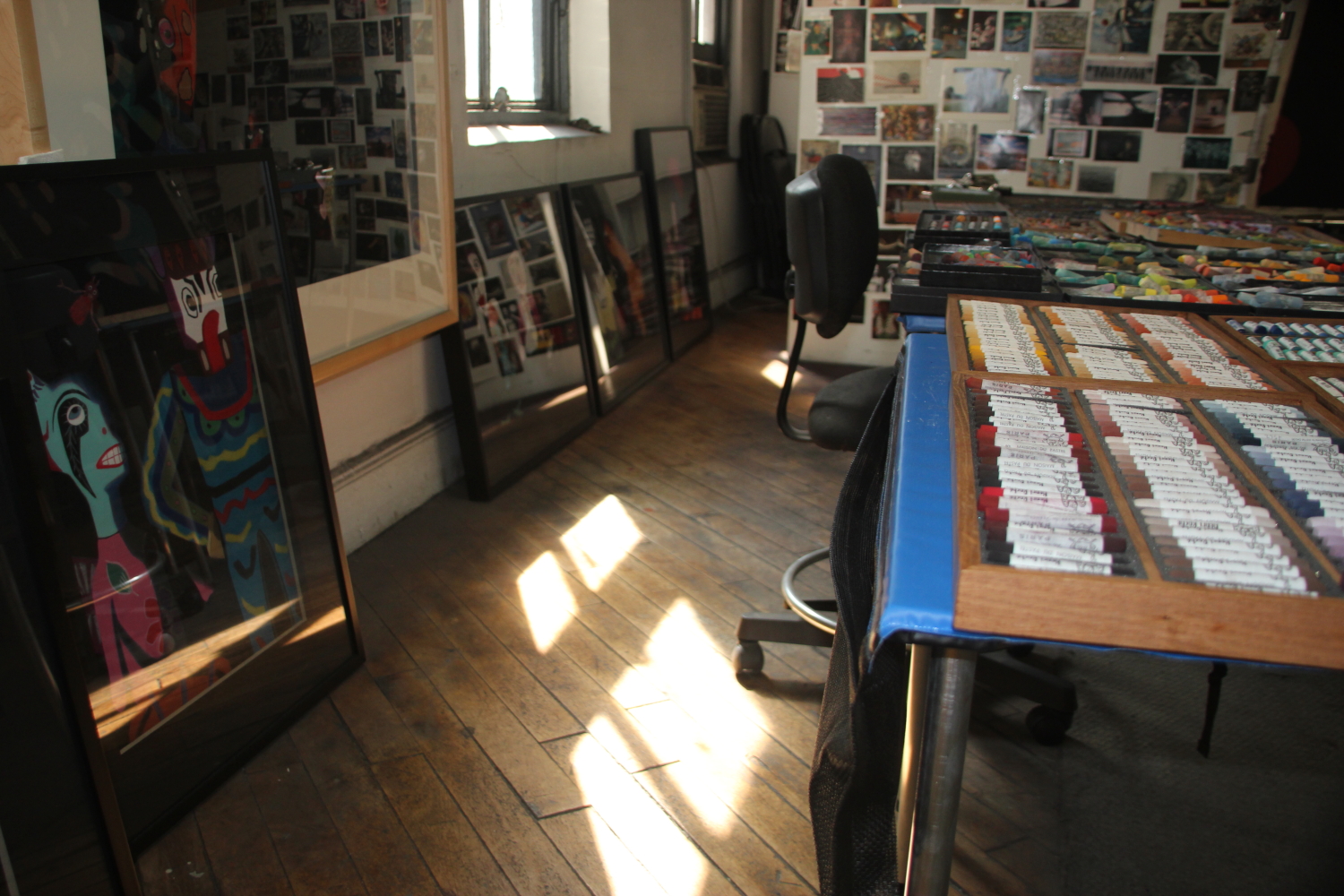
Morning sun at the studio
* an ongoing series of quotations – mostly from artists, to artists – that offers wisdom, inspiration, and advice for the sometimes lonely road we are on.
It’s one thing to be intelligent and it’s another to enjoy thinking, to relish the time spent alone with one’s thoughts, to happily muse, imagine, and analyze. Artists, who are introspective by nature, typically enjoy spending time in this fashion and may even prefer solitude to the company of others. Able to work by themselves, artists are often lost in a state of dreamy thoughtfulness of the sort described by the painter Hans Hofmann when he wrote, ” The first red spot on a white canvas may at once suggest to me the meaning of ‘morning redness,’ and from there I dream further with my color.” Artists are not introspective, thoughtful, lost in time and space because they wish to ignore the world. They’re introspective because out of that attitude artistic answers flow.
Eric Maisel in A Life in the Arts
Comments are welcome!
Q: What’s on the easel today?
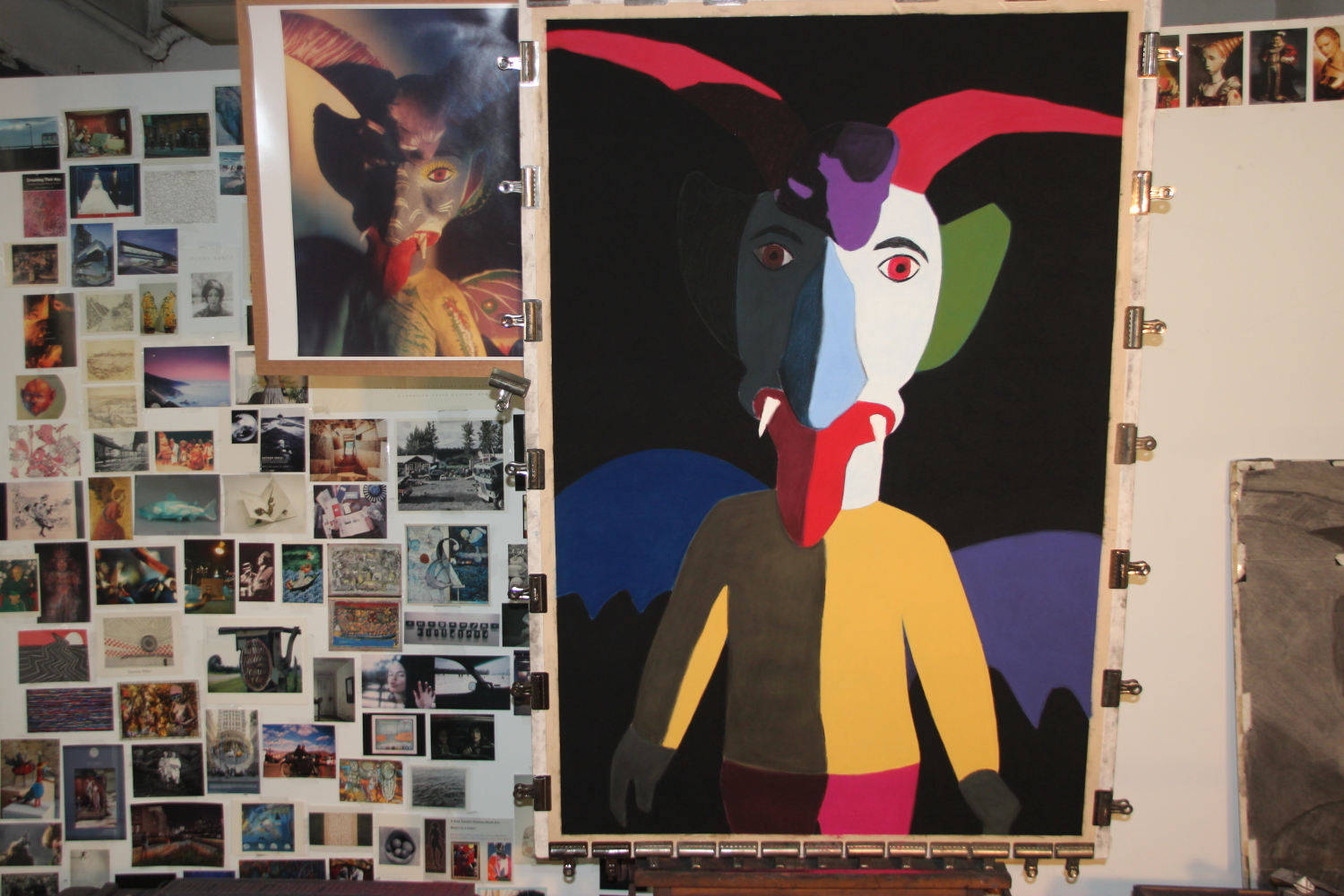
Work in progress, 58″ x 38″
A: Today is a day off to let my fingers heal. When I start a new painting, I need to rub my fingers against raw sandpaper in order to blend the pastel. With each layer the tooth of the paper gets filled up and becomes smooth, but until then my fingers suffer. Here is what I’ve been working on.
This pastel-on-sandpaper painting is an experiment, an attempt to push myself to work with bigger and bolder imagery. The photograph clipped to the easel is one of my favorites. It depicts a Judas that Bryan and I found in a dusty shop in Oaxaca. Among the Mexican and Guatemalan folk art pieces that I’ve collected are five papier mâché Judases. This particular one is unusual because it has a cat’s head attached at the forehead (the purple shape in the painting). They are not made to last. In some Mexican towns large Judases are hung from church steeples, loaded with fireworks, and burned in effigy. This takes place at 10:00 a.m. on the Saturday morning before Easter. Mexico is primarily a Catholic nation, of course, so effigy burning is done as symbolic revenge against Judas for his betrayal of Christ. The Judas in the photo is small and meant for private burning by a family (rather than in public at a church) so by bringing it back to New York I rescued it from a fire-y death! In sympathy with Mexican tradition, I began this painting last Saturday (the day before Easter) at 10 a.m.
Comments are welcome!
Pearls from artists* # 25
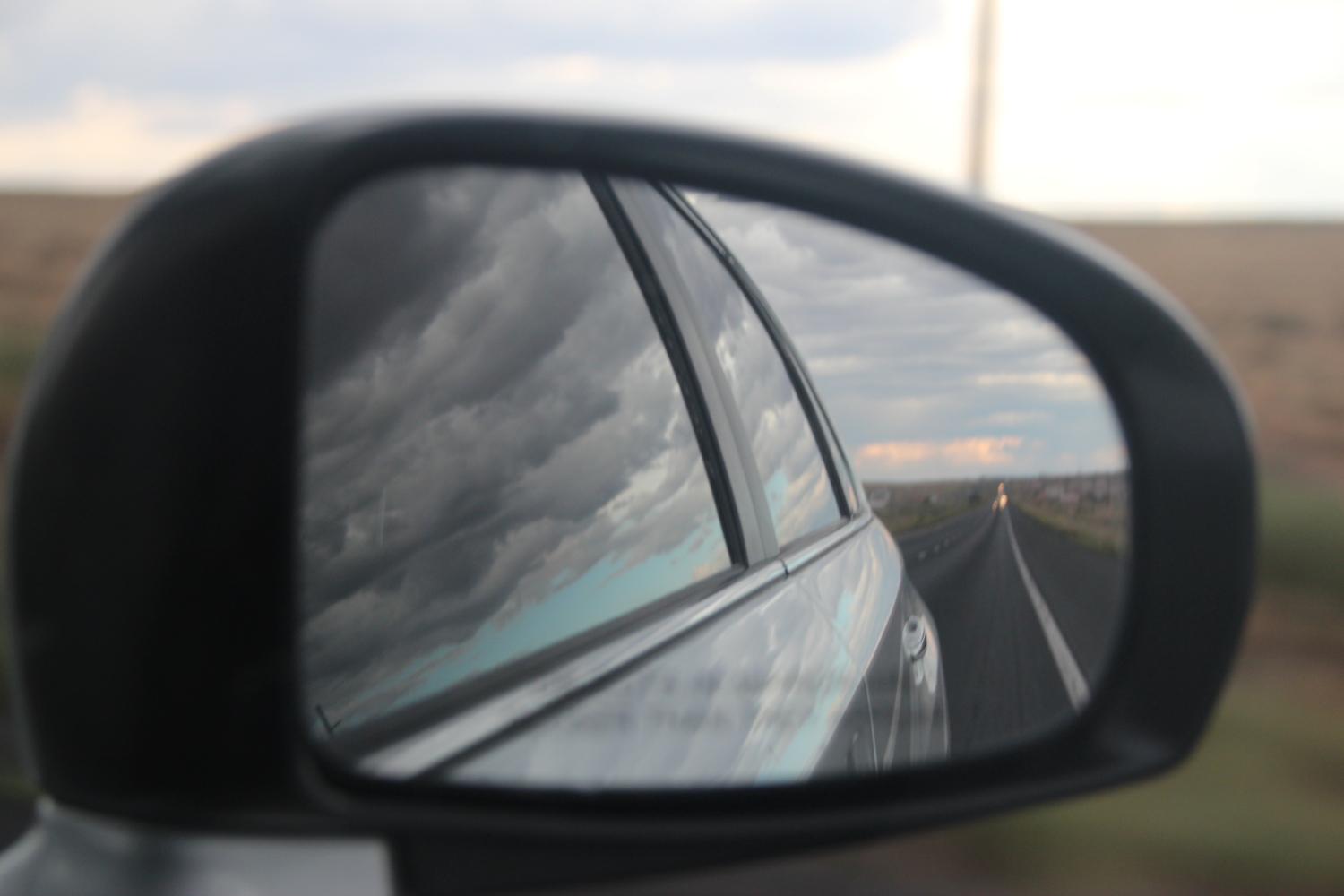
Arizona highway (Donna at the wheel)
* an ongoing series of quotations – mostly from artists, to artists – that offers wisdom, inspiration, and advice for the sometimes lonely road we are on.
February 21, 1924. A hell of a day yesterday. Bitter disappointment awaits the worker in photography.
After risking my neck to get the 8 x 10 camera on la azotea – flat roof – over Tina’s room, the highest vantage point of Lucerna 12, and after straining my back and stripping my nerves to capture a sweep of scurrying cloud forms, development revealed fog – ruinous fog – unmistakably from extraneous light – and a beautiful negative it was, or might have been!
The demon fog can play such uncanny tricks – always I am confounded, disconcerted, mystified until the trouble has been located. All morning I squinted and poked and probed, finally patching with felt the supposed leak due to a warped back, but I lost my negative, as fine a one as any of clouds I have done.
In a blue funk, I was ready to quit, and when Galvan called, accepted his suggestion that we ride into the country and then walk for a while.
North, and out of el distrito federal, he took us to a barranca – gorge – close by – in fact, hardly twenty minutes drive away, yet, from the desolation of this cactus covered gulch we seemed a hundred miles away from any city street. Cactus and rock and the tortuous curves of el arroyo seco – the dry gulch – a bleakness to the spot intensified by a lowering sky, black wrathful clouds, angrily unable to spill their burden of rain. We climbed, we shot, we lay on the dead grass and watched the sunset edge the clouds with rose, and all around stiff cacti in spreading silhouette. Tea with Galvan, his three old aunts and Don pepe – cajeta de Celaya, te, pasas – jelly from Celaya, tea, raisins, and sweet bread.
I feel better, to hell with photography, art, women and all.
Yet – I wished for my camera today. Those serrated stalks of the maguey, their bold uncompromising leaves cutting the horizon, they would make a fine jagged base to a typical Mexican sky.
Nancy Newhall, editor, The Daybooks of Edward Weston: Two Volumes in One: I. Mexico II. California
Comments are welcome!


 barbararachkoscoloreddust.com