Blog Archives
Pearls from artists* # 679
*an ongoing series of quotations – mostly from artists, to artists – that offers wisdom, inspiration, and advice for the sometimes lonely road we are on.
PC: In your painting, you’ve always kept this speed of movement. One senses that you work something out slowly, deep down, that it’s hard work, but there’s always something fresh about its expression
HM: That’s because I revise my notion several times over. People often add or superimpose completing things without changing their plan, whereas I rework my plan every time. I always start again, working from the previous state. I try to work in a contemplative state, which is very difficult: contemplation is inaction and I act in contemplation.
In all the studies I’ve made from my own ideas, there’s never been a faux pas because I’ve always unconsciously had a feeling for the goal; I’ve made my way toward it the way one heads north, following the compass. What I’ve done, I’ve done by instinct, always with my sights on a goal I still hope to reach today. I’ve completed my apprenticeship now. All I ask is four or five years to realize the goal.
PC: Delacroix said that too. Great artists never look back.
HM: Delacroix also said – ten years after he’d left the place – “I’m just beginning to see Morocco.” He needed the perspective. Rodin said to an artist, “You need to stand back a long way for sculpture.” To which the student replied, “Master, my studio is only ten meters wide.”
Chatting With Henri Matisse: The Lost 1941 Interview, Henri Matisse with Pierre Courthion, edited by Serge Guilbaut
Comments are welcome!
Q: What’s on the easel today?

Planning my next painting
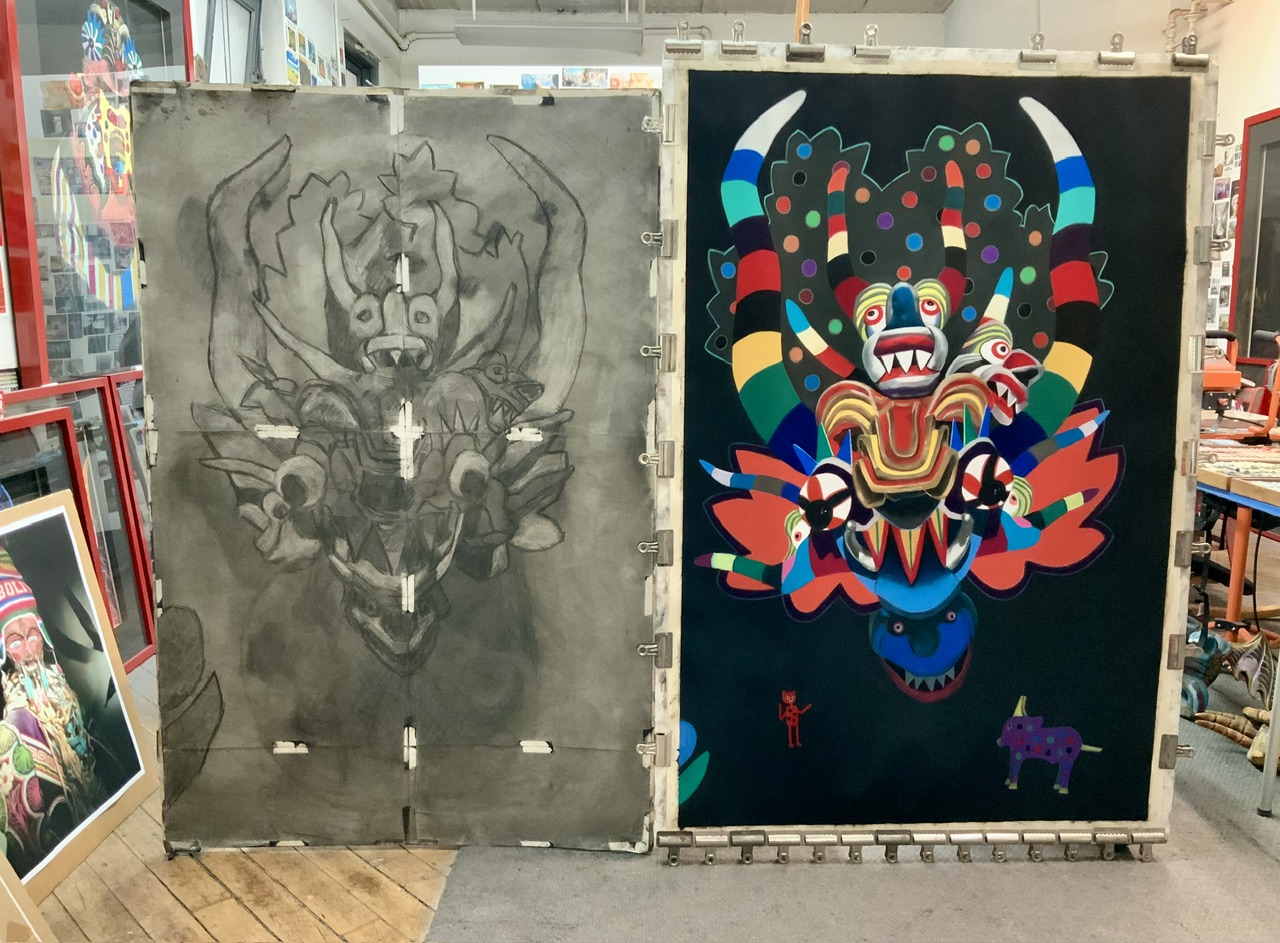
A: In preparation for my next large “Bolivianos” painting, I made this preliminary charcoal drawing.
Comments are welcome!
Q: What’s on the easel today?

Charcoal Drawing
A: This is a preliminary charcoal drawing to help plan my next small “Bolivianos” painting.
Comments are welcome!
Q: What’s on the easel today?

A: This is a preliminary charcoal drawing for my next “Bolivianos” painting.
Comments are welcome!
Q: What’s on the easel today?

Work in progress
A: I am planning my next pastel painting and the photo above shows a preliminary charcoal sketch for it. I’m continuing to study the effects of scaling my work up or down. This piece will be a smaller, 26” x 20,” version of “The Orator,” 38” x 58” (image), 50” x 70” (framed), from 2017.
Comments are welcome!
Q: What’s on the easel today?


A: Here is a preliminary charcoal drawing in preparation for my next ”Bolivianos” pastel painting. With the most recent works I have been experimenting with scale. This will be a 58” x 38” version of ”Schemer,” 2019, 26” x 20.”
Comments are welcome!
Pearls from artists* # 494
*an ongoing series of quotations – mostly from artists, to artists – that offers wisdom, inspiration, and advice for the sometimes lonely road we are on.
Emile Cartailhac was a man who could admit when he was wrong. This was fortunate, because in 1902 the French prehistorian found himself writing an article for L’Anthropolgie in which he did just that. In “Mea culpa d’un sceptique” he recanted the views he had spent the previous 20 years forcefully and scornfully maintaining: that prehistoric man was incapable of fine artistic expression and that the cave paintings found in Altmira, northern Spain, were forgeries.
The Paleothithic paintings at Altamira, which were produced around 14,000 B.C., were the first examples of prehistoric cave art to be officially discovered. It happened by chance in 1879, when a local landowner and amateur archaeologist was busily brushing away at the floor of the caves, searching for prehistoric tools. His nine-year-old daughter, Maria Sanz de Sautuola – a grave little thing with cropped hair and lace-up booties – was exploring farther on when she suddenly looked up, exclaiming, “Look, Papa, bison!” She was quite right: a veritable herd, subtly colored with black charcoal and ocher, ranged over the ceiling. When her father published the finding in 1880, he was met with ridicule. The experts scoffed at the very idea that prehistoric man – savages really – could have produced sophisticated polychrome paintings. The esteemed Monsieur Cartailhac and the majority of his fellow experts, without troubling to go and see the cave for themselves, dismissed the whole thing as a fraud. Maria’s father died, a broken and dishonored man, in 1888, four years before Cartailhac admitted his error.
After the discovery of many more caves and hundreds of lions, handprints, horses, women, hyenas, and bison, the artistic abilities of prehistoric man are no longer in doubt. It is thought that these caves were painted by shamans trying to charm a steady supply of food for their tribes. Many were painted using the pigment most readily available in the caves at the time: the charred stick remnants of their fires. At its simplest, charcoal is the carbon-rich by-product of organic matter – usually wood – and fire. It is purest and least ashy when oxygen has been restricted during it’s heating.
In The Secret Lives of Color by Kassia St. Clair
Comments are welcome!
Q: When did you start using the sandpaper technique and why (Question from “Arte Realizzata”)

A: In the late 1980s when I was studying at the Art League School in Alexandria, VA, I enrolled in a three-day pastel workshop with Albert Handel, an artist known for his southwest landscapes in pastel and oil paint. I had just begun working with soft pastel and was experimenting with paper. Handel suggested I try Ersta fine sandpaper. I did and nearly three decades later, I’ve never used anything else.
This paper is acid-free and accepts dry media, mainly pastel and charcoal. It allows me to build up layer upon layer of pigment and blend, without having to use a fixative. The tooth of the paper almost never gets filled up so it continues to hold pastel. (On the rare occasion when the tooth DOES fill up, which sometimes happens with problem areas that are difficult to resolve, I take a bristle paintbrush, dust off the unwanted pigment, and start again). My entire technique – slowly applying soft pastel, blending and creating new colors directly on the paper, making countless corrections and adjustments, rendering minute details, looking for the best and/or most vivid colors – evolved in conjunction with this paper.
I used to say that if Ersta ever went out of business and stopped making sandpaper, my artist days would be over. Thankfully, when that DID happen, UArt began making a very similar paper. I buy it in two sizes – 22″ x 28″ sheets and 56″ wide by 10-yard-long rolls. The newer version of the rolled paper is actually better than the old, because when I unroll it, it lays flat immediately. With Ersta I would lay the paper out on the floor for weeks before the curl would give way and it was flat enough to work on.
Comments are welcome!
Q: Why do you make a preliminary drawing before you begin a pastel painting?

A: I make a preliminary charcoal drawing because that’s how I like to begin thinking about and planning a new pastel painting. I always make preliminary drawings the same size as the upcoming pastel painting. While I draw, I make decisions about the overall composition, decide where the major light and dark shapes will be, and envision the likely problem areas that lie ahead. These drawings are done quickly. I spend perhaps an hour on them.
Once the drawing is in my head I no longer need it. So I put it away and when it’s time to begin a subsequent pastel painting, I erase it. I wipe it out with a paper towel and make the next preliminary charcoal drawing directly on top. These are ephemeral tools, existing only for as long as I need them.
Comments are welcome!
Q: What is your earliest memory of wanting to be an artist? (Question from “Arts Illustrated”).
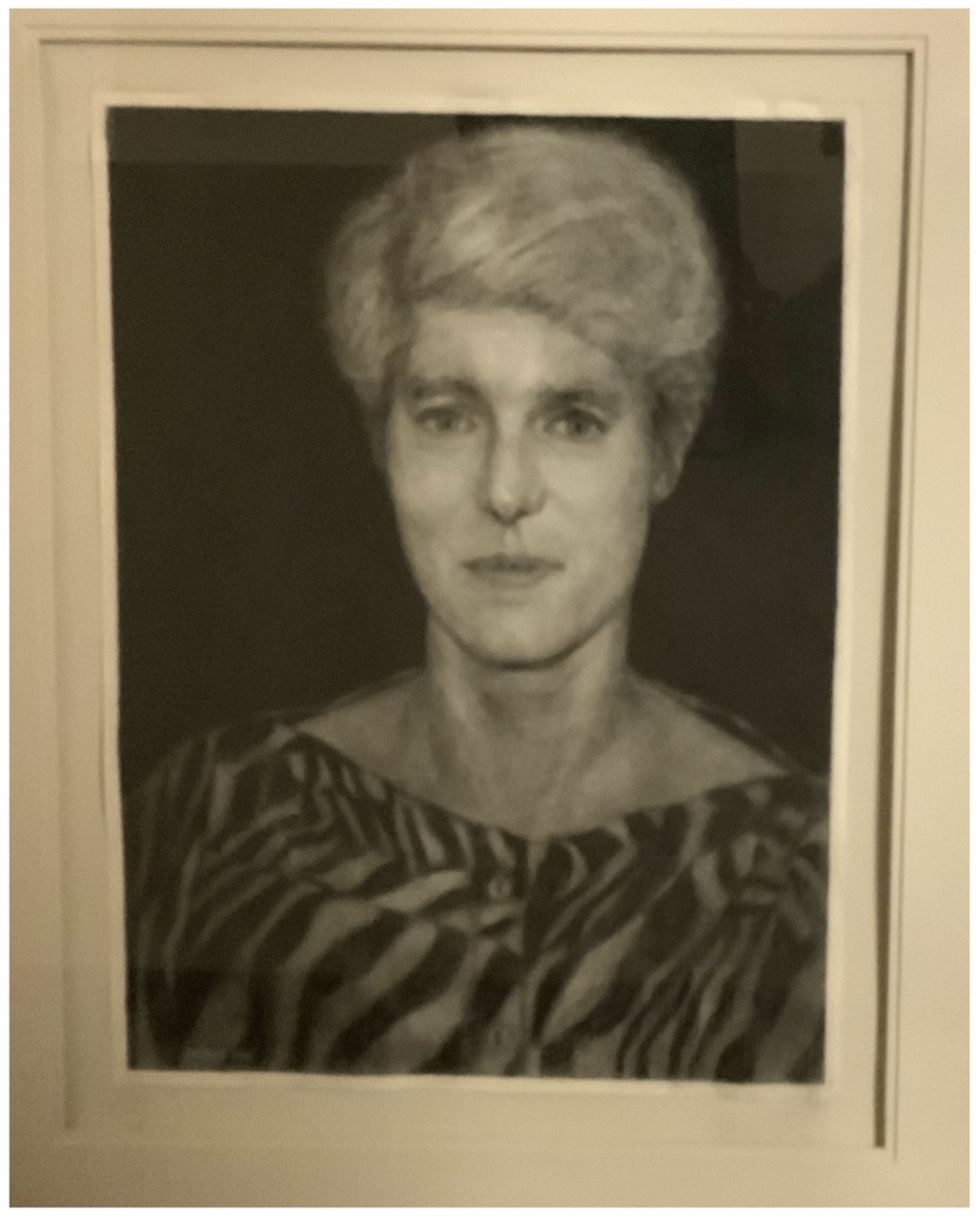
A: I don’t believe I have any such ‘early memories.’ I came to art late and my journey to becoming an artist was circuitous, to say the least.
In the mid-1980s I was a thirty-something Navy lieutenant. I worked a soul-crushing job as a computer analyst on the midnight shift in a Pentagon basement. We were open 24/7 and supported the Joint Chiefs of Staff.
Remembering the joyful Saturdays of my youth in New Jersey, when I had studied with a local painter, I enrolled in a drawing class at the Art League School in Alexandria, Virginia. I loved it! I took more classes and became a highly motivated, full-time art student who worked nights at the Pentagon. After two years and as my skills improved, I discovered my preferred medium – soft pastel on sandpaper.
I knew I had found my calling, submitted my resignation, and left active duty. On October 1, 1989 I became a professional artist. However, I remained in the Navy Reserve for another fourteen years, working at the Pentagon one weekend a month. On November 1, 2003, I retired as a Navy Commander.
Please also see Art Market (barbararachko.art)
Comments are welcome!


 barbararachkoscoloreddust.com