Blog Archives
Q: Why do people need art in their daily lives?
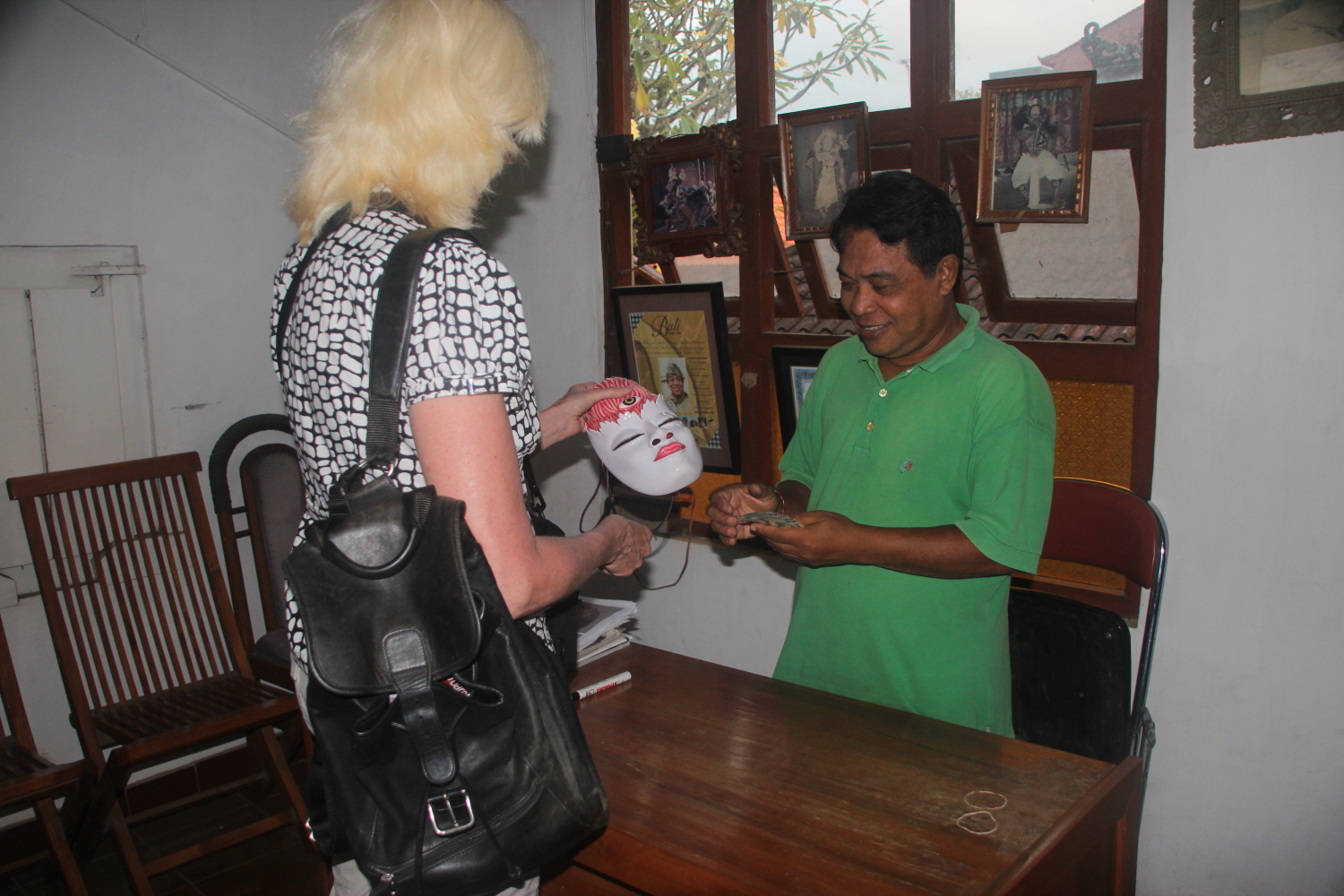
With Ida Bagus Anom, Mas, Bali; Photo: Donna Tang
A: That is for each person to decide, but as someone who devotes every waking moment to my work and to becoming a better artist, I cannot imagine my life without art.
I will tell you a little about what art has done for me. In my younger days boredom was a strong motivator. I left the active duty Navy out of boredom. I couldn’t bear not being intellectually challenged (most of my jobs consisted of paper-pushing), not using my flying skills (at 27 I was a licensed commercial pilot and Boeing-727 flight engineer), and not developing my artistic talents. In what surely must be a first, the Navy turned me into a hard-working and disciplined artist. And once I left the Navy there was no plan B. There was no time to waste. It was “full speed ahead.”
Art is a calling. You do not need to be told this if you are among those who are called. It’s all about “the work,” that all-consuming focus of an artist’s life. If a particular activity doesn’t seem likely to make me a better artist, I tend to avoid it. I work hard to nourish and protect my gifts. As artists we invent our own tasks, learn whatever we need in order to progress, and complete projects in our own time. It is life lived at its freest.
My art-making has led me to fascinating places: Mexico, Guatemala, Brazil, Argentina, Uruguay, France, England, Italy, Bali, Java, Sri Lanka, and more; and to in-depth studies of intriguing subjects: drawing, color, composition, art and art history, the art business, film and film history, photography, mythology, literature, music, jazz and jazz history, and archaeology, particularly that of ancient Mesoamerica (Olmec, Zapotec, Mixtec, Aztec, Maya, etc.). And this rich mixture continually grows! For anyone wanting to spend their time on earth learning and meeting new challenges, there is no better life!
Comments are welcome!
Q: I just got home from my first painting experience… three hours and I am exhausted! Yet you, Barbara, build up as many as 30 layers of pastel, concentrate on such intricate detail, and work on a single painting for months. How do you do it?
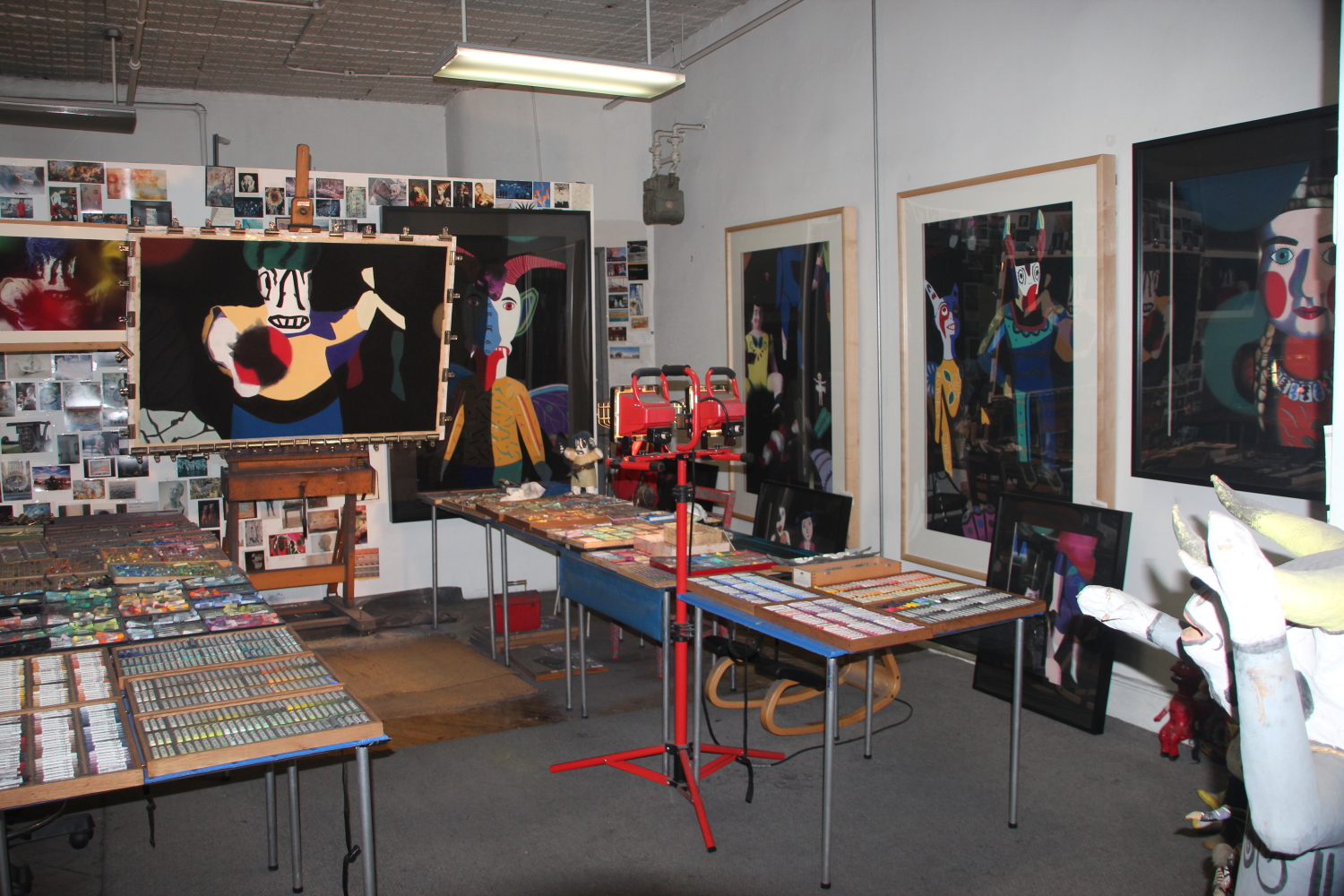
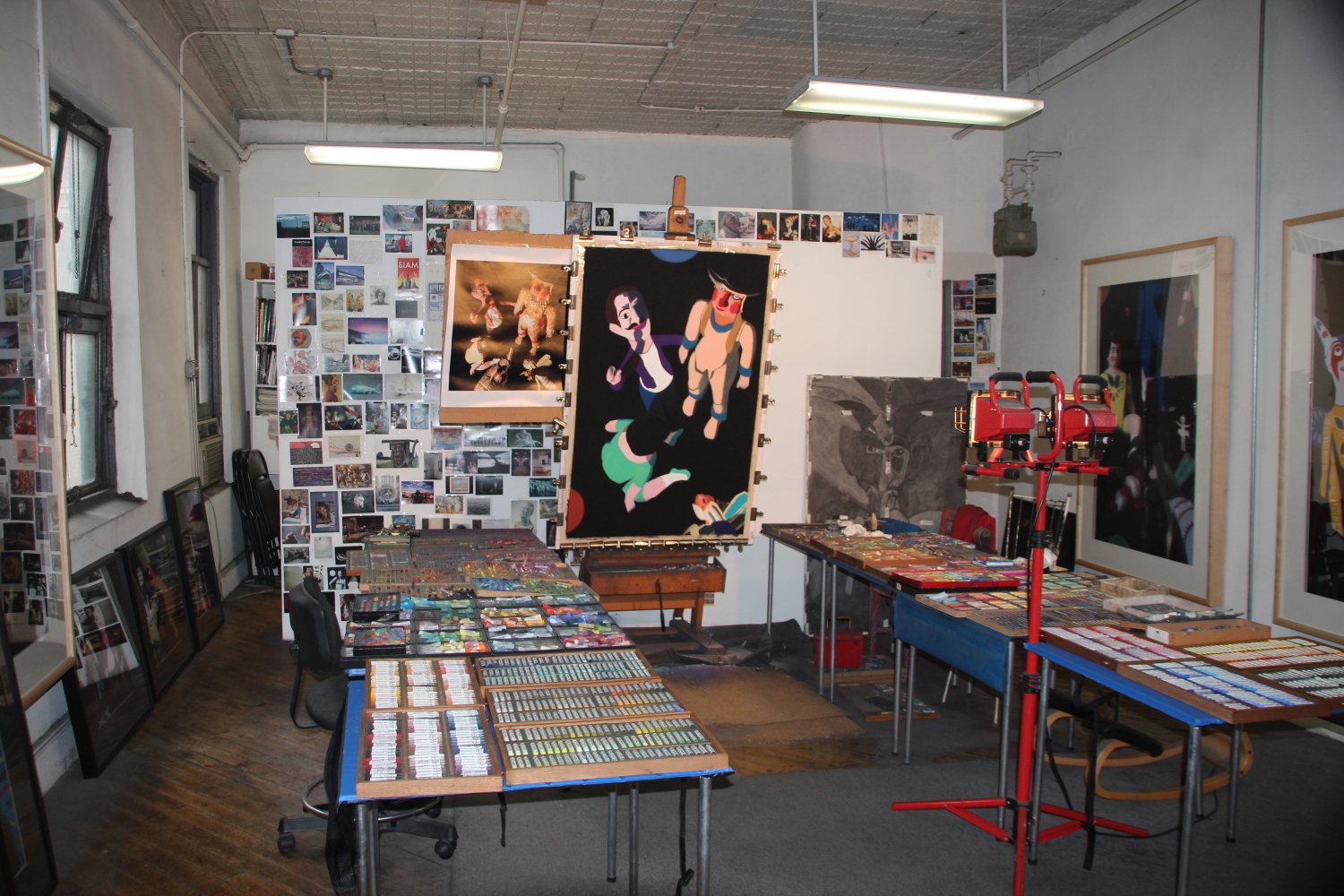
Barbara’s studio
A: The short answer is that I absolutely love making art in my studio and on the best days I barely even notice time going by!
Admittedly, it’s a hard road. Pursuing life as an artist takes a very special and rare sort of person. Talent and having innate gifts are a given, merely the starting point. We must possess a whole cluster of characteristics and be unwavering in displaying them. We are passionate, hard-working, smart, devoted, sensitive, self-starting, creative, hard-headed, resilient, curious, persistent, disciplined, stubborn, inner-directed, tireless, strong, and on and on. Into the mix add these facts. We need to be good business people. Even if we are, we are unlikely to make much money. We are not respected as a profession. People often misunderstand us: at best they ignore us, at worst they insult our work and us, saying we are lazy, crazy, and more.
The odds are stacked against any one individual having the necessary skills and stamina to withstand it all. So many artists give up, deciding it’s too tough and just not worth it, and who can blame them? This is why I believe artists who persevere over a lifetime are true heroes. It’s why I do all I can to help my peers. Ours is an extremely difficult life – it’s impossible to overstate this – and each of us finds our own intrinsic rewards in the work itself. Otherwise there is no reason to stick with it. Art is a calling and for those of us who are called, the work is paramount. We build our lives around the work until all else becomes secondary and falls away. We are in this for the duration.
In my younger days everything I tried in the way of a career eventually became boring. Now with nearly thirty years behind me as a working artist, I can still say, “I am never bored in the studio!” It’s difficult to put into words why this is true, but I know that I would not want to spend my time on this earth doing anything else. How very fortunate that I do not have to do so!
Comments are welcome!
Q: How would you describe your personal artistic style?
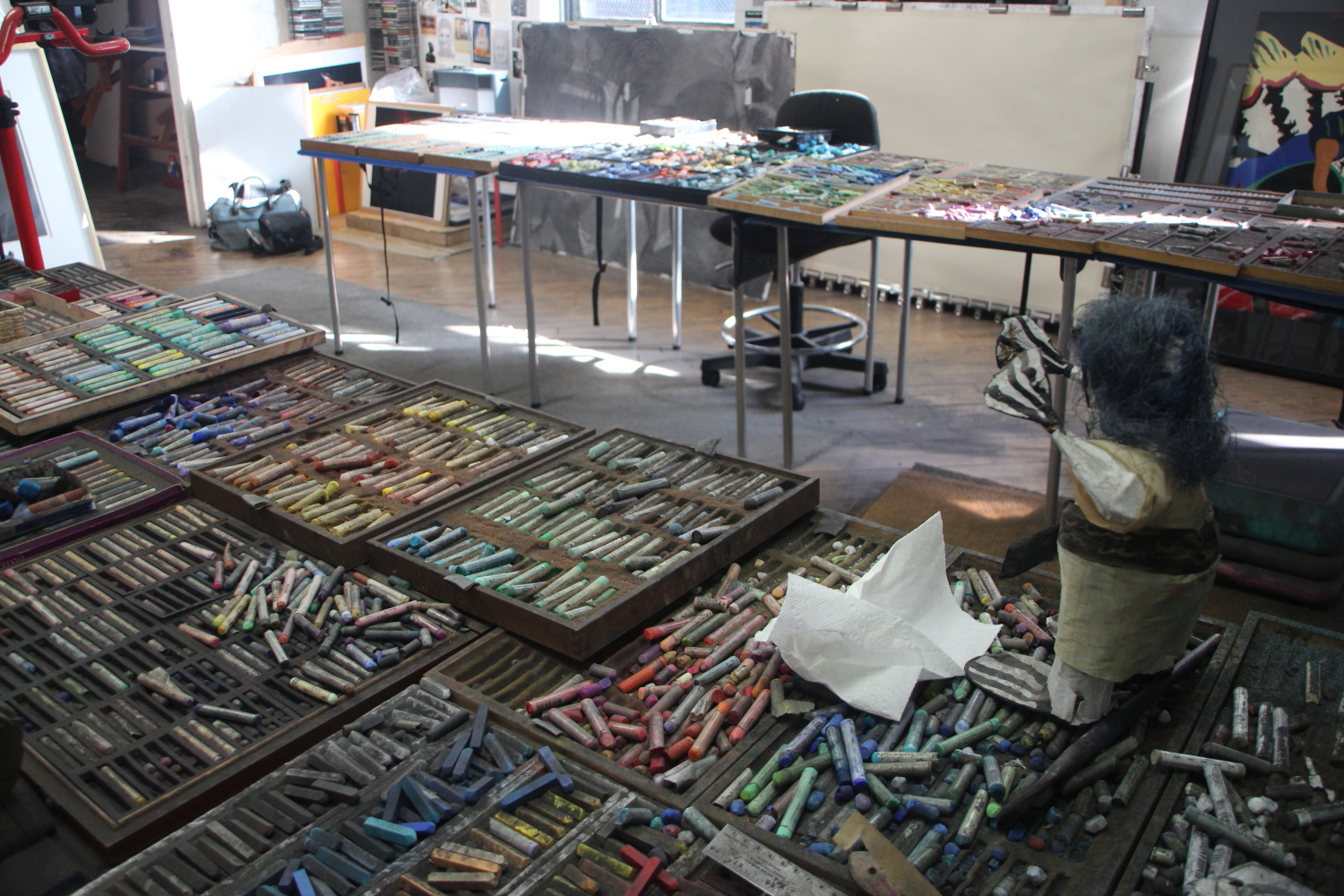
Barbara’a pastels
A: Regardless of what medium I am using, I am first and foremost a colorist. Everything I create is vibrant with color.
The Navy taught me to be organized, goal-oriented and focused, to love challenges, and in everything I do, to pay attention to the details. Trying to make it as an artist in New York is nothing BUT challenges, so these qualities serve me well, whether I am creating paintings, shooting and making photographs, or trying to understand the art business, keep up with social media, and manage all the tasks required of a busy artist with a New York studio, a business, and two residences to maintain. It’s a lot, but it forces me to continually learn and grow. As Helen Keller famously said, “Life is an adventure or it is nothing.”
These days I am rarely bored. I thoroughly enjoy spending long, solitary hours working to become a better artist. I am meticulous about craft and will not let work out of my studio until it is as good as I can make it. My creative process is more exciting than ever. It’s thrilling and energizing to continually push soft pastel to its limits and use it in ways that no other artist has done before!
Comments are welcome!
Pearls from artists* # 57

Studio corner
* an ongoing series of quotations – mostly from artists, to artists – that offers wisdom, inspiration, and advice for the sometimes lonely road we are on.
You are talented and creative. You rarely block, and when you do block you know how to move yourself along. Your moods are not incapacitating and you haven’t stepped over into madness. Your personality is sufficiently integrated that your necessary arrogance doesn’t prevent you from having successful relationships, your nonconformity hasn’t made you a pariah, and your skepticism hasn’t bred in you a nihilistic darkness. You work happily in isolation but can also move into the world and have a life. You have, in short, met the challenges posed so far.
Are you home free? Unfortunately not. The next challenges you face are as great as any posed so far. They are the multiple challenges of doing the business of art: making money, developing a career, acknowledging and making the most of your limited opportunities, living with compromise, dealing with mass taste and commercialism, negotiating the marketplace, and making personal sense of the mechanics and metaphysics of the business environment of art.
Many artists grow bitter in this difficult arena. Many an artist flounders. Only the rare artist sits himself down to examine these matters, for they are painful to consider. But you have no choice but to examine them. If you are an artist, you want an audience. And if you want an audience, you must do business.
Comments are welcome!
Eric Maisel in A Life in the Arts
Q: Would you speak about the practical realities – time and expenses – involved in making your pastel-on-sandpaper paintings? What might people be surprised to learn about this aspect of art-making?
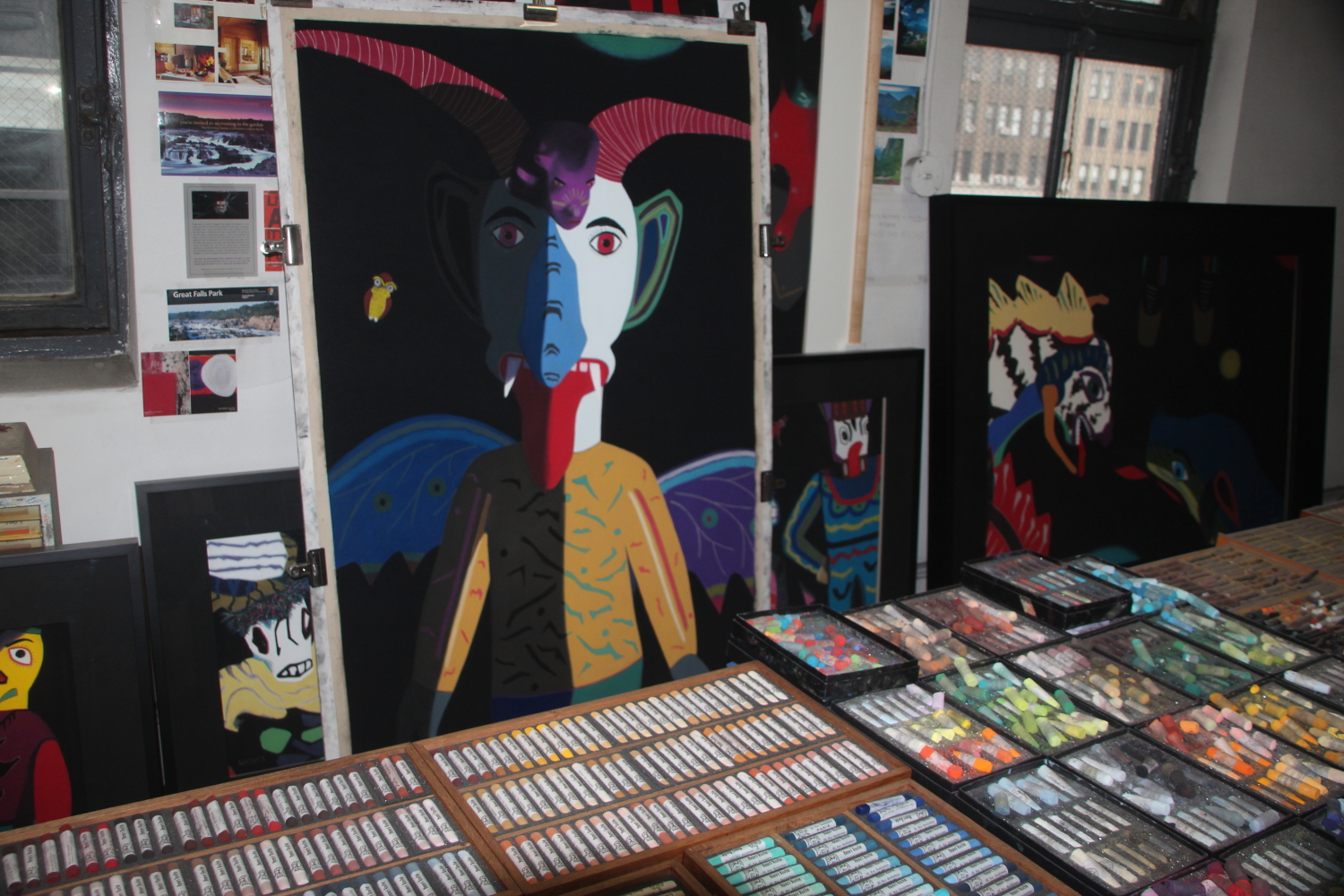
Studio
A: I have often said that this work is labor-intensive. In a good year I can complete five or six large (38″ x 58″) pastel paintings. In 2013 I am on track to make four, or, on average, one completed painting every three months. I try to spend between thirty-five and forty hours a week in the studio. Of course, I don’t work continuously all day long. I work for awhile, step back, look, make changes and additions, think, make more changes, step back, etc. Still, hundreds of hours go into making each piece in the “Black Paintings” series, if we count only the actual execution. There is also much thinking and preparation – there is no way to measure this – that happen before I ever get to stand before an empty piece of sandpaper and begin.
As far as current expenses, they are upwards of $12,000 per painting. Here is a partial breakdown:
$4500 New York studio, rent and utilities ($1350/month) for three months
$2500 Supplies, including frames (between $1500 – $1700), photographs, pastels (pro-rated), paper
$2000 Foreign travel to find the cultural objects, masks, etc. depicted in my work (approximate, pro-rated)
$3000 Business expenses, such as computer-related expenses, website, marketing, advertising, etc.
This list leaves out many items, most notably compensation for my time, shipping and exhibition expenses, costs of training (i.e. ongoing photography classes), photography equipment, etc. Given my overhead, the paintings are always priced at the bare minimum that will allow me to continue making art.
I wonder: ARE people surprised by these numbers? Anyone who has ever tried it knows that art is a tough road. Long ago I stopped thinking about the cost and began doing whatever is necessary to make the best paintings. The quality of the work and my evolution as an artist are paramount now. This is my life’s work, after all.
Comments are welcome!
Q: When and why did you start working on sandpaper?

Raw sandpaper
A: In the late 1980s when I was studying at the Art League in Alexandria, VA, I took a three-day pastel workshop with Albert Handel, an artist known for his southwest landscapes in pastel and oil paint. I had just begun working with soft pastel (I’d completed my first class with Diane Tesler) and was still experimenting with paper. Handel suggested I try Ersta fine sandpaper. I did and nearly three decades later, I’ve never used anything else.
The paper (UArt makes it now) is acid-free and accepts dry media, especially pastel and charcoal. It allows me to build up layer upon layer of pigment, blend, etc. without having to use a fixative. The tooth of the paper almost never gets filled up so it continues to hold pastel. If the tooth does fill up, which sometimes happens with problem areas that are difficult to resolve, I take a bristle paintbrush, dust off the unwanted pigment, and start again. My entire technique – slowly applying soft pastel, blending and creating new colors directly on the paper (occupational hazard: rubbed-raw fingers, especially at the beginning of a painting as I mentioned in last Saturday’s blog post), making countless corrections and adjustments, looking for the best and/or most vivid colors, etc. – evolved in conjunction with this paper.
I used to say that if Ersta ever went out of business and stopped making sandpaper, my artist days would be over. Thankfully, when that DID happen, UArt began making a very similar paper. I buy it from ASW (Art Supply Warehouse) in two sizes – 22″ x 28″ sheets and 56″ wide by 10 yard long rolls. The newer version of the rolled paper is actually better than the old, because when I unroll it it lays flat immediately. With Ersta I laid the paper out on the floor for weeks before the curl would give way and it was flat enough to work on.
Comments are welcome!


 barbararachkoscoloreddust.com