Blog Archives
Pearls from artists* # 690
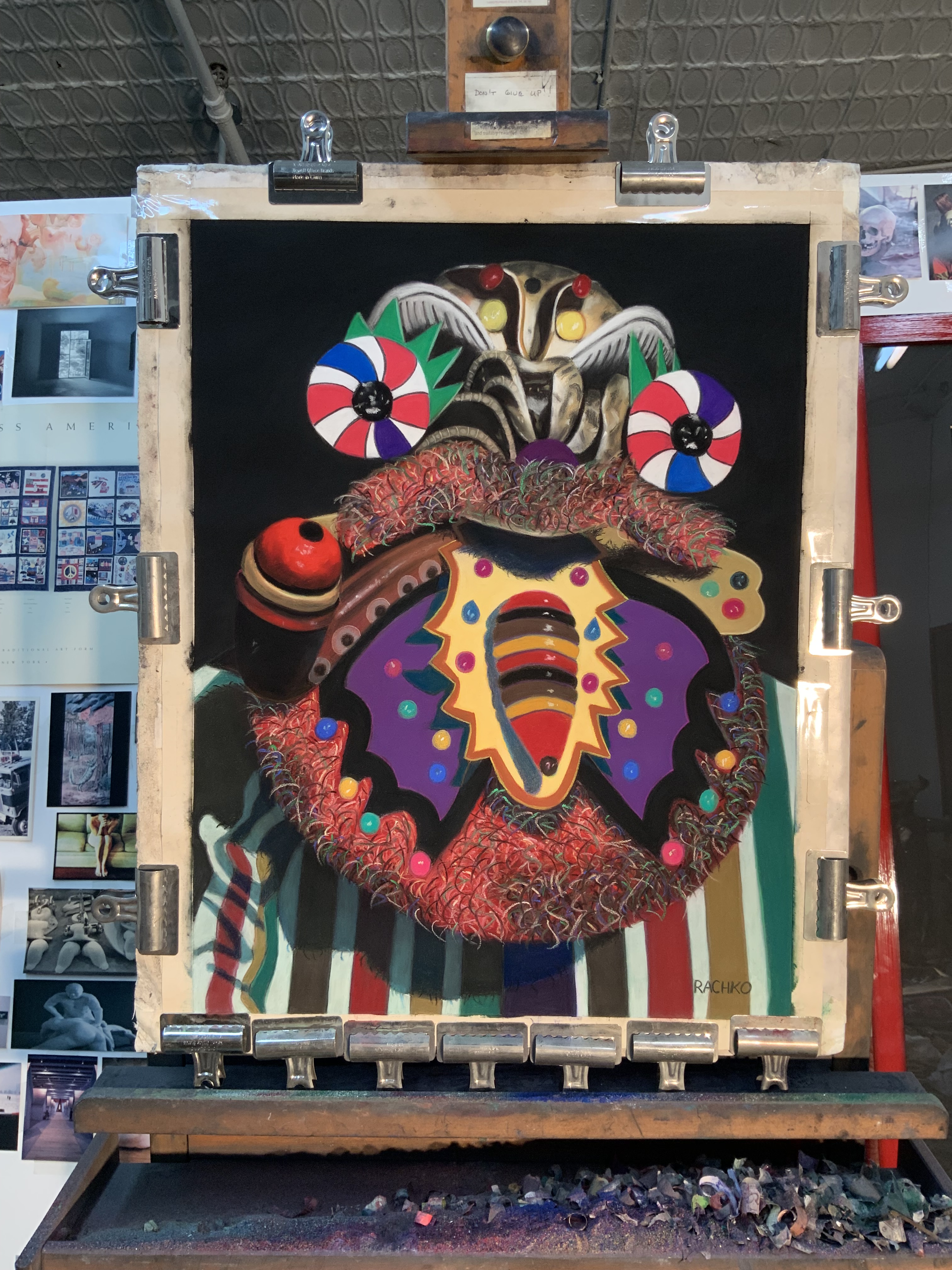
“Showman,” soft pastel on sandpaper, 26” x 20”
*an ongoing series of quotations – mostly from artists, to artists – that offers wisdom, inspiration, and advice for the sometimes lonely road we are on.
PC: And today, don’t you think a picture communicates primarily through its metiére? A mysterious transubstantiation takes place between the thing itself and the way in which our eye receives it. Or, more precisely, a painter’s metiére has life in it, as if it were still laden with the artist’s passion. You feel his pulse beating in it, his need to register the victory of his presence in physical space but outside the reach of time.
HM: Every painter with real talent has his own metiére, a way of laying on the paint with relish, with a certain voluptuous feel, which means that you could say that metiére of this or that painter is like velvet, or satin, or taffeta. As to manner… No one knows where this comes from. It’s magic. It’s not something you can learn. There are very rich paintings, like those of Cézanne, and others very lightly painted that have real density all the same: Velazquez, for example, with his Phillip IV. He uses a scumble for the landscape, which is very beautiful and solid with matiére—the scumble is so well proportioned that it combines with the background and harmonizes perfectly; the Rubens painting on wood in the Louvre, Portrait of Hélène Fourmont and Her Children, is painted mainly in colored oils, yet how deep and solid the colors seem!
Chatting with Henri Matisse: The Lost 1941 Interview, Henri Matisse and Pierre Courthion, edited by Serge Guilbaut
Comments are welcome!
Pearls from artists* # 687
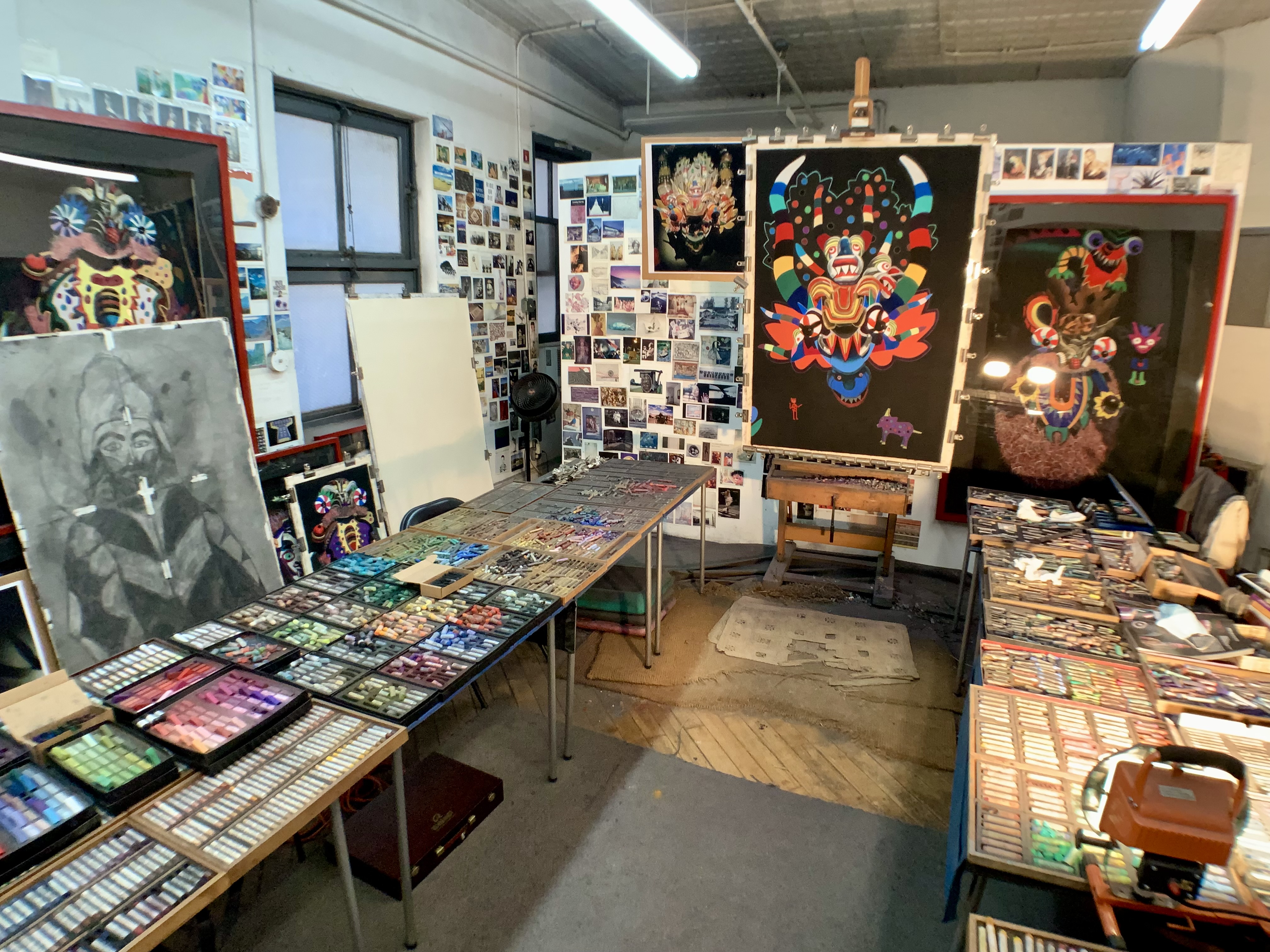
Barbara’s Studio
*an ongoing series of quotations – mostly from artists, to artists – that offers wisdom, inspiration, and advice for the sometimes lonely road we are on.
PC: Talking about sales, when it comes down to it, don’t you find that most of the time, the true art lovers, the disinterested amateurs, are the ones who can’t afford to buy?
HM: Yes, the man who buys, buys for speculative reasons, and after a year or two says to himself – what’s my painting worth? – he wants to cash in. But who knows whether a picture can be sold profitably at any given point? I have friends who begrudged me the fact that I persuaded them to buy a beautiful painting.
Henri Matisse in Chatting With Matisse: The Lost 1941 Interview, Henri Matisse with Pierre Courthion, edited by Serge Guilbault
Comments are welcome!
Pearls from artists* # 658

Barbara’s Studio
*an ongoing series of quotations – mostly from artists, to artists – that offers wisdom, inspiration, and advice for the sometimes lonely road we are on.
A civilized society needs not only doctors, lawyers, and teachers but also artists, craftspeople, and other creatives to make our earthly existence compelling, thoughtful, and vibrant. Most people work to buy a bigger house, a newer car, or better vacations for themselves and their families. Artists devote their lives to making our world a more beautiful, truthful, and equitable place for everyone. They put their labor in service of those they might never see, for rewards that are never guaranteed. To my mind, this is a magnanimous pursuit… and about as unselfish as you can get.
Kate Kretz in Art From Your Core: A Holistic Guide to Visual Voice
Comments are welcome!
Pearls from artists* # 629

Basquiat X Warhol Exhibition at Fondation Louis Vuitton, Paris. Photo: Christine Marchal
*an ongoing series of quotations – mostly from artists, to artists – that offers wisdom, inspiration, and advice for the sometimes lonely road we are on.
… scientists are right there with artists in insisting art is fundamental to being human. Art is one of our oldest creations (humans invented paint long before the wheel), one of our earliest means of communication (we drew long, long, long before we could write), and one of our most universal urges (we all engage with art, whether preschoolers, Parisians, or Paleolithic cave dwellers). I began to notice that art – or what scientists dispassionately call “human-made two- or three-dimensional structures that remain unchanged: – was everywhere: hung over the register at the hardware store, spray-painted on a bakery window, cock-eyed in a dive-bar bathroom. As humans, we’ve filled our lives with art since practically forever. The earliest known painting keeps getting older, but the last time I checked, archaeologists had traced the oldest portrait to a cave in Indonesia, where around 45,000 years ago, artists put their finishing touches on a fat figure with purple testifies for a chin. In other words, before Neanderthals went extinct, before mammoths died out, before we figured out how to harvest food or heal bloody wounds, humans applied themselves to painting a portrait of a warty pig. “It is clear that the creation of beautiful and symbolic objects is a characteristic feature of the human way of life,” wrote the biologist J.Z. Young. “They are as necessary as food or sex.”
Bianca Booker in Get the Picture: A Mind-Bending Journey Among the Inspired Artists and Obsessive Art Fiends Who Taught Me How to See
Comments are welcome!
Pearls from artists* # 598
*an ongoing series of quotations – mostly from artists, to artists – that offers wisdom, inspiration, and advice for the sometimes lonely road we are on.
For art to appear, we have to disappear. This may sound strange, but in fact it is a common appearance. The elementary case, for most people, is when our eye or ear is “caught” by something: a tree, a rock, a cloud, a beautiful person, a baby’s gurgling, spatters of sunlight reflected off some wet mud in the forest, the sound of a guitar wafting unexpectedly out of a window. Mind and sense are arrested for a moment, fully in the experience. Nothing else exists. When we “disappear” in this way, everything around us becomes a surprise, new and fresh. Self and environment unite. Attention and intention fuse. We see things just as we and they are, yet we are able to guide and direct them to be one just the way we want them. This lively and vigorous state of mind is the most favorable to the germination of original work of any kind. It has its roots in child’s play, and its ultimate flowering in full-blown artistic creativity.
Stephen Nachmanovitch in Free Play: Improvisation in Life and Art
Comments are welcome!
Q: What makes you just want to run back to the studio and start something new?
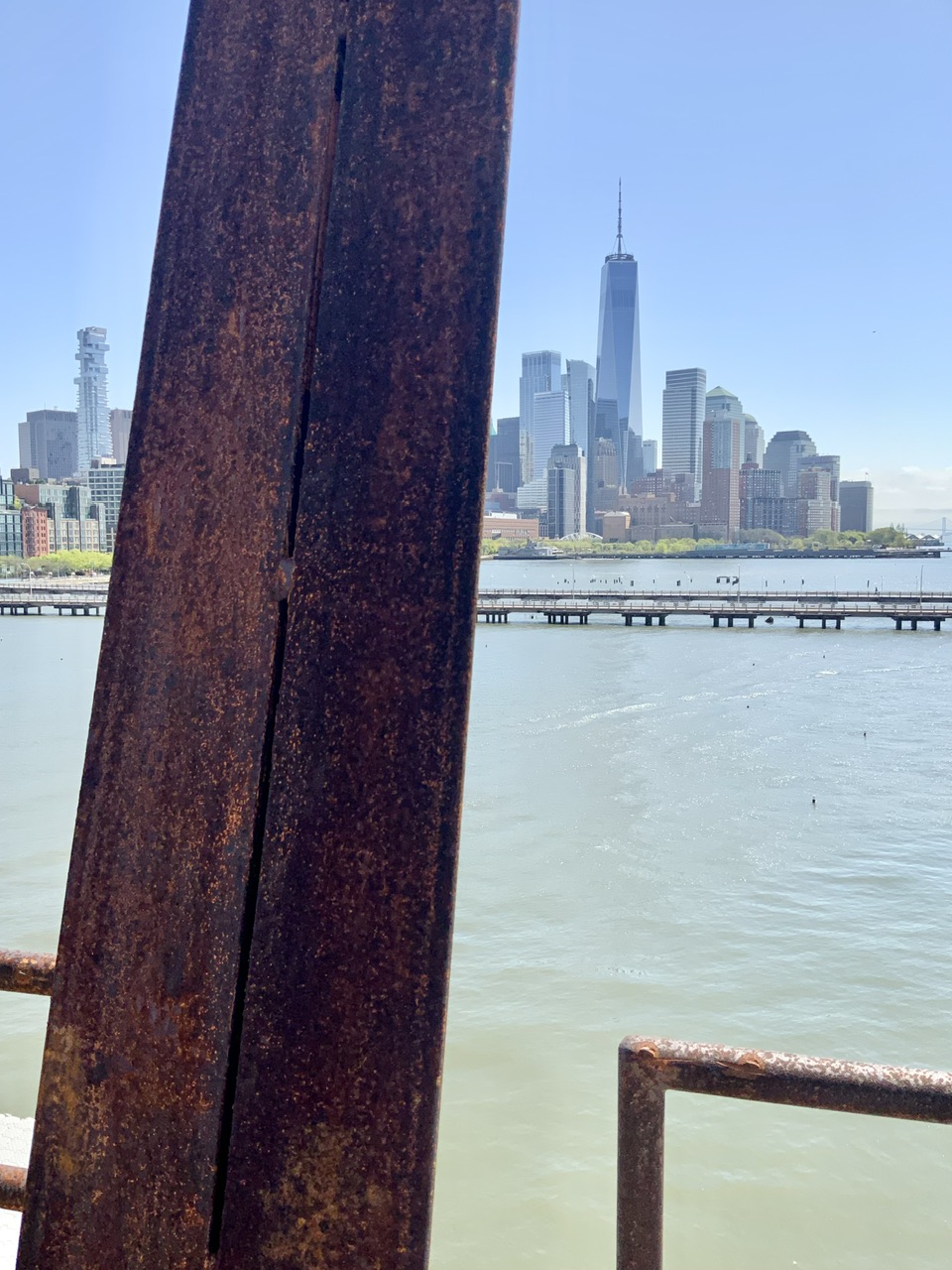
View of Lower Manhattan
A: I always work in series, which means that one pastel painting generally leads into the next. Considerable thought and planning go into each one before I begin, so it would be rare for me to just start something new out of the blue.
Sometimes on days off from the studio when we have beautiful weather, I can can hardly wait to go outside for a walk. I grab my iPad Pro and search for new sights to photograph. After a couple of hours, I usually return home with a handful of interesting images. Photography is such a departure from the slowness of my work in the studio, considering that in a good year I make 3 or 4 pastel paintings.
Comments are welcome!
Pearls from artists* # 518
*an ongoing series of quotations – mostly from artists, to artists – that offers wisdom, inspiration, and advice for the sometimes lonely road we are on.
“It’s more than beauty that I feel in music – that I think musicians feel in music. What we know we feel we’d like to convey to the listener. We hope that this can be shared by all. I think, basically, that’s what it is we are trying to do. We never talked about just what we were trying to do. If you ask me that question, I might say this today and tomorrow say something entirely different, because there are many things to do in music.
“But, overall, I think the main thing a musician would like to do is to give a picture to the listener of the many wonderful things he knows of and senses in the universe. That’s what music is to me – it’s just another way of saying this is a big, beautiful universe we live in, that’s been given to us, and here’s an example of just how magnificent and encompassing it is. That’s what I would like to do. I think that’s one of the greatest things you can do in life, and we all try to do it in some way. The musician’s is through his music.”
John Coltrane in Coltrane on Coltrane: The John Coltrane Interviews
Comments are welcome!
Pearls from artists* # 517
*an ongoing series of quotations – mostly from artists, to artists – that offers wisdom, inspiration, and advice for the sometimes lonely road we are on
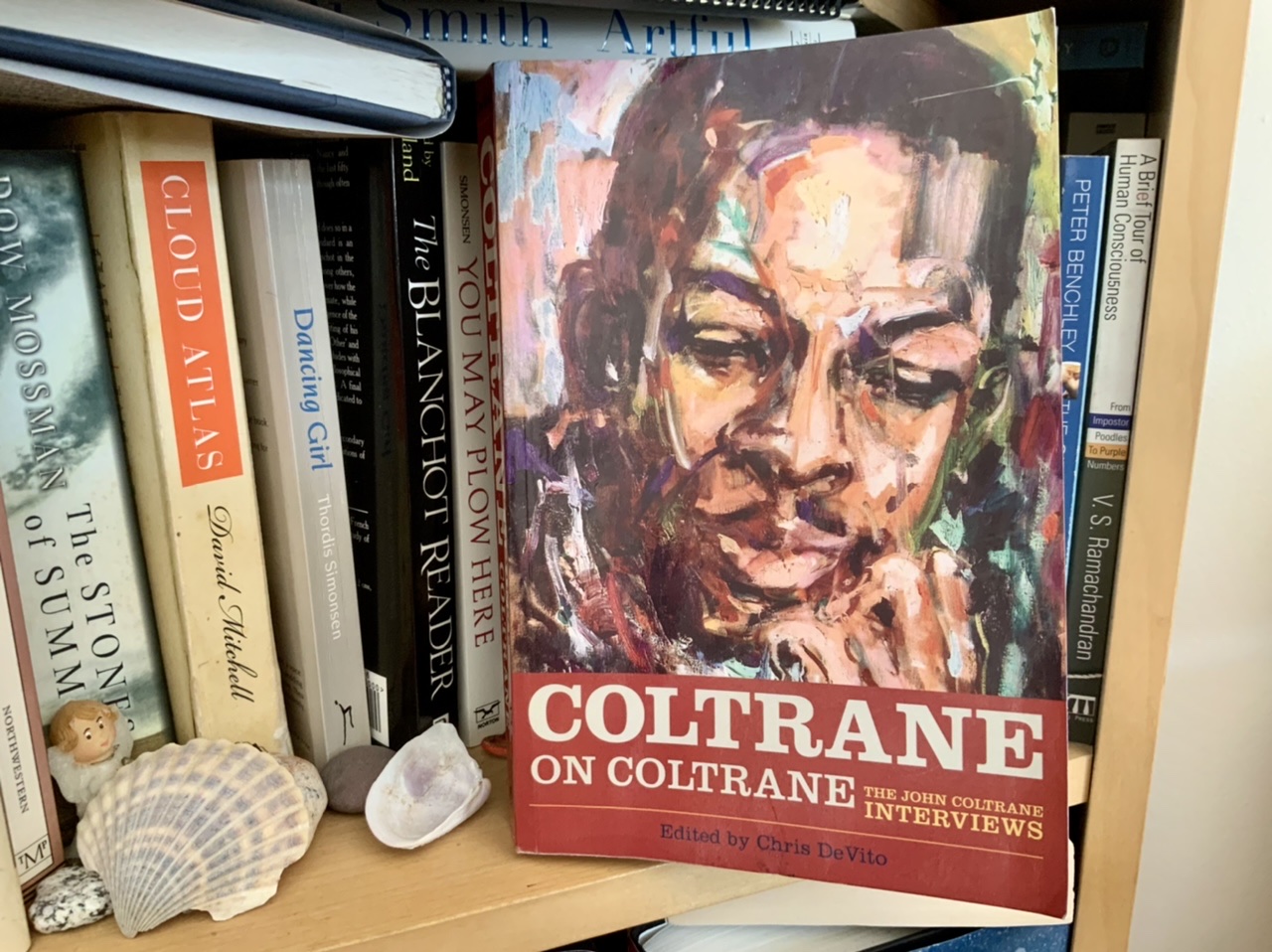
You know. Don, I was reading a book on the life of Van Gogh today. and I had to pause and think of that wonderful and persistent force – the creative urge. The creative urge was in this man who found himself so at odds with the world he lived in, and in spite of all the adversity, frustrations, rejections, and so forth – beautiful and living art came forth abundantly… If only he could be here today. Truth is indestructible. It seems history shows (and it’s the same way today) that the innovator is more often than not met with some degree of condemnation; usually according to the degree of his departure from the prevailing modes of expression or what have you. Change is always so hard to accept. We also see that these innovators always seek to revitalize, extend and reconstruct the status quo in their given fields, wherever it is needed. Quite often they are the rejects, outcasts, sub-citizens, etc. of the very societies to which they bring so much sustenance. Often they are people who endure great personal tragedy in their lives. Whatever the case, whether accepted or rejected, rich or poor, they are forever guided by that great and eternal constant – the creative urge. Let us cherish it and give all praise to God.
John Coltrane in Coltrane on Coltrane: The John Coltrane Interviews
Comments are welcome!
Pearls from artists* # 514
*an ongoing series of quotations – mostly from artists, to artists – that offers wisdom, inspiration, and advice for the sometimes lonely road we are on
Basically I am trying not to stagnate. I go this way and I go that way and I don’t know where I’m going next. But if I should get stagnant, I’d lose my interest.
There are so many things to be considered when making music. The whole question of life itself; my life in which there are many things on which I don’t think I’ve reached a final conclusion; there are matters I don’t think I’ve covered completely, and all these things have to be covered before you make your music sound any way. You have to grow to know.
When I was younger, I didn’t think this would happen, but now I know that I’ve still got a long way to go. Maybe when I’m sixty I’ll be satisfied with what I’m doing, but I don’t know… I’m sure that later on my ideas will carry more conviction.
I know that I want to produce beautiful music, music that does things to people that they need. Music that will uplift and make them happy – those are the qualities I’d like to produce.
Coltrane on Coltrane: The John Coltrane Interviews, edited by Chris DeVito
Comments are welcome!
Pearls from artists* # 513
*an ongoing series of quotations – mostly from artists, to artists – that offers wisdom, inspiration, and advice for the sometimes lonely road we are on.
… you will never be able to create anything interesting out of your life if you don’t believe that you’re entitled to at least try. Creative entitlement doesn’t mean behaving like a princess or acting as though the world owes you anything whatsoever. No, creative entitlement simply means believing that you are allowed to be here, and that – merely by being here – you are allowed to have a voice and a vision of your own.
The poet David Whyte calls this sense of creative entitlement “the arrogance of belonging,” and claims that it is an absolutely vital privilege to cultivate if you wish to interact more vividly with life. Without this arrogance of belonging, you will never be able to take any creative risks whatsoever. Without it, you will never push yourself out of the suffocating insulation of personal safety into the frontiers of the beautiful and the unexpected.
The arrogance of belonging is not about egotism or self-absorption. In a strange way, it’s the opposite; it is a divine force that will actually take you out of yourself and allow you to engage more fully with life. Because often what keeps you from creative living is your self-absorption (your self-doubt, your self-disgust, your self-judgment, your crushing sense of self-protection). The arrogance of belonging pulls you out of the darkest depths of self-hatred – not by saying “I am the greatest!” but merely saying “I am here!”
Elizabet Gilbert in Big Magic: Creative Living Beyond Fear
Comments are welcome!


 barbararachkoscoloreddust.com