Category Archives: Pastel Painting
Q: Do you ever erase the color? Can you do that with pastel? (Question from Hollis Hildebrand-Mills via Facebook)
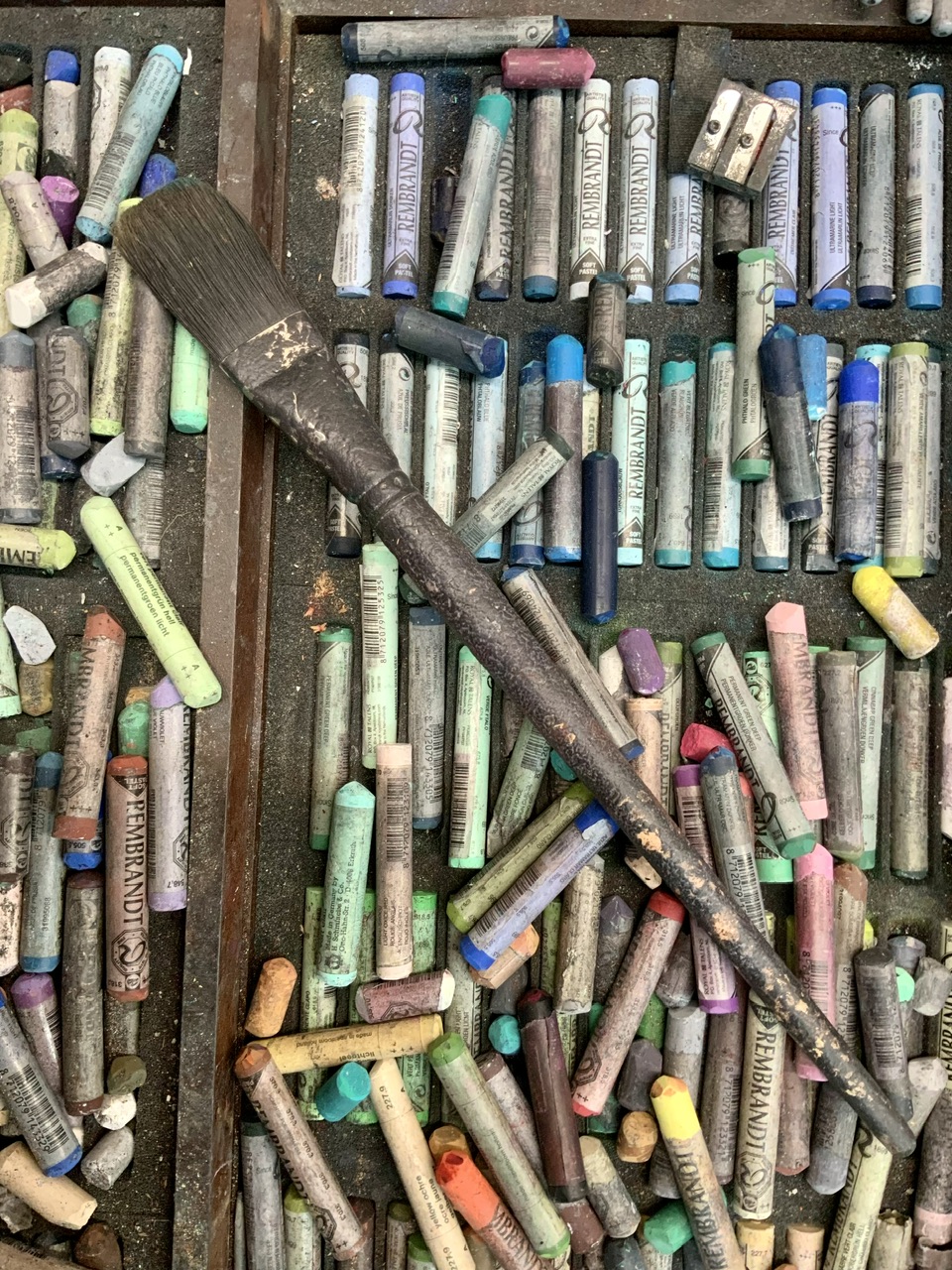
My “eraser”
A: Yes, sort of. I take a bristle brush and wipe it off. I do this only occasionally, when the sandpaper’s tooth is filled up and the paper will no longer accept more pastel. So I brush off what’s there and then I can start over.
Comments are welcome!
Pearls from artists* #571
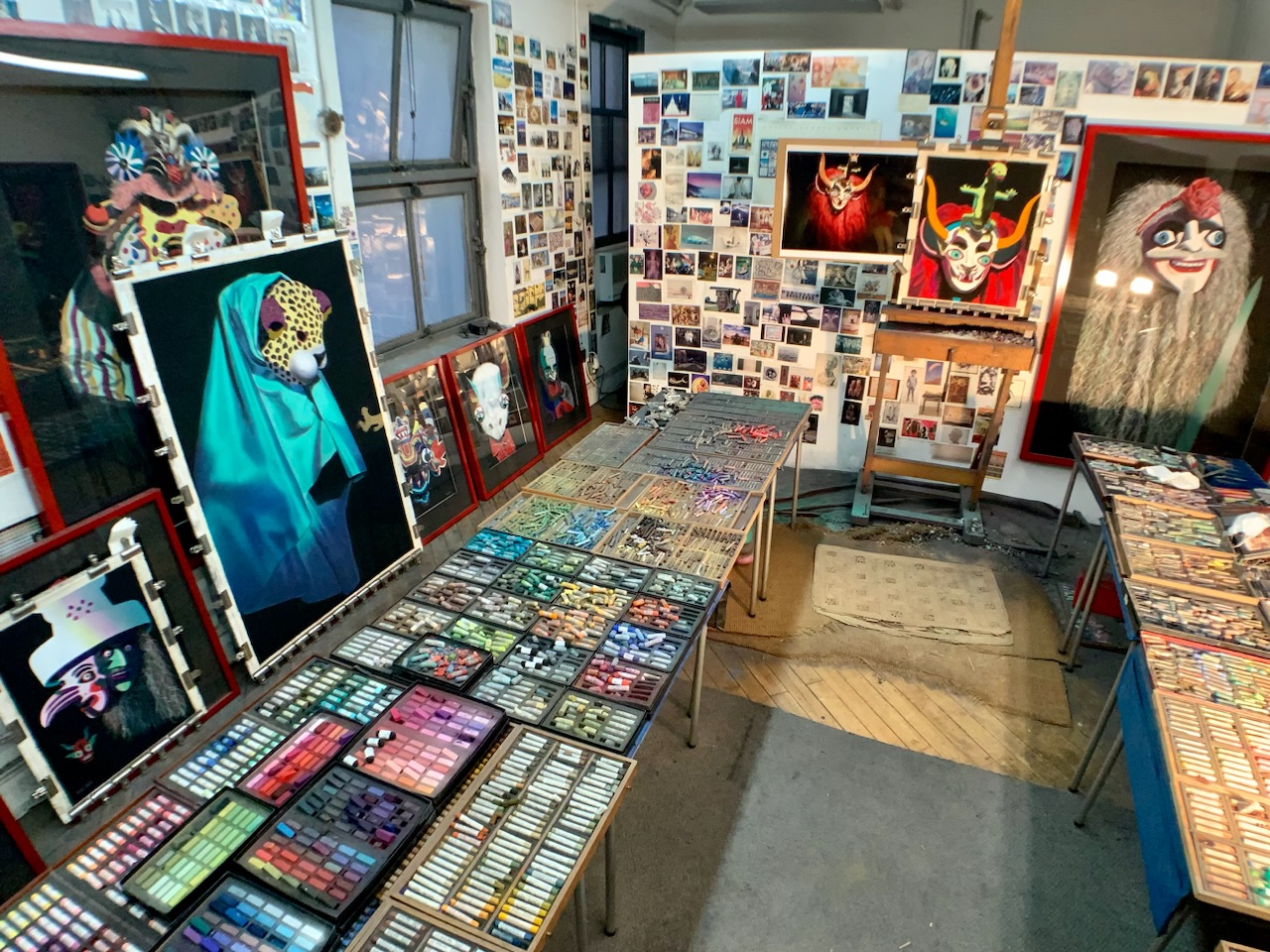
The Studio
*an ongoing series of quotations – mostly from artists, to artists – that offers wisdom, inspiration, and advice for the sometimes lonely road we are on.
To put it simply, but accurately, artists are often lost to the world because of their obsessions with their art. They may be just as lost as they prepare to work or incubate a new idea as in those feverish days when they make their final cuts on a film or race toward a publishing deadline. They may obsess about artistic questions and feel bursts of creative energy day or night, alone or in the company of others, in the middle of the work week or on vacation in the Bahamas.
Lost in time and space, the artist may feel more connected to Picasso, Emily Dickinson, Ingmar Bergman, Gertrude Stein, Handel, or Tennessee Williams than to the people in his immediate world. The living past holds extraordinary meaning for him. He travels elsewhere, removing his spirit and attention from the present. He may reside, as he works on his novel, in the childhood of a character, walking the garden paths and living the household dramas there. He may come upon a Rembrandt drawing and find himself wrenched, not to any particular place or time, but just elsewhere, as he experiences the greatness of his traditions, measures himself anew, and dreams again of his future.
Eric Maisel in A Life in the Arts: Practical Guidance and Inspiration for Creative and Performing Artists
Comments are welcome!
Q: Many of the world’s cultures have a mask tradition. Is there something special about Bolivian masks that first attracted you to them?

Bolivian Carnival Mask
A: My subject matter emerges directly from my travels. I visited Bolivia in 2017. What I especially liked then – and now – about Bolivian Carnival masks, is that they include additional textures – feathers, fur, costume jewelry, sequins, fabric, etc. that add to their physical presence. Masks from most of the other countries I’ve visited tend to be made of wood and/or paper mache and nothing else. In my view such masks are not as dramatic nor do they offer much expressive potential. They feel dead. They lack a certain “soulfulness.”
Furthermore, textures are challenging to render in soft pastel. For more than three decades I have been striving to improve my pastel techniques. By now I have a vast repertoire from which to select. As was true in my earlier series, with “Bolivianos” an important personal goal is to keep adding to the repertoire.
It takes months to create a pastel painting, which means I need masks that will hold my attention every day over the course of three or four months. I never want to be bored in the studio. If I am bored while making the work, those feelings will be directly transferred and I will make a boring pastel painting, something I hope never to do! The masks need to have a really strong ‘presence.’ Then as I slowly make a pastel painting, one that is exciting to work on from start to finish, I can transform my subject into something surprising and powerful that has never existed before!
Comments are welcome!
Q: What’s on the easel today?

Work in progress
A: I just started a new 58” x 38” pastel painting. This photo shows two days worth of work.
Comments are welcome!
Q: What’s on the easel today?
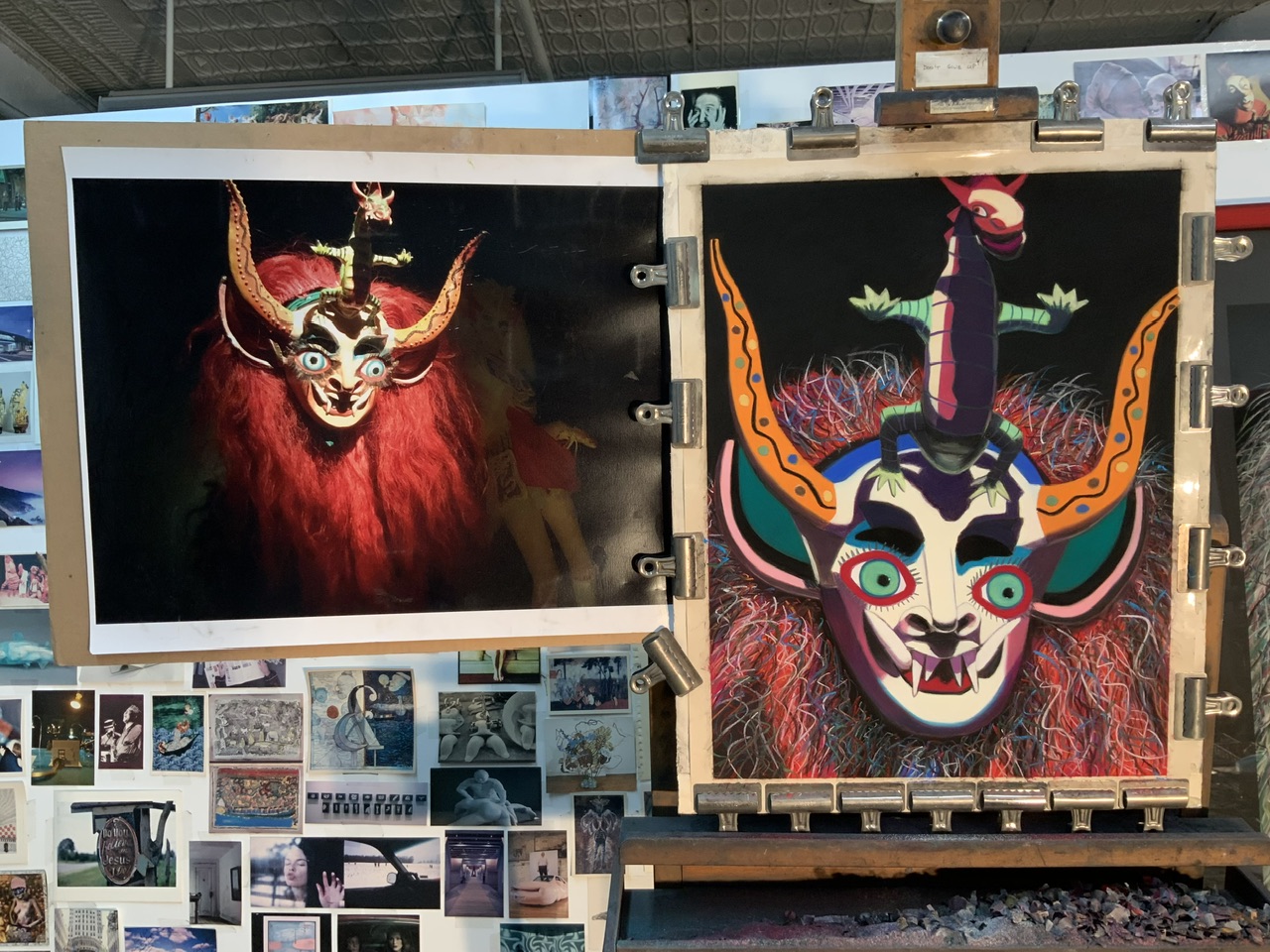
Work in progress
A: “The Moralist,” soft pastel on sandpaper, 26”x 20,” awaits finishing touches.
Comments are welcome!
Q: Love your selection of pastels! Do you have favorites that you need to force yourself not to continually return to? (Question from Donina Asera via Facebook)

A: No, I don’t think so. Certainly, I do have general preferences. I prefer dark, vivid, intense colors so many of my pale pastels go mostly unused. The single pastel that I use most is Rembrandt black – I buy them buy the dozens – because it takes many layers of pigment to achieve my dark black backgrounds. Otherwise, I strive to be open to whatever the painting needs. My goal – always! – is to make a pastel painting that is exciting to look at and different from anything I have created before.
Thank you very much for the great question!
Comments are welcome!
Q: What’s on the easel today?
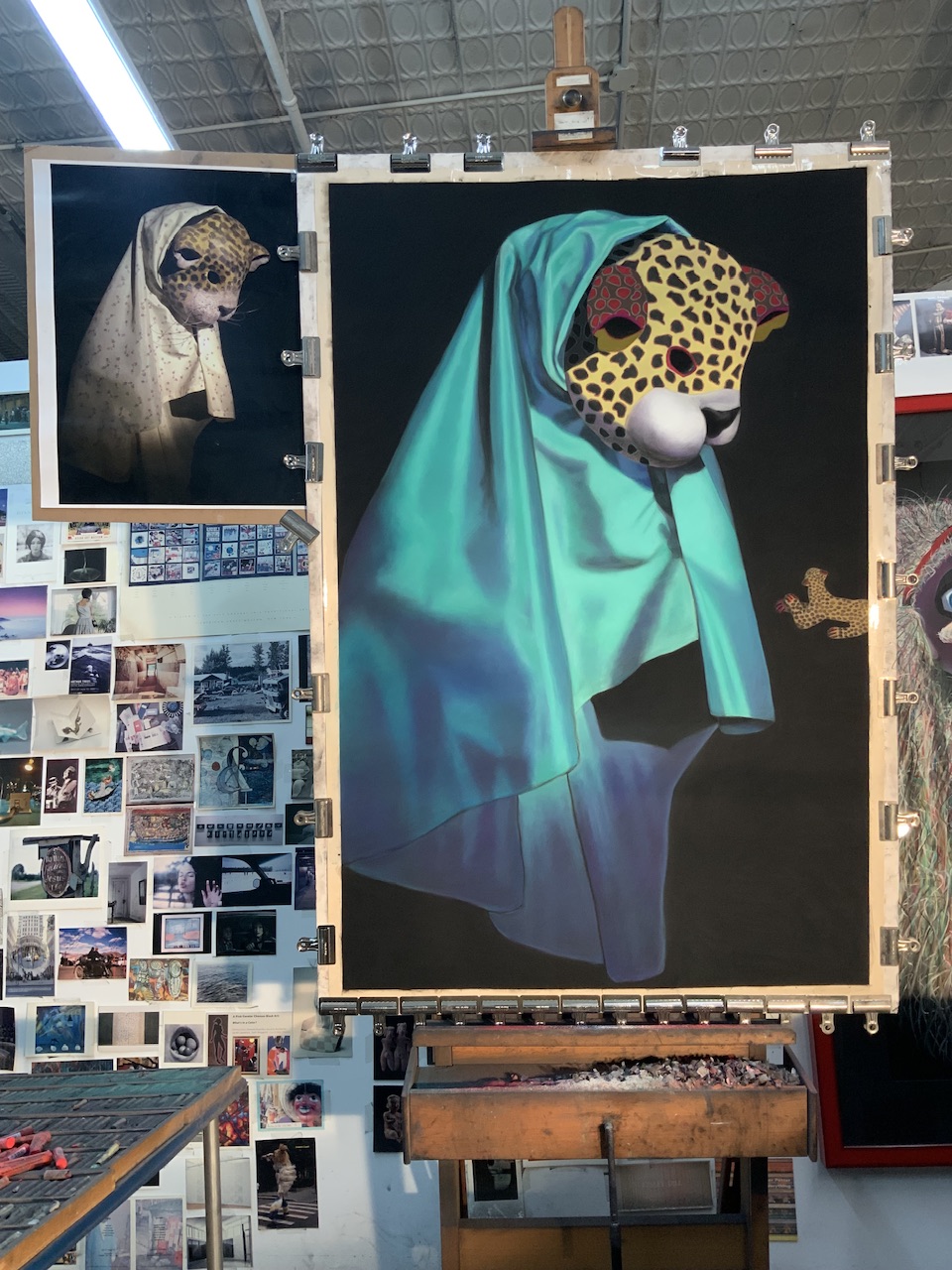
Work in progress
A: I continue adding details to “Wise One,” soft pastel on sandpaper, 58” x 38.”
Comments are welcome!
Q: How do you determine what size to make your pastel paintings? (Question from Prince North via Facebook)

A: For three decades I have been making pastel paintings in two sizes: 26” x 20” and 58” x 38.” These sizes are dictated by practical considerations.
The smaller ones are because 28” x 22” sheets of acid-free sandpaper are what’s available. (I mask off an inch all around for mats so the paintings are 20″ x 26″). For large paintings I buy rolls of acid-free sandpaper that measure 54 inches wide by 30 feet. I cut this down to 40″ x 60″ for paintings and mask off an inch all around on these, too.
And why specifically make them 58” x 38”? This is the absolute largest size I can make and I prefer making big paintings!
Again, practical factors come into play: the size of my truck, the cost and size of mat board, and the weight of the frames.
My pastel paintings need to lie flat when they are moved. Framed paintings are 70” x 50,” the largest size that can fit flat in the back of my Ford F-150. 58” x 38” is the largest size that will fit in a 8 feet by 4 feet sheet of mat board. (60 inch wide mat board is available, but the cost goes up considerably). Lastly, I’ve never weighed them but my large framed paintings are already rather heavy. It takes two people to carry them.
Comments are welcome!
Q: What’s on the easel today?

Work in progress
A: I continue working on “Shadow,” soft pastel on sandpaper, 26” x 20”
Comments are welcome!
Q: What does it feel like when you dop off a pastel painting at your Virginia framer’s shop? Are you sorry to see it go? (Question from Caroline Golden)
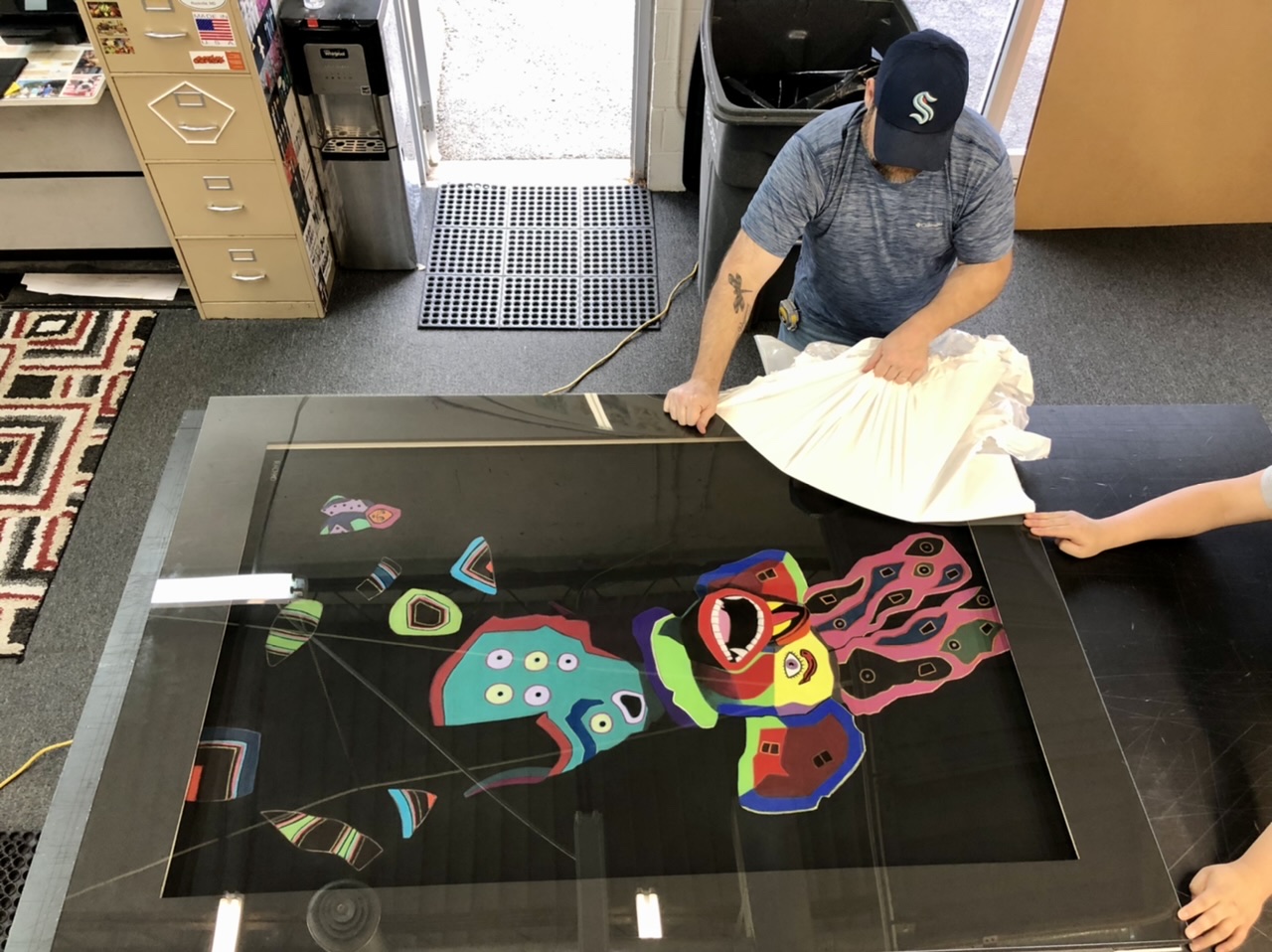
A: Actually, just the opposite since I have been looking at it on my easel for more than three months. Typically, I’m glad to say goodbye – temporarily – because I know when I pick it up in a month, I will have gained some distance and can begin to see and think about it more objectively. I can start reflecting on how this pastel painting relates to my overall body of work.
Comments are welcome!


 barbararachkoscoloreddust.com